太空人工智能计算

Search documents
大芯片,再度崛起?
半导体行业观察· 2026-01-25 03:52
Core Insights - The article discusses significant developments in the AI chip sector, highlighting Tesla's revival of the Dojo 3 supercomputer project and Cerebras Systems' multi-billion dollar agreement with OpenAI for AI computing power [1][10]. Group 1: AI Chip Developments - Tesla's Dojo 3 project aims to position the company as a leading AI chip manufacturer, with a focus on "space artificial intelligence computing" rather than traditional training models [6][8]. - Cerebras Systems has secured a contract with OpenAI worth over $10 billion, promising to deliver 750 megawatts of computing power by 2028, emphasizing the growing demand for low-latency inference capabilities [10][11]. Group 2: Chip Architecture and Performance - The distinction between two types of large chips is made: Cerebras' wafer-scale integration and Tesla's wafer-scale system, each addressing the "memory wall" and "interconnect bottleneck" challenges differently [2][4]. - Cerebras' WSE-3 chip boasts 40 trillion transistors and 900,000 AI cores, achieving a memory bandwidth of 21 PB/s, significantly outperforming NVIDIA's H100 [3][11]. Group 3: Strategic Shifts - Tesla's shift in strategy reflects a recalibration of resources, moving away from competing directly with NVIDIA's GPU clusters to focusing on specialized applications in space computing [7][8]. - Cerebras' approach to positioning itself as a provider of dedicated inference machines allows it to capitalize on the emerging demand for low-latency processing, differentiating itself from traditional training platforms [15][19]. Group 4: Market Dynamics and Competition - The AI chip market is becoming increasingly crowded, with competitors like AMD and NVIDIA rapidly advancing their offerings, which poses challenges for alternative architectures like those from Cerebras and Tesla [15][19]. - The collaboration between OpenAI and Cerebras is seen as a strategic move to secure a foothold in the burgeoning inference market, which is expected to dominate AI computing needs in the future [10][19]. Group 5: Future Outlook - The advancements in packaging technology, such as TSMC's CoWoS, are expected to blur the lines between large and small chip architectures, potentially reshaping the competitive landscape [16][19]. - The article concludes that both Tesla and Cerebras are not merely trying to replicate NVIDIA's success but are instead seeking to find value in niches overlooked by general solutions, indicating a long-term battle for survival and innovation in the AI chip market [20].


马斯克,开年忙落子
财联社· 2026-01-22 13:30
Group 1: SpaceX Developments - SpaceX plans to launch its second-generation Starlink system in 2027, aiming to provide higher-speed internet services, with the FCC approving the deployment of 7,500 satellites [3] - Elon Musk is pushing for SpaceX's IPO, targeting completion by July 2026, with ambitions to establish data centers in space [3] - Musk stated that the launch frequency of Starship will exceed once per hour within three years, with a goal of producing 10,000 Starships annually [3] Group 2: Tesla Innovations - Tesla's Optimus humanoid robot is expected to transform the company into a $25 trillion robotics firm, with its value projected to surpass current business segments [3] - The Dojo3 project, initially focused on machine learning, is being reoriented towards "space AI computing" [4] - Tesla's lithium refining plant has commenced operations, marking it as the largest lithium refining facility in the U.S. [4] Group 3: xAI Initiatives - xAI is forming a "recruitment strike team" with salaries up to $240,000 to attract AI talent [5] - The company plans to invest over $20 billion in building a data center in Mississippi, expected to start operations in February [5] - xAI will upgrade Grok Code to support complex programming tasks [5] Group 4: Neuralink Progress - Neuralink is set to launch large-scale brain-machine interface outputs this year, with plans to transition to nearly fully automated surgeries [6]

马斯克高调“复活”特斯拉Dojo3芯片项目
3 6 Ke· 2026-01-21 07:45
Core Insights - Tesla's CEO Elon Musk announced the revival of the previously shelved supercomputer project Dojo 3, marking a significant shift in Tesla's chip strategy [1][2] - The new mission of Dojo 3 will expand beyond training autonomous driving models on Earth to include "space artificial intelligence (AI) computing" [1][6] Group 1: Dojo 3 Project Overview - Dojo 3 was initially designed as a supercomputer for machine learning training, first introduced during Tesla's AI Day in 2021 [4] - The project aims to restructure its architecture and optimize costs, moving away from the complex paths of previous generations that relied on in-house D1 chips [4] - Musk hinted that the future of Dojo will involve a cluster architecture integrating numerous AI6 chips rather than developing dedicated training systems [4] Group 2: Strategic Shifts and Partnerships - Five months prior, Tesla halted the Dojo 3 project, disbanded its core team, and shifted focus to AI5, AI6, and subsequent chips, which can handle both efficient inference and core training tasks [2] - Tesla plans to increase reliance on Nvidia and other partners like AMD for computing, as well as on Samsung for chip manufacturing, rather than continuing to develop custom chips [2][5] - The AI5 chip is manufactured by TSMC and is intended to power Tesla's autonomous driving features and the Optimus humanoid robot [5] Group 3: Space AI Vision - Musk's latest statements indicate a vision for deploying AI computing centers in space, which he believes will be more cost-effective than terrestrial systems within four to five years [6][7] - The rationale includes the availability of "free" solar energy and relatively easier cooling technologies in space [6] - Musk's involvement in xAI, SpaceX, and Tesla creates a synergistic potential for these ventures, positioning Tesla as a major beneficiary if successful [6] Group 4: Challenges Ahead - Despite the ambitious goals, significant obstacles remain for establishing space-based AI data centers, including orbital debris, regulatory approvals, and international space policies [9] - Cooling high-power computing devices in a vacuum presents challenges, as temperature fluctuations in space can be extreme [9][10] - Constructing large AI data centers in geostationary orbit will require massive heat dissipation structures, which pose logistical and cost challenges [10]
马斯克高调“复活”特斯拉Dojo3芯片项目 再度剑指“太空AI”
Jin Rong Jie· 2026-01-21 04:30
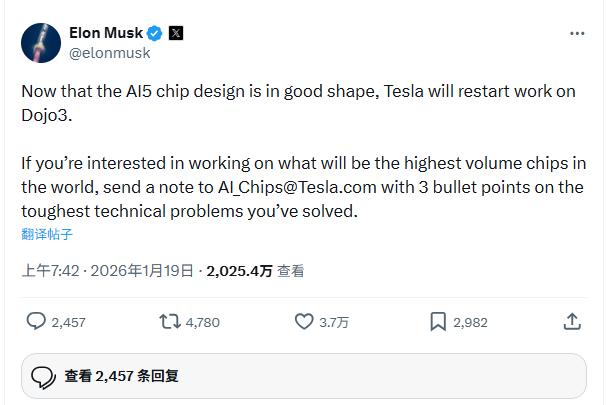
Core Viewpoint - Tesla is restarting its previously shelved supercomputer project Dojo 3, marking a significant shift in its chip strategy, with a new focus on "space AI computing" rather than just terrestrial autonomous driving model training [1] Group 1: Project Details - Dojo 3 was fully halted five months ago in August 2025, and its core mission is now expanded to include AI computing in space [1] - The decision to restart Dojo is based on the successful progress of AI5 chip design [1] Group 2: Recruitment and Vision - Elon Musk has issued a recruitment call for engineers interested in developing the world's highest output chips, asking candidates to summarize key technical challenges they have solved [1] - Musk's vision includes deploying AI computing centers in space, which he believes will be more cost-effective than operating similar systems on Earth within the next four to five years, due to "free" solar energy and relatively easy cooling technologies [1]
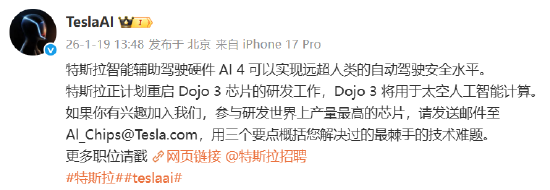
特斯拉正计划重启Dojo 3芯片研发工作
Xin Lang Cai Jing· 2026-01-19 05:56
Group 1 - Tesla announced that its AI 4 hardware for smart assisted driving can achieve safety levels far exceeding human capabilities [1][3] - The company plans to restart the development of the Dojo 3 chip, which will be used for space artificial intelligence computing [1][3] - Tesla issued a recruitment notice inviting engineers interested in developing the world's highest production chips to apply, requiring candidates to summarize three key technical challenges they have solved [1][3]