超级人工智能(AGI)

Search documents
马斯克预警:留给旧世界的时间只剩2000天,中国握着唯一的“王牌”
Xin Lang Cai Jing· 2026-01-13 08:24
Core Insights - Elon Musk emphasizes that humanity is at a critical juncture, with only 2000 days left for the old world, highlighting the urgency of technological advancements and the transition from carbon-based to silicon-based civilization [2][3]. Group 1: Key Predictions - The timeline for significant AI advancements includes: by 2026, AI intelligence will surpass the smartest human individuals; within 3 years, Optimus robots will outperform top surgeons; and by 2029, AI intelligence will exceed the total intelligence of all humans [4][5][6]. - Musk warns that the upcoming crisis will be related to transformers and electricity, asserting that China is leading in energy infrastructure, significantly outpacing the U.S. [7][22]. Group 2: Economic and Workforce Implications - The job market will undergo a major transformation, with white-collar jobs being the first to be affected by AI, while blue-collar jobs will face a delay until the mass production of Optimus robots [8][9]. - Musk predicts that traditional economic models will collapse, suggesting that saving for retirement will become irrelevant due to extreme deflation driven by AI and robotics [10]. Group 3: Technological Landscape - Musk believes that the semiconductor supply chain will become less relevant as physical limitations of chip manufacturing are reached, with China expected to overcome these challenges [11][31]. - The future bottleneck in computing power will shift to electricity and architecture, where both the U.S. and China will be on equal footing [12][32]. Group 4: Education and Societal Changes - Musk critiques the current education system, suggesting it will devolve into a social space as AI tutors become prevalent, rendering traditional knowledge acquisition obsolete [13][33]. - The future workforce will favor individuals who can effectively collaborate with AI, rather than those who excel in rote memorization [14][36]. Group 5: Competitive Landscape - Musk identifies three main players in the future AGI landscape: xAI, Google, and "China Inc." (the Chinese state), emphasizing that the competition will be defined by infrastructure, data, and national will [20][36]. - He suggests that only those who can harness national resources for infrastructure and talent will be able to compete effectively in the AGI arena [36][37].

马斯克预警:留给旧世界的时间只剩2000天,中国握着唯一的“王牌”
虎嗅APP· 2026-01-12 09:23
Core Insights - The article discusses Elon Musk's warning about the urgency of technological advancements, stating that humanity has only 2000 days left to adapt to the impending changes brought by AI and robotics [4][52]. - It highlights China's significant advantages in energy infrastructure and manufacturing, suggesting that these factors could reshape the global economic landscape [5][25]. Group 1: Key Predictions from Musk - Musk asserts that we are currently within a "singularity," predicting that by 2026, AI will surpass the intelligence of the smartest human beings [8]. - He forecasts that within three years, Optimus robots will outperform top surgeons in surgical procedures [9]. - By 2029, AI intelligence is expected to exceed the collective intelligence of all humanity [10]. Group 2: Energy and Manufacturing Insights - Musk emphasizes that China is leading in energy infrastructure, stating that they are "running circles around" the U.S. in this domain, with a significant increase in power generation [11][30]. - He notes that last year, China added 500 TWh of power generation capacity, with 70% coming from solar energy, and predicts that by 2026, China's electricity output will be three times that of the U.S. [30][32]. - The article warns that the reliance on cheap labor in manufacturing will diminish as robots become capable of performing complex tasks, potentially leading to a loss of competitive advantage for China [36][40]. Group 3: Implications for Education and Workforce - Musk critiques the current education system, suggesting that schools will primarily serve social functions as AI tutors become prevalent, rendering traditional knowledge acquisition obsolete [17][43]. - He argues that the future workforce will require skills in AI collaboration rather than rote memorization, indicating a shift in educational priorities [45][46]. Group 4: Future Competitors in AI - Musk identifies only three key players in the future of artificial general intelligence (AGI): xAI, Google, and "China Inc." (the Chinese state), emphasizing that the competition will be based on power, data, and national will [48][49]. - He suggests that only those who can harness national resources for infrastructure and talent will be able to compete effectively in the AGI landscape [48].
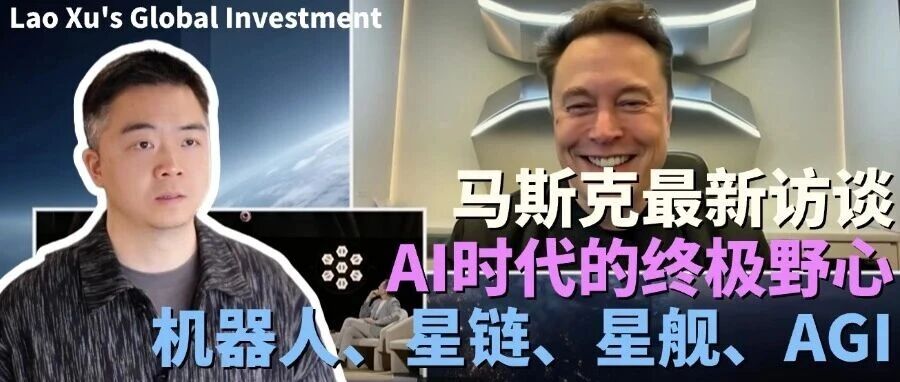
马斯克最新访谈:机器人、星链、星舰、AGI,AI时代的终极野心
老徐抓AI趋势· 2025-09-21 13:08
Group 1 - The core viewpoint of the article emphasizes that Elon Musk's recent interview reveals a clear technological roadmap and business strategy for his companies, particularly in the AI era, which investors and entrepreneurs should pay attention to [4][26]. Group 2: Tesla Robotics - Musk identifies three critical components for successful robotics: achieving human-like dexterity, enabling robots to understand the physical world, and achieving mass production [5]. - The human hand has 27 degrees of freedom, and replicating this complexity in robotic hands is essential for their functionality [7]. - Tesla's solution involves using actuators in the forearm and tendon-like cables to control the fingers, which has shown significant advancements in recent demonstrations [9]. - Understanding the physical world is crucial for robots, requiring them to make decisions in complex environments, which Tesla aims to achieve through advanced AI chips that significantly enhance performance [11]. - Mass production is key to reducing costs, with a target of producing 1 million robots at a cost of $20,000 to $25,000 each, including $6,000 for AI chips [13]. Group 3: Autonomous Driving - Musk reiterates the commitment to a pure vision approach for autonomous driving, rejecting the integration of lidar, emphasizing the importance of a clear technical path [14]. - The decision-making process in technology investment should focus on following proven leaders rather than emotional reactions [14]. Group 4: Starlink - Starlink aims to disrupt the traditional telecommunications industry, with SpaceX acquiring EchoStar for $17 billion to secure critical frequency bands for satellite-to-mobile connectivity [16]. - The plan includes collaborating with major smartphone manufacturers to adapt chips for these frequencies, with a two-year timeline to become a global operator [16]. - The cost comparison shows that Starlink's satellite internet could potentially replace 5G, with a significantly lower investment required for global coverage [18]. Group 5: Starship - Musk describes the Starship project as one of humanity's most challenging engineering feats, focusing on creating fully reusable rockets [20]. - The development of new heat shield materials is crucial for rapid reusability, with ambitious timelines set for testing and achieving full reusability by 2028 [21][24]. Group 6: Future of AI - Musk predicts the arrival of superintelligent AI within three years, indicating that the AI sector will continue to experience significant growth and opportunities [26]. - The overarching strategy of Musk's ventures involves setting grand goals, disrupting industries, and reinvesting profits into larger objectives, which is a model for potential investors to consider [26].