超级周期2.0

Search documents
美国通胀重回2%?贝森特亮出底牌,大宗商品迎来十年一遇配置窗口
Sou Hu Cai Jing· 2026-02-15 04:39
Group 1 - The U.S. Treasury Secretary's statement that tariffs do not lead to inflation has sparked significant debate, especially given his previous stance that tariffs would raise prices [1] - The January Consumer Price Index (CPI) showed a year-on-year increase of 2.4%, which is below market expectations and indicates a slowdown from December's 2.7% [3] - The core CPI, excluding food and energy, remained steady at 2.5%, marking the slowest growth since March 2021 [3] Group 2 - Following the CPI data release, market expectations shifted towards the likelihood of multiple interest rate cuts by the Federal Reserve, with predictions of two to three cuts in 2026 [4] - Goldman Sachs forecasts the first rate cut in June and a second in September, each by 25 basis points, while some analysts suggest the cuts could exceed current market expectations [4] Group 3 - The decline in inflation has led to a renewed focus on commodities, driven by three macro forces: changes in financial attributes, a shift in demand drivers, and a reallocation of capital [6][7] - The demand for commodities is now linked to broader themes such as the AI revolution, energy transition, and supply chain security, termed "supercycle 2.0" [6] Group 4 - The supply side of commodities is under pressure, with declining ore grades and a lack of large new projects, leading to historically low inventory levels [9] - The chemical sector is experiencing significant value differentiation, with high-end chemical products gaining pricing power compared to traditional petrochemical products [9] Group 5 - Gold is increasingly viewed as a hedge against credit risk, with central banks continuing to purchase gold, reflecting concerns over the U.S. dollar's credit system [10] - Predictions for gold prices in 2026 range between $4,500 and $5,000 per ounce, while silver's industrial demand is also expected to rise due to its dual financial and industrial roles [10] Group 6 - The macroeconomic environment is shifting, moving away from reliance on single-country urbanization to a new paradigm driven by technological revolution, energy security, and geopolitical dynamics [11] - The focus is now on tangible "hard materials" that support these transformations, with attributes of copper, silver, specialty chemicals, and gold becoming critical for future wealth allocation [11]


超级周期2.0,来了!最新解读
Xin Lang Cai Jing· 2026-01-25 13:19
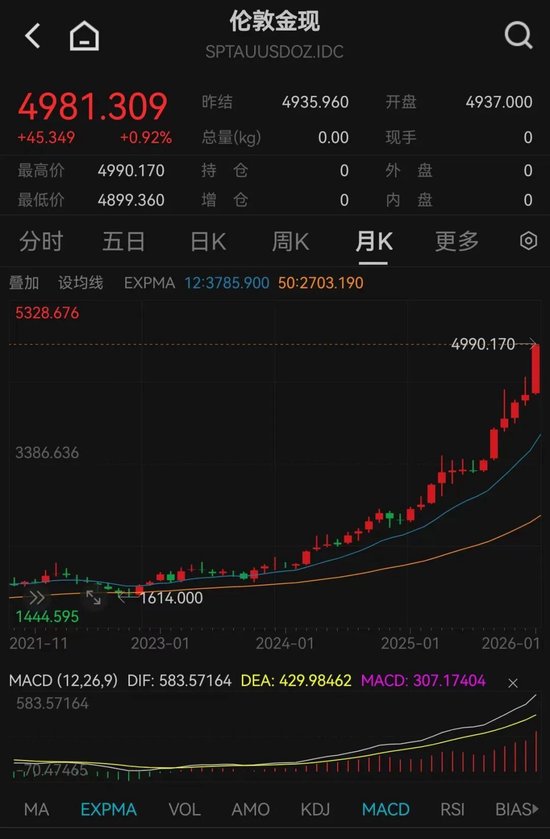
Core Viewpoint - The resource sector is currently in a "super cycle 2.0," driven by de-globalization, supply chain disruptions, and structural changes led by AI and energy transitions, rather than just global demand expansion [4][6][31]. Group 1: Investment Opportunities - The resource sector is not solely driven by short-term sentiment but is experiencing a prolonged price boom, with significant growth in the metals sector, particularly precious metals like gold and silver [4][6][31]. - Fund managers highlight that the current investment opportunities may be more concentrated in structural areas within the sector, particularly in precious and small metals, which are driven by both safety logic and industrial demand [4][5][12]. - The expected performance of metals in 2026 includes a focus on copper, gold, aluminum, lithium carbonate, and tungsten, with a favorable outlook due to external demand and new industrial trends [12][34][35]. Group 2: Market Dynamics - The current market is characterized by a shift towards safety in resource allocation, with a growing emphasis on the strategic value of resource assets amid geopolitical tensions and supply chain security concerns [18][40][42]. - Fund managers note that the resource sector is experiencing a re-evaluation phase, with many domestic metal companies having lower valuations compared to their international counterparts, despite similar growth potential [33][41]. - The investment logic has shifted from merely inflation-driven strategies to a focus on securing resources as a hedge against geopolitical risks and supply disruptions [20][42]. Group 3: Risks and Challenges - The resource sector faces risks related to the significant price increases seen in certain sub-sectors over the past year, which may lead to a decline in the risk-reward ratio for investors [21][23]. - There is a caution regarding the potential volatility in industrial metals like copper and aluminum, which require close monitoring of supply-demand dynamics [5][27][30]. - The overall economic uncertainty and potential for a global recession could impact demand for industrial metals, posing a risk to the current bullish outlook [22][23].
超级周期2.0,来了!最新解读
中国基金报· 2026-01-25 13:08
Core Viewpoint - The resource sector is currently in the "Super Cycle 2.0" phase, driven by de-globalization, supply chain restructuring, and central banks' continued gold purchases, indicating that the price boom is not solely driven by short-term sentiment [4][7][17]. Group 1: Current Market Dynamics - The resource sector is experiencing significant price increases, with the non-ferrous metals sector rising nearly 90% in 2025 and gold and silver prices reaching historical highs in early 2026 [2]. - Fund managers believe that the current resource sector is not merely a short-term emotional response but is part of a longer-term price cycle that is far from over [4][9][10]. - The ongoing cycle is characterized by a combination of macroeconomic factors, including inflation improvement and a weak dollar credit environment, which are favorable for commodities [10][19]. Group 2: Investment Opportunities - Fund managers suggest that investors should focus on structural opportunities within the sector, particularly in precious metals and small metals, which are driven by both safety logic and industrial demand [4][20]. - The five most promising investment opportunities for 2026 include copper, gold, aluminum, lithium carbonate, and small metals like tungsten, driven by new demand from sectors such as energy storage and AI infrastructure [20][21]. - The current market is seen as a re-evaluation cycle, with the overall PE levels of the sector remaining acceptable and the high profitability of non-ferrous metals indicating strong growth potential [19][28]. Group 3: Risks and Challenges - The resource sector faces risks due to significant price increases in certain sub-sectors over the past year, leading to a decline in the risk-reward ratio for investments [13][34]. - There is a need to monitor potential volatility in commodity prices, especially as many non-ferrous metals have reached historical highs, which could lead to increased market fluctuations [35][36]. - The sector's performance may be impacted by global macroeconomic uncertainties, including potential recessions in major economies, which could reverse the current upward trends in industrial metal demand [36][37].