跨境资本流动管理

Search documents
人民币汇率要变,可能升到6.5到6.8,美元存款面临双重压力
Sou Hu Cai Jing· 2026-01-18 04:47
Core Viewpoint - The article discusses the potential for the appreciation of the Renminbi (RMB) against the US dollar, driven by factors such as the Federal Reserve's interest rate cuts, a decline in the dollar's global reserve share, and the internationalization of the RMB. However, it emphasizes that this appreciation is not guaranteed and is subject to market corrections and underlying economic policies [1][3][12]. Group 1: Market Dynamics - The expectation of RMB appreciation is supported by seasonal capital flows and the real demand for dollars, with exporters converting large amounts of currency below the 7.1 psychological barrier, leading to an estimated total of over $200 billion in currency conversion by early next year [5][12]. - The offshore RMB market shows a growing expectation of appreciation, with the offshore RMB trading below the central parity, indicating that foreign capital is increasingly optimistic about the RMB's strength [3][5]. - The dual impact of declining interest rates and rising exchange rates creates a scenario where the interest earned on dollar deposits may be eroded by RMB appreciation, particularly if the appreciation exceeds 3% [3][5]. Group 2: Investment Strategies - Investors with genuine dollar obligations, such as for education or overseas purchases, may benefit from RMB appreciation, while purely investment-focused individuals need to consider currency hedging to protect returns from dollar-denominated assets [5][12]. - Two distinct investment strategies emerge: one prioritizing real dollar demand and interest rates, and another focusing on RMB-denominated investments that require careful consideration of exchange rate risks [9][12]. - The notion that high-yield dollar products are a permanent opportunity is misleading, as the Federal Reserve's eventual rate cuts will likely diminish these yields, necessitating a long-term perspective from investors [9][11]. Group 3: Policy Implications - The article suggests that policy should focus on managing cross-border capital flows to mitigate volatility from speculative funds and accelerate structural reforms to address deeper economic issues that cannot be resolved through exchange rate adjustments alone [14]. - The long-term strength of the RMB will depend not only on external factors like the Federal Reserve's actions but also on China's economic resilience, foreign exchange reserve management, and capital flow controls [7][14]. - It warns against viewing the exchange rate as a panacea for internal structural problems, emphasizing the need for comprehensive economic strategies rather than relying solely on currency fluctuations [11][14].


聚焦“十五五”规划建议|提升资本项目开放水平
Sou Hu Cai Jing· 2025-11-28 04:01
Group 1 - The core viewpoint of the articles emphasizes the importance of enhancing the level of capital account openness as a crucial aspect of high-level foreign openness in China [1][2] - By the end of Q2 2025, China's total foreign financial assets and liabilities are projected to reach 18.32 trillion USD, reflecting an 18% increase from the end of 2020 [1] - In the first half of 2025, the total amount of foreign-related payments and receipts under the capital account is expected to account for 41% of GDP, a 20 percentage point increase compared to 2020 [1] Group 2 - China's capital account openness is characterized by a wide range of fields and a steady process, with over 90% of projects achieving varying degrees of openness according to IMF and OECD standards [1] - The future focus on high-quality capital account openness should combine "bringing in" and "going out," encompassing a wide range of investments and business activities [2] - The State Administration of Foreign Exchange aims to build a more convenient, open, secure, and intelligent foreign exchange management system, establishing a dual framework for cross-border capital flow management to enhance financial risk prevention [2]
张明:中国外汇宏观审慎政策——框架塑造、政策实践与经验启示
Sou Hu Cai Jing· 2025-11-05 04:07
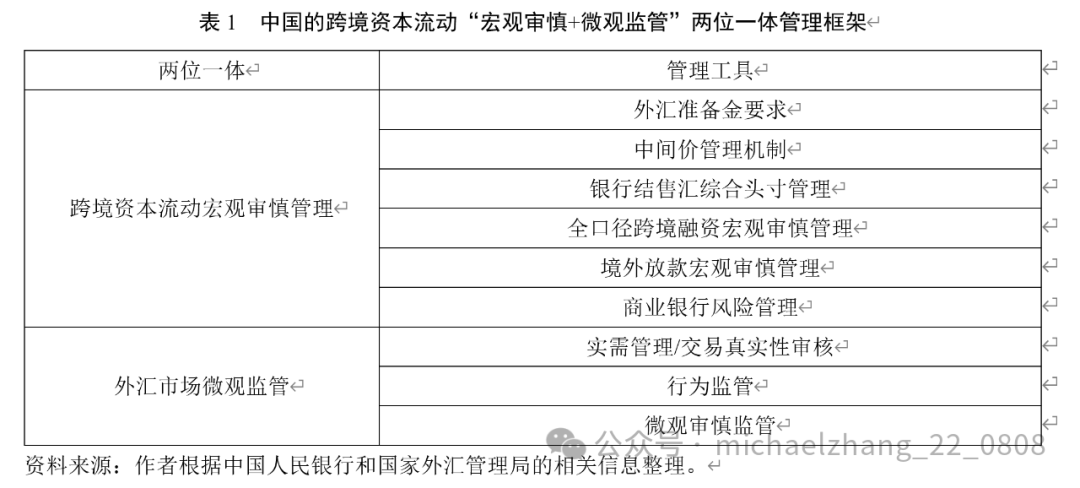
Core Viewpoint - After the global financial crisis, China has actively explored and implemented foreign exchange macro-prudential policies with Chinese characteristics during its gradual financial opening process. The main goals of these policies are to stabilize the RMB exchange rate and manage cross-border borrowing by domestic enterprises, rather than solely addressing systemic risks from volatile capital flows [1][2][3]. Summary by Relevant Sections Framework of China's Foreign Exchange Macro-Prudential Policy - The reform of China's foreign exchange management system has undergone three significant phases since the opening up in 1979, transitioning from a planned to a market-oriented system, and establishing a managed floating exchange rate system [4]. - The current phase, starting from 2013, focuses on balancing facilitation and risk prevention, particularly after the "8·11" exchange rate reform in 2015, which established a more market-oriented exchange rate formation mechanism [4][5]. Key Measures of Foreign Exchange Macro-Prudential Policy - Key measures include foreign exchange reserve requirements, middle price management mechanisms, comprehensive position management for banks' foreign exchange transactions, and macro-prudential management of cross-border financing and overseas lending [7][10]. - The foreign exchange reserve requirement includes three types: foreign exchange deposit reserve ratio, forward foreign exchange risk reserve ratio, and reserve ratio for deposits from foreign financial institutions [7][10]. Policy Effects and Adjustments - The foreign exchange deposit reserve ratio has been adjusted multiple times since its introduction in 2004, with the most recent adjustments occurring in 2022 and 2023, reflecting the central bank's response to changing market conditions [13][14]. - The foreign exchange risk reserve ratio was introduced in 2015 to curb excessive volatility in the foreign exchange market, with adjustments made based on market conditions [16][19]. - The comprehensive position management for banks has evolved since 2005, allowing for greater flexibility in managing foreign exchange risks and enhancing the overall development of the foreign exchange market [32][36]. Future Directions - The central bank aims to strengthen macro-prudential management of the foreign exchange market to support high-quality development of the real economy and maintain the RMB exchange rate at a reasonable and balanced level [3][39]. - The implementation of all-encompassing cross-border financing macro-prudential management has been expanded nationwide, allowing for better monitoring and management of cross-border financing activities [39][40].
将恢复公开市场国债买卖操作
Zhong Guo Zheng Quan Bao· 2025-10-27 21:03
Group 1 - The People's Bank of China (PBOC) has decided to resume the trading of government bonds in the open market after a pause due to imbalances in supply and demand and accumulated market risks [1] - The digital yuan ecosystem has been preliminarily established, and the PBOC plans to further optimize its management system and support more commercial banks to operate digital yuan services [1] - The PBOC will continue to combat the operation and speculation of domestic virtual currencies, maintaining economic and financial order while monitoring the development of overseas stablecoins [1] Group 2 - The PBOC is researching a one-time personal credit relief policy to help individuals repair their credit records, which will exclude certain default information from credit reports if loans have been repaid [2] - The PBOC aims to enhance macro-prudential management of cross-border capital flows, focusing on monitoring systemic financial risks and improving risk prevention measures for key institutions and sectors [2] - The PBOC plans to strengthen the collaborative governance mechanism of macro-prudential management, aligning monetary policy with fiscal and industrial policies [3]
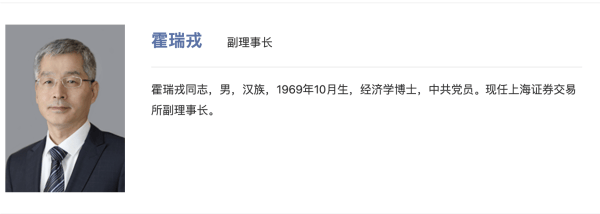
上海证券交易所领导班子再调整:霍瑞戎履新副理事长,资本市场国际化进程加速
Sou Hu Cai Jing· 2025-09-10 09:32
Core Insights - The appointment of Huo Ruirong as the Vice Chairman of the Shanghai Stock Exchange (SSE) is seen as a significant move towards enhancing the internationalization strategy of the exchange, coinciding with a critical phase of deepening openness in China's capital markets [1][4] Group 1: Leadership Changes - Huo Ruirong, aged 55 and an economist, has a diverse career spanning futures regulation, securities market monitoring, and cross-border cooperation [3] - Prior to this role, Huo held several key positions, including Deputy General Manager of the Shanghai Futures Exchange and General Manager of the China Financial Futures Exchange, where he focused on risk prevention and market data monitoring [3] - The SSE leadership team underwent optimization in August, with notable changes indicating a strong emphasis on international business [4] Group 2: Strategic Implications - Huo's experience in international regulatory frameworks and cross-border enforcement mechanisms is expected to accelerate SSE's connectivity with exchanges in London, Singapore, and Hong Kong [4] - The appointment is viewed as a signal for SSE to expand the coverage of the "Shanghai-London Stock Connect" and optimize the selection criteria for the "Shanghai-Hong Kong Stock Connect" [4] - There is potential for exploring cooperation with emerging markets in the Middle East and Latin America, further enhancing SSE's international presence [4]