迷你QE

Search documents
美联储“鹰鸽大战”愈发激烈,短期内降息阻力重重
2 1 Shi Ji Jing Ji Bao Dao· 2025-12-31 12:47
Core Viewpoint - The Federal Reserve's December monetary policy meeting minutes reveal significant internal disagreements regarding the decision to lower interest rates and future monetary policy expectations [1][2]. Group 1: Interest Rate Decisions - On December 10, the Federal Reserve announced a 25 basis point reduction in the federal funds rate target range to between 3.50% and 3.75%, with a vote of 9 in favor and 3 against, marking the highest number of dissenting votes since 2019 [1]. - Some officials expressed that the decision to ease monetary policy was a delicate balance due to various economic risks, indicating that they could have supported maintaining the current rate [2]. Group 2: Diverging Opinions - There is a growing divide among policymakers regarding whether inflation or unemployment poses a greater risk to the U.S. economy, leading to a more intense "hawk-dove" debate [2]. - Many officials believe that further rate cuts are appropriate if inflation decreases as expected, while others suggest maintaining rates for a period to assess the delayed impacts of recent monetary policy on the labor market and economic activity [2]. Group 3: Market Implications - The anticipated rate cuts are seen as beneficial for U.S. equities, particularly for small and mid-cap companies, with expectations of a continued market uptrend until 2026 [2]. - The potential for further rate cuts may weaken the U.S. dollar, which could favor emerging market stocks and local bonds [3]. Group 4: Short-Term Treasury Purchases - The Federal Reserve has initiated a "mini QE" through a short-term Treasury bond purchase program, with plans to buy approximately $220 billion in short-term Treasury bills over the next 12 months [4][5]. - As of December, the Fed had already purchased about $38 billion in short-term Treasury bills and plans to conduct two more purchasing operations in January [5]. Group 5: Reserve Management - The purchases are intended for reserve management and are not considered traditional QE, with the likelihood of true QE being low unless the U.S. faces a recession or systemic financial risks [6].
美联储火速启动“迷你QE” “鸽声嘹亮”背后暗藏玄机
2 1 Shi Ji Jing Ji Bao Dao· 2025-12-11 23:34
Group 1 - The Federal Reserve announced a 25 basis point cut in the federal funds rate target range to 3.50% to 3.75%, marking the third rate cut of the year and the sixth since September 2024 [1][11] - The Fed's Chairman Powell indicated that the rate cuts aim to stabilize the labor market and help inflation return to the 2% target as tariff impacts diminish [1][11] - The Fed will initiate a "mini QE" by purchasing approximately $40 billion in short-term Treasury bills starting December 12, with plans to maintain a high purchase scale for several months before significantly reducing it [1][5][11] Group 2 - The Fed is shifting to a wait-and-see mode after three consecutive rate cuts due to data uncertainty and economic conditions [12] - Economists suggest that the Fed's decision to lower rates is influenced by a cooling labor market and declining demand, with inflation remaining below target levels [12][20] - The Fed's economic projections show an optimistic growth outlook for next year, with a slight downward adjustment in inflation expectations [13][20] Group 3 - The dot plot indicates a divided Fed, with 7 officials advocating for no rate changes in 2026 and 8 supporting at least two rate cuts [17] - This internal division reflects differing beliefs about the "new normal" of high interest rates and concerns over the lagging effects of tightening [17] - The potential appointment of a new Fed Chair in 2026 adds uncertainty, with expectations that the new leader may lean more dovish due to political pressures [17][18] Group 4 - The "mini QE" is characterized by short-term Treasury purchases aimed at maintaining liquidity rather than lowering long-term rates [15][16] - This approach is seen as a market liquidity repair rather than a broad-based quantitative easing strategy [15][16] - The Fed's balance sheet is expected to undergo slow and moderate expansion, with interest rates gradually aligning towards neutral levels [16] Group 5 - The impact of tariffs on pricing and consumer behavior is a central concern for the Fed, with businesses facing pressure to manage costs and maintain profit margins [19] - Consumer confidence is declining, particularly among lower-income groups, which may hinder future consumption growth [19][20] - Given that personal consumption expenditures account for nearly 70% of GDP, any slowdown in spending could significantly affect GDP growth [20]
甲骨文市值蒸发7200亿 中概股反弹拉升 油价跳水 加密货币超15万人爆仓
2 1 Shi Ji Jing Ji Bao Dao· 2025-12-11 15:57
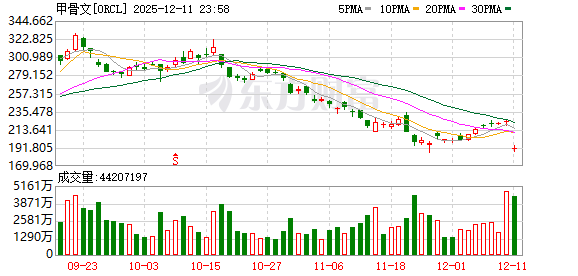
Market Overview - The three major U.S. stock indices opened mixed, with the Dow Jones up by 0.94%, while the S&P 500 and Nasdaq were down by 0.18% and 0.72%, respectively [2] - Major tech stocks experienced more declines than gains, with Oracle's stock dropping over 16%, resulting in a market value loss of approximately $102 billion (around 72 billion RMB) [4] - Other tech stocks such as Nvidia and AMD fell over 3%, while Intel dropped over 2%, and Tesla, Apple, and Google were down over 1% [4] Company-Specific Insights - Oracle's second-quarter earnings report showed that both revenue and cloud business income fell short of market expectations, leading to a significant drop in its stock price [4] - Oracle's stock price was reported at $193.48, down 13.24%, with a market capitalization of $551.6 billion [5] - In the Chinese stock market, major Chinese concept stocks initially fell but later rebounded, with the Nasdaq Golden Dragon China Index's decline narrowing from 1% to 0.26% [4] Commodity and Cryptocurrency Market - International oil prices saw a decline of nearly 2% for both WTI and Brent crude [6] - The cryptocurrency market faced a collective downturn, with Bitcoin dropping below the $90,000 mark, currently priced at $89,897.3, marking a 2.35% decrease in the last 24 hours [8][9] Economic Indicators - The U.S. Labor Department reported that the Employment Cost Index rose by 0.8% in Q3, indicating a slowdown in labor demand and slow growth in worker income [10] - The Federal Reserve announced a 25 basis point reduction in the federal funds rate target range to between 3.50% and 3.75%, marking the third rate cut of the year [10] - The Fed's dot plot indicates an expectation of one more rate cut in 2026, although analysts suggest this may be overly optimistic [12]

甲骨文市值蒸发7200亿,中概股反弹拉升,油价跳水,加密货币超15万人爆仓
21世纪经济报道· 2025-12-11 15:46
Market Overview - As of December 11, US stock indices showed mixed performance, with the Dow Jones up by 0.94%, while the S&P 500 and Nasdaq fell by 0.18% and 0.72% respectively [1] - Major tech stocks experienced declines, with Oracle's stock dropping by as much as 16%, resulting in a market cap loss of approximately $102 billion (around 72 billion RMB) [3] Company Performance - Oracle's second fiscal quarter results fell short of market expectations for both revenue and cloud business income, leading to a significant drop in its stock price [3] - Other tech giants like Nvidia and AMD saw declines of over 3%, while Intel dropped more than 2%. Tesla, Apple, and Google also experienced declines exceeding 1% [3] Cryptocurrency Market - The cryptocurrency market faced a collective downturn, with Bitcoin falling below the $90,000 mark, currently priced at $89,897.3, marking a 2.35% decrease in the last 24 hours [8] - Over 150,000 traders were liquidated in the past 24 hours due to the market's volatility [7] Oil Market - Both West Texas Intermediate (WTI) and Brent crude oil prices fell by nearly 2% [5] Labor Market Insights - The US Labor Department reported a 0.8% increase in the Employment Cost Index for Q3, indicating a slowdown in labor demand and slow growth in worker income [9] - The Federal Reserve announced a 25 basis point reduction in the federal funds rate target range to between 3.50% and 3.75%, marking the third rate cut of the year [9] Federal Reserve Actions - The Fed's dot plot indicates an expectation of one more rate cut in 2026, but analysts suggest this may be overly optimistic and could change based on labor market conditions [12] - The Fed is set to initiate a "mini QE" by purchasing approximately $40 billion in short-term Treasury bills starting December 12, aimed at addressing market liquidity rather than lowering long-term rates [13]