
铜市场供需平衡

Search documents
下游订单有回暖趋势,铜价小幅回升
Hua Tai Qi Huo· 2026-03-05 07:23
Report Industry Investment Rating - Copper: Cautiously bullish [8] Core Viewpoints of the Report - In March, the copper market is at a critical stage of supply - demand re - balancing. The supply side faces high global inventory and pressure in the first half of the month. The demand side improves after the Lantern Festival, but high copper prices inhibit replenishment, and inventory reduction is uncertain. The mine end is tight, and the macro - level is mixed. Copper prices are expected to rise slowly in a volatile manner. If the crude oil price continues to rise, it will have a positive impact on copper prices [8]. Summary by Relevant Catalogs Market News and Important Data - **Futures Quotes**: On March 4, 2026, the main contract of Shanghai copper opened at 100,530 yuan/ton and closed at 101,660 yuan/ton, a - 0.43% change from the previous trading day's close. The night - session main contract opened at 101,640 yuan/ton and closed at 101,700 yuan/ton, a 0.45% increase from the afternoon close [1]. - **Spot Situation**: The Shanghai copper 2603 contract fluctuated sharply. The mainstream flat - water copper was quoted at a discount of 230 - 100 yuan/ton, and good copper was quoted at a discount of 70 - 50 yuan/ton. The second - stage transactions were mainly at a discount of 210 - 170 yuan/ton. The downstream orders warmed up, and the procurement sentiment increased slightly. Supply arrivals continued, and high social inventory pressured, but demand recovery supported the premium. It is expected that the spot discount will continue to slowly recover [2]. Important Information Summaries - **Geopolitical Aspect**: The US - Iran conflict may last for 8 weeks or longer. The US will control the rhythm and intensity. NATO intercepting Iranian missiles will not trigger the collective defense clause. Iran denied the news of seeking negotiations with the US. China will send a special envoy to the Middle East. The US tariff rate will return to the level before the Supreme Court's veto of Trump's reciprocal tariffs, and the 15% global tariff rate may be adopted this week. The US DFC will provide insurance for oil tankers and cargo ships in the Persian Gulf [3]. - **Mine End**: In 2025, MMG's core mines had good performance. Las Bambas copper mine produced 410,800 tons of copper, a record - high second - annual output. Vale Base Metals is accelerating its IPO preparation, aiming for mid - 2026. Its parent company, Vale, plans to double copper production in the next decade and launched the "Novo Carajás" project in February 2026, with an expected 32% increase in annual copper production in the Carajás region by 2030, reaching about 350,000 tons [4]. - **Smelting and Import**: Hudbay Minerals will acquire Arizona Sonoran Copper Company. After the acquisition, it aims to build the second - largest copper cathode production area in the US. The Copper World project is expected to produce 92,000 tons of copper annually by 2030, and the Cactus project will add 103,000 tons. The US - Iran conflict mainly affects the recycled copper market, but its impact on China's domestic recycled copper supply is limited [5][6]. Consumption and Inventory - **Consumption**: High copper prices previously suppressed demand. The power sector had strong order support, while the construction and communication sectors were weak. After the Lantern Festival, the demand in the power and new - energy sectors is expected to improve, but the overall consumption may take time to return to the pre - holiday level [7]. - **Inventory and Warehouse Receipts**: LME warehouse receipts remained at 261,525 tons. SHFE warehouse receipts increased by 1,970 tons to 302,475 tons. On May 19, the domestic electrolytic copper spot inventory was 560,000 tons, a change of 28,300 tons from the previous week [7]. Strategies - **For Spot Enterprises**: In early March, maintain a cautious procurement strategy, use the deep - discount structure to buy on dips as needed, and avoid high - level concentrated stocking [8]. - **For Mid - stream Processing Enterprises**: Prioritize digesting pre - holiday raw materials and finished product inventories, and increase procurement efforts after confirming the inventory reduction signal in the middle and late March [8]. - **For Holders of Goods**: Reduce inventory exposure on rallies to avoid the risk of an expanding spot discount under high - inventory pressure [8]. - **Futures Hedging**: Conduct corresponding buying and selling hedging operations in the range of 100,000 - 104,600 yuan/ton for Shanghai copper. Adjust the hedging ratio according to the proximity to the upper and lower limits of the range [8].
ICSG:2025年12月铜市场供应过剩17.3万吨
Wen Hua Cai Jing· 2026-02-25 02:13
Group 1 - The International Copper Study Group (ICSG) reports a surplus of 173,000 tons in the global refined copper market by December 2025, an increase from a surplus of 74,000 tons reported in November [2] - The global refined copper market is expected to have a surplus of 380,000 tons in 2025, compared to a surplus of 69,000 tons in the previous year [2] - In December 2025, global refined copper production is projected to be 2,430,000 tons, while consumption is expected to be 2,260,000 tons [2] Group 2 - Global copper mine production is forecasted to reach 23,125,000 tons in 2025, up from 22,958,000 tons in 2024 [3] - The global copper smelting capacity is expected to increase to 34,945,000 tons in 2025, compared to 33,199,000 tons in 2024 [3] - The global refined copper consumption is projected to be 28,160,000 tons in 2025, an increase from 27,328,000 tons in 2024 [3]


铜日报:美铜在前高位置震荡,市场进入指引真空期-20260127
Tong Hui Qi Huo· 2026-01-27 09:42
Group 1: Copper Futures Market Data Analysis - The Shanghai Copper main contract closed at 101,880 yuan/ton on January 26, 2026, showing a slight increase compared to the previous day; the LME copper price rose from $12,840/ton on January 23, 2026, to $13,128.5/ton on January 26, 2026, continuing to rise. In terms of basis, the SMM premium copper discount deepened from -110 yuan/ton on January 23, 2026, to -135 yuan/ton on January 26, 2026, with the basis weakening; the LME (0 - 3) discount narrowed from -$82.84/ton to -$66.06/ton, with the basis strengthening [51]. - The LME copper positions increased by 9,606 lots to 325,527 lots on January 23, 2026, with the position volume expanding; the market trading activity improved marginally, but the spot trading remained light [51]. Group 2: Industry Chain Supply, Demand, and Inventory Analysis - On the supply side, SHFE approved the registration of Jiangxi Copper Guoxing's additional 180,000 - ton smelting capacity on January 26, 2026, increasing the supply; the BHP strike incident has not affected copper mine production for the time being. The inventories of LME, SHFE, and COMEX all increased, indicating supply pressure [52]. - On the demand side, as the Spring Festival approaches, the downstream's willingness to stock up at low prices has increased, and the export of copper cables is expected to grow in 2026, driven by global infrastructure demand. The demand in sectors such as power and construction has improved marginally [52]. - On the inventory side, the SMM social inventory decreased in January 2026, ending seven consecutive weeks of inventory accumulation; however, the exchange inventories increased, and the warehousing in Shanghai continued [53]. Group 3: Price Trend Judgment - The copper futures price is expected to fluctuate at a high level in the next one to two weeks. The new production capacity and inventory increase on the supply side put pressure on the price, while the stocking and export expectations on the demand side support the price. The market sentiment is positive, but the spot market is under pressure. The price is expected to fluctuate between 101,000 - 103,000 yuan/ton [55].
铜价分歧加剧!瑞银押注“供给崩塌”,高盛警惕“过热回调”,拐点到了吗?
美股IPO· 2026-01-13 04:16
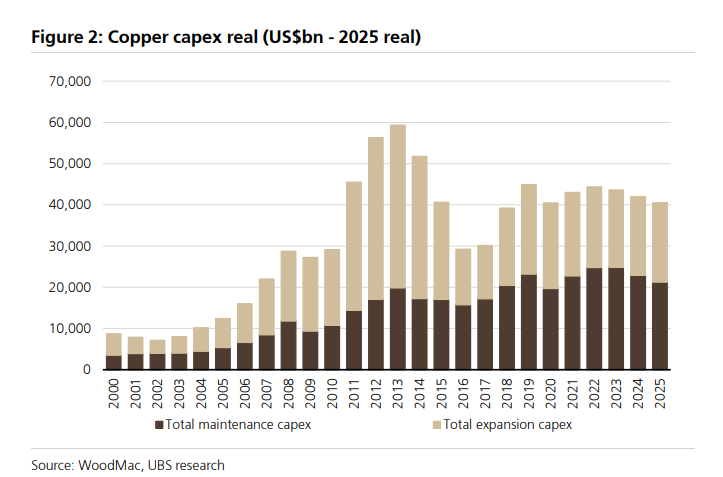
Core Viewpoint - UBS warns of a severe copper shortage in 2026/27 due to declining efficiency in mining capital investments, requiring $175 billion to fill a 7 million ton gap, while Goldman Sachs sees a short-term surplus driven by "tariff panic" [1][2][7]. Group 1: Capital Expenditure and Supply Challenges - UBS highlights that despite rising copper prices, mining project approvals (FID) remain at low levels from 2023 to 2025, indicating a structural supply shortage in the copper market [2][3]. - The report reveals that while nominal global copper industry capital expenditure remains stable at around $40 billion, real capital expenditure in 2025 is only about 30% of the peak level in 2013, showing a declining trend over the past three years [4]. - UBS notes a significant increase in capital intensity, with potential projects from 2025 to 2030 requiring an average capital intensity of $25,000 per ton, a 50% increase compared to projects approved from 2021 to 2025 [6]. Group 2: Future Supply and Investment Needs - UBS's long-term model indicates that global mining supply will peak between 2028 and 2030 and then decline, with a supply-demand gap expected to reach 7 million tons by 2035 [7][8]. - To address this gap, the industry needs to invest over $175 billion in new projects immediately, but project approvals are still near cyclical lows, making it difficult to meet demand growth [8][10]. - New project capital expenditure needs to increase to $5 billion by 2026 and reach $20 billion annually by 2030, maintaining this level until 2035 [10]. Group 3: Price Dynamics and Market Sentiment - UBS believes that current spot prices are at or above levels that can incentivize new project investments, estimating that a long-term copper price of $5.0 per pound (approximately $11,000 per ton) is necessary to stimulate most new projects [11]. - Despite prices reaching these levels, major companies like BHP and Rio Tinto are prioritizing mergers and acquisitions over high-risk new mine developments, indicating a slow supply response [11]. - The market is experiencing a split, with UBS focusing on long-term supply constraints and rising costs, while Goldman Sachs and Citigroup warn of a fragile balance driven by tariff fears and potential oversupply in the short term [18].

铜价分歧加剧!瑞银押注“供给崩塌”,高盛警惕“过热回调”,拐点到了吗?
Hua Er Jie Jian Wen· 2026-01-13 02:17
Core Viewpoint - There is a significant divergence in Wall Street's outlook on copper prices following a 22% surge, with UBS warning of a structural shortage by 2026/27 due to low project approvals, contrasting with Goldman Sachs and Citigroup's short-term caution regarding price sustainability driven by U.S. tariff fears [1][11][12] Group 1: Supply and Demand Dynamics - UBS analysts predict that despite a mixed demand outlook, the copper market will face a shortage by 2026/27, supported by declining inventories [5][12] - UBS's long-term model indicates that global mining supply will peak between 2028-2030 and then decline, with a projected supply-demand gap of 7 million tons by 2035 [5][6] - To address this gap, the industry needs to invest over $175 billion in new projects, with capital expenditures needing to rise significantly by 2026 and 2030 [6][8] Group 2: Capital Expenditure Challenges - UBS highlights that while nominal capital expenditures in the copper industry remain around $40 billion, real expenditures adjusted for inflation are only about 30% of the peak levels seen in 2013 [2][5] - The capital intensity of new projects is increasing, with potential projects from 2025-2030 requiring an average of $25,000 per ton, a 50% increase compared to previous projects [2][5] Group 3: Short-term Market Sentiment - Goldman Sachs and Citigroup express concerns that the recent price surge is primarily driven by speculative "stockpiling" in anticipation of U.S. tariffs, warning of a potential price correction once policy clarity is achieved [11][12] - Goldman Sachs maintains a forecast of a price drop to $11,200 per ton by Q4 2026, while Citigroup suggests that January may represent the peak price for 2026 [11][12] Group 4: Investment Strategies of Major Players - UBS notes that major mining companies like BHP and Rio Tinto are prioritizing mergers and acquisitions over high-risk new project developments, despite current prices being at levels that could incentivize new investments [8][12] - Key projects that may receive final investment decisions in the next 2-3 years include expansions in Chile and Argentina, as well as projects in the U.S. [8][12]
沪铜市场周报:供给收敛需求韧性,沪铜或将震荡运行-20251226
Rui Da Qi Huo· 2025-12-26 08:56
1. Report Industry Investment Rating - Not provided in the report 2. Core View of the Report - The Shanghai copper market is expected to oscillate, with a supply slightly converging and demand showing resilience. Traders are advised to trade with a light position, paying attention to controlling the rhythm and trading risks [6] 3. Summary by Relevant Catalogs 3.1 Weekly Summary - The Shanghai copper main contract showed a slightly stronger weekly oscillation, with a weekly increase of +5.95% and an amplitude of 6.79%. As of this week, the closing price of the main contract was 98,720 yuan/ton [6] - Internationally, the US economy expanded at a 4.3% rate in the third quarter, the fastest in two years, but the US consumer confidence index declined for five consecutive months. Domestically, the National Development and Reform Commission emphasized optimizing and upgrading traditional industries, including copper smelting [6] - In terms of fundamentals, the spot TC processing index of copper concentrates decreased slightly, and the expectation of tight supply persisted, providing strong cost support for copper prices. On the supply side, due to national policies and tight raw material supply, copper smelting capacity may gradually converge, and the growth rate of domestic refined copper supply will slow down. On the demand side, the strong copper price has curbed downstream purchases to some extent, and downstream buyers mostly replenish inventory on a need - to - buy basis. At the application end, the year - end sprint of the power, infrastructure, and new energy industries provides some resilience for copper consumption [6] 3.2 Futures and Spot Market - The Shanghai copper contract strengthened this week, and the spot was at a discount. As of December 26, 2025, the basis of the Shanghai copper main contract was - 980 yuan/ton, a decrease of 150 yuan/ton from last week. The main contract price was 98,720 yuan/ton, an increase of 5,540 yuan/ton from last week, and the trading volume was 252,097 lots, an increase of 14,445 lots from last week [10] - The spot price increased this week. As of December 26, 2025, the average spot price of 1 electrolytic copper was 97,740 yuan/ton, a weekly increase of 4,270 yuan/ton. The inter - month spread of the Shanghai copper main contract was - 260 yuan/ton, a decrease of 40 yuan/ton from last week [18] - The Shanghai copper bill of lading premium increased this week, and short positions dominated. As of the latest data, the average premium of Shanghai electrolytic copper CIF was 53 US dollars/ton, a week - on - week increase of 3 US dollars/ton. The net short position of the top 20 in Shanghai copper was - 37,446 lots, a decrease of 12,216 lots from last week [24] 3.3 Option Market - The short - term IV of at - the - money Shanghai copper options may converge. As of December 26, 2025, the short - term implied volatility of the Shanghai copper main at - the - money option contract was below the 90th percentile of historical volatility. As of this week, the put - call ratio of Shanghai copper option positions was 0.6635, a decrease of 0.0843 from last week [29] 3.4 Upstream Situation - The price of upstream copper ore increased, and the processing fee for blister copper rose. As of the latest data, the price of copper concentrates in the main mining area (Jiangxi) was 85,270 yuan/ton, a week - on - week increase of 2,430 yuan/ton. The processing fee for southern blister copper was 1,500 yuan/ton, a week - on - week increase of 100 yuan/ton [32] - The import volume of copper ore increased month - on - month, and the spread between refined and scrap copper widened. As of November 2025, the monthly import volume of copper ore and concentrates was 2.5262 million tons, an increase of 74,700 tons from October, a growth rate of 3.05% and a year - on - year increase of 12.55%. As of the latest data, the spread between refined and scrap copper (tax - included) was 7,200.67 yuan/ton, a week - on - week increase of 2,165.29 yuan/ton [36] - Global copper ore production and port inventory increased. As of October 2025, the global monthly production of copper concentrates was 1,938 thousand tons, an increase of 37 thousand tons from September, a growth rate of 1.95%. The global capacity utilization rate of copper concentrates was 77.1%, a decrease of 1.2% from September. As of the latest data, the inventory of copper concentrates at seven domestic ports was 680,000 tons, a month - on - month increase of 16,000 tons [38] 3.5 Industry Situation - On the supply side, the domestic production of refined copper rebounded, and global production increased. As of November 2025, the monthly production of refined copper in China was 1.236 million tons, an increase of 32,000 tons from October, a growth rate of 2.66% and a year - on - year increase of 9.09%. As of October 2025, the global monthly production of refined copper (primary + recycled) was 2,386 thousand tons, an increase of 21 thousand tons from September, a growth rate of 0.89%. The capacity utilization rate of refined copper was 78.4%, a decrease of 2.1% from September [43] - The import of refined copper decreased. As of November 2025, the monthly import volume of refined copper was 304,712.6 tons, a decrease of 18,404.29 tons from October, a decline of 5.7% and a year - on - year decline of 23.47%. As of the latest data, the import profit and loss was - 3,124.72 yuan/ton, a week - on - week decrease of 513.25 yuan/ton [48][49] - Social inventory increased slightly [53] 3.6 Downstream and Application - In the downstream, the monthly production of copper products increased, and the import decreased. As of November 2025, the monthly production of copper products was 2.226 million tons, an increase of 222,000 tons from October, a growth rate of 11.08%. The monthly import volume of copper products was 430,000 tons, a decrease of 10,000 tons from October, a decline of 2.27% and a year - on - year decline of 18.87% [61] - In the application end, the completed investment in power grids increased year - on - year, and the production of mainstream household appliances rebounded. As of November 2025, the cumulative completed investment in power and grid projects increased by - 1.8% and 5.9% year - on - year respectively. The monthly production of washing machines, air conditioners, refrigerators, freezers, and color TVs increased by 5.5%, - 23.4%, 5.6%, 3.6%, and - 5% year - on - year respectively [65] - The completed investment in real estate decreased year - on - year, and the cumulative production of integrated circuits increased both year - on - year and month - on - month. As of November 2025, the cumulative completed investment in real estate development was 785.909 billion yuan, a year - on - year decrease of 15.9% and a month - on - month increase of 6.84%. The cumulative production of integrated circuits was 43.184 billion pieces, a year - on - year increase of 10.6% and a month - on - month increase of 11.7% [71] 3.7 Overall Situation - According to ICSG statistics, as of October 2025, the global refined copper supply was in surplus, with a monthly surplus of 35 thousand tons. According to WBMS statistics, as of October 2025, the cumulative global supply - demand balance was - 1,400 tons [77][78]
高盛:铜价位于每吨11,000美元上方将是短暂现象
Wen Hua Cai Jing· 2025-10-31 00:44
Group 1 - Goldman Sachs indicates that the copper market fundamentals suggest a reasonable consolidation at the upper end of the price forecast range of $10,000 to $11,000 per ton, with any significant breakout unlikely to be sustained [1] - On Wednesday, copper prices surged to $11,200 per ton due to supply concerns and improved trade outlook, surpassing the previous record high of $11,104.50 per ton [1] - The investment bank does not foresee a tightening of copper market fundamentals in the next six months, predicting a slight supply surplus in 2026 even with a significant drop in global refined copper production [1] Group 2 - Goldman Sachs aligns its forecast of $10,500 per ton for copper in 2026 with the expectation that if visible copper inventories do not continue to decline, investors may start to liquidate long positions in early 2026 [2] - Despite tight positions among LME copper investors, the open interest in COMEX remains low compared to the peak in Q2 2024, indicating potential for further entry into the COMEX copper market, which may temporarily push LME copper prices higher [2] Group 3 - As the world's largest copper consumer, China faces three major challenges: increasing reliance on foreign upstream resources, excess capacity in the midstream processing sector, and downstream demand being suppressed by high copper prices [3]

瑞银:重申对铜价乐观展望 推荐英美资源、泰克资源及紫金矿业等
Xin Lang Cai Jing· 2025-09-25 06:25
Core Viewpoint - UBS report indicates that Freeport-McMoRan, a major U.S. mining company, has announced a temporary production halt at its Grasberg mine in Indonesia due to a mining accident, leading to a larger-than-expected reduction in copper output for the next two years, which will exacerbate the anticipated supply gap in the global copper market by 2026 [1] Group 1: Company Impact - Freeport-McMoRan's temporary production halt at the Grasberg mine is a significant event impacting its copper output forecasts [1] - The company’s revised copper production outlook is more pessimistic than market expectations, indicating potential challenges ahead [1] Group 2: Market Outlook - UBS maintains an optimistic outlook on copper prices despite the production issues, suggesting a bullish sentiment in the market [1] - Global refined copper production is forecasted to be 27.853 million tons in 2025, with demand at 27.586 million tons, resulting in a supply-demand balance deficit of 267,000 tons for that year [1] - For 2026, refined copper production is expected to reach 28.062 million tons, while demand is projected at 28.482 million tons, leading to a forecasted supply-demand balance deficit of 421,000 tons [1] - The supply-demand balance deficits are expected to worsen in subsequent years, with projections of negative 510,000 tons in 2027, negative 756,000 tons in 2028, and negative 1.224 million tons in 2029 [1] Group 3: Investment Recommendations - UBS recommends several mining stocks, including Anglo American, Teck Resources, Antofagasta, and Zijin Mining, as key investment opportunities in the sector [1]



铜价高位震荡延续,供给需求角力未明
Tong Hui Qi Huo· 2025-07-01 08:42
1. Report Industry Investment Rating No relevant information provided. 2. Core Viewpoints of the Report - The copper market may maintain high - level volatility in the short term. Supply - side factors such as the resumption of mine shipments and high domestic smelting capacity release pose pressure, but export diversion and the commissioning of bonded mixed ore support domestic spot premiums. On the demand side, the continuous decline in the operating rate of refined copper rod enterprises restricts the upside space, and the weakening of the US dollar provides short - term bullish support [6]. 3. Summaries According to Relevant Catalogs 3.1 Daily Market Summary 3.1.1 Copper Futures Market Data Changes - On June 30, the main contract of SHFE copper closed at 79,800 yuan/ton, a slight drop of 0.08% from the previous day. The LME copper price slightly declined from $9,896/ton to $9,879/ton, maintaining a high - level volatility pattern. The premiums of premium copper, flat - water copper, and wet - process copper in the spot market all increased, and the basis strengthened overall [1]. - SHFE copper inventory decreased by 650 tons to 90,625 tons, with two consecutive weeks of destocking. LME copper inventory continued to increase by 505 tons to 25,851 tons. The holding volume of the LME 0 - 3 copper contract increased by 4,590 lots to 292,214 lots [2]. 3.1.2 Industry Chain Supply - Demand and Inventory Changes - Supply side: Overseas mine disturbances eased, and the domestic smelting sector showed differentiation. The spot supply in Jiangsu was tight due to export plans, while the warehouse receipts in Shanghai and Guangdong increased, and the smelting plant operating rate remained high [3]. - Demand side: The operating rate of refined copper rod enterprises continued to decline. During the week from June 20th to 26th, it decreased by 1.81 percentage points to 74.01%, and some enterprises planned further production cuts and inventory reduction at the beginning of July. Downstream buyers showed obvious high - price aversion, with weak spot trading in North China [4]. - Inventory side: The pressure of overseas visible inventory increased, with the LME inventory increasing by more than 2,000 tons in two consecutive weeks to 25,851 tons, and the COMEX inventory also increasing to 209,281 short tons. The destocking pace of domestic SHFE inventory slowed down, and there was a risk of spot market liquidity after export diversion [5]. 3.2 Industry Chain Price Monitoring - The price of SMM 1 copper decreased by 210 yuan/ton to 80,090 yuan/ton on June 30, a decrease of 0.26%. The premiums of premium copper, flat - water copper, and wet - process copper all increased, with increases of 11.11%, 35.29%, and 83.33% respectively. The LME (0 - 3) price decreased by 59 dollars/ton to 182 dollars/ton, a decrease of 24.51%. The SHFE price decreased by 60 yuan/ton to 79,800 yuan/ton, a decrease of 0.08%. The LME price decreased by 1 dollar/ton to 9,878 dollars/ton, a decrease of 0.01% [8]. - LME inventory increased by 505 tons to 25,851 tons, an increase of 1.99%. SHFE inventory decreased by 650 tons to 90,625 tons, a decrease of 0.71%. COMEX inventory increased by 1,928 short tons to 211,209 short tons, an increase of 0.92% [8]. 3.3 Industry Dynamics and Interpretations - On June 30, SHFE copper futures warehouse receipts increased by 505 tons, with 399 tons in Shanghai and 401 tons in Guangdong, and a decrease of 295 tons in Jiangsu. The continuous decrease of warehouse receipts in Jiangsu was due to the export plans of local smelters [9]. - On June 30, First Quantum Minerals' Cobre Panama copper mine started to transport copper ore, which may increase supply [9]. - From June 20th to 26th, the weekly operating rate of domestic main refined copper rod enterprises decreased to 74.01%, a decrease of 1.81 percentage points, lower than the expected value by 2.22 percentage points, and an increase of 4.99 percentage points year - on - year. It is expected that the operating rate will further decline to 73.48% in the week from June 27th to July 3rd [9]. - On June 25th, the copper concentrate mixing project of Zhongtong (Tangshan) Mineral Products Co., Ltd. was successfully put into operation, marking the full - scale smooth operation of the bonded mixed ore business process [10]. 3.4 Industry Chain Data Charts - The report includes charts of China PMI, US PMI, US employment situation, US interest rate and LME copper price correlation, dollar index and LME copper price correlation, TC processing fees, CFTC copper positions, LME copper net long positions analysis, SHFE copper warehouse receipts, LME copper inventory changes, COMEX copper inventory changes, and SMM social inventory [11][12][13]
有色铜Q3观点更新:基于样本矿企产量指引的平衡表调整
2025-06-30 01:02
Summary of Copper Market Conference Call Industry Overview - The conference call focuses on the copper market, particularly in relation to the impact of the U.S. 232 tariff policy and its implications for global supply and demand dynamics [1][2][33]. Key Points and Arguments 1. **Supply Tightness**: Prior to the implementation of the 232 tariff, the U.S. has shifted approximately 400,000 tons of copper from non-U.S. regions, with an expected additional 200,000 tons in the coming months, leading to tight supply in non-U.S. markets [1][2]. 2. **Price Projections**: Post-implementation, copper prices may experience a slight pullback, but the decline is expected to be limited, providing a potential buying opportunity. The first target for LME copper price is projected at $11,000 per ton, while domestic prices are expected to range between 81,000-82,000 CNY per ton [1][4]. 3. **Annual Production Growth**: The annual growth rate for copper production has been adjusted to 0.6%, with an estimated increase of 130,000 tons, based on data from 17 major copper mining companies that account for 55% of global supply [1][5]. 4. **Consumption Growth**: Consumption growth has also been adjusted to 0.6% due to the impact of tariffs and high interest rates, maintaining a tight balance in the copper market [1][5]. 5. **Market Dynamics**: Copper is noted to have the strongest fundamentals within the non-ferrous metals sector, with limited supply from mines and tight spot supply due to the 232 tariff [1][6][7]. 6. **Investor Behavior**: Commodity investors are increasingly favoring copper, viewing it as a hedge or allocation asset, with long-term funds showing significant interest in the copper market [1][7]. 7. **Price Resilience**: The current market environment indicates that copper prices are more likely to rise than fall, supported by strong fundamentals. Since April 2, copper prices have rebounded significantly, outperforming other commodities [1][8]. 8. **Future Supply Dynamics**: The copper supply is expected to diversify, with significant contributions from regions like Africa and North America, while the U.S. may face oversupply conditions post-232 tariff implementation [3][16][33]. 9. **Impact of Tariffs**: The 232 tariff is anticipated to create a "copper island" in the U.S., leading to a surplus domestically while non-U.S. markets experience extreme tightness [3][33]. 10. **Long-term Outlook**: The expectation for 2026 is optimistic, with potential liquidity boosts from interest rate cuts, which could lead to a demand turnaround and price increases beyond early 2024 highs [3][35]. Additional Important Insights - **Copper Quality Decline**: The decline in copper ore grades has significantly impacted production increments, particularly in South America, leading to a continuous decrease in output since 2022 [12]. - **Role of Small and Medium Enterprises**: Small and medium-sized mining companies are playing an increasingly vital role in global copper production, contributing more significantly to growth compared to larger firms [13][14]. - **Inflation and Price Dynamics**: The divergence between copper prices and inflation expectations is attributed to supply constraints not being fully accounted for in demand and cost expectations [15]. - **U.S. Demand Share**: U.S. copper demand constitutes about 6% to 7% of global demand, indicating a relatively small but significant market influence [40]. This summary encapsulates the critical insights and projections regarding the copper market as discussed in the conference call, highlighting the interplay between supply, demand, pricing, and macroeconomic factors.