铝产业转型

Search documents
铝价突破历史高位:新能源需求激增,铝业如何破解困局
中国能源报· 2026-01-26 06:08
Core Viewpoint - The global aluminum industry is facing challenges in price stability and supply due to rising energy costs and a tightening supply-demand relationship, with a notable increase in aluminum prices since late 2025 [1][3]. Group 1: Industry Trends - In early 2026, several Chinese aluminum companies, including Nanshan Aluminum and Innovation Group, announced plans to expand production overseas, covering the entire aluminum production chain [3]. - Aluminum's application has been expanding, particularly in energy sectors such as photovoltaics, energy storage, and electric vehicles, making it an essential material [3][5]. - The demand for aluminum in the construction sector remains significant, accounting for 33% of total consumption in 2023, while the transportation sector's demand is growing and now represents 25% of total consumption [5]. Group 2: Demand and Supply Dynamics - Since November 2025, aluminum prices have been on the rise, with the main contract price on the Shanghai Futures Exchange surpassing 25,000 yuan per ton for the first time on January 13, 2026, indicating a tight supply-demand situation [3]. - The production of aluminum is energy-intensive, with the energy required to produce one ton of aluminum equivalent to the annual electricity consumption of 3-4 households [8]. - China's alumina production accounts for about half of the global total, with aluminum smelting production ranging from 50% to 60% of the global output [8]. Group 3: Resource Challenges - Global bauxite reserves are concentrated in Guinea, Australia, and Vietnam, which together hold 57% of the total reserves, while China's bauxite reserves are only about 1 billion tons, representing 3.3% of the global total [9]. - China is the second-largest bauxite mining country, producing around 90 million tons annually, which is 23.68% of global production, but it heavily relies on imports, with a dependency rate of 68% [9]. - The quality of domestic bauxite resources is declining, and stricter environmental regulations are slowing down mining project approvals, necessitating enhanced exploration and efficient utilization of resources [12]. Group 4: Future Development Strategies - The "Implementation Plan for High-Quality Development of the Aluminum Industry (2025-2027)" aims to increase domestic bauxite resources by 3%-5% and achieve a recycled aluminum production of over 1.5 million tons [13]. - Recycled aluminum, produced from scrap rather than bauxite, offers significant advantages in energy consumption, emissions, and resource efficiency, becoming a key direction for the global aluminum industry to achieve low-carbon transformation [13].

与AI抢电力、价格创新高,铝产业“反内卷”的突围之路
Tai Mei Ti A P P· 2025-12-09 12:29
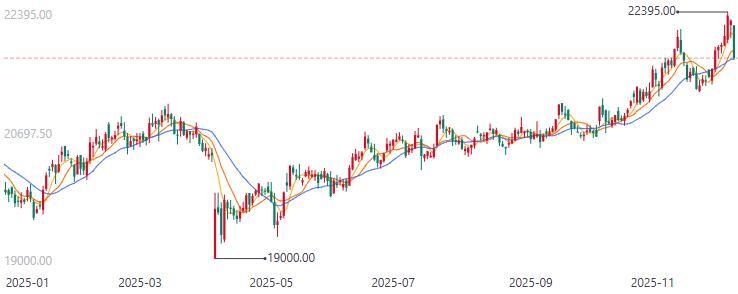
Core Viewpoint - The aluminum industry is experiencing a remarkable turnaround by the end of 2025, with prices surpassing 22,000 yuan/ton, marking a three-year high, driven by structural changes in supply and demand, energy dynamics, and environmental reforms [1][3]. Price Surge: The "Reversal Curve" of Aluminum Market in 2025 - Aluminum prices began at around 19,700 yuan/ton in early 2025, dipped to 19,000 yuan/ton in April, and surged to over 22,000 yuan/ton by December, indicating a significant upward trend [3]. - The price increase is attributed to supply-demand imbalances, with stable domestic production capacity and seasonal fluctuations in hydropower affecting supply, while demand from sectors like electric vehicles and renewable energy is rising [3][4]. Energy Cost Restructuring - The explosive growth in electricity demand from AI data centers is creating competition for power resources, leading to structural increases in industrial electricity prices, which directly impact aluminum production costs [4]. - Electricity accounts for over one-third of the production cost of electrolytic aluminum, making it sensitive to price fluctuations [4]. Carbon Market and Industry Transformation - The inclusion of the aluminum smelting industry in the national carbon trading market in March 2025 introduces new costs for carbon emissions, pushing companies to adopt energy-saving technologies and increasing the share of recycled aluminum production [6][7]. - The proportion of recycled aluminum is expected to exceed 25% in 2025, reflecting a significant shift towards green transformation in the industry [6][9]. Competitive Landscape and Industry Evolution - The focus of competition is shifting from production capacity to energy consumption and carbon emissions, leading to a consolidation of the industry where companies with clean energy and advanced technology gain competitive advantages [7][8]. - Leading aluminum companies are diversifying into high-value products such as aerospace materials and lightweight automotive components, enhancing their resilience against market fluctuations [7][8]. Future Outlook: The New Metal King in 2026 - The aluminum industry is expected to continue its transformation in 2026, with a focus on clean energy integration and product structure upgrades, particularly in high-performance aluminum alloys for strategic sectors [8][9]. - The share of recycled aluminum is projected to surpass 30%, with urban mining and recycling systems becoming new industry hotspots [9][10]. - Chinese aluminum companies are likely to accelerate international expansion, particularly in regions rich in hydropower, while enhancing risk management through financial instruments [10]. Conclusion - The aluminum industry has demonstrated its vitality through significant price performance and profound changes, reflecting a shift from factor-driven to innovation-driven growth, emphasizing energy efficiency and high-end production in the new industrial landscape [11].
从区域集群到全球竞争力:来今年这届滨州铝博会见证铝产业链转型质变时刻
Sou Hu Cai Jing· 2025-10-16 03:03
Core Insights - The aluminum industry in China is undergoing a significant transformation, moving from scale leadership to global competitiveness, with a focus on high-end applications and sustainable practices [2][4][13] Industry Overview - Binzhou, known as the "Aluminum Valley" of China, has established a complete industrial cluster from alumina, electrolytic aluminum to high-precision processed materials, with alumina capacity accounting for 25% and electrolytic aluminum capacity for 16% of the national total [4] - The industry is shifting from expansion in scale to quality and efficiency, and from single processing to full-chain collaboration, responding to global industrial upgrades and green low-carbon transitions [4][9] Innovations and Developments - The upcoming Binzhou Aluminum Expo will showcase innovations in the recycling system for aluminum, including efficient waste aluminum recovery and low-energy production processes, aligning with "green dual carbon" goals [9] - Advanced products such as aerospace-grade aluminum alloys, integrated die-casting aluminum components for electric vehicles, and precision aluminum foils for high-end electronics will be featured, highlighting the transition from basic processing to deep manufacturing [9][10] Collaborative Platform - The expo will serve as a connector for collaborative innovation across the industry chain, gathering over 300 leading enterprises and research institutions, facilitating connections from material research to application implementation [10][13] - The event represents a platform for showcasing the integration of regional clusters with global markets, emphasizing the industry's commitment to innovation and transformation [10][13] Future Outlook - The Binzhou Aluminum Expo is positioned as a window for the Chinese aluminum industry to convey its "innovative strength" and "transformation determination" to the world, marking a shift from quantity accumulation to quality leap [13][15]