银行存款搬家

Search documents
继续完善银保资管产品规范,金监总局下发新规,保险证券ETF(515630)涨近1%
Xin Lang Cai Jing· 2025-12-26 02:51
Group 1 - The China Securities and Insurance Index (399966) increased by 0.98% as of December 26, 2025, with notable gains from stocks such as Bank of China Securities (601696) up 6.26% and Industrial Securities (601377) up 3.77% [1] - The National Financial Regulatory Administration issued the "Management Measures for Information Disclosure of Asset Management Products by Banking and Insurance Institutions," which standardizes the disclosure practices for asset management trust products, wealth management products, and insurance asset management products [1] - Guosheng Securities highlighted that the insurance industry will benefit from the trend of bank deposits moving, with a positive outlook for the liability side performance in 2026 due to successful short-term initiatives [1] Group 2 - The Insurance Securities ETF closely tracks the China Securities and Insurance Index, which selects securities from the insurance sector based on the broader China Securities 800 Index, providing diverse investment options [2] - As of November 28, 2025, the top ten weighted stocks in the China Securities and Insurance Index accounted for 63.12% of the index, including major companies like Ping An Insurance (601318) and CITIC Securities (600030) [2]
内险股普涨 中国太平涨近4% 中国平安涨近2% 机构看好保险业前景
Ge Long Hui· 2025-12-12 03:47
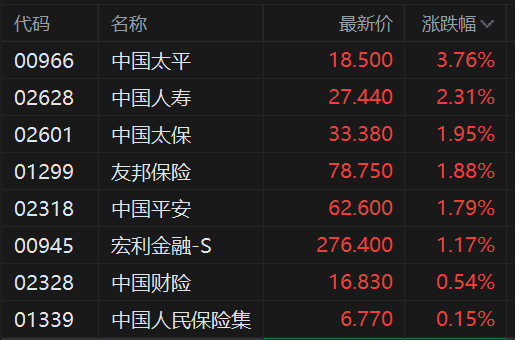
Core Viewpoint - The Hong Kong insurance sector experienced a collective rise, driven by positive market sentiment and favorable regulatory changes, indicating a strong outlook for the industry in both the short and long term [1] Group 1: Market Performance - On December 12, major Hong Kong insurance stocks saw significant gains, with China Taiping rising nearly 4%, China Life up 2.3%, and China Ping An, China Taibao, and AIA increasing by nearly 2% [1] - The stock prices and their respective changes include: - China Taiping: 18.500, +3.76% - China Life: 27.440, +2.31% - China Taibao: 33.380, +1.95% - AIA: 78.750, +1.88% - China Ping An: 62.600, +1.79% - China Pacific Insurance: 16.830, +0.54% - China People's Insurance: 6.770, +0.15% [2] Group 2: Industry Outlook - Guosheng Securities reported that the insurance industry will benefit from the trend of bank deposits moving to insurance products, with diverse demands in retirement, healthcare, and savings expected to drive industry expansion [1] - The smooth progress of the insurance companies' "opening red" is anticipated to boost the liability performance in 2026 [1] - The adjustment of product reservation interest rates is expected to significantly alleviate the risk of industry interest spread losses, while the "integration of reporting and operations" is promoting a reduction in internal competition and increasing concentration among leading companies [1] Group 3: Regulatory Impact - UBS highlighted that the recent notification from the National Financial Regulatory Administration, which adjusts risk factors for insurance companies, reinforces the policy direction encouraging long-term patient capital, thus enhancing market sentiment [1] - The recent rise in Chinese government bond yields and the steepening yield curve are seen as beneficial for insurance companies in the long run [1] - UBS reiterated its preference for China Ping An as the top choice in the industry, maintaining a "buy" rating with a target price of 70 HKD, citing attractive risk-reward dynamics [1]




国盛证券:保险业阶段性超额收益显著 积极看好板块配置价值
智通财经网· 2025-12-11 03:44
Group 1 - The insurance industry is expected to benefit from the trend of bank deposits moving to insurance products, with diverse demands in retirement, healthcare, and savings driving industry expansion in the long term [1] - Short-term performance of insurance companies is promising, with a positive outlook for the liability side in 2026 due to successful initial progress in the new year [1] - The reduction in product reservation interest rates significantly alleviates the risk of interest spread losses, while the "reporting and operation integration" promotes industry consolidation and enhances the concentration of leading companies [1] Group 2 - The insurance industry has shown significant phase-specific excess returns, but has underperformed the overall market due to a shift in market style [2] - From early 2025 to the present, the A-share market has rebounded significantly, with the overall A index up by 25.76% and the insurance industry index up by 18.17%, outperforming the CSI 300 by 0.71 percentage points but underperforming the overall A index by 7.59 percentage points [2] - The insurance index outperformed the CSI 300 by 5.64 percentage points in the first half of the year, but has since lagged behind due to a market style shift towards technology and growth sectors [2] Group 3 - There is a significant disparity in individual stock performance among listed insurance companies, with New China Life leading with a 40.73% increase [3] - The differences in stock performance are attributed to investment and performance variations, with New China Life showing the most significant increase in total investment returns [3] - As of Q2 2025, New China Life and Ping An have a higher proportion of stock investments, contributing to their superior net profit growth rates compared to other companies [3] Group 4 - New single premium growth is notable, with New China Life leading significantly, reflecting a shift in residents' financial asset allocation towards non-bank institutions [4] - The total new single premium growth rate for the first three quarters of 2025 shows New China Life at 55.2%, followed by Taikang at 20.5%, and Ping An at 2.3% [4] - The actual trading volume and market capitalization of major insurance companies vary, with Ping An having the largest market cap, while New China Life and China Life have smaller trading volumes, leading to greater price elasticity [4]





存款大逃亡!5个月2.4万亿居民存款“搬家”,钱都去了这5个地方
Sou Hu Cai Jing· 2025-06-25 22:58
Core Viewpoint - The recent data from the central bank indicates a significant outflow of bank deposits, with a total decrease of 2.46 trillion yuan in the first five months of the year, contrasting with an increase of 987.3 billion yuan in the same period last year. The month of May alone saw a direct evaporation of 1.17 trillion yuan in deposits, marking four consecutive months of net outflow, raising concerns about the declining attractiveness of bank deposits, particularly for small and medium-sized banks [1]. Group 1: Reasons for Deposit Outflow - The continuous reduction of bank deposit interest rates over the past two years has led to rates dropping to historical lows in the "1 era," prompting depositors to seek better returns elsewhere [4]. - Many depositors are increasingly investing in bank wealth management products, with a notable increase of 2.1 trillion yuan in April, bringing the total scale to 31.3 trillion yuan, as the annualized yield of these products (2.4%-2.8%) significantly exceeds that of traditional bank deposits [6]. - A substantial portion of the outflow, approximately 33.4% or 820 billion yuan, has been redirected to the A-share market, with new retail investor accounts surging by 62.3%, adding 8.73 million new investors [9]. - Public funds have seen a dramatic increase, with the total scale surpassing 29.7 trillion yuan by the end of May, reflecting a 3.6 trillion yuan increase since the beginning of the year, as many individuals prefer professional management over direct stock investments [12]. - Some individuals are withdrawing deposits to pay off mortgages early, motivated by the disparity between previous mortgage rates (5.88%) and current rates (around 3%), as well as declining property values [14]. Group 2: Impact on Consumption - The decline in deposit interest income has led some depositors to increase their consumption, contributing to a recovery in the low-end consumer market, with retail sales reaching 19.3 trillion yuan in the first five months, a year-on-year growth of 5.2% [16]. - While low-end consumption is rebounding, demand for high-end goods such as automobiles, luxury items, and real estate remains sluggish, indicating a mixed recovery in consumer spending [16].