
银行网点转型

Search documents
银行网点 变身暖心“服务站”
Zhong Guo Zheng Quan Bao· 2026-02-09 22:06
Core Insights - The article highlights the transformation of bank branches into community service hubs, focusing on customer experience and engagement during the festive season [1][2][3] Group 1: Customer Experience and Engagement - Agricultural Bank of China has optimized cash allocation processes to meet increased demand for new banknotes ahead of the Spring Festival [1] - The bank has redesigned its waiting areas to enhance customer comfort, allowing clients to enjoy amenities like coffee and reading materials while waiting [1][2] - The branch has organized various community activities for the New Year, such as calligraphy writing and family-friendly events, to foster a festive atmosphere [2][3] Group 2: Community Integration and Services - The bank's branches are evolving from mere transaction points to comprehensive community service stations, providing essential services like healthcare insurance guidance [4] - Initiatives include a partnership with local healthcare authorities to offer Medicare services directly at bank branches, enhancing accessibility for residents [4] - The introduction of self-service real estate registration equipment at multiple banks aims to streamline property registration processes, integrating financial services with community needs [4] Group 3: Future Directions in Banking - Experts suggest that banks should focus on transforming physical branches into service-oriented spaces, emphasizing efficiency, community integration, and customer interaction [5] - The shift from transactional to service-oriented banking is seen as essential for maintaining relevance in a digital age, with a focus on human-centered financial services [5]

新春走基层|“做好社区客厅”,银行网点升级了
Zhong Guo Zheng Quan Bao - Zhong Zheng Wang· 2026-02-09 13:18
Core Insights - The article highlights the transformation of Agricultural Bank of China (ABC) branches into community service hubs, focusing on enhancing customer experience and meeting traditional cultural needs during the Spring Festival [1][4][6]. Group 1: Customer Experience and Services - ABC has optimized cash allocation to ensure sufficient supply of new banknotes for customers during the festive season, reflecting an increase in foot traffic at branches [1]. - The bank has redesigned waiting areas and service windows to enhance customer privacy and comfort, creating a more welcoming environment [2]. - The branch has organized various community activities, such as calligraphy and family events, to engage with local residents and foster a sense of community [6]. Group 2: Branch Transformation - The branch aims to evolve from a traditional banking service point to a comprehensive community service station by 2025, emphasizing warmth and human connection [4][9]. - ABC is implementing a "medical insurance service station" model to extend healthcare services to the community, showcasing the integration of banking with social services [7]. - The shift in bank branches reflects a broader trend in the industry, where physical locations are becoming more integrated into community governance and social responsibility [8][9]. Group 3: Future Directions - Industry experts predict that bank branches will increasingly focus on value creation rather than just transaction processing, becoming essential in community governance and social services [8]. - The future of bank branches will involve a transition to service-oriented models, emphasizing efficiency, customer interaction, and community integration [8][9].


上证深一度 | 银行网点“腾笼换鸟” 一边批量关停 一边新设补位
Shang Hai Zheng Quan Bao· 2026-01-09 18:48
Core Viewpoint - The trend of physical bank branches is not a continuous decline as previously expected, but rather a structural improvement with both closures and new openings, indicating a transformation in the banking sector [1][2]. Group 1: Bank Branch Dynamics - In 2025, over 8,000 bank branches are expected to close, while more than 8,400 new branches will be established, leading to a net increase in the number of bank branches [2]. - The closures primarily involve older, less efficient branches that are far from communities and can be fully replaced by online services [3]. - The new branches are often integrated into communities, providing diverse services such as financial consultations and community activities, thus becoming local "convenience centers" [1][2]. Group 2: Reasons for New Branch Openings - The increase in new branches is driven by the rural revitalization strategy, with a significant proportion located in county-level and below areas [2]. - Mergers and acquisitions in the banking sector have led to the transformation of village banks into branch institutions, contributing to the growth of new branches [2]. - There is a focus on serving niche customer groups and enhancing service scenarios that online channels cannot adequately cover [2]. Group 3: Branch Functionality and Transformation - The closures of inefficient branches are aimed at reallocating resources to areas that require more in-person services, such as elderly and inclusive finance [3]. - The banking industry is reassessing the functions of physical branches, with a shift towards digitalization and cost efficiency, as traditional services are increasingly replaced by online channels [4]. - New branches are adopting a more intelligent, lightweight, and specialized approach, focusing on services for the elderly, inclusive finance, and small enterprises [7]. Group 4: Regulatory and Strategic Considerations - Regulatory bodies emphasize the need for banks to ensure the availability of physical branches in rural areas while balancing economic and social benefits [5]. - Banks are encouraged to avoid redundant constructions and over-competition while addressing potential financial exclusion caused by branch closures [5]. - The future of bank branches is seen as a combination of digital and community services, providing both efficient transactions and personalized service [7].
银行网点“腾笼换鸟” 一边批量关停 一边新设补位
Shang Hai Zheng Quan Bao· 2026-01-09 18:38
Core Viewpoint - The trend of bank branches in China is shifting towards structural improvement, with both closures and new openings, rather than a simple reduction in the number of branches [2][4]. Group 1: Bank Branch Dynamics - In 2025, over 8,000 bank branches are expected to close, while more than 8,400 new branches will be established, indicating a net increase in the number of bank branches [4]. - The closures primarily involve outdated branches with low foot traffic, while new branches are being integrated into communities, offering diverse services such as financial consultations and community activities [2][3]. Group 2: Reasons for New Branch Openings - The increase in new branches is driven by the rural revitalization strategy, with a significant proportion located in county and lower regions [4]. - Mergers and acquisitions in the banking sector have led to the transformation of village banks into branch institutions, contributing to the net increase in branches [4]. - Banks are focusing on niche customer segments and enhancing service offerings that online channels cannot fully cover [4][5]. Group 3: Transformation of Bank Branch Functions - New bank branches are adopting a more digital, lightweight, and specialized approach, reducing the number of traditional counters and increasing areas for consultation and smart devices [6]. - The future of bank branches is seen as a combination of digital and community services, providing both efficient transactions and personalized service [6][7]. - The transformed branches are expected to play a crucial role in connecting resources and serving small and micro enterprises, enhancing customer loyalty and optimizing revenue structures [6][7].

2025年银行网点数量增长“意外转正”
Jin Rong Shi Bao· 2026-01-09 00:49
Group 1 - The core viewpoint of the articles highlights a significant transformation in the banking sector, characterized by a net increase in bank branches for the first time in three years, despite a large number of closures [1][2][3] - In 2025, a total of 7,871 bank branches were closed, while 8,494 new branches were established, resulting in a net increase of 623 branches [1][3] - The closures were primarily concentrated in rural financial institutions, with 5,400 branches from rural commercial banks shutting down, while state-owned banks closed over 900 branches [1][2] Group 2 - The reduction in bank branches is linked to the large-scale consolidation of the rural credit system, with 377 banks being dissolved or merged by December 2025, surpassing the total for 2024 [2] - New branches are strategically located in key areas such as county regions and community services, focusing on specialized services like elderly care and government collaboration [3][4] - The banking sector is moving towards a model of "dynamic stability" in branch numbers, with ongoing structural adjustments and functional upgrades to better meet regional economic needs and customer characteristics [3][4]
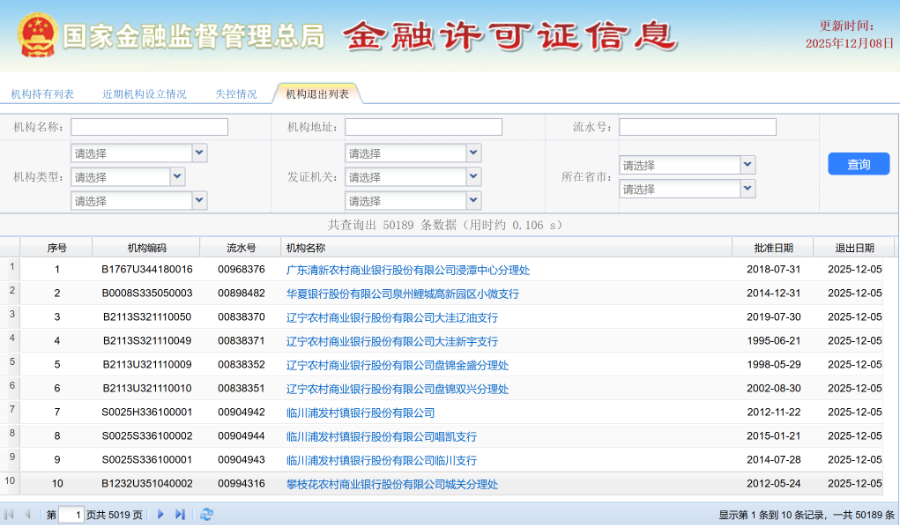
银行网点加减法:近万家退出VS新增超7000家
2 1 Shi Ji Jing Ji Bao Dao· 2025-12-10 03:17
Core Viewpoint - The banking industry is undergoing a transformation from superficial adjustments of branches to deeper structural optimization, focusing on a "slimming and strengthening" approach by closing inefficient branches while reconstructing offline value with specialized layouts [1][3]. Group 1: Branch Exit Data - As of December 8, 2023, a total of 9,661 bank branches have been approved for exit this year, with 1,580 branches completing the exit approval in the first quarter alone, indicating a significant acceleration in the industry's "slimming" process [1][3]. - In contrast, 7,168 new branches have been established, with a focus on specialization and functionality [1]. Group 2: Reasons for Branch Closures - The primary reason for the accelerated exit of bank branches is the impact of digitalization, with many traditional branches experiencing a significant decline in business volume, particularly in cash and basic counter services [5]. - The operational cost of traditional bank branches is high, with individual branches incurring annual operating costs of several million yuan, while business volume has decreased by over 70% in some cases [5]. Group 3: Strategic Shift in Branch Layout - The banking sector is shifting from a focus on quantity to structural optimization, with banks reducing physical branches to control operational costs while increasing investment in intelligent and experiential branches [8]. - Future branch layouts will emphasize wealth management, corporate finance, and community services, creating integrated "finance + lifestyle" service spaces [8]. Group 4: Regulatory and Market Response - The financial regulatory authority has indicated that it will guide banks to ensure the supply of physical branches in rural areas while balancing economic and social benefits, avoiding both excessive competition and financial exclusion [9]. - The trend towards establishing specialized branches is seen as a way for banks to enhance their brand and customer retention, although challenges such as high costs and variable usage rates remain [10].
今年已有8000多家银行网点关闭
21世纪经济报道· 2025-10-28 05:15
Core Viewpoint - The banking sector is undergoing a significant transformation in its branch network, characterized by a dual approach of "shrinking" while "growing" in functionality, with a notable increase in branch closures and openings focused on specialized services [1][5]. Group 1: Branch Closures and Openings - As of October 24, 2023, a total of 8,592 bank branches have been approved for closure, representing an increase of nearly 200% compared to 2,677 closures in the previous year [1][2]. - In the fourth quarter alone, 601 branches have been approved for closure, which is an increase of 511 compared to the same period last year [2][4]. - Despite the closures, 6,859 new branches have been opened, emphasizing a trend towards specialized and functional banking services [1]. Group 2: Impact of Digitalization - The primary reason for the accelerated closure of bank branches is the impact of digitalization, with mobile and online banking leading to a significant decline in traditional branch business volume, particularly in cash and basic counter services [5]. - The operational costs of traditional branches are high, with individual branches incurring annual costs of several million yuan, while business volume has decreased by over 70% in some cases [5]. Group 3: Transformation of Branch Functions - The banking sector is shifting from a focus on quantity to optimizing branch structures, with an emphasis on reducing physical branches to control operational costs while investing in smart and experiential branches [7]. - Future branches are expected to focus more on wealth management, corporate finance, and community services, creating integrated service spaces that combine finance with lifestyle [7][9]. - Over 90% of branches have implemented smart teller machines, and some have introduced remote video customer service and VR experience zones [7]. Group 4: Case Studies of Innovative Branches - Examples of innovative branches include the establishment of a specialized automotive finance branch by Industrial Bank in Guangzhou, which aims to serve over 200 automotive companies and provide financing of no less than 10 billion yuan by the end of 2027 [8][10]. - Agricultural Bank of China has launched dedicated branches for the new energy vehicle industry, providing specialized financial services and support to key players in the sector, with credit support exceeding 73.7 billion yuan [10]. Group 5: Future Outlook - The future of bank branches is envisioned as interactive points for customer engagement and brand representation, with a consensus among banks on the need for transformation while balancing costs and customer experience [10]. - Although the number of branches is expected to continue decreasing, particularly in first- and second-tier cities, the pace of closures will slow, and branch operations will become more differentiated and scientifically planned [10].

银行网点“变形记”:从瘦身到增肌 特色化功能取代传统模式
2 1 Shi Ji Jing Ji Bao Dao· 2025-10-28 04:09
Core Insights - The banking sector is undergoing a significant transformation in its branch network, shifting from simple closures to a strategy of "slimming down" while "growing" in functionality [1][4][6] Summary by Category Branch Closures - As of October 24, 2023, 8,592 bank branches have been approved for closure, a nearly 200% increase from 2,677 closures in the previous year [1][3] - In the fourth quarter alone, 601 branches have been approved for closure, which is an increase of 511 compared to the same period last year [3][4] New Branch Openings - Despite the closures, 6,859 new branches have been established, focusing on specialized and functional services [1][4] - The overall strategy is moving from rapid expansion to optimization of branch locations, with closures in urban areas and new openings in rural areas [1][4] Reasons for Change - The primary driver for the accelerated closure of branches is the impact of digital banking, which has led to a significant decline in traditional branch business volume, particularly in cash and basic counter services [4][6] - Operational efficiency is a critical consideration, as the annual operating cost of a single branch can reach several million yuan, while transaction volumes have dropped by over 70% in some cases [4][6] Future Branch Strategy - Banks are not abandoning physical branches but are instead restructuring their functions, focusing on wealth management, corporate finance, and community services [6][9] - Over 90% of branches have implemented smart teller machines, and some have introduced remote video customer service and VR experience zones [6][9] Innovative Branch Models - Banks are developing specialized branches, such as automotive finance branches, to cater to specific industries and customer needs [7][8] - Agricultural banks are also establishing dedicated branches for the new energy vehicle industry, providing tailored financial services to key players in the sector [8] Customer Interaction and Experience - Future branches are envisioned as interactive points for customer engagement and brand representation, balancing cost and customer experience [9]

新北洋:聚焦“银行网点转型”和“海外商业零售”两大场景
Zheng Quan Ri Bao Wang· 2025-08-28 08:14
Core Viewpoint - New Beiyang (002376) is focusing on providing integrated solutions for financial equipment, particularly in the areas of "bank outlet transformation" and "overseas commercial retail" [1] Group 1: Business Focus - The company is developing scenario-based product solutions that include core modules, intelligent machines, platform software, and system integration [1] - New Beiyang is actively preparing products and solutions related to the promotion of digital RMB, with devices like smart self-service retail and intelligent teller machines supporting digital RMB based on customer needs [1] Group 2: Future Trends - The company plans to continuously track and research the development trends of "stablecoins" to explore their alignment with the company's business strategy [1]
