
银行资本管理

Search documents
年内九家银行赎回优先股,权益类理财难寻“代餐”
2 1 Shi Ji Jing Ji Bao Dao· 2025-12-18 11:16
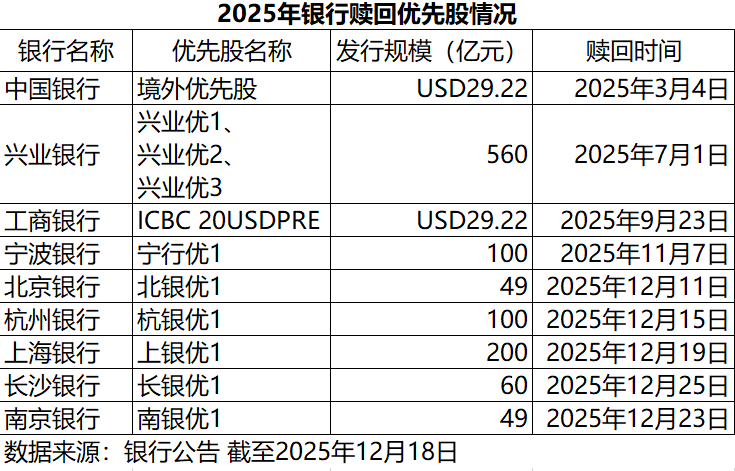
Group 1 - The core viewpoint of the articles indicates that since 2025, there has been an accelerated redemption of bank preferred shares, with several banks announcing their plans to redeem these shares, leading to a shrinking market for preferred stocks, particularly in the banking sector [1][4][7] - As of December 18, 2023, a total of 55 preferred shares have been issued, raising a total of 906.55 billion yuan, with bank preferred shares accounting for 35 of these, totaling 839.15 billion yuan [1][4] - The redemption trend is primarily driven by banks seeking to optimize financing costs, with significant redemptions occurring this year compared to only two last year [4][7] Group 2 - The preferred shares are a major component of bank wealth management products, with over 90% of equity investments in these products being allocated to preferred shares [2][10] - Due to the shrinking market for preferred shares, wealth management products are now looking for alternative investment options, as the supply of preferred shares diminishes [3][10] - The issuance of perpetual bonds has surged, with 69 perpetual bonds issued this year, totaling 821.8 billion yuan, indicating a shift in capital-raising strategies among banks [8][12] Group 3 - The redemption of preferred shares must comply with capital adequacy requirements, necessitating prior approval from regulatory authorities to ensure banks maintain sufficient capital levels [8] - The fixed and floating interest rates of preferred shares are subject to adjustments, with some banks reducing their dividend rates in response to changing market conditions [7] - The overall market for equity assets in bank wealth management has been declining, with the proportion of equity assets dropping from 4.8% in 2020 to around 2% by the end of 2023 [10][11]







高息优先股密集退场 银行优先股投资逻辑生变
Zhong Guo Jing Ying Bao· 2025-11-25 13:12
Core Viewpoint - Recent announcements from multiple commercial banks regarding the redemption of preferred shares indicate a shift in capital management strategies within the banking sector [1][2]. Group 1: Redemption of Preferred Shares - Several banks, including Ping An Bank and Nanjing Bank, have announced plans to redeem preferred shares issued over five years ago, with Ping An Bank set to redeem 200 million shares worth 20 billion yuan by March 2026 and Nanjing Bank planning to redeem 49 million shares worth 4.9 billion yuan by December 2025 [1]. - Since July, at least nine banks, including Industrial and Commercial Bank of China and Bank of Beijing, have disclosed similar redemption plans, creating a notable trend in the market [1]. Group 2: Reasons for Redemption - The high dividend rates set at the time of issuance, combined with declining market interest rates, incentivize banks to redeem high-cost preferred shares and replace them with lower-cost perpetual bonds [2]. - Regulatory changes and the need for banks to optimize their capital structures are also significant factors driving the decision to redeem high-cost preferred shares [2]. Group 3: Capital Management Strategies - The banking sector is transitioning from a focus on scale expansion to a cost-efficiency-centered model, emphasizing the need for banks to balance the redemption of high-interest preferred shares with the issuance of low-cost capital tools [3]. - Banks are adopting more diversified and flexible capital supplement tools, allowing them to respond to market conditions effectively, such as redeeming high-interest preferred shares when interest rates are low [3].


年内多家银行赎回优先股
Zheng Quan Ri Bao Zhi Sheng· 2025-11-07 16:11
Core Viewpoint - The announcement from Ningbo Bank regarding the redemption of its preferred stock "Ningxing You 02" reflects a broader trend among banks to optimize financing costs and adapt to changing market conditions [1][2]. Group 1: Redemption of Preferred Stocks - Ningbo Bank's preferred stock "Ningxing You 02," issued in November 2018 with a total scale of 10 billion yuan (1 billion shares at 100 yuan each), will cease trading on November 7 and has been fully redeemed at a price of 104.5 yuan per share [1]. - Many banks have initiated redemption plans for preferred stocks this year, characterized by a "concentrated and large-scale" approach, including major banks like Bank of China and Industrial and Commercial Bank of China [2]. - The redemption of preferred stocks is driven by high coupon rates at issuance compared to current lower market rates, allowing banks to reduce capital costs by replacing them with cheaper capital instruments [2]. Group 2: Impact on Capital Management - The redemption of preferred stocks may create short-term liquidity pressures due to the large cash outflows required, but it is expected to enhance long-term capital efficiency by reducing interest expenses [3]. - Different types of banks are adopting varied strategies for redeeming preferred stocks, with large state-owned banks favoring simultaneous redemption and issuance to maintain capital adequacy, while regional banks often rely on internal profit accumulation post-redemption [3]. - The trend of banks redeeming high-interest preferred stocks to replace them with lower-cost capital tools is seen as a response to narrowing net interest margins and increasing profitability pressures [3]. Group 3: Future Trends in Capital Tools - The development of capital tools in the banking sector is expected to follow three trends: continuous optimization of tool structures, acceleration of innovative products, and more refined capital management practices [4]. - Market-based capital supplement tools are anticipated to diversify, supporting high-credit-quality banks in optimizing capital management through market issuance [4]. - Policies involving local government special bonds are expected to play a larger role in supplementing the capital of small and medium-sized banks [4].

Northwest Bancshares(NWBI) - 2025 Q3 - Earnings Call Transcript
2025-10-28 14:00
Financial Data and Key Metrics Changes - Total assets reached $16.4 billion, total deposits were $13.7 billion, and total loans amounted to $12.9 billion [6][10] - Revenue for the third quarter was a record $168 million, reflecting over 20% year-over-year growth [6][10] - Net interest margin improved by nine basis points quarter-over-quarter to 3.65% [6][10] - GAAP EPS for the nine months ended September 30, 2025, increased by $0.08 or 15%, while adjusted EPS rose by $0.16 or 21% [7][10] Business Line Data and Key Metrics Changes - Commercial and industrial loan growth exceeded 25% year-over-year [6] - Non-interest income increased by $1.3 million or 4% quarter-over-quarter, driven by service charges [10][18] - Adjusted pre-tax, pre-provision net revenue rose to almost $66 million, an 11.5% increase quarter-over-quarter [10] Market Data and Key Metrics Changes - The company has over 150 financial centers across Pennsylvania, New York, Ohio, and Indiana, with plans to open three new centers in the Columbus market [4][5] - The company was named a top 50 SBA lender nationally by volume [6] Company Strategy and Development Direction - The merger with Penns Woods Bancorp was completed, enhancing balance sheet scale and expected to achieve full cost savings by the second quarter of 2026 [3][24] - The company is focusing on organic growth through de novo branches and potential M&A opportunities in high-growth markets [45][46] - The strategy includes maintaining tight cost controls and risk management discipline while investing in talent for future growth [9][19] Management's Comments on Operating Environment and Future Outlook - Management expressed confidence in maintaining net interest margin levels in the mid-360s and reaffirmed guidance for the fourth quarter [23] - The company is managing criticized and classified assets, which may impact loan growth but is expected to improve over time [30][39] - Management noted no direct exposure to companies with recent credit issues and emphasized strong risk management practices [7][21] Other Important Information - The company declared a quarterly dividend of $0.20 per share, representing an annualized yield of approximately 6.5% [8] - The liquidity position is strong, with sources covering approximately 250% of uninsured deposits [12] Q&A Session Summary Question: Loan growth expectations and impact of new branches - Management indicated that while the acquisition had a significant impact on loan growth, they expect to hold the balance sheet stable and look for growth opportunities in the fourth quarter [26][27] Question: Expense management and future guidance - Management aims to maintain positive operating leverage while investing for growth, with no significant increase in expenses expected from current levels [31][32] Question: Capital management post-acquisition - The company is comfortable with its capital levels and will consider opportunities for buybacks or acquisitions while maintaining a strong capital base [37] Question: Trends in consumer portfolio and deposit activity - Management noted elevated delinquencies due to administrative issues from the acquisition but remains comfortable with the overall consumer exposure [43][44] Question: Scaling the bank and future growth strategies - The focus is on maximizing integration and efficiency from the Penns Woods merger while pursuing organic growth and potential M&A opportunities [45][46]

多个省份:24小时内上报“二级债未赎回”事项
Zhong Guo Jing Ying Bao· 2025-10-24 20:16
Core Viewpoint - The People's Bank of China has introduced a regulation requiring banks to report any intention not to redeem subordinated debt within 24 hours, reflecting increased scrutiny on banks' capital adequacy and risk management [1][3]. Regulatory Changes - The Tianjin branch of the People's Bank of China has proposed a reporting system for significant events, including the decision not to redeem subordinated debt, which must be reported within 24 hours [1]. - Other branches, including those in Chongqing and Shandong, have already included similar reporting requirements [1]. Impact on Banks - Most banks typically choose to redeem subordinated debt after five years due to lower market interest rates, which makes new issuances more attractive [2]. - Some banks are opting not to redeem subordinated debt due to stricter regulatory scrutiny and concerns about meeting capital adequacy requirements [2][4]. - As of 2025, two banks, Nanchang Rural Commercial Bank and Fuxin Bank, have not redeemed their subordinated debt, with Nanchang's capital adequacy ratio at 9.20%, close to the regulatory minimum [2]. Market Reactions - The new regulation is expected to enhance the monitoring of potential risks by regulatory bodies, allowing for timely assessments of banks' capital levels and operational risks [3]. - The market conditions for issuing subordinated debt are favorable, with banks able to replace high-cost old debt with lower-rate new debt [3]. - There is a noticeable divergence in behavior between large banks, which are actively refinancing, and smaller banks, which are hesitant to redeem due to capital adequacy pressures [3]. Capital Management Strategies - Banks nearing the regulatory capital adequacy threshold must adopt prudent capital management strategies, focusing on internal capital accumulation and exploring alternative capital-raising methods [4]. - Strategies include improving profitability, optimizing business structures, and reducing reliance on external financing [4]. - Banks should also prepare contingency plans and maintain close communication with regulators to navigate potential capital shortfalls [5].