
非关税贸易壁垒

Search documents
二十年博弈终达成“技术妥协”:韩国批准谷歌地图数据导出
Zhi Tong Cai Jing· 2026-02-27 08:22
Group 1 - South Korea has approved Google's request to export high-precision map data to overseas servers, marking a significant shift after two decades of refusal [1] - The approval is contingent upon strict security requirements, including the obfuscation of military and sensitive facilities and restrictions on displaying latitude and longitude coordinates of South Korea on Google Maps and Google Earth [1] - Google must process map data on local servers and is only allowed to export data related to government-approved navigation and direction services [1] Group 2 - The long-standing negotiation between Google and the South Korean government dates back to 2007, with South Korea being one of the few countries where Google Maps could not operate normally, allowing local companies like Naver and Kakao to dominate the digital map service market [1] - Previous attempts by Google to establish a presence in South Korea, including a major public relations campaign in 2016, were rejected due to the company's refusal to set up a data center in Korea and to obscure sensitive facilities in satellite imagery [2] - The recent policy shift is believed to be driven by both technical compromises and increasing trade diplomatic pressure, with the U.S. Trade Representative's office previously criticizing South Korea's map data restrictions as a form of non-tariff trade barrier [2]

特朗普称美国与墨西哥的关税协议将延长90天
Yang Shi Xin Wen· 2025-07-31 15:33
Core Viewpoint - The complexity of reaching an agreement with Mexico differs from that with other countries, with a 90-day extension agreed upon for various tariffs and trade barriers [1] Group 1: Tariff Agreements - Mexico will continue to pay a 25% tariff on fentanyl, a 25% tariff on automobiles, and a 50% tariff on steel, aluminum, and copper [1] - Mexico has agreed to immediately eliminate many non-tariff trade barriers [1] Group 2: Future Negotiations - The United States will engage in negotiations with Mexico over the next 90 days, aiming to sign a trade agreement within that timeframe or longer [1] Group 3: Border Security Cooperation - Both countries will continue to collaborate on various aspects of border security, including issues related to drugs, drug distribution, and illegal immigration [1]
特朗普:墨西哥已同意立即终止其非关税贸易壁垒。
news flash· 2025-07-31 15:10
Core Viewpoint - Mexico has agreed to immediately terminate its non-tariff trade barriers, which could enhance trade relations and economic cooperation with the United States [1] Group 1 - The agreement signifies a potential reduction in trade friction between the two countries, which may lead to increased trade volumes [1] - The termination of non-tariff barriers is expected to benefit various industries by facilitating smoother trade processes [1] - This development may positively impact investor sentiment towards companies engaged in cross-border trade with Mexico [1]
美国财长贝森特:我们在韩国协议中消除了很多非关税贸易壁垒。
news flash· 2025-07-31 11:40
Group 1 - The core viewpoint is that the U.S. Treasury Secretary has indicated significant progress in eliminating non-tariff trade barriers in the agreement with South Korea [1]
特朗普表示将延长对欧盟商品征收50%关税的期限
Shang Wu Bu Wang Zhan· 2025-05-27 03:44
Group 1 - The core point of the article is that President Trump has extended the deadline for imposing a 50% tariff on the EU to July 9, following complaints about slow progress in trade negotiations and perceived unfair regulations targeting U.S. companies [1] - The original tariff rate announced in April was set at 20%, which was reduced to 10% after the suspension of the implementation until July 9 [1] - The U.S. Treasury Deputy Secretary highlighted the challenge of negotiating tariffs with the EU as a whole while also addressing non-tariff barriers in separate discussions with individual European countries, creating a "negotiation dilemma" [1] Group 2 - Trump aims to use tariffs to encourage companies to manufacture in the U.S. rather than overseas, threatening a 25% tariff on smartphones produced abroad by companies like Apple and Samsung [2] - Despite the tariff threats, Trump agreed with Treasury Secretary Mnuchin's recent comments that the U.S. does not need to bring textile manufacturing back to the country [2]
利好!大涨
Zhong Guo Ji Jin Bao· 2025-05-26 09:42
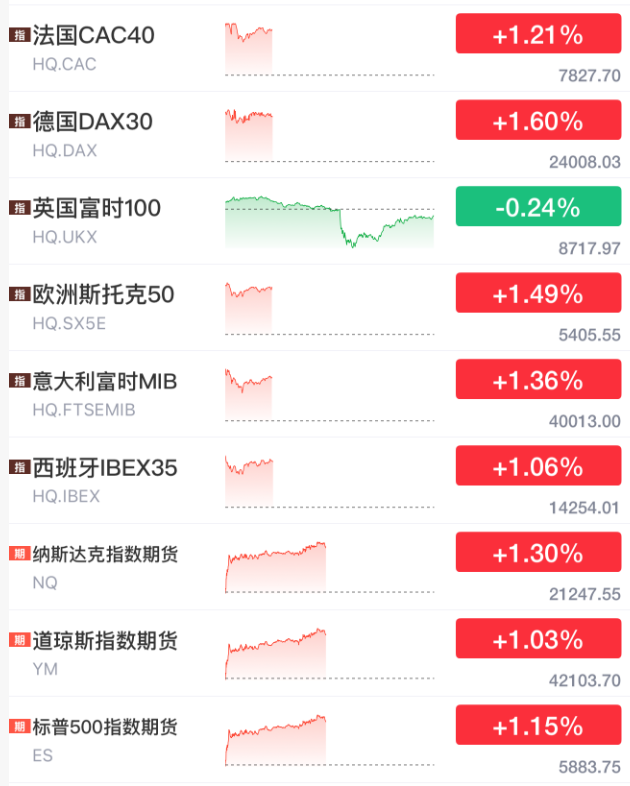
Group 1 - European stock markets opened higher following the announcement of the delay in the 50% tariffs on EU goods by Trump, with the French CAC40 index rising by 1.21% and the German DAX index increasing by 1.6% [1][4] - The initial announcement of the tariffs was made by Trump on his Truth Social platform, where he accused the EU of being difficult to negotiate with and claimed that trade talks were at a standstill [3] - After a phone call with Ursula von der Leyen, the President of the European Commission, Trump agreed to postpone the implementation of the tariffs to July 9, which was originally set for June 1 [4] Group 2 - The EU had planned to impose a 20% tariff in response to the proposed tariffs, but this was reduced to 10% following the postponement, effective until July 9 [4] - The proposed 50% tariffs could impact $321 billion worth of US-EU trade, potentially leading to a 0.6% decrease in US GDP and a price increase of over 0.3% [5] - The US Treasury Deputy Secretary highlighted the challenges of negotiating tariffs with the EU as a whole while also addressing non-tariff barriers with individual member states [5] Group 3 - Trump emphasized the use of tariffs to encourage domestic manufacturing rather than outsourcing, specifically mentioning the potential for tariffs on smartphones produced overseas by companies like Apple and Samsung [5] - He expressed a preference for the US to focus on producing significant items such as chips, computers, and AI technology rather than textiles [6]

美媒爆:印美关税谈判,印度提出特定商品“零换零”
Huan Qiu Shi Bao· 2025-05-07 22:42
Group 1 - India has proposed a "zero-for-zero" tariff arrangement for specific goods, including steel, auto parts, and pharmaceuticals, during trade negotiations with the US, based on reciprocity and limited to a certain quantity of imports [1][2] - The US has expressed concerns regarding India's quality control regulations, viewing them as non-tariff trade barriers that restrict market access for American companies [1][2] - India's exports of pharmaceuticals to the US are valued at $10.5 billion, while engineering products exports amount to $19.1 billion in the new fiscal year [1] Group 2 - The proposal for "zero-for-zero" tariffs has garnered attention, but it is unlikely to be adopted due to differing economic development levels between the US and India [2] - The number of quality control orders in India has increased significantly from 14 before 2014 to over 140 since 2017, raising transparency and fairness concerns [2] - President Trump claimed that India agreed to reduce tariffs on US imports to "zero," although India has not officially confirmed this statement as negotiations are ongoing [3]
特朗普想“强卖”汽车!石破茂:不急于达成协议
第一财经· 2025-04-23 09:41
对于谈判,石破茂表示,不会做出重大让步,也不急于达成协议。 专注于日企供应链研究的分析人士王岩告诉第一财经记者,在供应链深度交织的当前,试图通过所谓 的"零逆差"重构贸易格局,不仅违背经济规律,更可能引发全球经济衰退,"美国认为日本通过高关 税、技术壁垒等手段保护本土产业,导致美国商品难以进入日本市场。但这种指责显然忽略了美日产 业结构差异,贸易逆差本是国际分工的自然结果。" 2025.04. 23 本文字数:2047,阅读时长大约4分钟 作者 | 第一财经 潘寅茹 美日经贸谈判暗流涌动。据央视网报道,4月22日,日本首相石破茂透露,美国总统特朗普表示,希 望将对日贸易逆差缩减至零。 这已不是特朗普第一次公开表示希望把美日之间的贸易逆差缩减至零。2月上旬,石破茂访美期间, 特朗普就在双方的会面中强调了减少美国对日本贸易逆差的重要性。他表示,美国目前对日本存在约 1000亿美元的贸易逆差,并希望将这一逆差缩减至零。 日本汽车进口商协会的数据显示,2024年财年,美国汽车(不包括特斯拉)在日本销量超过1万辆。 由于特斯拉没有按地区详细披露其销售数据,但通过日本汽车进口商协会的数据估算,今年第一季 度,"其他品牌" ...
据日经新闻:在与美国谈判之前,日本开始审查自身存在的美国总统特朗普所反对的非关税贸易壁垒,包括对汽车和农产品进口的规定。
news flash· 2025-04-14 21:55
Group 1 - Japan is reviewing non-tariff trade barriers that are opposed by U.S. President Trump, particularly regulations on automobile and agricultural product imports [1]
