
非加速通胀失业率

Search documents
澳洲联储主席警告:通胀高企不可接受 必要时将再次加息
智通财经网· 2026-02-12 06:43
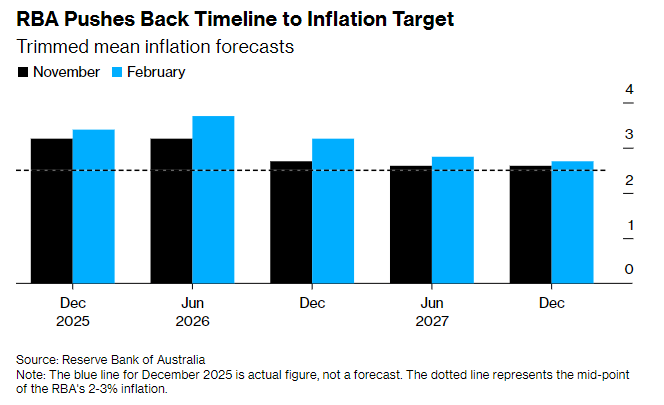
Core Viewpoint - The Reserve Bank of Australia (RBA) is prepared to raise interest rates again if inflation remains stubbornly high, with a cautious approach to further tightening of monetary policy emphasized by Governor Michele Bullock [1][4]. Group 1: Inflation and Monetary Policy - The RBA has become the first major central bank to raise interest rates this year, with expectations of at least one more increase in the coming months as inflation is projected to exceed the target range of 2%-3% [1][4]. - Bullock stated that an inflation rate above 3% is unacceptable, aligning with Deputy Governor Andrew Hagger's warning about the current high inflation levels being a significant challenge for the monetary policy committee [1][4]. - The next RBA meeting is scheduled for mid-March, where decision-makers will review employment and inflation data, along with GDP data for Q4 2025, which is expected to show a resilient Australian economy [4]. Group 2: Economic Challenges - The RBA's recent rate hike marks a sharp policy shift from six months ago when the bank was cutting rates, highlighting structural economic challenges faced by Australia, particularly low productivity growth [4]. - Bullock indicated that without improvements in productivity, maintaining a growth rate above 2% without triggering inflation will be difficult [4]. Group 3: Labor Market and Employment - Despite ongoing inflation control challenges, the unemployment rate remains historically low at 4.1% as of December, with the estimated non-accelerating inflation rate of unemployment (NAIRU) at 4.6% [5]. - Assistant Governor Sarah Hunter emphasized the importance of evaluating economic capacity pressures and labor market conditions to determine whether the recent inflation rise is temporary or a trend [5]. Group 4: Government Spending and Political Sensitivity - Bullock expressed frustration during the hearing regarding media criticism of the RBA's reluctance to attribute government spending to inflationary pressures, highlighting the political sensitivity surrounding fiscal policy [5][6]. - While acknowledging the impact of government spending on the economy, Bullock avoided direct criticism of fiscal policy, stating that public consumption increases total demand but is viewed as a "given condition" by the RBA [5].

“美联储独立性”是伪命题?特朗普真正的目标:“金融压抑”与债务稀释
Hua Er Jie Jian Wen· 2026-01-22 16:13
Group 1: Core Insights - The conflict between the White House and Federal Reserve Chairman Powell is fundamentally a power struggle over policy control rather than merely a debate about central bank independence [1] - The Trump administration aims to lower interest rates to 1% to mask the growing sovereign debt risk and maintain asset bubbles, facilitating a hidden transfer of wealth through financial repression [1] - The Federal Reserve has become a key institution that can still check presidential power, especially as the influence of Congress and public institutions has weakened [1] Group 2: Historical Context of Central Bank Independence - Central bank independence became a widely accepted concept only recently, with New Zealand's 1990 legislation establishing an inflation-targeting framework being a significant milestone [2] - The historical context of central bank independence is rooted in the high inflation periods of the 1970s and 1980s, where governments delegated tough policy decisions to central banks to avoid political backlash [2] - There are ongoing debates about the theoretical basis and practical effectiveness of central bank independence, particularly regarding conflicting policy goals and limited control over key economic variables [2] Group 3: Limitations and Critiques of Central Banks - Central banks' reliance on core analytical models like NAIRU and the Phillips curve has faced criticism for their predictive effectiveness in real-world scenarios [3] - The decision-making bodies of central banks often consist of economists with similar academic backgrounds, which may limit the diversity and effectiveness of policy-making [3] - Historical performance of central banks has been questioned, particularly regarding their responses to economic crises and the long-term effects of their policies on asset bubbles and social inequality [4] Group 4: Political Motivations and Wealth Transfer - Trump's strategy involves appointing Federal Reserve governors who support his interest rate policies, aiming to obscure sovereign debt pressures and sustain market bubbles [6] - Lowering interest rates allows the government to continue expansionary fiscal policies, benefiting political and business supporters while diluting debt burdens through negative real interest rates [6] - This approach mirrors Trump's previous business strategies, characterized by high leverage and risk-taking, suggesting a continuity in his operational mindset [6] Group 5: Power Balance and Democratic Accountability - The debate over central bank independence reflects a restructuring of power balance within the U.S. political system, with the Federal Reserve serving as a critical check on executive power [7] - There is a growing populist sentiment favoring low interest rates and high growth, alongside increasing skepticism towards technocratic elites and their decision-making processes [7] - The surface-level discussion about central bank independence masks deeper issues of power distribution, democratic accountability, and institutional checks within the political economy [7]