金融压抑

Search documents
“美联储独立性”是伪命题?特朗普真正的目标:“金融压抑”与债务稀释
Hua Er Jie Jian Wen· 2026-01-22 16:13
Group 1: Core Insights - The conflict between the White House and Federal Reserve Chairman Powell is fundamentally a power struggle over policy control rather than merely a debate about central bank independence [1] - The Trump administration aims to lower interest rates to 1% to mask the growing sovereign debt risk and maintain asset bubbles, facilitating a hidden transfer of wealth through financial repression [1] - The Federal Reserve has become a key institution that can still check presidential power, especially as the influence of Congress and public institutions has weakened [1] Group 2: Historical Context of Central Bank Independence - Central bank independence became a widely accepted concept only recently, with New Zealand's 1990 legislation establishing an inflation-targeting framework being a significant milestone [2] - The historical context of central bank independence is rooted in the high inflation periods of the 1970s and 1980s, where governments delegated tough policy decisions to central banks to avoid political backlash [2] - There are ongoing debates about the theoretical basis and practical effectiveness of central bank independence, particularly regarding conflicting policy goals and limited control over key economic variables [2] Group 3: Limitations and Critiques of Central Banks - Central banks' reliance on core analytical models like NAIRU and the Phillips curve has faced criticism for their predictive effectiveness in real-world scenarios [3] - The decision-making bodies of central banks often consist of economists with similar academic backgrounds, which may limit the diversity and effectiveness of policy-making [3] - Historical performance of central banks has been questioned, particularly regarding their responses to economic crises and the long-term effects of their policies on asset bubbles and social inequality [4] Group 4: Political Motivations and Wealth Transfer - Trump's strategy involves appointing Federal Reserve governors who support his interest rate policies, aiming to obscure sovereign debt pressures and sustain market bubbles [6] - Lowering interest rates allows the government to continue expansionary fiscal policies, benefiting political and business supporters while diluting debt burdens through negative real interest rates [6] - This approach mirrors Trump's previous business strategies, characterized by high leverage and risk-taking, suggesting a continuity in his operational mindset [6] Group 5: Power Balance and Democratic Accountability - The debate over central bank independence reflects a restructuring of power balance within the U.S. political system, with the Federal Reserve serving as a critical check on executive power [7] - There is a growing populist sentiment favoring low interest rates and high growth, alongside increasing skepticism towards technocratic elites and their decision-making processes [7] - The surface-level discussion about central bank independence masks deeper issues of power distribution, democratic accountability, and institutional checks within the political economy [7]
营造让创新热情永不落幕的场域
Di Yi Cai Jing Zi Xun· 2025-12-19 00:28
Group 1 - The core viewpoint of the articles emphasizes the significant role of innovation in China's economic development, highlighted by the impressive market performance of domestic GPU companies like Muxi Co., Ltd. and Moore Threads, which reflects strong investor confidence in innovation-driven enterprises [2][3]. - Muxi Co., Ltd. debuted on the STAR Market with a nearly sevenfold increase in share price, marking it as the third highest stock price in A-shares history, showcasing the wealth effect in the A-share market [2]. - The recent Central Economic Work Conference underscored the importance of innovation, advocating for a dual approach of policy support and reform to foster high-quality development [2]. Group 2 - The high premiums on stocks of innovative companies like Muxi and Moore Threads indicate market expectations for China's innovation capabilities, amidst a backdrop of asset scarcity in the domestic financial market [3][4]. - To transform the initial sparks of innovation into widespread success, it is essential to create a conducive environment for innovation, emphasizing the need for clear policy support and the freedom for enterprises to innovate [4][5]. - The articles stress the importance of maintaining a competitive and open environment for innovation, as the success of companies like Muxi and Moore Threads is linked to international collaboration and the backgrounds of their founding teams [4][5].


困境与破局:美联储的“财政囚徒”困境与金银的宏观机遇
雪球· 2025-12-10 08:36
Core Viewpoint - The article discusses the challenges faced by the Federal Reserve in managing monetary policy amid persistent inflation and rising debt levels, suggesting a shift towards a "fiscal dominance" scenario that could benefit gold and silver as key investment assets [2][4]. Group 1: Monetary Policy Challenges - The expectation of returning to a low interest rate environment is unrealistic, as the structural changes in inflation and labor shortages make the 2% inflation target unattainable [2]. - Even if the Federal Reserve initiates rate cuts, the terminal rate is likely to remain above 3%, indicating a need to adapt to a "higher for longer" interest rate environment [2][3]. Group 2: Fiscal Implications - The U.S. faces significant fiscal challenges with a national debt of $38 trillion, projected to reach $41 trillion, leading to exponentially increasing interest payments that could exceed $1 trillion annually [3]. - If interest rates remain above 3.5%, the cost of debt servicing could consume a substantial portion of fiscal revenue, potentially leading to a debt spiral [3]. Group 3: Potential Policy Responses - Historical precedents suggest that the Federal Reserve may prioritize government credit over strict inflation targets, potentially leading to forced rate cuts even if inflation is not fully under control [3]. - This approach could result in "financial repression," where nominal interest rates are kept artificially low, diluting national debt but risking damage to the dollar's credibility and uncontrolled inflation expectations [4]. Group 4: Investment Outlook - Under the described macroeconomic conditions, gold and silver are positioned not just as traditional safe-haven assets but as essential tools against the devaluation of fiat currency, with a potential target price for gold reaching $10,000 [4].

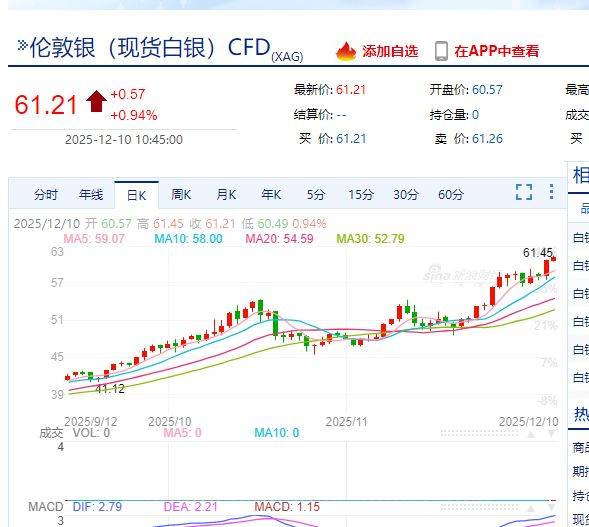
涨势远超黄金!白银年内已涨近110%!发生了什么?
Sou Hu Cai Jing· 2025-12-10 03:21
Group 1 - Silver prices surged past $60 per ounce on December 9, reaching a historical high, driven by multiple factors including rising expectations of interest rate cuts by the Federal Reserve, global supply tightness, and inclusion in the U.S. "critical minerals" list [1] - Year-to-date, silver has increased nearly 110%, outperforming both gold and platinum [1] - As of the report, spot silver was priced at $61.21 per ounce, with a daily increase of 0.94% [1] Group 2 - In comparison, gold has also risen by 60% this year, surpassing $4,200, but its growth rate is still less than that of silver, resulting in the gold-silver ratio dropping below 70 for the first time since July 2021 [3] - The core catalyst for the current silver price increase is the repricing of interest rates and policy expectations, with the Federal Reserve initiating a new round of easing since September and reducing the federal funds rate to a range of 3.75% to 4.00% [5] - Market expectations indicate an 85% probability of further rate cuts in December, influenced by statements from key Federal Reserve officials and weak economic data [5] Group 3 - Analysts note that silver possesses both financial and commodity attributes, benefiting from a macro environment of liquidity easing, which supports its strong performance [7] - A global decline in silver inventories has led to noticeable supply tightness in the spot market, with recent trends showing a premium for physical silver in Europe and tightness in the domestic silver market [7] - The current high gold-silver ratio suggests significant potential for correction, while increasing demand from industrial sectors like photovoltaics supports silver prices [7]
美元的归途:破百的条件和时机?(民生宏观林彦)
川阅全球宏观· 2025-03-23 13:42
Core Viewpoint - The article discusses the potential for the US dollar to face downward pressure due to long-term economic challenges and uncertainties stemming from the Trump administration's policies, suggesting that the dollar index may experience a "last hurrah" before a significant decline [1][2]. Summary by Sections Short-term Economic Outlook - The US is currently experiencing a short-term rebound in market expectations, but fiscal spending has not decreased as anticipated, with a 14% year-on-year increase in spending for the first two months of the year compared to the same period in 2024 [1]. - The government initially planned to cut $2 trillion in spending but revised this to $1 trillion, indicating a lack of substantial fiscal tightening [1]. Long-term Economic Challenges - The US economy is on the brink of a long-term downtrend, primarily driven by an unsustainable debt cycle. The article outlines that the US economy is consumption-driven, heavily reliant on income and corporate profitability, which are influenced by financial leverage [2][3]. - The article references Ray Dalio's framework for understanding debt cycles, indicating that the US is currently in the "bubble burst stage," where debt defaults may soon occur [3][4]. Federal Reserve's Role - The Federal Reserve is expected to face significant challenges as it navigates through the debt cycle, with the potential for a loss of government creditworthiness as it moves from a phase of balance sheet expansion to one of increasing liabilities [4]. - The article suggests that the Fed may have limited options to control debt, with financial repression (lowering interest rates) and fiscal control being the two primary paths, but both face significant hurdles [4]. Currency Dynamics - The article analyzes the factors influencing the dollar index, including real interest rate differentials, purchasing power parity, and monetary policy differences between the US and Europe [4][5]. - It predicts that the dollar may breach the 100 mark this year, particularly in the second and third quarters, contingent on economic performance and inflationary pressures in the US [6]. Inflation and Monetary Policy - The US is expected to face greater inflationary pressures this year, influenced by tariffs and potential labor market imbalances, while European inflation may ease due to lower energy prices [5][6]. - The article notes that market expectations for interest rate cuts differ significantly between the US and Europe, with the Fed facing more substantial risks of easing monetary policy [6].