非美资产

Search documents
创纪录资金涌入,却换来15年最差相对表现!美股光环褪去,美元警报响起?
Hua Er Jie Jian Wen· 2026-02-26 03:22
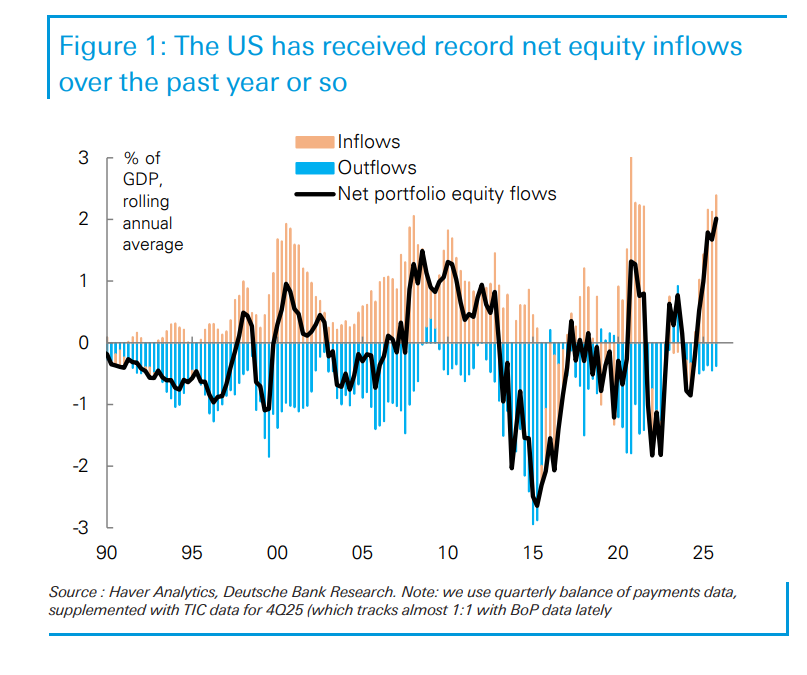
Core Insights - The U.S. stock market is experiencing a paradox where increased foreign investment is not translating into superior performance, raising concerns about potential declines in the dollar if this trend reverses [1][14]. Group 1: Investment Trends - Deutsche Bank reports unprecedented net inflows into the U.S. stock market, reaching a staggering 2% of U.S. GDP for the entire year of 2025 [2]. - This influx of capital is significant enough to finance two-thirds of the U.S. current account deficit [2]. - U.S. investors show a strong preference for domestic stocks, with a notable decline in interest in foreign equities, contrasting with trends in other G10 countries [2]. Group 2: Market Performance - Despite the capital influx, the U.S. stock market has underperformed compared to cheaper and more cyclical markets, marking the worst relative performance in 15 years [5][10]. - The relative underperformance of U.S. stocks has become evident in recent months, with a significant decline in performance compared to non-U.S. assets [5]. - Over a three-year period, while U.S. stocks have remained robust, their performance has recently dropped to a low point [5]. Group 3: Global Economic Context - Strong global economic data has persisted for over a year, correlating with rising global stock markets and favorable conditions for corporate earnings [7]. - Global corporate earnings are growing at over 15%, a trend typically seen during recovery periods following recessions [7]. Group 4: Valuation and Profitability - The valuation gap between U.S. stocks and non-U.S. markets remains significant, with U.S. stocks previously trading at a 70% premium, now reduced to a 40% premium [10][13]. - Non-U.S. markets are beginning to show a positive shift in earnings, with a notable 14% increase in profitability over the past six months [10]. Group 5: Currency Implications - A potential shift in capital away from U.S. stocks could lead to a significant decline in the dollar, as historical patterns suggest that reduced inflows correlate with dollar depreciation [14][17]. - The long-term trajectory of the dollar is closely tied to the performance of U.S. stocks relative to emerging markets, indicating that a reversal in foreign investment could trigger a downward trend for the dollar [17].


洪灝:今年任何非美资产都会跑赢,比如欧元、黄金、港股,黄金可涨2年或20年,港股三季度会有新高
华尔街见闻· 2025-05-14 03:27
Core Viewpoint - The article discusses the potential market trends following the consensus on tariff adjustments between China and the U.S., emphasizing the expected outperformance of non-U.S. assets, particularly gold and Hong Kong stocks, in the current economic climate [1][2][11]. Group 1: Market Trends and Asset Performance - Non-U.S. assets are expected to outperform this year, with gold significantly leading the way [2][11]. - The article suggests that this year should focus on assets outside the U.S., such as Hong Kong stocks, the euro, and gold [3][13]. - The weakening of the U.S. dollar is anticipated to continue for several years, impacting gold prices positively [8][19]. Group 2: Hong Kong Stock Market Outlook - The Hong Kong stock market is projected to reach new highs, with a specific forecast of surpassing 24,000 points by the third quarter [6][45]. - The article notes that the recent high of 24,874 points was observed in March, and a new peak is expected soon [7][45]. - Key sectors expected to drive this growth include technology, consumer goods, and healthcare, supported by favorable national policies and strong earnings growth [47]. Group 3: Economic Influences and Predictions - The article highlights that individual actions, such as those by former President Trump, cannot alter the overall economic cycle but can increase market volatility [5][30][34]. - The article emphasizes the importance of understanding the logic behind market valuations, particularly regarding the price-to-earnings (PE) ratios of Hong Kong stocks [41][42]. - It suggests that significant inflows of capital from mainland China could positively impact the Hong Kong market [43].