美股

Search documents
国泰海通 · 晨报260320|美联储:“胀”重于“滞”
国泰海通证券研究· 2026-03-19 14:05
Core Viewpoint - The Federal Reserve emphasizes inflation concerns over economic stagnation, indicating a hawkish stance in its recent monetary policy meeting, with a focus on rising inflation risks rather than economic downturn risks [2]. Group 1: Federal Reserve Meeting Insights - The Federal Reserve's recent meeting highlighted the unclear impact of Middle Eastern tensions on the economy, making it difficult to provide precise economic forecasts [2]. - The economic projections in the Summary of Economic Projections (SEP) were revised upward, reflecting increased inflation expectations [2]. - The Federal Reserve maintained its interest rate decision, with a median forecast of one rate cut this year, although many officials lowered their expectations for the number of cuts and discussed the possibility of rate hikes, indicating a generally hawkish outlook [2]. Group 2: Inflation and Interest Rate Expectations - Short-term inflation expectations are driven by tariffs and geopolitical risks, which are suppressing rate cut expectations; however, these factors are expected to have a temporary impact, with potential for rate cut expectations to rise in the second half of the year [3]. - The influence of tariffs is becoming clearer, with the expectation that any increases will be limited and viewed as one-time impacts on inflation, alleviating concerns from the Federal Reserve [3]. - The labor market remains weak, necessitating further rate cuts, but short-term inflation pressures are hindering this process; if tariffs and geopolitical risks stabilize, inflation expectations may ease, creating conditions for rate cuts [3]. Group 3: Market Reactions and Projections - U.S. Treasury yields are expected to oscillate at high levels in the short term, awaiting renewed rate cut expectations, while U.S. equities may experience volatility but could find support from easing expectations [4]. - The anticipated rate cuts would lower the risk-free rate, supporting equity valuations, and could bolster corporate earnings, potentially reversing economic downturns and initiating recovery [4]. - Short-term volatility in U.S. equities is likely due to geopolitical risks and liquidity concerns, with upward turning points dependent on future developments [4].


策略专题研究:资产间相关性对A股的影响
Guolian Minsheng Securities· 2026-02-27 12:14
Core Insights - The report highlights that the correlation between A-shares and US stocks has increased, which is beneficial for short-term performance, while a long-term low correlation environment is preferred for A-shares [3][10] - It emphasizes that low correlation among equity markets globally is favorable for A-shares, particularly in the context of long-term performance [3][15] - The report indicates that a decline in multi-asset correlation is necessary for the better performance of the A-share market in the long run [3][30] Group 1: A-shares and US Stocks - The current correlation between A-shares and US stocks is at a historically high level, which supports short-term performance [7][10] - A higher correlation in the short term leads to greater elasticity in A-shares, while a lower correlation in the long term is associated with higher future returns [10][29] Group 2: A-shares and Hong Kong Stocks - The correlation between A-shares and Hong Kong stocks is also at a historically high level, which is beneficial for A-share performance [11][14] - Similar to the US market, a short-term increase in correlation with Hong Kong stocks is favorable, while a long-term low correlation is preferred [14][29] Group 3: Global Equity Market Correlation - The report notes that the correlation among equity markets in Europe and the US is relatively high, while Asian markets also exhibit high internal correlation [15][16] - Long-term low correlation among different countries' equity markets is advantageous for A-shares [15][29] Group 4: Multi-Asset Correlation - The report discusses that various assets such as equities, gold, silver, copper, and oil show a significant positive correlation, while the US dollar index and bonds exhibit a negative correlation with these assets [3][30] - A decline in multi-asset correlation is essential for the A-share market's performance in the long term [30][45] Group 5: Impact of Asset Performance on A-shares - The performance of precious metals, particularly gold and silver, positively influences A-shares [34][38] - The report indicates that strong performance in global equity markets, including US and Asian markets, has a positive impact on A-shares [19][22]
美股持续走低 纳斯达克综合指数跌1%
Jin Rong Jie· 2026-02-26 15:16
Group 1 - The U.S. stock market continues to decline, with the Dow Jones Industrial Average rising by 0.25%, while the S&P 500 index fell by 0.47% and the Nasdaq Composite index decreased by 0.97% [1]
创纪录资金涌入,却换来15年最差相对表现!美股光环褪去,美元警报响起?
Hua Er Jie Jian Wen· 2026-02-26 03:22
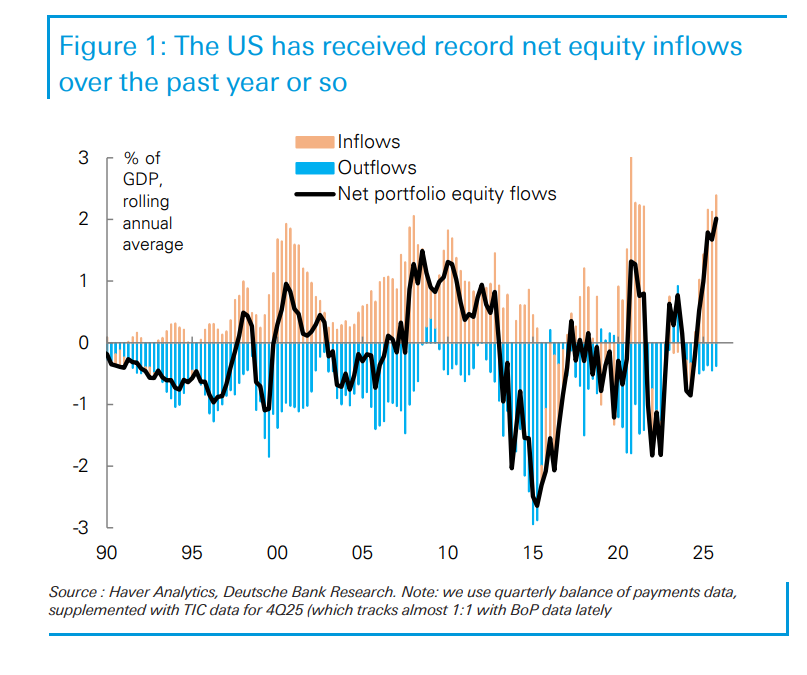
Core Insights - The U.S. stock market is experiencing a paradox where increased foreign investment is not translating into superior performance, raising concerns about potential declines in the dollar if this trend reverses [1][14]. Group 1: Investment Trends - Deutsche Bank reports unprecedented net inflows into the U.S. stock market, reaching a staggering 2% of U.S. GDP for the entire year of 2025 [2]. - This influx of capital is significant enough to finance two-thirds of the U.S. current account deficit [2]. - U.S. investors show a strong preference for domestic stocks, with a notable decline in interest in foreign equities, contrasting with trends in other G10 countries [2]. Group 2: Market Performance - Despite the capital influx, the U.S. stock market has underperformed compared to cheaper and more cyclical markets, marking the worst relative performance in 15 years [5][10]. - The relative underperformance of U.S. stocks has become evident in recent months, with a significant decline in performance compared to non-U.S. assets [5]. - Over a three-year period, while U.S. stocks have remained robust, their performance has recently dropped to a low point [5]. Group 3: Global Economic Context - Strong global economic data has persisted for over a year, correlating with rising global stock markets and favorable conditions for corporate earnings [7]. - Global corporate earnings are growing at over 15%, a trend typically seen during recovery periods following recessions [7]. Group 4: Valuation and Profitability - The valuation gap between U.S. stocks and non-U.S. markets remains significant, with U.S. stocks previously trading at a 70% premium, now reduced to a 40% premium [10][13]. - Non-U.S. markets are beginning to show a positive shift in earnings, with a notable 14% increase in profitability over the past six months [10]. Group 5: Currency Implications - A potential shift in capital away from U.S. stocks could lead to a significant decline in the dollar, as historical patterns suggest that reduced inflows correlate with dollar depreciation [14][17]. - The long-term trajectory of the dollar is closely tied to the performance of U.S. stocks relative to emerging markets, indicating that a reversal in foreign investment could trigger a downward trend for the dollar [17].

美股延续涨势,纳指涨幅达1.00%。
Jin Rong Jie· 2026-02-25 15:10
Group 1 - The U.S. stock market continues its upward trend, with the Nasdaq index increasing by 1.00% [1]
美股三大股指延续涨势,纳指涨超1%,道指涨0.83%,标普500指数涨0.68%。
Jin Rong Jie· 2026-02-24 16:27
Group 1 - The three major U.S. stock indices continued their upward trend, with the Nasdaq rising over 1%, the Dow Jones increasing by 0.83%, and the S&P 500 gaining 0.68% [1]
都在喊跌就安全了?美股情绪指标急转直下 多头却看到了希望
智通财经网· 2026-02-24 12:13
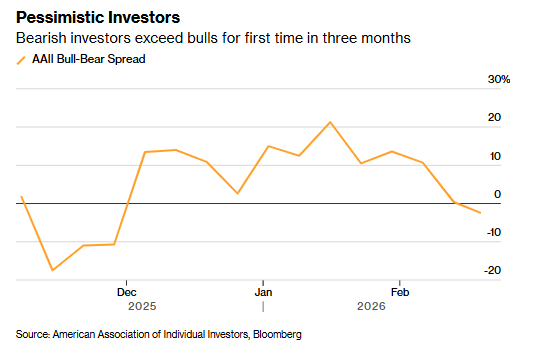
Core Viewpoint - The U.S. stock market has been fluctuating near historical highs for nearly four months, with each rally quickly followed by a sell-off, indicating a shift in investor sentiment towards a more bearish outlook for the first time since November last year [1] Group 1: Market Sentiment and Trends - A recent investor sentiment survey shows that bearish sentiment has surpassed bullish sentiment for the first time since November 2022, with Deutsche Bank's subjective stock positioning indicator dropping to an underweight zone [1] - Despite the bearish signals, historical patterns suggest that this could signal a buying opportunity, as stock buying may soon rebound [1] - The current market environment is characterized by a rare combination of pessimism and broad upward momentum, which is seen as overall positive for the U.S. stock market [1][2] Group 2: Performance of Indices - The S&P 500 index is down 0.8% from its historical high on October 28, 2022, and has declined 2% from its peak four weeks ago, while the Russell 2000 small-cap index and S&P 500 equal-weight index have risen at least 5.2% this year [2] - Funds are shifting from large-cap tech stocks to smaller, riskier stocks, as well as sectors like energy, materials, and consumer staples [2] Group 3: Earnings and Investor Behavior - The earnings data indicates that S&P 500 companies are expected to see a 13% year-over-year profit growth in Q4, significantly exceeding the market's previous expectation of less than 9% [2] - Despite a generally pessimistic sentiment from the American Association of Individual Investors (AAII), there is a belief that respondents may not fully reflect their true market actions, as they are increasing their positions in risk assets [3][5] Group 4: Market Dynamics and Uncertainties - Investors are increasingly moving into high-risk stocks and using leveraged ETFs to increase bullish bets, with retail investors actively buying on dips [5] - Approximately half of the S&P 500 companies have raised their earnings guidance, marking the highest proportion since Q2 2021, indicating strong operational performance despite market pricing challenges [5] - The market is currently in a "chaotic range," suggesting a need for tactical caution, yet Citigroup maintains an overweight position on U.S. stocks while reducing exposure to tech stocks [6]