高端市场突破

Search documents
华为高端机再战迪拜
第一财经· 2025-12-12 15:27
Core Viewpoint - Huawei is making significant efforts to penetrate the high-end smartphone market in the Middle East, traditionally dominated by Apple and Samsung, with recent product launches including the Mate X7 foldable phone and open TWS earphones [3][5]. Group 1: Market Dynamics - The Middle East smartphone market is projected to reach 15.1 million units in Q3 2025, reflecting a 23% year-on-year growth, with the UAE market growing by 13% [5]. - Apple and Samsung hold over 90% of the high-end market share in the region, with Apple accounting for approximately 46% and Samsung 45% of shipments priced at $500 and above [7]. Group 2: Strategic Importance of Dubai - Dubai serves as a strategic hub for the Middle East, North Africa, and South Asia, with a population exceeding 1 billion, making it a critical battleground for global smartphone brands [4]. - Huawei previously held a strong market position in Dubai before 2019, making it essential for the company to regain its foothold in this high-end market [5]. Group 3: Challenges and Opportunities - Huawei faces significant challenges in overcoming brand recognition and ecosystem barriers to compete effectively against Apple and Samsung in the high-end segment [7]. - The company is not only focusing on smartphone deployment but is also accelerating its market activities in the region, including partnerships with local firms to enhance its ecosystem and service offerings [9]. Group 4: Long-term Strategy - To succeed in the high-end market, Huawei must enhance its brand, ensure consistent ecosystem experiences, and develop comprehensive product trial and evaluation programs [10]. - The Middle East market presents growth opportunities for Chinese brands in both mid-range and high-end segments, but long-term commitment and strategic planning are essential for success [10].

华为高端机再战迪拜
Di Yi Cai Jing· 2025-12-12 09:25
Core Insights - Huawei is striving to regain market share in the high-end smartphone segment in the Middle East, which has been dominated by Apple and Samsung for a long time [1][4] - The Middle East market is becoming a crucial growth pillar for Chinese smartphone brands outside Asia, with Huawei launching multiple high-end products in a short span [1][6] Group 1: Market Dynamics - The Middle East smartphone market is projected to reach 15.1 million units by Q3 2025, reflecting a 23% year-on-year growth, with the UAE market growing by 13% [2] - Apple and Samsung dominate the high-end market, holding over 90% of the market share, with Apple accounting for approximately 46% and Samsung 45% in the $500 and above price segment [4] Group 2: Strategic Moves - Huawei's recent product launch in Dubai includes the Mate X7 foldable phone, targeting direct competition with Samsung's Galaxy Z Fold series [2] - Huawei is not only focusing on smartphone deployment but also accelerating its market actions in the Middle East by proposing a regional smart transformation strategy and collaborating with local companies [5] Group 3: Challenges and Opportunities - Huawei faces significant challenges in overcoming brand recognition and ecosystem barriers in the high-end market [4] - The Middle East market presents both growth opportunities in the mid-range segment and profit potential in the high-end and mid-high-end markets for Chinese brands [6]


开源证券给予华明装备“买入”评级,公司信息更新报告:重视股东回报延续高比例分红,海外营收同比高增
Sou Hu Cai Jing· 2025-10-28 10:37
Group 1 - The core viewpoint of the article is that Huaming Equipment (002270.SZ) has been given a "buy" rating by Kaiyuan Securities due to its strong overseas revenue growth and dual attributes of growth and dividends [1] - The company reported significant year-on-year growth in overseas revenue in its Q3 2025 report, indicating robust performance [1] - The power equipment business continues to grow, supported by stable domestic demand and high growth in overseas demand [1] Group 2 - The domestic high-end market is expected to continue achieving breakthroughs, while the overseas market expansion is anticipated to yield positive results [1] - The article highlights the recent surge in the A-share market, surpassing 4000 points, marking a significant market revival after a decade of stagnation [1] - The technology sector is identified as a key driver reshaping the market, contributing to a new "slow bull" market pattern [1]

春风动力(603129):2025年三季度利润小幅提升,全地形车、极核等引领高端化
Guoxin Securities· 2025-10-23 11:23
Investment Rating - The report maintains an "Outperform" rating for the company [7][5][38] Core Insights - The company achieved revenue of 14.1 billion yuan in Q1-Q3 2025, a year-on-year increase of 30.9%, driven by the motorcycle and all-terrain vehicle (ATV) segments, although profit growth has slowed due to tariff impacts [1][10] - The company is set to launch several new products in 2024, including high-performance models in the ATV and motorcycle segments, which are expected to enhance competitiveness and drive growth [3][24][27] - The electric two-wheeler segment, represented by the brand "Jike," is emerging as a new growth curve, with significant sales increases anticipated [35][36] Financial Performance - For Q1-Q3 2025, the company reported a gross margin of 27.6%, down 3.9 percentage points year-on-year, and a net margin of 10.0%, up 0.1 percentage points year-on-year [2][18] - The company forecasts net profits of 18.49 billion, 23.86 billion, and 28.61 billion yuan for 2025, 2026, and 2027 respectively, with corresponding earnings per share of 12.12, 15.64, and 18.75 yuan [5][38] Product Development - The company is actively expanding its motorcycle lineup with new models set to launch in 2024 and 2025, enhancing its market presence and competitiveness [4][27][29] - The introduction of the U10 PRO and U10 XL PRO models in the ATV segment is expected to significantly boost the company's market position in high-end products [24][25] Market Expansion - The company is focusing on expanding its export business, particularly in North America and Europe, leveraging its competitive pricing and product offerings [31][32] - The electric two-wheeler market is being targeted with a comprehensive product matrix aimed at various consumer segments, indicating a strategic shift towards electric mobility [35][36]

春风动力(603129):2025 年三季度利润小幅提升,全地形车、极核等引领高端化
Guoxin Securities· 2025-10-23 09:05
Investment Rating - The report maintains an "Outperform" rating for the company [7][5]. Core Insights - The company achieved revenue of 14.1 billion yuan in Q1-Q3 2025, a year-on-year increase of 30.9%, driven by the motorcycle and all-terrain vehicle (ATV) businesses, although profit growth has slowed due to tariff impacts [1][10]. - The gross margin for Q1-Q3 2025 was 27.6%, down 3.9 percentage points year-on-year, while the net margin was 10.0%, up 0.1 percentage points year-on-year [2][18]. - The company is set to launch several new products in 2024, including the U10 PRO and U10 XL PRO, which are expected to drive significant growth in the ATV segment [3][24]. Financial Performance - For Q3 2025, the company reported revenue of 50.4 billion yuan, a year-on-year increase of 28.6%, but a quarter-on-quarter decline of 10.1% [1][10]. - The net profit for Q3 2025 was 4.1 billion yuan, reflecting a year-on-year growth of 11.0% but a quarter-on-quarter decline of 29.5% [1][10]. - The company forecasts net profits of 18.49 billion yuan, 23.86 billion yuan, and 28.61 billion yuan for 2025, 2026, and 2027, respectively [5][38]. Product Development - The company is actively expanding its motorcycle lineup with new models such as the 150SC, 450MT, and 500SR VOOM, aiming to enhance competitiveness and market share [4][27]. - The electric motorcycle brand, Jike, is expected to become a significant growth driver, with plans to establish a production base in Zhejiang Province [35][36]. Market Expansion - The company is focusing on both domestic and international markets, with a renewed emphasis on exporting motorcycles, particularly to North America and Europe [31][32]. - The competitive pricing of its products, such as the 450SS, positions the company favorably against established competitors in overseas markets [32][34].
手机品牌冲高端的难题,还得看联发科和vivo的答案
Tai Mei Ti A P P· 2025-10-15 06:40
Core Insights - The smartphone market is shifting towards high-end products, with brands like vivo aiming to establish themselves in this segment while maintaining profitability [1][4][19] - The collaboration between MediaTek and vivo has led to significant advancements in high-end smartphone technology, exemplified by the launch of the vivo X300 series [3][11][18] Group 1: Market Trends - The overall smartphone market growth is projected to be around 2%, while the high-end market is expected to grow by 8% year-on-year in the first half of 2025, reaching record levels [4][19] - The competition in the high-end smartphone market has evolved into a "full-competence" phase, where brands must excel in multiple areas such as performance, imaging, and AI [4][10] Group 2: Product Development - The vivo X300 series showcases a collaboration between MediaTek's Dimensity 9500 chip and vivo's self-developed imaging technology, resulting in enhanced performance and user experience [6][18] - The Dimensity 9500 chip utilizes a third-generation 3nm process, significantly improving AI capabilities, imaging, and gaming experiences [4][8] Group 3: Strategic Collaboration - MediaTek and vivo's partnership has transitioned from simple collaboration to a deeper integration, with both companies investing over 1,000 engineers in the development of the X300 series [18][21] - The partnership is characterized by a shared vision of prioritizing user needs and a commitment to co-developing technology that enhances the overall smartphone experience [14][16] Group 4: Competitive Positioning - vivo has established itself as a leader in the high-end smartphone market, particularly in the 4,000-6,000 yuan price range, with the X300 series expected to drive further growth [11][19] - MediaTek's Dimensity brand has gained significant market share, with approximately 40% of smartphones globally utilizing its chips, indicating strong demand for its technology [16][21]
vivo为“高端突破”拼了
Hua Er Jie Jian Wen· 2025-10-14 09:44
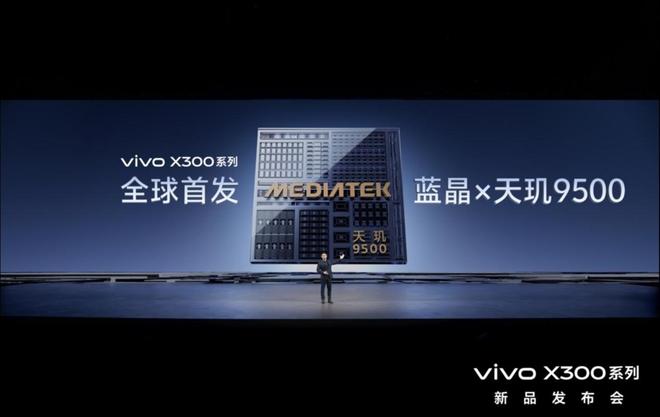
Core Insights - Vivo aims to strengthen its position in the high-end smartphone market through technological advancements and enhanced product configurations, especially in the context of Huawei's strong return and intensified industry competition [2][6]. Product Launch - On October 13, Vivo officially launched its annual high-end flagship smartphone, the Vivo X300 series, continuing its strategy of emphasizing "blue technology" [3][4]. - The Vivo X300 series features four major upgrades in "blue technology": Blue Crystal Chip Technology Stack, Blueprint Imaging, Blue Ocean Battery System, and Blue River Operating System [4]. Technological Innovations - The series is powered by the Vivo and MediaTek co-developed Blue Crystal × Dimensity 9500 flagship chip and Vivo's self-developed Blueprint Imaging chip V3+, achieving efficient collaboration between the two chips [5]. - The X300 series runs on the restructured OriginOS 6, which enhances performance through innovations in super-core computing, dual rendering architecture, and photon storage [5]. Imaging Capabilities - Vivo positions the X300 series as the "Zeiss 200 Million Imaging Dual Flagship," featuring a Zeiss 2.35x telephoto lens and a photographer's kit [5][6]. - The standard X300 model is priced at 4,399 yuan, which is 100 yuan more than the Vivo X200 but 300 yuan less than the Vivo X200 Pro mini, indicating Vivo's intent to capture more high-end market share [6]. Market Position and Strategy - Vivo has maintained the largest market share in China for four consecutive years, with over 17% market share as of September 28, 2025 [8]. - In the price segment of 4,000 to 6,000 yuan, Vivo's market share increased from 8.8% to 14%, while Apple's share decreased from 23.4% to 17%, showcasing Vivo's competitive edge in this segment [9]. Competitive Landscape - The competition in the high-end smartphone market is intensifying, with Huawei, Xiaomi, and Vivo each leveraging their strengths: Huawei focuses on full-stack self-research, Xiaomi integrates global supply chain resources, and Vivo enhances mobile photography through a dual-track approach of self-research and co-research [9]. - Vivo's efforts in the high-end market are beginning to yield results, and the X300 series is expected to be a core growth engine for the company moving forward [9][10].

研判2025!中国傅立叶红外光谱仪行业产业链、发展现状及重点企业分析:核心部件国产化与智能化升级并进,环保医药新能源需求爆发催生行业新增长极[图]
Chan Ye Xin Xi Wang· 2025-07-14 01:38
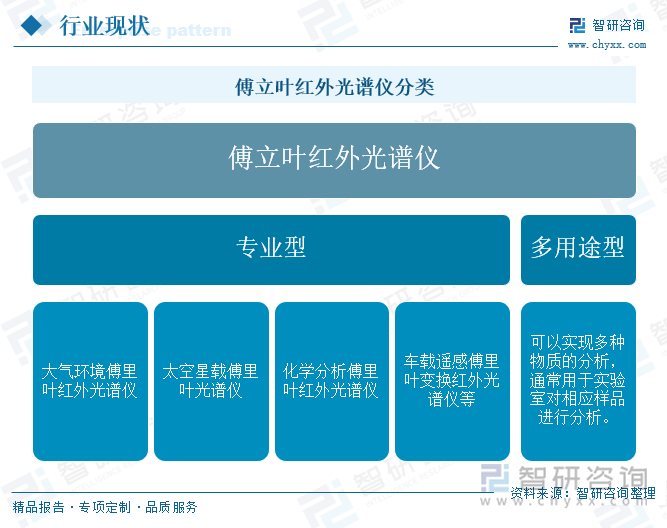
Core Insights - The Chinese Fourier Transform Infrared Spectrometer (FTIR) industry has made significant technological advancements, with domestic companies overcoming key technical barriers and achieving international standards in some products [1][12][22] - The market size for FTIR in China is projected to reach 1.824 billion yuan in 2024, reflecting a year-on-year growth of 9.75% [1][12] - The application scenarios for FTIR are expected to expand due to stricter environmental regulations, increased investment in biomedicine research, and a surge in demand for new energy materials [1][12] Industry Overview - FTIR is an instrument that utilizes Fourier transform principles to obtain infrared spectra of substances, providing crucial data for chemical analysis and material identification [3] - The industry can be categorized into specialized and multifunctional FTIR spectrometers, with applications ranging from environmental monitoring to chemical analysis [3] Industry Development History - The FTIR industry in China has evolved through four main stages: exploration (1987-2000), independent research and development (2000-2008), industrialization (2009-2014), and intelligent development (2015-present) [4][5][6] - Key milestones include the introduction of the first domestic FTIR model in 1993 and the development of portable FTIR devices that surpassed international counterparts in performance by 2011 [4][5] Industry Value Chain - The upstream of the FTIR industry includes optical materials, electronic components, and mechanical parts, while the midstream focuses on manufacturing FTIR devices [8] - Downstream applications span various fields, including biomedicine, environmental monitoring, materials science, and food safety [8] Current Industry Status - The FTIR industry in China has seen remarkable progress in technology, with domestic firms breaking through barriers in critical components like interferometers and detectors [12] - The market is expected to continue growing, driven by regulatory changes and increased research funding [12] Key Companies' Performance - The competitive landscape is shifting, with domestic companies like Yanzhao Optical and Beijing Rayleigh gradually breaking the international monopoly in the high-end FTIR market [14][22] - International giants such as Thermo Fisher and Bruker maintain a stronghold in the high-end market, but domestic firms are gaining traction through innovation and improved performance [14] Industry Development Trends - The integration of AI and IoT technologies is transforming FTIR from a simple detection tool to an intelligent analysis platform, enhancing measurement efficiency and data accuracy [19][20] - Domestic companies are actively expanding their market presence both domestically and internationally, particularly in Southeast Asia and Africa, driven by the Belt and Road Initiative [21] - The trend of domestic substitution is gaining momentum, with local firms increasingly penetrating the high-end market and offering customized solutions [22]