
高质量选股

Search documents
红利ETF还值得买吗?盘一盘几个有代表性的红利ETF
2 1 Shi Ji Jing Ji Bao Dao· 2025-07-23 08:02
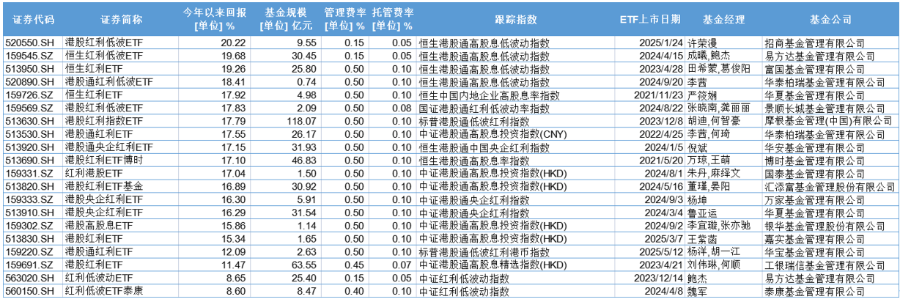
Core Viewpoint - Dividend strategies have gained market attention since last year, characterized by their defensive attributes and high dividend yields, making them attractive to investors. However, with the rise of technology and pharmaceutical sectors in 2025, growth stocks have overshadowed dividend assets, despite institutional investments still favoring dividend-related sectors, particularly in Hong Kong stocks [1]. Group 1: Market Performance and Trends - As of July 18, 2025, the total scale of listed dividend-themed ETFs has exceeded 150 billion, with 58 out of 61 ETFs achieving positive returns this year [1]. - The Hang Seng Hong Kong Stock Connect High Dividend Low Volatility Index has shown a year-to-date increase of 17.52%, benefiting the ETFs that track it [3]. - The largest ETF by scale, the E Fund Hang Seng Dividend Low Volatility ETF, has surpassed 30 billion in assets, demonstrating significant growth since its inception in April 2024 [3]. Group 2: ETF Characteristics and Performance - The top-performing ETFs are primarily those tracking the Hang Seng Hong Kong Stock Connect High Dividend Low Volatility Index, which selects stocks based on high dividend yields and low volatility [3][4]. - The China Securities Dividend Low Volatility Index, tracked by the largest dividend ETF, has maintained a consistent performance with a year-to-date return of 8.21% [9]. - The Morgan Hong Kong Dividend Index ETF, the first cross-border strategy ETF to exceed 10 billion in scale, has a year-to-date return of 17.79% [11]. Group 3: Sector Allocation and Composition - The financial sector accounts for over 30% of the index composition, followed by energy, real estate, and industrial sectors, each exceeding 10% [4]. - The index maintains a diversified approach, with no single stock exceeding 5% weight, ensuring a balanced exposure to various companies [4]. Group 4: Future Outlook and Valuation - Despite concerns over high relative valuations, the absolute valuations of major dividend low volatility indices remain around 7 times, indicating potential for long-term investment [14]. - The current market dynamics suggest a valuation recovery rather than a bubble, with stable dividend assets expected to retain their allocation value in the long term [14].


水电股,“赢麻了”!科技基金、新能源主题、互联网基金……都来了
券商中国· 2025-07-20 23:27
Core Viewpoint - The increasing diversity of fund products heavily investing in hydropower stocks, particularly leading companies like Yangtze Power, reflects the growing appeal of the hydropower sector due to its low valuation, dividends, and high yield potential [2][3]. Group 1: Fund Product Diversity - The hydropower sector is attracting a wide range of fund types, including dividend funds, technology funds, environmental funds, and even internet funds, indicating a breaking down of traditional investment boundaries [2][3]. - Yangtze Power's market capitalization has reached 721.8 billion, nearing its historical high, with 10 out of the last 12 years showing positive stock price returns [3]. - Various funds, including global QDII and ESG-themed funds, are increasingly holding significant positions in Yangtze Power, with some funds allocating over 9% of their portfolios to this stock [4]. Group 2: Financial Performance - Yangtze Power reported a total revenue of 84.49 billion, a year-on-year increase of 8.12%, and a net profit of 32.50 billion, up 19.28%, indicating strong financial health compared to many tech stocks [5]. - The company's cash flow from operating activities reached 59.65 billion, aligning with the current focus of public funds on cash flow as a key indicator of corporate value [5]. Group 3: Market Trends and Investment Strategies - The public fund industry is increasingly launching high-dividend products and ETFs, which are expected to enhance the value of hydropower stocks [7]. - The overall demand for electricity in China continues to grow, with stable power generation and decreasing supply costs, making the power sector attractive for long-term investment [8]. - The transition towards clean energy and the ongoing reforms in the domestic electricity market are expected to further enhance the long-term investment value of the green power sector [8].

水电资产关注度大增 有望持续吸引基金布局
Zheng Quan Shi Bao· 2025-07-20 18:36
Group 1 - The water and electricity industry is increasingly attracting various types of public funds due to its low valuation and high dividend characteristics, leading to a diverse range of fund products heavily investing in leading water power stocks like Changjiang Electric [1][2] - Changjiang Electric has a market capitalization of 721.8 billion yuan and has achieved positive stock price returns in 10 out of the last 12 years, making it a favored choice among different fund types, including A-share, Hong Kong stock, and global QDII funds [2][3] - Various thematic funds, such as dividend, state-owned enterprise, and environmental funds, have also heavily invested in Changjiang Electric, with some funds allocating over 9% of their portfolios to this stock [2][3] Group 2 - The bond fund sector, which typically has lower stock allocation needs, has also shown interest in Changjiang Electric, increasing its stock allocation from 0.16% to 6.22% within a few months, indicating strong preference for this stock [3] - The fundamental resilience of water power stocks, along with characteristics like corporate governance, cash flow, and low valuation, aligns with the high-quality stock selection criteria of public funds [4][5] - Changjiang Electric is projected to achieve an operating revenue of 84.492 billion yuan in 2024, a year-on-year increase of 8.12%, and a net profit of 32.5 billion yuan, reflecting a 19.28% growth, which is attractive in the current economic environment [4] Group 3 - The public fund industry is increasingly launching high-dividend products and index funds, which will likely lead to continued investment in quality water power stocks, supporting the real economy [7][8] - The market for clean energy generation is expected to expand significantly, driven by the overall increase in electricity demand and the transition to renewable energy sources, highlighting the long-term investment value of the green power sector [8]