
AI智能锁

Search documents
鹿客科技冲刺IPO,患“小米依赖症”,自有业务萎缩
Guo Ji Jin Rong Bao· 2026-02-11 07:43
Core Viewpoint - Luoketech (Beijing) Co., Ltd. has submitted an application for a mainboard IPO to the Hong Kong Stock Exchange, aiming to become the "first AI smart lock stock" in the Hong Kong market [1] Group 1: Financial Performance - The company reported revenue growth from 1.015 billion to 1.086 billion yuan from 2023 to 2024, with a year-on-year increase of 11.5% in the first three quarters of 2025, reaching 774 million yuan [2] - Profits for 2023 and 2024 are projected at 14.03 million and 53.11 million yuan, respectively, with 31.98 million yuan reported for the first three quarters of 2025 [3] Group 2: Cash Flow Challenges - Operating cash flow showed a significant decline, with net inflow dropping from 89.485 million yuan in 2023 to just 1.247 million yuan in 2024, and turning negative with a net outflow of 38.307 million yuan in the first three quarters of 2025 [4] - As of September 2025, cash and cash equivalents were only 66.73 million yuan, a substantial decrease from the beginning of the period [5] Group 3: Business Structure and Dependency - The company's revenue growth heavily relies on ODM (Original Design Manufacturer) business, which accounted for 61.6% of total revenue in the first three quarters of 2025, up from 50.6% in 2023 [6] - Revenue from proprietary brand consumer products declined from 319 million yuan in 2023 to 301 million yuan in 2024, further dropping to 159 million yuan in the first three quarters of 2025, reducing its share from 27.8% to 20.5% [6] - The overall gross margin decreased from 35.2% in 2024 to 31.2% in 2025 due to the imbalance in business structure [7] Group 4: Client Dependency Risks - The company is significantly dependent on a single client, with sales to the top five clients accounting for 65.2% of total revenue, and sales to the largest client, Xiaomi, making up 60.6% [8] - The founder, Chen Bin, acknowledged that after receiving investment from Xiaomi, the company largely abandoned its proprietary brand, leading to a lack of product differentiation [9]

鹿客科技冲刺IPO,患“小米依赖症”,自有业务萎缩
IPO日报· 2026-02-11 07:14
Core Viewpoint - Luoketech (Beijing) Co., Ltd. is applying for a mainboard IPO on the Hong Kong Stock Exchange, aiming to become the first "AI smart lock" stock in the market, with funds primarily allocated for technology R&D, brand marketing, overseas expansion, debt repayment, and working capital [1]. Group 1: Company Overview - Luoketech was founded in 2014 by Chen Bin, a master's degree holder from Tsinghua University, positioning itself as a pioneer in "global AI home security" with smart locks as its core product [4]. - The company is projected to lead the global market in smart lock shipments in 2024, with a market share of 10.5%, and ranks fourth globally and third in China for overall smart lock shipments, holding a 5.8% market share in the domestic market [4]. Group 2: Financial Performance - According to the prospectus, the company's revenue is expected to grow from 1.015 billion yuan in 2023 to 1.086 billion yuan in 2024, with a revenue of 774 million yuan in the first three quarters of 2025, reflecting an 11.5% year-on-year growth [6]. - The profits for 2023 and 2024 are projected to be 14.03 million yuan and 53.11 million yuan, respectively, with 31.98 million yuan reported for the first three quarters of 2025 [7]. Group 3: Cash Flow and Operational Challenges - The company faces cash flow challenges, with net cash inflow from operating activities dropping from 89.485 million yuan in 2023 to 1.247 million yuan in 2024, and a net outflow of 38.307 million yuan in the first three quarters of 2025, indicating increasing operational pressure [8]. - As of September 2025, the company's cash and cash equivalents were only 66.73 million yuan, significantly reduced from the beginning of the period [9]. Group 4: Business Structure and Risks - The company's revenue growth heavily relies on ODM (Original Design Manufacturing) business, which accounted for 61.6% of total revenue in the first three quarters of 2025, up from 50.6% in 2023, while its own brand business is declining [12]. - Revenue from the self-owned brand consumer products decreased from 319 million yuan in 2023 to 301 million yuan in 2024, further dropping to 159 million yuan in the first three quarters of 2025, leading to a decline in the overall gross margin from 35.2% in 2024 to 31.2% in 2025 [13][14]. - The company is significantly dependent on a single client, with sales to the top five clients accounting for 65.2% of total revenue, and sales to the largest client, Xiaomi, making up 60.6% [15][16].


鹿客冲刺AI智能锁第一股,2024年出货量全球第四
Jin Rong Jie· 2026-02-10 07:41
Core Viewpoint - Luoketech is aiming to become the first publicly listed company in the AI smart lock sector by submitting its prospectus to the Hong Kong Stock Exchange, with significant support from Xiaomi's ecosystem [1][3]. Group 1: Company Development - Luoketech, originally founded as Yunding Network in 2014, focused on B2B commercial applications in the early stages of China's smart lock industry [3]. - The company launched the "Luoketech" brand in 2017, pricing its product at 1,699 yuan through Xiaomi's crowdfunding platform, achieving a tenfold growth in the consumer market with 300,000 units sold that year [3]. - Luoketech became the only smart lock enterprise in Xiaomi's ecosystem, deepening their collaboration over time [3]. Group 2: Financial Performance - From 2019, Luoketech began providing ODM services to Xiaomi, which became its largest customer, contributing 48.6%, 51.7%, and 60.6% of Luoketech's revenue in 2023, 2024, and the first three quarters of 2025, respectively [3]. - ODM business has become a core revenue pillar for Luoketech, with ODM revenue accounting for 61.6% of total revenue in the first three quarters of 2025, leading to a revenue of 774 million yuan, an 11.5% year-on-year increase [3]. Group 3: Market Position - Luoketech is the first company globally to achieve large-scale production of vein smart locks, ranking first in global shipments in 2024 with a market share of 10.5% [3]. - The overall smart lock shipment volume ranks fourth globally with a market share of 2.6%, while in the Chinese mainland market, it ranks third with 1.2 million units shipped in 2024, capturing a market share of 5.8% [3].

从大厂辞职卖门锁,清华硕士获雷军投资,公司年营收10亿冲刺港交所!估值11年增长超260倍
Sou Hu Cai Jing· 2026-02-09 10:44
Core Viewpoint - Luker Technology (Beijing) Co., Ltd. is aiming to become the first publicly listed company in the AI smart lock sector, with significant attention due to its leading position in the global market for vein recognition smart locks and backing from prominent investors like Baidu and Xiaomi. However, the company faces challenges such as slowing revenue growth and a decline in its own brand business [1][5]. Company Overview - The founder of Luker Technology, Chen Bin, has a master's degree from Tsinghua University and previously worked at Sony and Baidu before founding the company in 2014 [3][5]. - The company has received multiple rounds of investment from notable firms, achieving a valuation of 3.5 billion RMB by December 2025, a staggering increase of over 261 times since its initial valuation of 13.33 million RMB in July 2014 [5]. Market Position - Luker Technology is recognized as the first company globally to achieve mass production of vein recognition smart locks, with a market share of 10.5% in 2024. The company ranks fourth in overall smart lock shipments globally, holding a market share of 2.6% [8][9]. - In mainland China, the company shipped 1.2 million smart locks in 2024, ranking third with a market share of 5.8% [9]. Financial Performance - The company reported revenues of 1.015 billion RMB, 1.086 billion RMB, and 774 million RMB for the years 2023, 2024, and the first three quarters of 2025, respectively. Corresponding profits were 14.03 million RMB, 53.11 million RMB, and 31.98 million RMB [11][12]. - Despite overall revenue and profit growth, the revenue from the company's own brand products has declined, with a significant drop in the first three quarters of 2025 compared to the previous year [14]. Revenue Breakdown - The main revenue source for Luker Technology is its ODM projects, which accounted for 50.6%, 53.4%, and 61.6% of total revenue during the reporting periods [16]. - The revenue from the company's own brand consumer products decreased from 319.47 million RMB in 2023 to 158.55 million RMB in the first three quarters of 2025, indicating a downward trend [15][16]. Corporate Governance - The company's board of directors has seen a significant reduction in total compensation, dropping to 2.4 million RMB in the first nine months of 2025 from 16.4 million RMB in 2024, which may raise concerns about the stability of the core team [18].
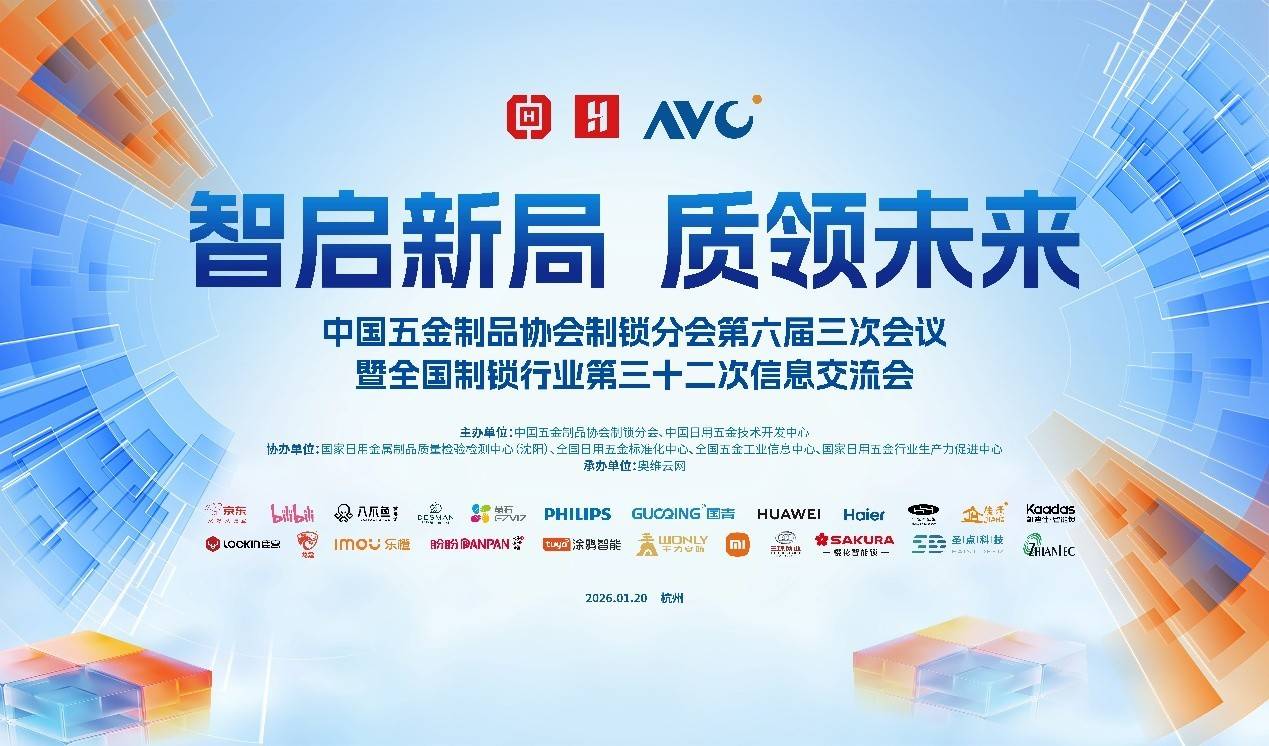
智启新局质领未来——全国制锁行业第三十二次信息交流会在杭州隆重召开
Sou Hu Cai Jing· 2026-01-22 04:50
Core Insights - The conference focused on the theme "Intelligent Initiation of New Situations and Quality Leadership of the Future," highlighting the integration of digital economy and smart home industries, particularly in the smart lock sector [1][5][49]. Group 1: Industry Challenges and Opportunities - The smart lock industry is experiencing robust growth driven by new and replacement demand, but it faces challenges such as severe competition, product quality inconsistency, and inadequate after-sales service [5][9]. - The industry is urged to move towards high-quality development, emphasizing innovation, product quality, and safety as core competitive advantages [5][49]. Group 2: Market Trends and Consumer Insights - The market penetration of smart locks in China remains low, indicating significant potential for new user acquisition [11]. - The 2025 market research report indicates a positive outlook for the smart lock industry, with increasing upstream shipment volumes and clearer supply chain dynamics [9]. Group 3: Technological Innovations - Companies are integrating AI technology into smart locks to enhance user experience and security, with products like the MiyaAI smart lock series showcasing advanced interaction capabilities [16][18]. - Innovations such as the LockinAuraCharge technology by Luokai aim to address power supply issues, enabling wireless charging and continuous operation of smart locks [24]. Group 4: Standardization and Industry Collaboration - The launch of the "Smart Door Group Standard" aims to establish a unified framework for the industry, promoting standardized development and high-quality growth [35]. - The conference emphasized the importance of collaboration among government, associations, and enterprises to foster a healthy and sustainable industry ecosystem [49]. Group 5: Recognition and Awards - The conference recognized leading brands in the smart lock industry, awarding titles such as "China Smart Lock Leading Brand" and "Consumer Preferred Brand" to companies like Deshman and Kaidishi [37][43]. - The event also highlighted high-end products and best-selling smart locks, reinforcing the importance of quality and consumer trust in the market [39][41].
智能门锁2025年度峰会在杭州举行 AI智能锁崛起成全年亮点
Zheng Quan Shi Bao Wang· 2026-01-21 13:21
Core Insights - The smart lock industry in China is at a critical juncture of technological innovation and market upgrade, focusing on product core reconstruction, value enhancement, and user experience empowerment as key directions for high-quality development [1][2] - The integration of smart security and smart home technologies is accelerating, with smart locks reinforcing their essential role in home security, while the industry faces challenges such as price competition and product homogeneity [1][2] Industry Trends - The demand for smart locks is steadily increasing, with both new and replacement needs being released, and the upstream shipment volume is continuously rising, indicating a clearer supply chain structure [1][2] - The market penetration of smart locks remains low, with significant potential for new user growth, and AI smart locks are emerging as a major highlight for the year [2][3] Standardization Efforts - The China Daily Hardware Technology Development Center is actively promoting the establishment of industry standards to address common challenges and guide the industry towards a new phase of quality competition focused on innovation, product quality, and safety [2][3] - The release of the "2025 China Smart Lock Industry White Paper" and the "2025 China Smart Door Consumer White Paper" aims to provide insights into industry development, market characteristics, and consumer trends to support strategic decision-making [3]
AI时代,凯迪仕重新定义“一把好锁”
3 6 Ke· 2025-11-19 10:08
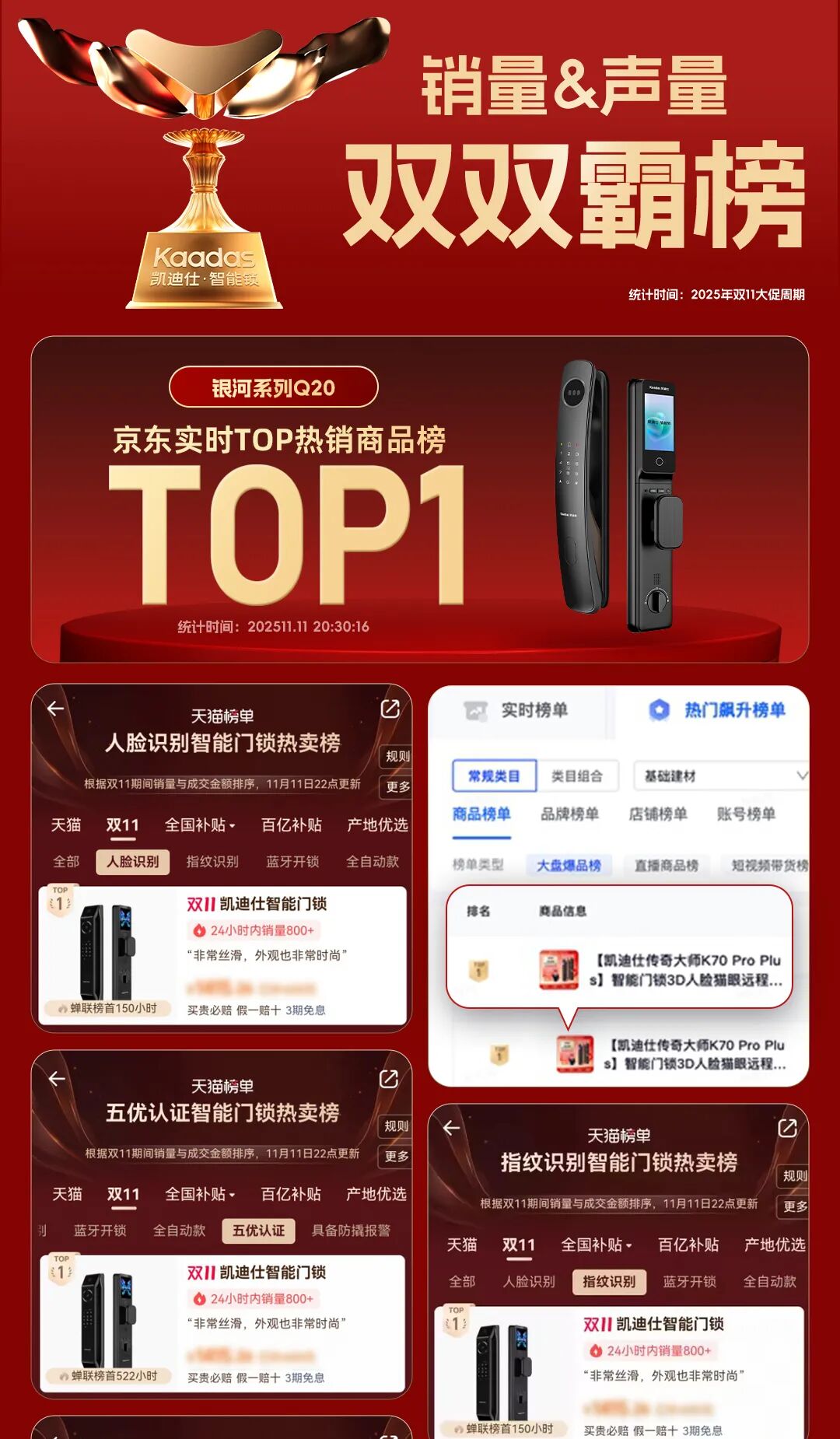
Core Insights - Kaadas achieved impressive sales during the 2025 Double 11 shopping festival, ranking first in multiple categories and generating over 5 billion in online buzz [1][4] - The growth engine for the smart lock category is shifting towards AI smart locks, with the market expected to reach 480 billion by 2025, growing at a compound annual growth rate of over 30% [4][23] - Kaadas has been recognized as a leader in the industry, receiving multiple awards for its AI smart locks, including being named the "Global AI Smart Lock Pioneer" [4][30] Group 1: Market Trends - The Chinese smart home market is projected to reach 945 billion by 2025, with smart locks expected to penetrate over 35% of the market [4] - Consumers are moving beyond basic needs for keyless entry to seeking deeper security and intelligent experiences [4][29] - The establishment of industry standards for AI smart locks indicates a maturation of technology and a move towards more regulated products [9][10] Group 2: Company Strategy - Kaadas has focused on early investment in AI technology and has developed the engineering capabilities to translate this into stable products [6][12] - The company integrates AI into its products not just as an added feature but as a transformative technology that enhances user experience [6][22] - Kaadas has invested nearly 10% of its revenue into R&D, holding over 711 patents and expanding its global presence to 36 countries [22][30] Group 3: Product Innovation - AI smart locks are evolving from simple security devices to proactive guardians that can detect unusual behavior and alert users [8][22] - The integration of AI allows for advanced features such as multi-dimensional recognition and adaptive algorithms, enhancing usability for all family members [8][23] - Kaadas' AI capabilities enable features like real-time alerts for package monitoring and personalized video summaries of door activity [16][22] Group 4: Future Outlook - The future of smart locks will focus on more precise security recognition and enhanced situational awareness [23][28] - Kaadas is exploring deeper integration with major smart home ecosystems, aiming for a comprehensive service model [28][30] - The competition in the smart lock market is shifting towards brands that effectively combine technology, user needs, and human-centered design [29][30]
AI时代,凯迪仕重新定义“一把好锁”
36氪未来消费· 2025-11-19 09:50
Core Viewpoint - Kaadas is leading the smart lock industry with AI technology, achieving significant sales and recognition during the 2025 Double 11 shopping festival, with a total online voice exceeding 5 billion [3][4][8]. Group 1: Market Performance and Trends - Kaadas achieved top rankings in various sales categories, with its flagship products dominating platforms like Tmall and JD [3][4]. - The smart home market in China is projected to reach 945 billion by 2025, with smart locks expected to penetrate over 35% of the market [7]. - AI smart locks are anticipated to reach a market size of over 48 billion by 2025, with a compound annual growth rate exceeding 30% [8]. Group 2: Technological Advancements - The evolution of smart locks from basic security to AI-driven intelligent systems is transforming user experiences, addressing deeper usage pain points [13][14]. - AI technology enables enhanced recognition capabilities, allowing smart locks to adapt to various user scenarios, such as elderly or child users [13][14]. - Kaadas has established a comprehensive AI recognition system, ensuring rapid and accurate identification, achieving a response time of 0.6 seconds [31]. Group 3: Industry Recognition and Standards - Kaadas has received multiple accolades, including being recognized as the "Global AI Smart Lock Pioneer" and "China's Leading AI Smart Lock Brand" [8]. - The establishment of industry standards for AI smart locks during the China International Hardware Exhibition marks a significant step towards product regulation and quality assurance [15][20]. Group 4: Manufacturing and R&D Capabilities - Kaadas has integrated AI technology with manufacturing, utilizing advanced production facilities and industrial internet 4.0 models to ensure reliable product quality [18][20]. - The company invests nearly 10% of its revenue into R&D, holding over 711 patents and employing a global research team [29]. Group 5: Future Directions - The future of AI smart locks will focus on more precise security recognition and enhanced situational awareness [31]. - Kaadas is exploring deeper integration with major smart home ecosystems, aiming for seamless interaction and enhanced user experiences [34][35].

萤石网络20250902
2025-09-02 14:41
Summary of the Conference Call for Yingzi Network Company Overview - **Company**: Yingzi Network - **Industry**: Smart Home and Security Solutions Key Points Financial Performance - **Gross Margin**: The gross margin for smart home hardware increased to 36.8%, up by 1.3 percentage points year-on-year [2][3] - **Cash Flow Stability**: Cash flow business is stabilizing, with the smart lock business achieving a gross margin of 46.3%, an increase of 5.1 percentage points year-on-year, and has turned a small profit in Q2 [2][8] - **Revenue Growth**: Total hardware revenue reached 22.56 billion yuan, accounting for approximately 80% of total revenue, with a year-on-year growth of about 8.9% [3] Market Dynamics - **Domestic Market**: Demand for cameras is slowing down, but niche segments like portable 4G TV cameras and video call cameras are growing rapidly [2][3] - **Sub-brands**: The company launched sub-brands "Jin Xiaodou" for young consumers and "Aiketou" for sports enthusiasts to expand its consumer market [3][5] - **Overseas Market**: The overseas security monitoring demand is significant, with a year-on-year growth of 7.2%, and about 12% when excluding the impact of operator contraction [2][4] Product Development - **Smart Lock Innovations**: The smart lock business is a key growth driver, with self-developed technologies leading to rapid growth. The Y5,000 AI smart lock is noted for defining industry innovation [2][7] - **Product Line Expansion**: The company is diversifying its product line to include villa doorbells, smart peepholes, and cleaning robots, enhancing revenue structure balance [2][15] Strategic Insights - **Future Growth**: The company anticipates that overseas business growth will continue to exceed domestic growth, with revenue share expected to rise above 40% [3][16] - **Market Opportunities**: The company sees potential in both domestic and international markets, particularly in security monitoring products, which vary significantly across countries [5][21] Challenges and Risks - **Cleaning Robot Market**: The low-end cleaning robot segment is growing slowly at around 9%, primarily due to internal management changes and product line restructuring [9] - **Competition**: The company faces competition from brands like Xiaomi, which has a strong market presence but differs in target demographics and product strategies [22] Cloud Services - **Cloud Service Growth**: The cloud service segment is experiencing a slowdown due to changes in 4G connectivity affecting revenue recognition, but actual growth is around 25% [13][20] - **Future Projections**: The company expects financial pressure to ease over the next two to three years, with cloud service profits expected to match product profits [14][20] Robotics and AI - **Robotics Expansion**: The company is exploring new forms of consumer service robots and has launched commercial cleaning robots [25] - **User Base Utilization**: With over 65 million users on Yingzi Cloud Video, the company is developing various value-added services, including AI and IoT integrations [26] Conclusion - **Overall Outlook**: Yingzi Network is positioned for growth through product innovation, market expansion, and strategic brand differentiation, despite facing challenges in certain segments and competitive pressures. The focus on smart locks and cloud services is expected to drive future profitability and market share.

萤石网络(688475):智能门锁产品表现亮眼,海外渠道积极开拓
Huachuang Securities· 2025-08-27 06:45
Investment Rating - The report maintains a "Recommendation" rating for the company with a target price of 38.90 CNY [2][8]. Core Views - The company achieved a revenue of 2.83 billion CNY in H1 2025, representing a year-over-year increase of 9.5%. The net profit attributable to the parent company was 300 million CNY, up 7.4% YoY [2][8]. - The smart door lock products showed strong performance, with significant growth attributed to the upgrade from facial recognition locks to AI smart locks, enhancing product competitiveness [2][8]. - The overseas market is expanding, with revenue from international channels reaching 1.06 billion CNY, a 25.4% increase YoY, driven by the development of various distribution channels [2][8]. Financial Summary - For 2025, the company is projected to have total revenue of 6.15 billion CNY, with a growth rate of 13.0% [4]. - The net profit for 2025 is estimated at 585 million CNY, reflecting a growth rate of 16.0% [4]. - The earnings per share (EPS) for 2025 is forecasted to be 0.74 CNY, with a price-to-earnings (P/E) ratio of 48 [4][8]. - The gross margin for H1 2025 was 43.6%, slightly up by 0.2 percentage points YoY, with the smart home product segment contributing to this increase [2][8]. Business Performance - The smart home products and IoT cloud platform generated revenues of 2.26 billion CNY and 550 million CNY respectively, with growth rates of 8.9% and 12.2% YoY [2][8]. - The smart home camera and smart entry products achieved revenues of 1.55 billion CNY and 440 million CNY, with growth rates of 7.2% and 33.0% YoY [2][8]. - The company’s marketing expenses increased, leading to a slight decline in net profit margin to 11.4% in Q2 2025, down 0.3 percentage points YoY [2][8].