
AI算力上天

Search documents
四大证券报头版头条内容精华摘要_2025年12月15日_财经新闻
Xin Lang Cai Jing· 2025-12-14 23:16
Group 1 - The Ministry of Commerce, the People's Bank of China, and the Financial Regulatory Bureau jointly issued 11 policy measures to enhance the collaboration between commerce and finance, aiming to boost consumption significantly [6][10][14] - The policies focus on various consumption areas, including goods, services, and new consumption models, emphasizing the need for financial support and cooperation [25][28][33] Group 2 - The Central Economic Work Conference has shifted the policy focus from "promoting stability through growth" to "improving quality and efficiency," indicating a transition towards optimizing structure and enhancing effectiveness in economic development [5][24] - The emphasis on domestic demand as a primary task highlights the importance of financial services in supporting wealth management and expanding consumption [5][24] Group 3 - The National Development and Reform Commission plans to increase the scale of central budget investments and utilize various government investment funds to stabilize and promote investment [3][22] - The focus on new policy financial tools aims to support significant projects and enhance infrastructure development [17][35] Group 4 - The satellite and aerospace sectors have shown significant growth, with satellite-themed ETFs performing well in the market, indicating a strong commercial outlook driven by trends in AI and space exploration [4][23] - The increasing interest in commercial aerospace is seen as a key area for investment as the market opens up domestically and internationally [4][23] Group 5 - The film industry has achieved a significant milestone, with total box office revenue surpassing 500 billion yuan, reflecting a 22% increase compared to the previous year [32][36] - The holiday season has contributed notably to this growth, with a substantial number of viewers and screenings reported [32][36]
卫星主题ETF多次“霸榜” 产业发展机遇凸显
Zhong Guo Zheng Quan Bao· 2025-12-14 20:19
Core Viewpoint - The A-share market experienced fluctuations from December 8 to 12, with significant performance in the satellite and aerospace sectors, driven by trends in AI and commercial space exploration, indicating a growing investment opportunity in these industries [1][3]. Market Performance - The satellite and aerospace sectors showed notable activity, with several ETFs related to these industries ranking high in market performance [1][2]. - On December 11, four of the top ten ETFs by daily increase were related to the satellite industry, including the E Fund CSI Satellite Industry ETF and the GF CSI Satellite Industry ETF [2]. - For the week, the top 20 ETFs primarily came from artificial intelligence and communication sectors, particularly those linked to satellite industries [2]. Fund Flows - As of December 12, several ETFs tracking satellite and communication industries saw net inflows exceeding 350 million yuan, ranking them among the top in the market [2]. - Notable ETFs with significant inflows included the Yongying National Satellite Communication Industry ETF and the Fuguo CSI Communication Equipment Theme ETF [2]. Investment Opportunities - The domestic commercial aerospace sector has recently seen several positive developments, including the successful launch of the Zhuque-3 reusable rocket on December 3, marking a significant breakthrough [3]. - The National Space Administration has issued a plan for promoting high-quality and safe development in commercial aerospace from 2025 to 2027, indicating strong governmental support [3]. Institutional Insights - Multiple public funds and brokerage firms view investment opportunities in the satellite sector as promising, emphasizing the strategic necessity of satellite frequency and orbital resources [3]. - The manager of the Ping An CSI Satellite Industry Fund highlighted the potential of SpaceX's upcoming IPO and its implications for commercial space ventures, suggesting that advancements in space computing could enhance operational efficiency [3]. Investment Strategies - Institutions recommend focusing on various segments of the commercial aerospace industry, including ground terminals, rocket launches, and satellite manufacturing [4]. - Investment in ETFs and industry funds is suggested as a viable strategy to capitalize on the diverse growth prospects within the satellite and aerospace sectors [4]. - The shift from active to passive investment strategies reflects the maturation of the aerospace industry, with a focus on the commercialization of technological advancements [5].
这个方向,连续领涨!
Zhong Guo Zheng Quan Bao - Zhong Zheng Wang· 2025-12-12 12:56
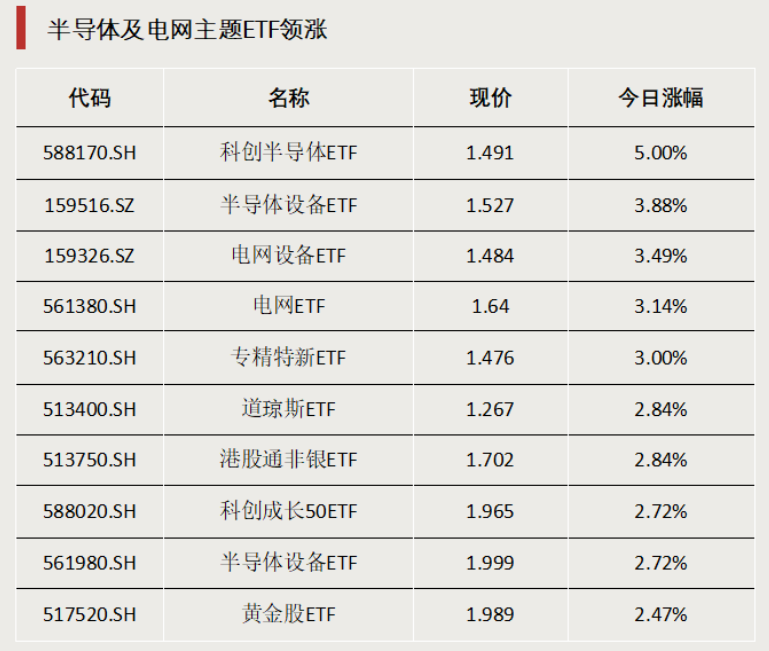
Group 1 - A-shares market rebounded on December 12, with semiconductor and power grid sectors showing strong performance, leading to significant gains in related ETFs [1][10][13] - The Hong Kong stock market exhibited even stronger performance, with technology, securities, and consumer sectors collectively rising, driving up related ETFs [3][11] - The technology sector in A-shares has been on an upward trend this week, with substantial capital inflow into technology-related ETFs, including the Sci-Tech Bond and Sci-Tech 50 ETFs [12][6] Group 2 - Several ETFs related to the semiconductor and power grid sectors recorded notable gains, with the Sci-Tech Semiconductor ETF rising by 5.00% and the Power Grid Equipment ETF increasing by 3.49% [2][14] - The Hong Kong market saw the Hang Seng Index rise by 1.75%, marking its largest single-day gain in over half a month, driven by positive news from the Federal Reserve [3][11] - Bond ETFs also saw active trading, with the Short-term Bond ETF and Yinhua Daily Yield ETF each exceeding 100 billion yuan in trading volume [5][16] Group 3 - The Huatai-PB CSI 500 ETF attracted over 20 billion yuan in net inflow this week, ranking first in the market, while other CSI 500 ETFs also saw significant inflows [17][18] - The satellite and aerospace sectors have been active, with related ETFs performing well, driven by the scarcity of frequency orbit resources and the commercial potential of AI in satellite technology [19][8] - The Hong Kong high-dividend assets have regained strength following the Federal Reserve's interest rate cut, with the Hong Kong Stock Connect High Dividend Select Index showing a 12-month dividend yield of 5.56% [20][9]

资金“抄底”了,大举净流入
Zhong Guo Zheng Quan Bao· 2025-11-24 12:12
Group 1: ETF Performance - Aerospace and satellite-themed ETFs showed strong gains, with multiple products rising over 4% on November 24 [4] - The Satellite ETF (563230) surged by 3.79%, with its share increasing nearly 50% since the end of September, making it the top performer among similar ETFs [4] - The technology-focused Nasdaq ETF (159509) experienced a significant premium of 19.23% after resuming trading following a one-hour suspension [3][10] Group 2: Market Trends - The market saw a significant adjustment last week, but there was a "bottom-fishing" trend with substantial net inflows into several broad-based ETFs [2][7] - The lithium carbonate futures contract hit a limit down, negatively impacting market expectations for related companies, leading to a decline in rare metals and energy-related ETFs [5] - Despite recent adjustments, the long-term development logic of the new energy sector remains solid, supported by policy, market demand, and performance recovery [5] Group 3: Fund Flows - Notable net inflows were recorded for several broad-based ETFs, including the CSI 500 ETF, which saw a net inflow of 57.78 billion [9] - The Hang Seng Technology and CSI 50 ETFs also ranked high in net inflows for November, indicating investor interest in these sectors [9] - Active trading was observed in various currency and bond ETFs, with the Silver Day ETF (511880) achieving a transaction volume exceeding 20 billion [7][8]
资金“抄底”了!大举净流入
Zhong Guo Zheng Quan Bao· 2025-11-24 11:59
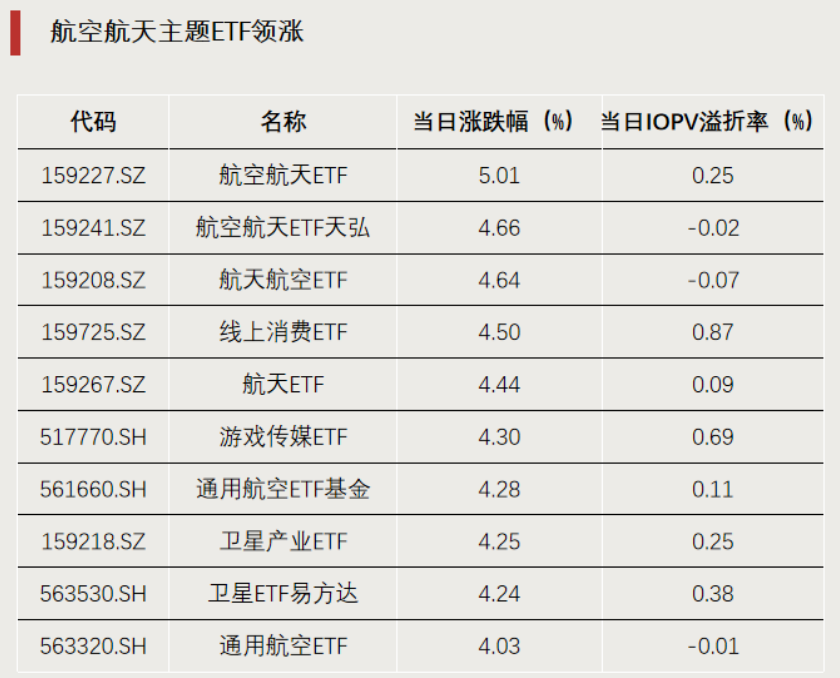
Group 1: Market Performance - On November 24, aerospace and satellite-themed ETFs showed strong gains, while rare metal ETFs collectively declined [1][4] - The market experienced significant adjustments last week, but there was a "bottom-fishing" trend with substantial net inflows into several broad-based ETFs [2][10] - The NASDAQ Technology ETF (159509) was suspended for one hour on November 24 due to a significant premium, resuming trading with a premium rate of 19.23% at market close [3][12] Group 2: ETF Highlights - Aerospace-themed ETFs led the market with multiple products rising over 4%, including the Satellite ETF (563230), which surged by 3.79% and saw a nearly 50% increase in shares since September [4][5] - The Satellite ETF tracks the China Satellite Industry Index, including companies involved in satellite launch, navigation, and internet services [4] - The top-performing ETFs on November 24 included Aerospace ETF (159227) with a gain of 5.01%, and several others with gains ranging from 4.03% to 4.66% [6] Group 3: Rare Metals and Energy ETFs - Rare metal ETFs experienced significant declines, with the Sci-Tech Composite Index ETF (589580) leading the drop at -2.14% [7][8] - The decline in rare metals was attributed to a drop in lithium carbonate futures, which negatively impacted market expectations for related companies [7] Group 4: Fund Flows and Investment Trends - There was active trading in currency and bond ETFs, with the Silver River Daily ETF (511880) exceeding 20 billion yuan in trading volume [9][10] - Despite market adjustments, there was a notable net inflow into broad-based ETFs such as the CSI 500 and ChiNext ETFs, indicating investor confidence [11] - The CSI 500 ETF saw a net inflow of 5.778 billion yuan last week, while the Hang Seng Technology ETF also reported significant inflows [11] Group 5: Premium Risks in Cross-Border ETFs - Several cross-border ETFs have been issuing warnings about high premium rates, with the NASDAQ Technology ETF (159509) and NASDAQ 100 ETF (159660) showing premiums exceeding 10% [12][14] - On November 24, multiple cross-border ETFs, including those tracking the Nikkei 225 and S&P 500, issued midday announcements regarding premium risks, advising investors to be cautious [14][15]
光模块下一步看什么?——交付
2025-09-15 14:57
Summary of Conference Call on Optical Module Industry Industry Overview - The optical module industry is expected to benefit significantly from the advent of the optical CPU era, which will lead to a substantial increase in the number of board-level connection interfaces, thereby improving supply and demand dynamics in the industry [1][2] - The optical communication market is projected to expand significantly in the coming years, potentially reaching a market capacity of several hundred billion yuan, driven by new technologies such as Ruby, Ultra, and FIMAN [1][8] Key Companies - Leading companies like Yizhongtian are well-positioned to capitalize on ecosystem development and demand growth, solidifying their market position [1][2] - Yizhongtian and other top manufacturers possess strong delivery capabilities and are expected to continue to perform well in their quarterly reports [1][5] - These companies are becoming crucial players in the global optical communication supply chain, with their market share steadily increasing due to supply-demand tightness [1][10] Competitive Advantages - Yizhongtian and other leading firms have significant competitive advantages, including superior data transmission capabilities, strong delivery capacity, and effective supply chain management [1][4] - The self-developed silicon photonic chips are anticipated to enhance profit margins for leading manufacturers by reducing costs and improving product performance [1][6] Technological Developments - The Ruby architecture update is expected to expand the scale-up space in the optical communication industry, increasing card quantities and accelerating iteration speed [1][7] - Recent technological advancements showcased at the Optical Expo, including optical switching and silicon photonics, indicate a positive trend in the industry, with improved yield rates [1][11] Market Dynamics - The demand for 800G and 1.6T products is optimistic for 2026, with delivery capability becoming a critical factor for manufacturers [1][17] - Companies with strong material support and production capacity, especially those with overseas capabilities, are likely to gain market share [1][17] Emerging Trends - The concept of space computing is gaining traction, utilizing inter-satellite and ground communication to address energy supply and heat dissipation issues on Earth [1][18][19] - Companies like StarCloud are planning to launch satellites equipped with NVIDIA H100 chips by 2025, indicating a growing interest in space-based computing solutions [1][23] Conclusion - The optical module industry is on the brink of significant growth, driven by technological advancements and increasing demand for high-capacity data transmission solutions. Leading companies are well-positioned to leverage these trends, while emerging concepts like space computing present new opportunities for innovation and expansion [1][25]