
逆周期和跨周期调节

Search documents
资讯早间报-20260401
Guan Tong Qi Huo· 2026-04-01 02:13
Report Industry Investment Rating - Not provided in the report. Core Viewpoints of the Report - The report comprehensively presents the overnight market trends of global futures, important macro and industry - related news, and the performance of financial markets at home and abroad. It also provides information on upcoming economic data releases and events, helping investors understand the current market situation and possible future trends. Summary by Relevant Catalogs Overnight Night - Market Trends - International precious metal futures generally rose, with COMEX gold futures up 3.12% at $4699.60 per ounce and COMEX silver futures up 6.77% at $75.34 per ounce [4][45]. - U.S. oil and Brent oil futures fell. U.S. oil's main contract dropped 1.28% to $101.56 per barrel, and Brent oil's main contract fell 3.86% to $103.25 per barrel. The significant increase in U.S. API crude inventories last week led to concerns about oversupply [4][45]. - Most London base metals rose, with LME copper up 1.30% at $12382.5 per ton, LME aluminum up 1.03% at $3436.0 per ton, etc., while LME lead and nickel declined slightly [4][46]. - Domestic futures contracts showed mixed results. Low - sulfur fuel oil and BR rubber rose over 2%, and some commodities like rubber and palm oil rose over 1%. Meanwhile, coking coal dropped over 2%, and glass, fuel oil, and soda ash fell over 1% [4]. Important News Macroeconomic News - The People's Bank of China's Monetary Policy Committee emphasized implementing a moderately loose monetary policy and coordinating the relationship between total supply and demand [7]. - China's manufacturing PMI in March was 50.4%, up 1.4 percentage points from the previous month, returning to the expansion range [7]. - Tensions in the Iran - related situation continued, with statements from multiple parties regarding the war and the Strait of Hormuz issue [8][10]. Energy and Chemical Futures - The production lines of Tianjin Taibo Float Glass and Jiangxi Ganyue Photovoltaic were shut down. South Africa will cut fuel taxes to offset the impact of rising oil prices. OPEC's oil production in March dropped to the lowest level since June 2020 [12]. Metal Futures - Silver production in some regions in March increased by about 4.22% compared to February. A large - scale alumina plant in Shandong raised the purchase price of ion - membrane caustic soda. CSPT did not set a reference price for spot copper concentrate processing fees in the second quarter [15]. Black - Series Futures - Inner Mongolia Baite Metallurgical and Building Materials Co., Ltd. reduced the production of a silicon - manganese alloy furnace, affecting the daily output by 300 tons. The floating value of coking coal long - term contracts in March decreased by 24 yuan/ton compared to February [18][19]. Agricultural Product Futures - Malaysia's palm oil exports in March increased significantly. Some soybean - processing plants in Northeast China shut down due to shortages. The开机率 of some oil mills decreased slightly, and it is expected that the soybean meal inventory will decline slightly by the end of the month [23][24]. Financial Markets Financial - A - shares fluctuated downward, with the Shanghai Composite Index down 0.8%, the Shenzhen Component Index down 1.81%, and the ChiNext Index down 2.7%. The Hong Kong Hang Seng Index rose 0.15% [30][32]. - The public - offering fund market is implementing new regulations on performance comparison benchmarks. Many companies' IPO applications were suspended for financial data updates. Zhongke Yuhang's application for a science - and - technology innovation board IPO was accepted, and Galaxy Aerospace started A - share listing counseling [32][33]. Industry - During the Tomb - sweeping Festival in 2026, 7 - seat and below small passenger cars on highways will be exempt from tolls. The nine - department jointly issued a plan to promote the innovation and development of the Internet of Things industry. The Ministry of Industry and Information Technology will formulate the "15th Five - Year" new - battery development plan [34][36]. Overseas - The Iran - related war may cause significant losses to the GDP of Arab countries, and some countries' GDP may shrink. The U.S. may make decisions on NATO's future after the end of the military operation against Iran [37]. - The U.S., Israel, and Iran continued military actions and exchanges of warnings. The Kansas Fed President warned about the inflation impact of rising energy prices due to the Iran conflict [39][40]. International Stock Markets - U.S. stocks rose across the board, with the Dow up 2.49%, the S&P 500 up 2.91%, and the Nasdaq up 3.83%. European stocks also rose, while most Asian - Pacific stocks fell [43][44]. Commodities - International precious metal futures rose, while oil futures fell. The average price of gasoline in the U.S. reached a nearly 4 - year high, and most London base metals rose [45][46]. Bonds - The inter - bank bond market in China was mainly in shock, with most major interest - rate bond yields rising slightly. The U.S. Treasury bond yields showed a mixed trend [47][48]. Foreign Exchange - The on - shore RMB against the U.S. dollar rose. The Japanese government warned about the yen's decline, and the South Korean won against the U.S. dollar approached a 17 - year low [50]. Upcoming Economic Data and Events - A series of economic data from various countries will be released, including Japan's first - quarter short - term large non - manufacturing sentiment index, South Korea's March trade balance preliminary value, etc. [53] - There are also important events such as the European Central Bank's executive's speech on the digital euro and the release of the Bank of Canada's monetary policy meeting minutes [55].
人民银行:促进经济稳定增长和物价合理回升
Bei Jing Shang Bao· 2026-03-31 16:06
Core Viewpoint - The People's Bank of China (PBOC) continues to implement a moderately accommodative monetary policy while emphasizing the need to regulate credit market operations and reduce financing intermediary costs [1][2][3] Group 1: Monetary Policy Adjustments - The PBOC's monetary policy committee meeting highlighted the need for increased counter-cyclical and cross-cyclical adjustments to better utilize monetary policy tools for stable economic growth and reasonable price recovery [2] - The meeting reiterated the importance of maintaining ample liquidity and aligning social financing scale and money supply growth with economic growth and price level expectations [2] Group 2: Financing Costs and Market Behavior - A new focus on "regulating credit market operations and reducing financing intermediary costs" was introduced, indicating a shift towards lowering additional costs associated with financing beyond principal and interest [3] - The meeting emphasized the role of large banks in supporting the real economy and encouraged small and medium-sized banks to focus on their core responsibilities while enhancing capital strength [3] Group 3: Exchange Rate and Financial Stability - The PBOC aims to enhance the resilience of the foreign exchange market and stabilize market expectations, maintaining the RMB exchange rate at a reasonable and balanced level [3] - The meeting underscored the importance of maintaining financial market stability and advancing high-level financial openness while improving economic and financial management capabilities under open conditions [3]

中信证券首席经济学家明明:商品的输入性通胀对我国物价管理构成一定挑战
Xin Lang Cai Jing· 2026-03-31 13:59
Core Viewpoint - The People's Bank of China (PBOC) emphasizes the need to promote stable economic growth and reasonable price recovery while addressing potential external risks from geopolitical tensions and trade conflicts [1] Group 1: Economic Outlook - The first quarter of 2026 has seen heightened geopolitical tensions, particularly between the U.S. and Iran, leading to concerns about external demand impacting China's economy [1] - Input inflation from commodities like crude oil poses challenges for China's price management [1] Group 2: Monetary Policy - Current monetary policy in China still has room for maneuver, with a focus on creating a conducive social financing environment to support stable economic growth [1] - Flexibility in monetary policy is deemed necessary due to uncertainties in the economic environment [1] Group 3: Policy Framework - The "14th Five-Year Plan" period aims to establish a scientifically sound and robust monetary policy system, balancing short-term and long-term goals, growth support, and risk prevention [1] - Emphasis on strengthening counter-cyclical and cross-cyclical adjustments to avoid excessive monetary policy tightening or loosening, ensuring stable macroeconomic operations [1]

国家统计局公布最新经济数据
21世纪经济报道· 2026-03-16 02:19
Core Viewpoint - The article highlights a positive start for China's economy in the first two months of 2026, with significant recovery in key economic indicators due to proactive macroeconomic policies and increased domestic demand [1] Economic Performance - In January-February, industrial production accelerated, with the added value of industrial enterprises above designated size growing by 6.3% year-on-year, an increase of 1.1 percentage points compared to December of the previous year [1] - The equipment manufacturing sector saw a year-on-year increase of 9.3%, while high-tech manufacturing increased by 13.1%, outperforming the overall industrial growth by 3.0 and 6.8 percentage points respectively [1] Service Sector Growth - The service sector experienced rapid growth, with the national service production index increasing by 5.2% year-on-year, which is a 0.2 percentage point acceleration from December of the previous year [1] Consumer Market - Market sales showed a rebound, with total retail sales of consumer goods reaching 86,079 billion yuan, a year-on-year increase of 2.8%, which is a 1.9 percentage point acceleration from December [1] - Service retail sales grew by 5.6% year-on-year, slightly up by 0.1 percentage points compared to the entire previous year [1]


刚刚,重要经济数据公布
第一财经· 2026-03-16 02:17
Core Viewpoint - The article highlights a positive economic outlook for early 2026, driven by strong industrial production, service sector growth, and increased consumer spending, despite ongoing external challenges and domestic economic transitions [3][12]. Group 1: Industrial Production - In January-February, the industrial added value for large-scale enterprises increased by 6.3% year-on-year, accelerating by 1.1 percentage points compared to December [4]. - The equipment manufacturing sector saw a 9.3% increase, while high-tech manufacturing grew by 13.1%, outperforming the overall industrial growth by 3.0 and 6.8 percentage points respectively [4]. - The production of 3D printing equipment, lithium-ion batteries, and industrial robots surged by 54.1%, 42.6%, and 31.1% year-on-year [4]. Group 2: Service Sector Growth - The service sector production index rose by 5.2% year-on-year, with notable growth in information transmission, software, and IT services at 10.1% [5]. - The business activity index for the service sector was at 49.7%, indicating a slight improvement from the previous month, while the business activity expectation index reached 55.8% [5]. Group 3: Market Sales - The total retail sales of consumer goods reached 86,079 billion yuan, growing by 2.8% year-on-year, with urban retail sales at 74,449 billion yuan and rural retail sales at 11,630 billion yuan [6]. - Online retail sales amounted to 32,546 billion yuan, marking a 9.2% increase, with online goods retail at 20,812 billion yuan, growing by 10.3% [6]. Group 4: Fixed Asset Investment - Fixed asset investment (excluding rural households) was 52,721 billion yuan, up by 1.8% year-on-year, reversing a decline of 3.8% from the previous year [7]. - Infrastructure investment grew by 11.4%, while real estate development investment fell by 11.1% [7]. Group 5: Trade and Employment - The total value of goods imports and exports reached 77,321 billion yuan, increasing by 18.3% year-on-year, with exports at 46,178 billion yuan and imports at 31,143 billion yuan [8]. - The urban surveyed unemployment rate averaged 5.3%, remaining stable compared to the previous year, with a slight increase of 0.1 percentage points from the previous month [9]. Group 6: Price Trends - The Consumer Price Index (CPI) rose by 0.8% year-on-year, with food and beverage prices increasing by 0.6% [11]. - The Producer Price Index (PPI) for industrial producers decreased by 1.2% year-on-year, indicating a narrowing decline [11].

最新经济数据出炉!起步有力、开局良好
清华金融评论· 2026-03-16 02:16
Economic Overview - In the first two months, under the strong leadership of the Central Committee, the economy showed a strong start with stable employment and prices, and a growth in new productive forces [3] Industrial Production - The industrial added value for large-scale enterprises increased by 6.3% year-on-year, accelerating by 1.1 percentage points compared to December of the previous year [4] - The equipment manufacturing industry saw a 9.3% increase, while high-tech manufacturing grew by 13.1%, outperforming the overall industrial growth by 3.0 and 6.8 percentage points respectively [4] - The manufacturing purchasing managers' index was at 49.0, indicating a slight contraction, while the business activity expectation index rose to 53.2 [4] Service Sector Growth - The service production index increased by 5.2% year-on-year, with significant growth in information transmission, software, and IT services at 10.1% [6] - The business activity index for the service sector was at 49.7, with a business activity expectation index of 55.8, indicating positive sentiment [6] Retail Sales - The total retail sales of consumer goods reached 86,079 billion yuan, growing by 2.8% year-on-year, with urban retail sales at 74,449 billion yuan and rural retail sales at 11,630 billion yuan [8] - Online retail sales of goods and services reached 32,546 billion yuan, with online goods retailing at 20,812 billion yuan, accounting for 24.2% of total retail sales [8] Fixed Asset Investment - Fixed asset investment (excluding rural households) was 52,721 billion yuan, with a year-on-year growth of 1.8%, reversing from a decline of 3.8% in the previous year [10] - Infrastructure investment grew by 11.4%, while real estate development investment fell by 11.1% [10] Trade Performance - The total import and export value reached 77,321 billion yuan, with a year-on-year growth of 18.3%, including exports of 46,178 billion yuan and imports of 31,143 billion yuan [12] - Private enterprises' imports and exports increased by 22.8%, with mechanical and electrical product exports growing by 24.3% [12] Employment Situation - The urban survey unemployment rate averaged 5.3%, remaining stable compared to the previous year, with a slight increase of 0.1 percentage points in February [13] - The average weekly working hours for employees were 48.1 hours [13] Price Trends - The Consumer Price Index (CPI) rose by 0.8% year-on-year, with food and beverage prices increasing by 0.6% [14] - The Producer Price Index (PPI) for industrial producers decreased by 1.2% year-on-year, indicating a narrowing decline [14] Conclusion - Overall, major economic indicators showed a significant rebound in the first two months, indicating a good start for the national economy, although challenges remain due to external environment changes and geopolitical risks [17]

央行,重磅会议!
证券时报· 2026-03-12 12:27
Core Viewpoint - The People's Bank of China (PBOC) is committed to implementing a moderately accommodative monetary policy, enhancing counter-cyclical and cross-cyclical adjustments to support the real economy and ensure stable financial market development [1][3]. Group 1: Monetary Policy Implementation - The PBOC held a meeting on March 12, 2023, to analyze the current economic and financial situation, focusing on monetary policy support for the real economy and the reform of the monetary policy framework [1][3]. - Experts at the meeting emphasized the importance of achieving the main goals for economic and social development by 2025, highlighting the positive momentum in economic operations since the beginning of the year [3]. - The PBOC has made several adjustments to structural monetary policy tools, which have effectively boosted market confidence and stabilized social expectations [3]. Group 2: Future Directions - The PBOC plans to fully implement the spirit of the 20th National Congress of the Communist Party of China and the Central Economic Work Conference, aiming to create a conducive monetary and financial environment for sustained economic improvement [3]. - The focus will be on constructing a scientific and robust monetary policy system while continuing to apply a moderately accommodative monetary policy [3].
2026年政府工作报告学习体会:开局起步留空间强化创新重实效
Zhongyuan Securities· 2026-03-11 07:36
Economic Growth and Inflation Targets - The 2026 government work report sets the GDP growth target at an elastic range of 4.5%-5%, down from the previous "around 5%" target, indicating a focus on sustainable growth and reform[12] - The consumer price index (CPI) target is maintained at around 2%, contrasting with the 2025 CPI growth of 0%[12] Macro Policy Orientation - The macroeconomic policy emphasizes increased counter-cyclical and cross-cyclical adjustments, integrating existing and new policies for enhanced effectiveness[13] - Fiscal policy remains proactive, with a deficit rate set at around 4% and a budget expenditure of 30 trillion yuan, an increase of approximately 1.27 trillion yuan from the previous year[15] Key Tasks and Reforms - The report outlines ten key tasks, prioritizing domestic demand, innovation, and reform across various sectors, including rural revitalization and green transformation[24] - Specific measures include a focus on expanding domestic demand and enhancing new growth drivers, with a budget of 755 billion yuan for central investments and 8 trillion yuan in special bonds for major projects[26] Risk Management - The report expands risk management to include safety capacity building, shifting from reactive to proactive governance, particularly in real estate and local government debt management[35] - Emphasis is placed on stabilizing the real estate market through inventory reduction and supply optimization strategies[37] Capital Market Development - Continuous deepening of capital market reforms is highlighted, with a focus on improving long-term funding mechanisms and investor protection[33] - The government aims to enhance the role of capital markets in supporting industrial transformation and high-quality development, with specific measures to support innovative enterprises[33]

提质增效,2026年政策支持的重要着力点
Xin Lang Cai Jing· 2026-02-25 04:34
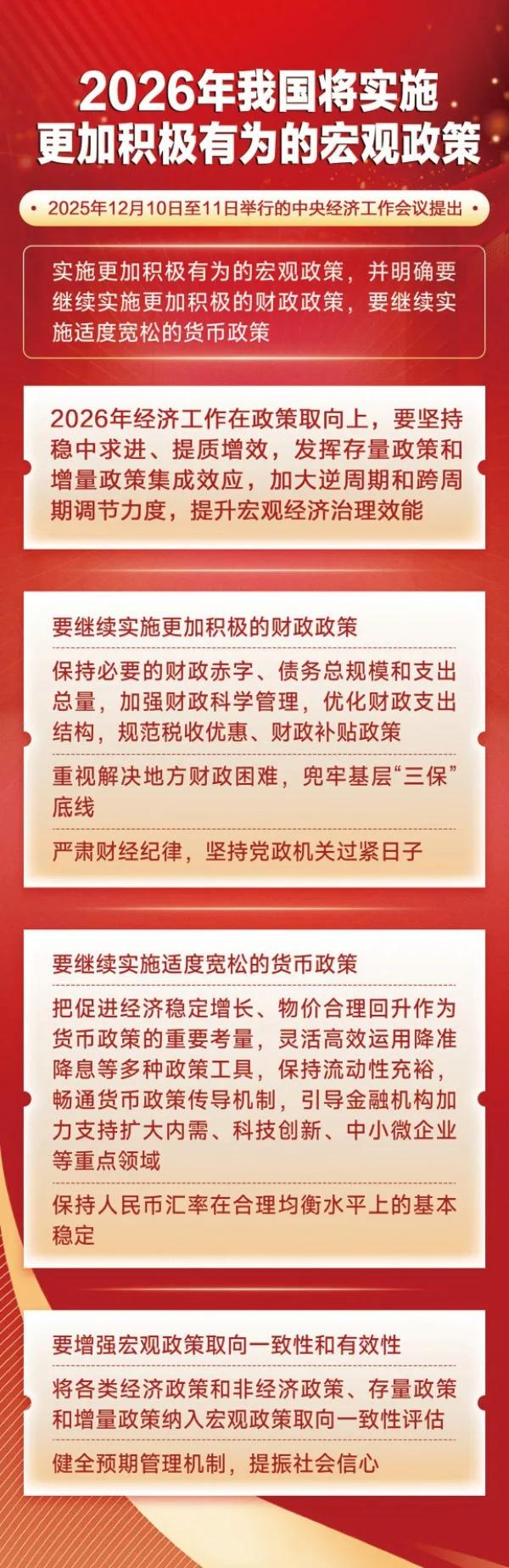
Group 1 - The core viewpoint emphasizes the importance of effective macroeconomic policies as a solid support for stable economic operation, particularly during the "14th Five-Year Plan" period, focusing on addressing prominent issues that restrict high-quality economic development [1] - The Central Economic Work Conference scheduled for December 10-11, 2025, proposed the implementation of more proactive macroeconomic policies, including a continuation of active fiscal policies and moderately loose monetary policies [4] - In 2026, which marks the beginning of the "15th Five-Year Plan," it is crucial to start strong and maintain momentum through more proactive macroeconomic policies, enhancing the effectiveness of both existing and new policies while increasing counter-cyclical and cross-cyclical adjustments [5] Group 2 - A significant focus for policy support in 2026 is "quality improvement and efficiency enhancement," although challenges such as changes in objective circumstances and discrepancies in policy understanding may lead to deviations in policy implementation [5] - Since 2022, the State Council has mandated that all documents related to macroeconomic stability and market expectations must undergo a consistency assessment by the National Development and Reform Commission, aiming to enhance the consistency and compatibility of various economic policies [6] - The macroeconomic policy consistency assessment mechanism should be utilized effectively to ensure that all economic and non-economic policies align with macroeconomic objectives, thereby stabilizing market expectations and boosting social confidence [6]
LPR连续9个月保持不变 年内仍有下行空间
Zheng Quan Ri Bao· 2026-02-24 15:41
Group 1 - The latest Loan Prime Rate (LPR) remains unchanged at 3.0% for the 1-year term and 3.5% for the 5-year term, consistent with market expectations [1] - The stability of policy rates since February indicates that the pricing basis for LPR has not changed, suggesting a lack of motivation among banks to lower LPR quotes [1][2] - The current low interest rate environment reduces the urgency for LPR to decrease, as maintaining the LPR helps stabilize banks' net interest margins [2] Group 2 - The People's Bank of China has implemented a series of structural monetary policies to support key sectors, indicating that monetary policy is currently in an observation phase, likely keeping LPR stable [2] - There is potential for a reduction in LPR by 5 to 10 basis points this year, as banks' funding costs are expected to decrease due to lower deposit rates and the central bank's policy adjustments [3] - A comprehensive policy rate cut may occur in the second quarter, which could lead to a subsequent reduction in LPR, benefiting both corporate and household loan rates [3]