AI芯片自主化

Search documents
至少有九家中国AI芯片公司出货量超万卡
3 6 Ke· 2026-01-28 01:46
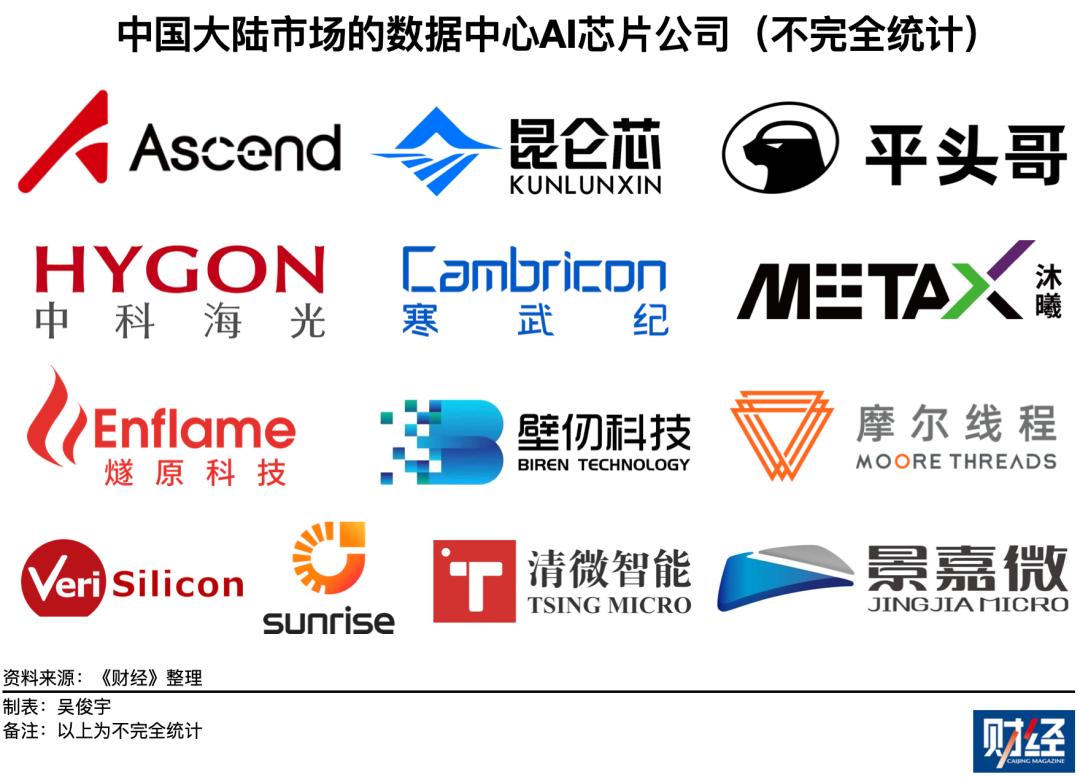
Core Insights - The self-sufficiency process of domestic AI chips in data centers is accelerating due to strict chip export controls, with over ten brands including Huawei Ascend, Baidu Kunlun, and Alibaba PingTouGe emerging in the market [1] - At least nine Chinese AI chip companies have reported shipment or order volumes exceeding 10,000 units, indicating a growing market acceptance of domestic AI chips [1][2] - The average price of domestic inference AI chips ranges from 30,000 to 200,000 yuan per unit, reflecting their performance, stability, and total cost of ownership [1] Group 1: Market Dynamics - The Chinese AI chip server market is projected to reach $16 billion in the first half of 2025, with domestic AI chips capturing approximately 35% market share, significantly growing faster than Nvidia [2] - The emergence of companies with 10,000-unit shipments marks the beginning of a "scale delivery verification" phase in the industry [2][15] - Major players like Huawei Ascend and Baidu Kunlun are leading in market share, with Huawei Ascend being used in various domestic clusters [5] Group 2: Company Performance - Companies like Mozi, Tianshu Zhixin, and Suiruan Technology have reported cumulative shipments exceeding 10,000 units, with Mozi achieving over 25,000 units by August 2025 [8] - Sunrise and Qingwei Intelligent, still in startup phases, have also surpassed the 10,000-unit mark, although they lag behind leading companies in terms of volume [10] - The performance of some domestic AI chips has reportedly reached or exceeded that of Nvidia's H20, particularly in inference scenarios [14] Group 3: Competitive Landscape - Domestic AI chip companies are focusing on usability and controllability rather than peak performance, often utilizing more mature manufacturing processes like 12nm due to limited advanced process capacity [11] - The push to lower inference costs is a common goal among industry players, with some companies aiming to reduce the cost of generating one million tokens to one cent [13] - The software ecosystem remains a challenge, with many domestic chips facing difficulties in model adaptation compared to Nvidia's offerings [15] Group 4: Future Outlook - The domestic AI inference chip market is expected to experience explosive growth between 2026 and 2027, with multiple new products anticipated [11] - The competitive landscape is likened to the early stages of the photovoltaic industry, with rapid growth driven by policy support and market dynamics [16] - However, the unique nature of AI chip development, influenced by software, hardware, and ecosystem factors, suggests that competition will differ fundamentally from that of standardized manufacturing products like solar panels [16]


AI芯片板块强势拉升,科创板50ETF(588080)、科创人工智能ETF(588730)标的指数涨超2%
Mei Ri Jing Ji Xin Wen· 2025-12-17 06:55
Core Insights - The A-share semiconductor industry chain is leading the market, with significant gains in AI chips, liquid-cooled servers, and communication equipment sectors, as evidenced by a 2.4% increase in the STAR 50 Index and a 2.1% rise in the STAR AI Index as of 14:20 [1] - Recent inflows into related ETFs have been notable, with the STAR 50 ETF (588080) attracting over 1.3 billion yuan in the last five trading days [1] - According to Xinda Securities, the overall high-end AI chip market in China is expected to grow by over 60% by 2026, with domestic AI chips moving towards self-sufficiency, and promising chip design firms potentially increasing their market share to around 50% [1] Industry Composition - The STAR 50 Index consists of 50 stocks from the STAR Market that are large-cap and liquid, with significant representation from "hard technology" leaders; the top three sectors—digital chip design, integrated circuit manufacturing, and semiconductor equipment—account for over 60% of the index [1] - The STAR AI Index focuses on companies within the AI industry chain on the STAR Market, balancing foundational chips and AI applications; the leading sectors—digital chip design, horizontal general software, and IT services—make up over 80% of the index [1] Investment Opportunities - The STAR 50 ETF (588080) and STAR AI ETF (588730) track the aforementioned indices, providing investors with opportunities to capitalize on the self-sufficiency development of AI chips [1]
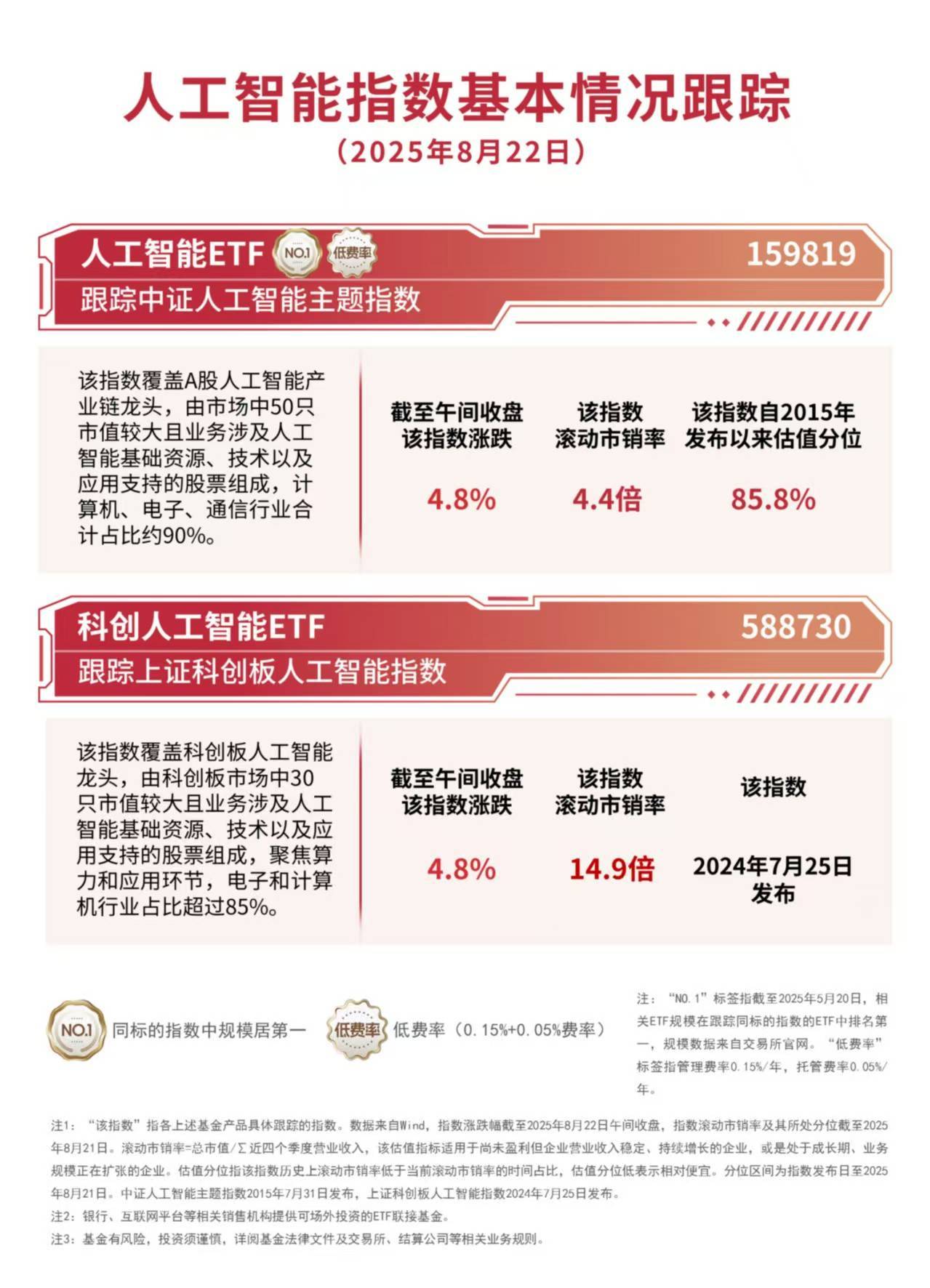
科创人工智能ETF(588730)标的指数大涨近5%,机构称AI芯片自主化逻辑不变
Sou Hu Cai Jing· 2025-08-22 05:06
Group 1 - The core viewpoint of the news highlights a significant increase in AI-related indices, with the China Securities Artificial Intelligence Theme Index and the Shanghai Stock Exchange Sci-Tech Innovation Board AI Index both rising by 4.8% [1] - The AI ETF (159819) saw a net subscription of 28 million shares in the morning session, marking a continuous inflow of funds for five consecutive days, totaling nearly 1 billion yuan [1] - Shanghai Securities emphasizes that the logic of AI chip localization remains unchanged, with the domestic ecosystem continuously improving [1] Group 2 - The advancement of independent manufacturing processes is expected to open up market space for domestic chips, enhancing competitiveness in the AI chip sector [1] - Leading companies are continuously improving the domestic AI chip ecosystem, further boosting market competitiveness [1]
每周观察 | 2024年全球前十大封测厂营收排名;2024年SiC衬底营收年减9%;云端巨头自研ASIC进程…
TrendForce集邦· 2025-05-16 04:08
Group 1: SiC Substrate Market - The global N-type SiC substrate market is projected to experience a revenue decline of 9% in 2024, amounting to $1.04 billion, due to weakened demand in the automotive and industrial sectors, alongside intensified market competition and significant price drops [1] Group 2: Semiconductor Packaging and Testing Market - The combined revenue of the top ten semiconductor packaging and testing companies is expected to reach $41.56 billion in 2024, reflecting a year-on-year growth of 3% [4] - ASE Holdings and Amkor maintain their leading positions, while companies like JCET and Tianshui Huatian are experiencing double-digit growth, posing strong challenges to the existing market structure [4][5] Group 3: AI Chip Development - The demand for AI servers is accelerating the self-research of ASIC chips among major North American cloud service providers, with new versions expected to be released every 1-2 years [6] - The proportion of AI chips sourced from foreign suppliers like NVIDIA and AMD in the Chinese market is anticipated to decrease from approximately 63% in 2024 to about 42% in 2025, while local suppliers are expected to increase their share to 40% under government policy support [6]

研报 | AI芯片自主化进程加速,云端巨头竞相自研ASIC
TrendForce集邦· 2025-05-15 07:15
Core Insights - The article discusses the accelerating trend of AI server demand driving major North American Cloud Service Providers (CSPs) to develop their own Application-Specific Integrated Circuits (ASICs) to reduce reliance on external suppliers like NVIDIA and AMD [1][2][3][4][5]. Group 1: North American CSP Developments - Google has launched the TPU v6 Trillium, focusing on energy efficiency and optimization for large AI models, with plans to significantly replace the TPU v5 by 2025 [2]. - AWS is collaborating with Marvell on the Trainium v2, which supports generative AI and large language model training, and is expected to see substantial growth in ASIC shipments by 2025 [2]. - Meta is developing the next-generation MTIA v2 in partnership with Broadcom, emphasizing energy efficiency and low-latency architecture for AI inference workloads [3]. - Microsoft is accelerating its ASIC development with the Maia series chips, optimizing for Azure cloud services, and is collaborating with Marvell for the Maia v2 design [3]. Group 2: Chinese AI Supply Chain Autonomy - Huawei is actively developing the Ascend chip series for domestic markets, targeting applications in LLM training and smart city infrastructure, which may challenge NVIDIA's market position in China [4]. - Cambricon's MLU AI chip series is aimed at cloud service providers for AI training and inference, with plans to advance its solutions to the cloud AI market by 2025 [4]. - Chinese CSPs like Alibaba, Baidu, and Tencent are rapidly developing their own AI ASICs, with Alibaba's T-head launching the Hanguang 800 AI inference chip and Baidu working on the Kunlun III chip [5].