AI蛋白设计

Search documents
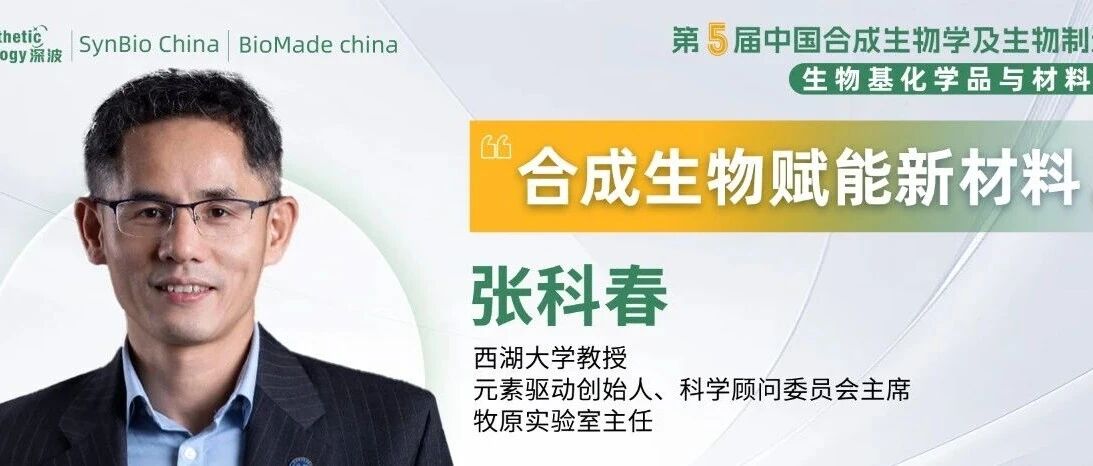
西湖大学教授、元素驱动创始人张科春老师担任联合发起人,并发表主题演讲:《合成生物赋能新材料》
synbio新材料· 2026-03-06 06:26
Group 1 - The "SynBio China Fifth China Synthetic Biology and Biomanufacturing Conference" will be held in Hangzhou on March 31 to April 1, 2026, featuring a special session on bio-based chemicals and materials [2][8] - Professor Zhang Kechun from Westlake University will be a co-initiator of the bio-based chemicals and materials session and will deliver a keynote speech titled "Synthetic Biology Empowering New Materials" [2][11] - Zhang Kechun has over 20 years of research experience in synthetic biology and has developed the first scalable production of elastic biodegradable polymer materials [3][5] Group 2 - Element Driven is a key incubation project of Westlake University's new productivity cultivation platform, recognized as a national high-tech enterprise [5] - The company has established the MiNT-X Platform, which integrates AI and biomanufacturing to develop efficient green biosynthesis of amino acids and new ecological materials [5] - Element Driven is collaborating with major companies like Muyuan Group and Vipshop to set up two large-scale production factories [5] Group 3 - The conference will accommodate around 1,000 participants and is organized by Synbio Deep Wave, with support from various media outlets [8] - The agenda includes multiple specialized sessions focusing on topics such as biomanufacturing technology, functional food, and bio-based chemicals [9][11] - The event will also provide opportunities for exhibitors from the synthetic biology and modern biotechnology sectors to showcase their innovations [18]

官宣!西湖大学教授、元素驱动创始人张科春老师出席!担任「生物基化学品与材料专场」联合发起人!
synbio新材料· 2026-01-30 06:09
Group 1 - The "SynBio China Fifth China Synthetic Biology and Biomanufacturing Conference" will be held in Hangzhou on March 31 to April 1, 2026, with an expected attendance of 1,000 participants [5]. - Zhang Kechun, a professor at Westlake University and founder of Element Driven, will deliver a keynote speech at the "Biobased Chemicals and Materials" session [2][3]. - Element Driven is a key incubation project of Westlake University's new productivity cultivation platform, focusing on AI and biomanufacturing [4]. Group 2 - The conference will feature various sessions, including topics on biomanufacturing industry ecology, functional food and nutrition science, and biobased chemicals and materials [7][10]. - The event will provide opportunities for exhibitors from synthetic biology and modern biotechnology sectors, including project roadshows and sponsorships [12]. - Registration for the conference is free but limited, requiring pre-registration and approval [17].
字节Seed发布PXDesign:蛋白设计效率提升十倍,进入实用新阶段
量子位· 2025-10-01 03:03
Core Insights - The article discusses the advancements in AI protein design, particularly through the introduction of the PXDesign method by ByteDance's Seed team, which significantly enhances the efficiency and success rates of protein design tasks [1][3][10]. Summary by Sections Introduction to PXDesign - PXDesign is a scalable protein design method that allows for the generation of hundreds of high-quality candidate proteins within 24 hours, achieving a generation efficiency approximately 10 times higher than mainstream methods [3][10]. - The method has demonstrated a wet lab success rate of 20%–73% across multiple targets, surpassing the success rates of existing models like DeepMind's AlphaProteo, which ranges from 9% to 33% [3][10]. Background and Significance - Proteins are fundamental to life processes, and recent Nobel Prizes in Chemistry highlight the importance of both protein structure prediction and design [6]. - The challenge lies not only in predicting structures but also in reverse designing proteins based on functional requirements, which is crucial for developing new therapies for diseases like cancer and infections [7][8]. Methodology of PXDesign - PXDesign employs a "generation + filtering" approach, where a large number of candidate designs are generated quickly, followed by a filtering process to identify the most promising candidates [13][21]. - The team explored two main technical routes: Hallucination and Diffusion, with PXDesign-d (Diffusion) showing superior performance in generating high-quality, diverse structures [15][16]. Advantages of PXDesign - PXDesign-d utilizes a DiT network structure, allowing for efficient training on larger datasets, which enhances generation speed and quality compared to other methods [17]. - The filtering process uses structural prediction models to select the most viable candidates, with Protenix outperforming AlphaFold 2 in accuracy and efficiency [25][26]. Tools and Services - The Protenix team has developed the PXDesign Server, a user-friendly web service that allows researchers to design and evaluate binder candidates without needing complex setups [28][29]. - The server offers two modes: Preview for quick debugging and Extended for in-depth research, significantly reducing the design cycle compared to traditional methods [30][32]. Evaluation Standards - To address the lack of unified evaluation standards in the field, the Protenix team introduced PXDesignBench, a comprehensive evaluation toolbox that integrates various assessment metrics and processes [32]. Industry Context - Other tech giants like Microsoft and Apple are also making strides in the biological field, indicating a growing trend of AI applications in biotechnology and pharmaceuticals [33].
Cell:哈佛团队破解百年难题,AI设计出首个可溶性Notch激动剂,实现T细胞高效制造与免疫增效
生物世界· 2025-08-04 04:02
Core Viewpoint - The research presents a breakthrough in T cell therapy by designing the world's first soluble Notch agonist, enabling efficient T cell differentiation in suspension culture and enhancing T cell function and anti-tumor immunity [3][7][8]. Group 1: Research Background - Notch signaling pathway is one of the most evolutionarily conserved pathways, crucial for the development and function of immune cells, particularly T cells [2][10]. - Traditional methods for T cell production rely on complex environments, making large-scale production challenging and costly [7][11]. Group 2: Research Breakthrough - The research team utilized AI protein design tools to create a soluble Notch agonist that activates the Notch signaling pathway in suspension culture, overcoming the mechanical activation challenge [3][8][12]. - The designed C3-DLL4 structure effectively bridges cells, facilitating the formation of immune synapses and activating Notch signaling [13][14]. Group 3: Applications and Advantages - The new method allows for the mass production of T cells in suspension bioreactors, significantly reducing production time and costs compared to traditional methods [16][19]. - In vivo experiments showed that C3-DLL4 enhances T cell function, indicating potential for developing Notch enhancers to improve cancer vaccines and infection prevention [18][19]. Group 4: Future Prospects - The research team is developing an upgraded version, C515H-DLL4, which further improves T cell differentiation efficiency, marking a step towards practical applications [22]. - The AI-designed proteins offer advantages in manufacturing, storage, and clinical administration, potentially transforming CAR-T cell production and vaccine development [23].

世界人工智能大会:分子之心发布10大解决方案 AI蛋白设计迈入“可编程”时代
Huan Qiu Wang· 2025-07-28 02:17
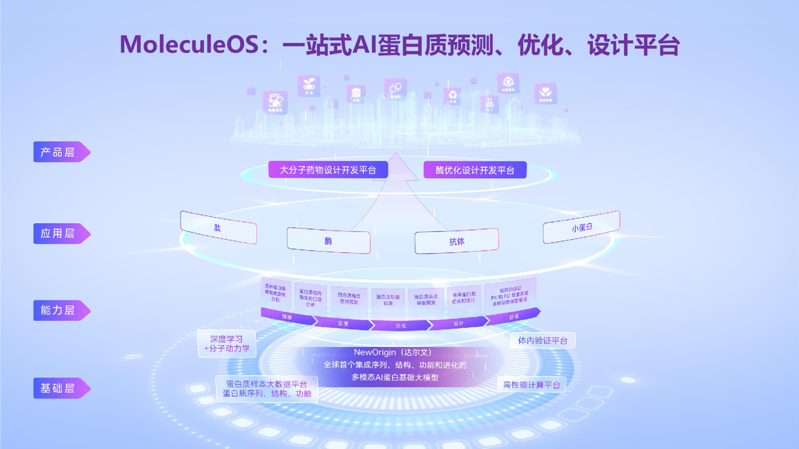
Core Insights - The AI protein design company "MoleculeOS," founded by Xu Jinbo, showcased significant advancements at the WAIC 2025, marking a breakthrough in the AI protein design field [1][3] Group 1: Technology and Innovation - MoleculeOS is an industry-grade AI protein infrastructure platform that integrates the world's first multimodal AI protein foundation model, NewOrigin (Darwin), along with over ten leading AI protein prediction, optimization, and design technologies [1] - The platform demonstrates superior performance, surpassing AlphaFold 3 in complex structure prediction, achieving not only comparable accuracy but also improved physical properties for better antigen-antibody and enzyme-substrate complex predictions [3] - MoleculeOS has significantly enhanced molecular simulation precision and efficiency, achieving a million-fold increase in efficiency, reaching industrial-grade levels [3] Group 2: Industry Applications - The platform has been optimized to meet industry demands, offering automated workflows for drug design, enzyme design, and various other applications, including antibody design and enzyme stability [4] - MoleculeOS has been validated in multiple industrial projects, addressing real-world needs in innovative drug design and synthetic biology, allowing for customized protein design with a single click [4] Group 3: Accessibility and Impact - MoleculeOS features a conversational AI agent, enabling biologists without an AI background to design high-value molecules quickly and accurately, thus lowering the technical barrier [6] - The traditional methods of protein design are time-consuming and have low success rates, but AI integration offers a transformative approach, significantly improving research efficiency and success rates in drug development [6] - MoleculeOS aims to empower biologists by freeing them from tedious laboratory tasks, allowing them to focus on strategic design and judgment, ultimately leading to safer, more effective drugs and lower-cost bioproducts [6]
艾吉科技 Ignite 3.0 平台:在超级内卷小赛道中,如何用“磐石之基”锚定高通量 DNA 合成未来
思宇MedTech· 2025-07-17 06:21
Core Viewpoint - Synthetic biology is poised to reshape the world through innovations such as novel antibody drugs, mRNA vaccines, and DNA data storage, with DNA synthesis as the foundational technology [1] Industry Status: Supply and Demand "Time Lag" - The high-throughput DNA synthesis sector in China is experiencing a "time lag" between supply and demand, with various applications yet to fully materialize [4] Challenges and Opportunities on the Marathon Track - Increased capital influx has led to intense competition focused on capacity and pricing, hindering the establishment of true technological barriers and sustainable business models [5] - The company aims to be a "marathon runner" in the industry, focusing on long-term value creation and resilience through economic cycles [5] Performance Priority and Cost Optimization - The company prioritizes performance as the cornerstone of technological value, ensuring high-quality synthesis before pursuing cost reductions through innovation and process optimization [6] Robust Operational System: Building a Value-Driven Moat - Long-term development is rooted in core value and robust operational capabilities, with a focus on customer value and a resilient operational system [7] - The company controls the entire supply chain from raw materials to delivery, enhancing risk resistance and ensuring stable delivery [7] Supply Side: Industry Outlook Attracting Capital - The high-throughput DNA synthesis market has seen over twelve companies emerge, with intense price competition and rapid cost declines [8] - The market capacity is projected to be between 100-150 million RMB by 2025, with potential demand growth offset by rapid price declines [8] Core Technology Deep Self-Research - The company has developed a high-throughput synthesis platform from scratch, continuously optimizing key processes to ensure quality while optimizing costs [9] Ignite 3.0: Reducing Burden and Accelerating Innovation - The company has launched the Ignite 3.0 platform, designed to address core industry pain points and enhance the development of synthetic biology [10] - Ignite 3.0 integrates high throughput, quality, and short cycles, supporting oligo pools of varying sizes and achieving a low error rate of below 0.2% [11] Performance Data Evidence - The platform can synthesize 680,000 independent points in a single run, with a synthesis length of up to 200nt and a coverage rate exceeding 99.9% [12] - The uniformity of the synthesized products is demonstrated with a 95/5 percentile ratio of 1.82, ensuring equal sampling in downstream screening [14] Future Prospects: Open Experience - Ignite 3.0 is not just a synthesizer but a validated "full-process solution," with high-quality oligo pools already showing strong competitiveness in various fields [19] - The company invites research users to apply for testing the Ignite 3.0 platform, aiming to expand into high-throughput gene construction [19]

途深智合,上线干湿闭环的超智能蛋白设计平台!
合成生物学与绿色生物制造· 2025-06-23 12:35
Core Insights - The article discusses the upgrade of Tushen Zhihuo's protein design platform to ProteinNova, which now features AI-driven full-process protein design capabilities [1][5] - The integration of dry and wet lab processes allows for a closed-loop system in AI protein design, enhancing the efficiency of scientific research and product development [2][5] Group 1: AI-Driven Protein Design - The upgraded platform showcases a complete closed-loop process from AI-generated design to experimental validation, emphasizing the importance of real-world testing in scientific research [2] - The platform's capabilities include task management, data tracking, and feedback integration, enabling users to create personalized iterative tasks for rapid prototype validation [2][5] Group 2: Optimization of Decision-Making - The system's reasoning process has been streamlined to enhance clarity and user experience, allowing users to quickly grasp core insights without being distracted by unnecessary steps [3] - A complete logical chain is maintained for users who wish to delve deeper into the AI's reasoning, ensuring transparency while keeping the process efficient [3] Group 3: Reporting Enhancements - The introduction of structured report templates allows AI to extract key information such as design logic and improvement suggestions, improving report readability and usability [4] - The language of the reports has been optimized to balance scientific rigor with accessibility for researchers [4] Group 4: Future Implications - The launch of the dry-wet iteration system marks a significant advancement in AI's role in scientific research, enabling rapid feedback and self-optimization [5] - The platform aims to support a wider range of disciplines and experimental types, moving towards the realization of "automated science" as a foundational tool for research teams [5] Group 5: Company Background - Tushen Zhihuo focuses on accelerating scientific breakthroughs and product innovation through super-intelligent platforms, significantly reducing the cycle time for new product design [6] - The core team comprises experts from prestigious institutions, bringing extensive experience in AI research and commercialization [6]