AI HPC

Search documents
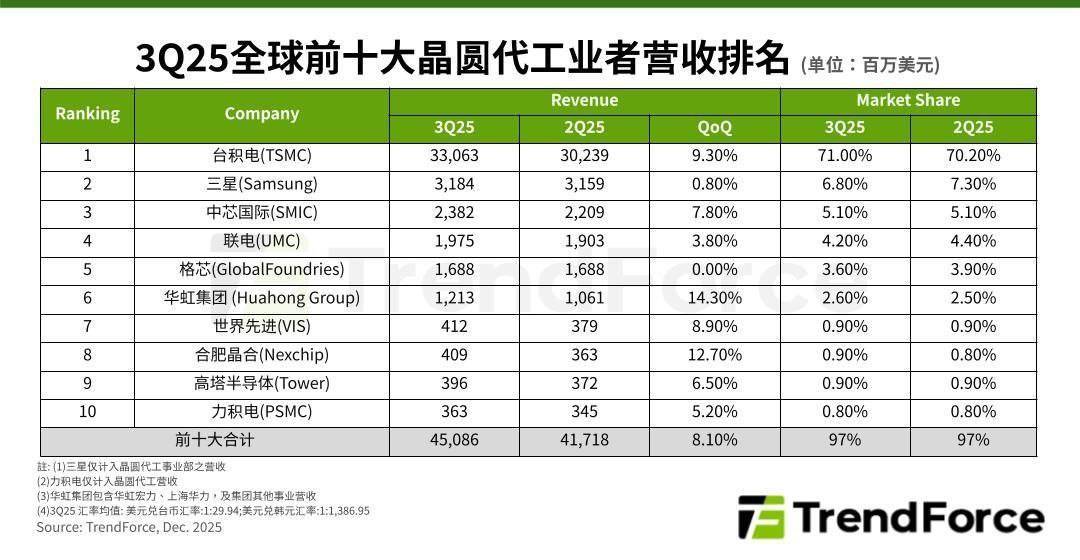
TrendForce:全球十大晶圆代工企业2025Q3总营收环比增长8.1%
Sou Hu Cai Jing· 2025-12-12 08:38
Core Insights - TrendForce reports that the global top ten foundry companies achieved a revenue increase of 8.1% quarter-on-quarter in Q3 2025, reaching $45.086 billion (approximately 318.586 billion RMB) [1][2] Group 1: Revenue and Market Share - TSMC remains the largest foundry with a revenue of $33.063 billion in Q3 2025, reflecting a 9.3% increase from the previous quarter and holding a market share of 71% [2] - Samsung follows with a revenue of $3.184 billion, showing a 0.8% increase and a market share of 6.8% [2] - SMIC reported a revenue of $2.382 billion, up 7.8%, maintaining a market share of 5.1% [2] - UMC's revenue reached $1.975 billion, increasing by 3.8%, with a market share of 4.2% [2] - GlobalFoundries had stable revenue at $1.688 billion, with a market share of 3.6% [2] - Huahong Group saw significant growth with a 14.3% increase in revenue to $1.213 billion, capturing a 2.6% market share [2] - The total revenue for the top ten foundries indicates a strong demand driven by AI HPC and new consumer electronics [2] Group 2: Future Outlook - For Q4 2025, TrendForce anticipates a more conservative outlook for the foundry industry due to international conditions and rising memory prices, which may limit growth momentum in capacity utilization [3] - Despite a potential rebound in demand from automotive and industrial control sectors, the overall revenue growth for the top ten foundries is expected to slow down significantly [3]




TrendForce集邦咨询:AI催生超大封装需求 ASICs有望从CoWoS转向EMIB技术
智通财经网· 2025-11-25 05:47
Core Insights - The demand for AI HPC (High-Performance Computing) is driving the need for advanced packaging solutions, particularly TSMC's CoWoS technology, but some cloud service providers (CSPs) are considering Intel's EMIB technology due to increasing chip integration requirements and packaging area demands [1][2]. Group 1: Technology Comparison - TSMC's CoWoS solution connects different functional chips using an interposer, while Intel's EMIB simplifies the structure by embedding silicon bridges directly into the substrate, resulting in higher yield rates [3][7]. - EMIB technology has advantages over CoWoS in terms of thermal expansion coefficient (CTE) issues, as it has a lower silicon ratio and fewer contact areas, reducing the risk of warping and reliability challenges [3][7]. Group 2: Market Dynamics - The current market for advanced packaging is facing capacity shortages and high costs associated with CoWoS, leading companies like Google and Meta to explore Intel's EMIB solutions [2][8]. - Intel's EMIB technology is expected to support larger die sizes and provide cost-effective solutions by eliminating the expensive interposer layer, making it attractive for AI customers [7][8]. Group 3: Future Prospects - EMIB is projected to achieve significant advancements in mask size, with EMIB-M already providing 6x mask size and expected to reach up to 12x by 2027, while CoWoS technologies are limited to lower mask sizes [4][7]. - Intel's Foundry Services (IFS) has been developing EMIB technology since 2021, and with major clients like Google and Meta showing interest, this could lead to substantial growth for IFS [8].


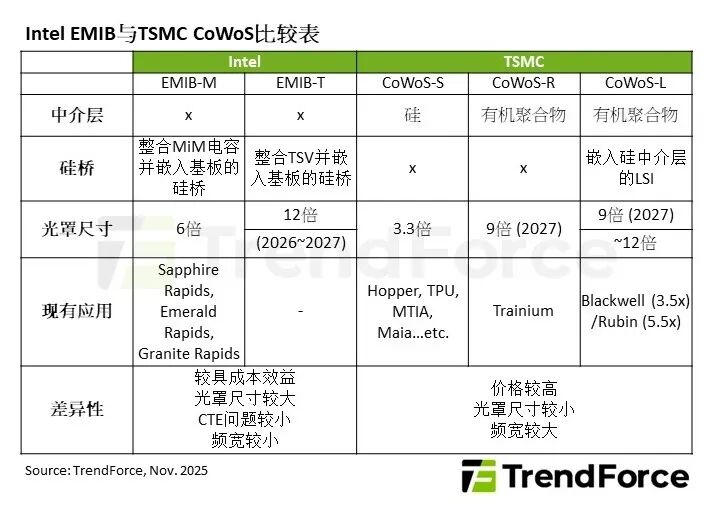
研报 | AI催生超大封装需求,ASICs有望从CoWoS转向EMIB技术
TrendForce集邦· 2025-11-25 05:01
Core Insights - The article discusses the increasing demand for AI HPC (High-Performance Computing) and the shift from TSMC's CoWoS solution to Intel's EMIB technology by cloud service providers (CSPs) due to capacity shortages and cost considerations [2][3][4]. Group 1: Technology Comparison - TSMC's CoWoS solution connects different functional chips using an interposer, while Intel's EMIB simplifies the structure by embedding silicon bridges directly into the substrate, leading to higher yield rates [4][6]. - EMIB technology has advantages such as a lower coefficient of thermal expansion (CTE) issue, which reduces the risk of warping and reliability challenges compared to CoWoS [4][6]. - EMIB can achieve larger die sizes, with EMIB-M supporting up to 6 times the mask size, while CoWoS-L is expected to reach 9 times by 2027 [6]. Group 2: Market Dynamics - The demand for CoWoS is facing challenges such as capacity shortages and high costs, leading CSPs like Google and Meta to explore Intel's EMIB solutions [3][7]. - Intel's EMIB technology is being adopted in its server CPU platforms, and companies like Google and Meta are considering it for their products, indicating a potential shift in market dynamics [7][8]. - NVIDIA and AMD, which require high bandwidth and low latency, are likely to continue using CoWoS as their primary packaging solution [7].



Canaan(CAN) - 2025 Q3 - Earnings Call Transcript
2025-11-18 14:02
Financial Data and Key Metrics Changes - Total revenue for Q3 2025 reached $150.5 million, up 50.2% quarter-over-quarter and 104% year-over-year, exceeding guidance of $125 million-$145 million [7][20] - Gross profit increased to $16.6 million, a significant rise from $9.3 million in Q2, with a product gross margin of 17% [7][24] - Cash balance at the end of the quarter rose to $119 million, representing an 80.9% increase [7] Business Line Data and Key Metrics Changes - Mining machine sales delivered a record high of 10 exahash per second, up 55.6% sequentially and 37.7% year-over-year, with an average selling price of $11.8 per terahash, a 33.8% increase year-over-year [8][20] - The Avalon Home series generated $12.2 million in revenue, a 115% quarter-over-quarter increase, contributing 10.3% of total product revenue [10][22] - Mining revenue reached $30.6 million, marking a 241% year-over-year increase, with 267 BTC mined during the quarter [10][22] Market Data and Key Metrics Changes - North American customers contributed 31% of total revenue in Q3, indicating a strong recovery in demand [21] - The global hash rate increased from 846 exahash per second at the end of Q2 to 1,041 exahash per second at the end of Q3 [6] Company Strategy and Development Direction - The company is focusing on expanding its consumer product line and energy operations while optimizing its R&D and administrative cost structure [15][29] - New projects include partnerships for energy infrastructure, such as a wind-powered mining facility in Texas and a project converting stranded natural gas into computing power [11][12] - The company aims to integrate high-density Bitcoin mining with energy-intensive AI and HPC workloads, reflecting a long-term vision for sustainable energy and computing [12][14] Management's Comments on Operating Environment and Future Outlook - Management expressed cautious optimism for Q4, expecting total revenue to be in the range of $175 million-$205 million, influenced by macroeconomic conditions and U.S. tariff policies [17][29] - The CEO noted that while some public miners are reducing operations, the overall global hash rate is expected to remain strong in the near term [44][56] Other Important Information - The company holds a cryptocurrency treasury of approximately 1,582 Bitcoin and 2,803 Ethereum, with an estimated market value of around $189 million [24] - A strategic investment of $72 million was closed with top-tier institutional investors to fund North American data center sites and expand Bitcoin mining machine production capacity [27] Q&A Session Summary Question: Delivery timing and gross margin on the 50,000 A15 Pro units order - The order is expected to be completed by the end of 2025, with positive gross margins anticipated [32][33] Question: Margins on home mining sales versus industrial mining equipment - The Avalon Home series achieved a gross margin of 33% in Q3, significantly higher than industrial miners [34] Question: Shipping schedule and scale for the new A16 models - The A16 series was launched at the end of October, with sample shipments expected by the end of November and volume shipments in Q1 2026 [41] Question: Market impact of public Bitcoin miners winding down operations - The CEO noted that while some miners are reducing operations, the global hash rate is expected to remain strong, and the company is focusing on fulfilling customer requirements [44][56] Question: Inventory levels for the A15 series and guidance for Q2 2025 - Inventory at the end of Q3 was approximately $200 million, with expectations for lower levels in Q1 due to market uncertainties [64] Question: Growth opportunities in pilot projects in Canada and Japan - The company is validating technical approaches and business models in pilot projects, with potential for scale-up in the future [66] Question: Self-mining objectives and strategy in Ethiopia - The company plans to slow the pace of self-mining hash rate additions while focusing on delivering large orders and developing power resources [72] Question: Details on wafer purchases and processing costs - The $56 million wafer purchase includes prepayments for future supply, while the $90 million processing costs relate to supply chain expenses [80][86]

Canaan(CAN) - 2025 Q3 - Earnings Call Transcript
2025-11-18 14:00
Financial Data and Key Metrics Changes - Total revenue for Q3 2025 reached $150.5 million, a 50.2% increase quarter-over-quarter and a 104% increase year-over-year, exceeding guidance [6][19] - Gross profit improved to $16.6 million, up 78.6% from Q2 2025, marking a significant turnaround from a gross loss of $21.5 million in the same period last year [22][26] - Cash balance at the end of the quarter increased to $119 million, representing an 80.9% increase [6] Business Line Data and Key Metrics Changes - Mining machine sales delivered a record high of 10 exahash per second of computing power, up 55.6% sequentially and 37.7% year-over-year [7][19] - Average selling price for mining machines increased by 33.8% year-over-year to $11.8 per terahash [7][19] - Avalon Home series generated $12.2 million in revenue, a 115% quarter-over-quarter increase, contributing over 10% of total product revenue for the first time [20][23] Market Data and Key Metrics Changes - North American customers contributed 31% of total revenue in Q3 2025, indicating a strong recovery in demand [19] - The global hash rate increased from 846 exahash per second at the end of Q2 to 1,041 exahash per second at the end of Q3 [5] Company Strategy and Development Direction - The company is focusing on expanding its consumer product line and energy operations while streamlining existing R&D and administrative costs [29] - New projects include partnerships for deploying mining machines at renewable energy facilities, indicating a shift towards integrating energy infrastructure with mining operations [12][15] Management's Comments on Operating Environment and Future Outlook - Management expressed cautious optimism for Q4 2025, expecting total revenue to be in the range of $175 million to $205 million, influenced by macroeconomic conditions and U.S. tariff policies [17][29] - The company is closely monitoring the impact of global mining and energy regulations on its operations [17] Other Important Information - The company holds a total cryptocurrency treasury of approximately 1,582 Bitcoin and 2,803 Ethereum, with an estimated market value of around $189 million at the end of Q3 [23] - A strategic investment of $72 million was closed with top-tier institutional investors to fund the acquisition and deployment of North American data center sites [27] Q&A Session Summary Question: Delivery timing and gross margin on the 50,000 A15 Pro units order - The order is expected to be completed by the end of 2025, with positive gross margins anticipated [31] Question: Margins on home mining sales versus industrial mining equipment - Home mining series achieved a gross margin of 33%, significantly higher than industrial miners [32] Question: Shipping schedule and expectations for the new A16 models - A16 series launched at the end of October, with sample shipments expected by the end of November and volume shipments in Q1 2026 [34] Question: Impact of public Bitcoin miners winding down operations - The company believes the global hash rate will not slow down in the near term, and it is focusing on building AI-ready mining facilities [36] Question: Inventory levels for the A15 series and guidance for Q2 2025 - Inventory at the end of Q3 is approximately $200 million, with expectations for lower levels in Q1 2026 due to market uncertainties [46] Question: Growth opportunities in pilot projects in Canada and Japan - Pilot projects are aimed at validating technical approaches and business models, with potential for scale-up in the future [48] Question: Self-mining objectives and strategy in Ethiopia - The company plans to slow the pace of adding self-mining hash rate in the near term while focusing on delivering large orders [50]
Cango Inc. Releases Letter to Shareholders
Prnewswire· 2025-11-06 10:00
Core Insights - Cango Inc. has successfully transformed into a robust Bitcoin mining operation, marking a significant milestone in its strategic evolution [1][7] - The company aims to deliver energy-secured high-performance computing (HPC) services, leveraging its Bitcoin mining foundation for future growth [5][6] Company Transformation - The transformation began in November 2024, with Bitcoin mining as a practical entry point to secure energy access and build operational expertise [1] - Cango scaled its operations to a 50 EH/s global platform within eight months by acquiring mining machines, divesting China-based assets, and onboarding a new management team [2] Financial Performance - In Q2 2025, Cango reported revenues of US$139.8 million and adjusted EBITDA of US$99.1 million, driven by an asset-light model focused on operational efficiency [3] - The company held US$117.8 million in cash equivalents, establishing a competitive core business with a global footprint across multiple countries [3] Operational Milestones - Cango acquired a 50 MW facility in Georgia for US$19.5 million in August 2025, enhancing operational control and securing better power terms [4] - The company's hashrate efficiency exceeded 90%, and Bitcoin holdings grew to over 6,400 BTC by October 31, 2025, through a disciplined HODL strategy [4] Future Plans - Cango plans to expand into energy and HPC markets through disciplined, phased pilots and dual-purpose energy infrastructure development [5] - The company is set to transition to a direct NYSE listing on November 17, 2025, to enhance its capital structure [4]

HIVE Digital surpasses 23 EH/s, secures prime land for next-gen Tier III+ AI HPC data centers
Proactiveinvestors NA· 2025-11-03 13:57
Group 1 - Proactive provides fast, accessible, informative, and actionable business and finance news content to a global investment audience [2][3] - The news team covers key finance and investing hubs including London, New York, Toronto, Vancouver, Sydney, and Perth [2] - Proactive focuses on medium and small-cap markets while also covering blue-chip companies, commodities, and broader investment stories [2][3] Group 2 - The team delivers news and insights across various sectors including biotech, pharma, mining, natural resources, battery metals, oil and gas, crypto, and emerging technologies [3] - Proactive adopts technology to enhance workflows and improve content production [4][5] - All content published by Proactive is edited and authored by humans, ensuring adherence to best practices in content production and search engine optimization [5]


Riot Platforms(RIOT) - 2025 Q2 - Earnings Call Transcript
2025-07-31 21:30
Financial Data and Key Metrics Changes - Riot reported total revenue of $153 million for the second quarter, a 5% decrease from $161.4 million in the previous quarter, primarily due to lower Bitcoin production [19] - Gross profit for the second quarter was $70.3 million, compared to $73.6 million in the prior quarter, with a gross margin of 46%, unchanged from the previous quarter [19] - Net income for the second quarter was $219.5 million, or $0.65 per share, compared to a net loss of $296.4 million, or $0.90 per share, in the prior quarter [19][20] - Non-GAAP adjusted EBITDA for the second quarter was $495.3 million, compared to a loss of $176.3 million in the prior quarter [20] Business Line Data and Key Metrics Changes - Riot increased its self-mining hash rate from 33.7 to 35.4, representing a 5% increase, while the global hash rate rose by 9% during the same period [18] - Bitcoin mining revenue totaled $140.9 million, consistent with the prior quarter's revenue of $142.9 million, with a gross margin of 50%, up from 48% in the previous quarter [21] - Direct cost to mine, excluding depreciation, totaled $48,992 per Bitcoin, with power costs accounting for 77% of total direct costs [21][22] Market Data and Key Metrics Changes - The market for data center talent is highly competitive, with significant demand for power and infrastructure that is not currently being met [49] - The demand for compute capacity is expected to continue growing, driven by the AI arms race and increasing CapEx budgets from hyperscalers [49] Company Strategy and Development Direction - Riot's strategy focuses on maximizing the value of its power portfolio and transitioning power capacity towards data centers while utilizing Bitcoin mining where advantageous [13][41] - The company aims to build a robust and scalable data center segment, leveraging its existing power assets and Bitcoin mining capabilities [7][10] - Riot has hired Jonathan Gibbs as Chief Data Center Officer to lead the development of its data center business [14][36] Management's Comments on Operating Environment and Future Outlook - Management expressed confidence in the company's ability to capitalize on market dynamics, emphasizing the importance of having readily available power in high-demand jurisdictions [41] - The company is strategically positioned to benefit from the growing gap between power demand and supply, particularly in key markets like Dallas and Austin [40] - Management highlighted the importance of a disciplined approach to capital allocation and the potential for shareholder value creation through strategic growth initiatives [12][41] Other Important Information - Riot ended the second quarter with over 19,000 Bitcoin and $330 million in cash, representing $2.4 billion in liquidity [15] - The company is actively engaged in discussions with potential data center tenants and has made significant progress in its Bitcoin mining operations [15][29] Q&A Session Summary Question: Discussion on Bitcoin generation and huddle strategy - Management explained that selling Bitcoin production allows the company to cover operating costs and focus on growth opportunities, with plans to adjust strategies based on Bitcoin price fluctuations [44][46] Question: Market dynamics regarding power transactions - Management noted robust demand in the data center market, with a significant gap between power availability and forecasted demand, emphasizing the importance of large-scale power capacity [49][50] Question: Basis of design for data centers - Management confirmed that significant progress has been made on the basis of design, which is crucial for engaging potential tenants and advancing negotiations [55][57] Question: Long lead times and infrastructure development - Management stated that critical infrastructure has already been secured, and they are confident in their ability to meet timelines for equipment procurement [59][60] Question: Potential tenants and negotiations - Management indicated that the basis of design will enhance negotiations with potential tenants, allowing for flexibility in serving various customer types [66][68] Question: Bitcoin mining outlook and network hash rate - Management projected a year-over-year growth of approximately 26% from 2024 to 2025, with a focus on maximizing the value of their power portfolio [74]

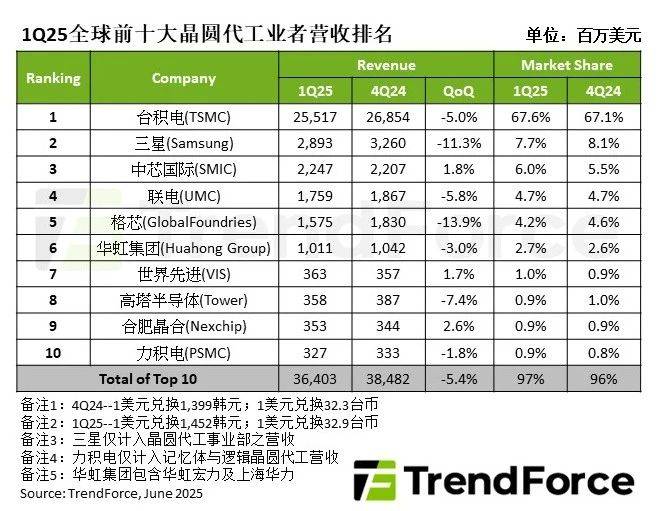
最新10大晶圆代工厂排名!
国芯网· 2025-06-10 10:42
Core Viewpoint - The global wafer foundry industry is experiencing a seasonal revenue decline of approximately 5.4%, reaching $36.4 billion in Q1 2025, influenced by the U.S. tariff policy and China's old-for-new subsidy program [1][4]. Group 1: Industry Overview - According to TrendForce, the global wafer foundry industry is expected to see a revenue decrease of about 5.4% in Q1 2025, totaling $36.4 billion, due to the impact of U.S. tariff policies and the advance stocking effect before the expiration of tariff exemptions [1]. - The overall industry revenue is being supported by China's continuation of the old-for-new subsidy policy, which mitigates some seasonal impacts [1]. Group 2: Company Performance - TSMC maintains the top position with a market share of 67.6%, reporting a revenue of $25.5 billion, a 5% decrease due to the smartphone inventory seasonality, partially offset by stable AI HPC demand and urgent orders from television manufacturers [4]. - Samsung, ranked second, faced an 11.3% revenue decline to $2.89 billion, with a market share slightly decreasing to 7.7%, affected by U.S. advanced process restrictions on Chinese customers [4]. - SMIC, in third place, benefited from customers' advance stocking due to U.S. tariffs and China's subsidy policy, resulting in a 1.8% revenue increase to $2.25 billion [4]. Group 3: Future Outlook - TrendForce anticipates that as the advance stocking driven by tariffs concludes, overall momentum will gradually slow down. However, the continuation of China's old-for-new subsidy policy, along with the upcoming smartphone launches and stable AI HPC demand, is expected to drive capacity utilization and shipments in Q2 [5]. - The top ten wafer foundry companies are projected to see a revenue increase in Q2 [5].
2025Q1全球晶圆代工市场:中芯国际份额升至6%,排名第三!
Sou Hu Cai Jing· 2025-06-09 15:55
Core Viewpoint - The global wafer foundry market revenue is expected to decline by approximately 5.4% quarter-on-quarter to $36.4 billion in Q1 2025, influenced by international market conditions and preemptive inventory stocking by various manufacturers [1] Group 1: Market Overview - The overall wafer foundry market revenue for Q1 2025 is projected to be $36.4 billion, down from $38.5 billion in Q4 2024 [2] - TSMC remains the market leader with a revenue of $25.5 billion and a market share of 67.6%, despite a 5% decline from the previous quarter [2][4] - Samsung's foundry revenue decreased by 11.3% to $2.89 billion, resulting in a market share drop to 7.7% [4] - SMIC's revenue increased by 1.8% to $2.25 billion, with a market share rise to 6% [4] - UMC's revenue fell by 5.8% to $1.76 billion, maintaining a market share of 4.7% [4] - GlobalFoundries experienced a significant revenue drop of 13.9% to $1.58 billion, with a market share of 4.2% [4] Group 2: Company Performance - Huahong Group's revenue decreased by 3% to $1.01 billion, with a market share of 2.7% [5] - VIS saw a revenue increase of 1.7% to $363 million, achieving a market share of 1% [5] - Tower Semiconductor's revenue declined by 7.4% to $358 million, with a market share of 0.9% [5] - Nexchip's revenue grew by 2.6% to $353 million, maintaining a market share of 0.9% [5] - PSMC's revenue decreased by 1.8% to $327 million, with a market share of 0.9% [5] Group 3: Future Outlook - The second quarter is expected to see a slowdown in momentum as the preemptive inventory stocking due to tariffs concludes, but the continuation of China's trade-in subsidy policy and upcoming smartphone launches are anticipated to drive demand [5]