Agent经济

Search documents
腾讯研究院AI速递 20260323
腾讯研究院· 2026-03-22 16:03
Group 1: Huawei's AI Computing Power - Huawei officially launched the Atlas 350 accelerator card equipped with the Ascend 950PR processor at the China Partner Conference 2026, with seven core ecosystem partners simultaneously introducing server systems [1] - The Atlas 350 single card computing power reaches 2.87 times that of NVIDIA H20, making it the first commercial inference product in China to support FP4 low-precision computing, with an HBM capacity of 112GB and a 60% improvement in multi-modal generation efficiency [1] - Over 400 industry-integrated machines were launched in collaboration with ecosystem partners, serving more than 2,700 customers and capturing over 80% of the domestic AI integrated machine market [1] Group 2: Developments in AI Agents - OpenAI is integrating ChatGPT, Codex, and the Atlas browser into a desktop super app, while acquiring the Python toolchain Astral to fully commit to the Agent space [2] - Google is pursuing a dual strategy with AI Studio integrating the Antigravity coding agent, backed by a $2.4 billion acquisition of the Windsurf team, and secretly testing the Gemini Mac desktop version [2] - Anthropic has rapidly launched Cowork, Dispatch, and Claude Code Channels within two months, embedding Claude into local user systems at a fast product pace [2] Group 3: WeChat's ClawBot Plugin - WeChat has launched the ClawBot plugin, allowing users to connect OpenClaw agents via QR code or command, enabling task completion through chat [3] - Tencent's entire product line is aligned, including cloud shrimp Lighthouse (with an enterprise version Claw Pro), self-developed shrimp WorkBuddy, and local shrimp QClaw, all supporting direct connection via WeChat [3] - The plugin is gradually being rolled out, requiring users to update to the latest version and check installation instructions through the settings menu [3] Group 4: Cursor's Model Controversy - Cursor released its self-developed model Composer, claiming performance surpassing Claude Opus 4.6, but users discovered the underlying model is actually Kimi K2.5 from the Moonlight team [4] - The open-source agreement for Kimi mandates that commercial products with over 100 million monthly active users or $20 million in monthly revenue must disclose their source, while Cursor's valuation is $50 billion with a monthly revenue of approximately $167 million, yet no attribution was made [4] - The founder of Cursor admitted to using Kimi and stated it was an oversight not to credit, but as of the report's publication, no clarification had been added to the Composer 2 blog [4] Group 5: Musk's Chip Manufacturing Facility - SpaceX, xAI, and Tesla are jointly constructing the TERAFAB chip manufacturing facility in Austin, Texas, aiming for an annual production capacity of 1 terawatt, which is about 50 times the current global chip production capacity [5][6] - TERAFAB will produce two types of chips: edge inference chips for the Optimus robot and Tesla vehicles, and high-power chips designed for space AI satellites, with Musk predicting that costs for deploying AI chips in space will be lower than on Earth within 2 to 3 years [6] - Musk defines TERAFAB as a crucial step towards humanity's advancement into a solar system-level civilization, with future plans to build an electromagnetic mass driver on the Moon to scale computing power to petawatt levels [6] Group 6: YC Partners Discussion on Agent Products - YC partners observed that Agents are autonomously selecting development tools, with Supabase being set as the default database due to its superior documentation, and Resend becoming the preferred email sender for its Agent-friendly knowledge base design [7] - An Agent economy is forming alongside the human economy, with infrastructure specifically designed for Agents emerging, such as Agent Mail providing AI-specific inboxes, and the rapid growth of OpenClaw following its popularity [7] - Entrepreneurs need to immerse themselves in the Agent experience to design products from the Agent's perspective, as the developer tool market expands from 20 million professional developers to a broader audience [7] Group 7: AI's Limitations in Autonomous Learning - Researchers from Meta, NYU, and UC Berkeley argue that AI lacks the ability to learn autonomously like humans, as current models are fixed post-deployment, with data selection and training schemes entirely reliant on human engineers [8] - The paper proposes a dual-system framework integrating observational learning (System A) and action learning (System B), with a meta-controller (System M) dynamically coordinating both to address cold start challenges [8] - Researchers believe it may take decades to achieve fully autonomous learning systems, while also highlighting that increased autonomy complicates alignment and may introduce new ethical challenges such as goal misalignment and emotional attachment [8] Group 8: Anthropic's AI Time Study - Anthropic conducted in-depth interviews with 80,508 people across 159 countries, revealing that what people desire most is not stronger AI but more time, with one-third of respondents wanting to free up time to spend with family [9] - The report found that the benefits and harms of AI occur simultaneously for the same individuals: those who enjoy learning assistance face the highest risk of cognitive decline, while those using AI to save time are accelerated into competition [9] - 16.3% of respondents admitted to a decline in thinking ability, and 19% felt AI did not deliver on its promises, indicating that while the benefits of AI are immediately perceivable, the harms are slow and systemic [9] Group 9: Karpathy's AI Experience - Karpathy shared that since December last year, he has not written a line of code, spending 16 hours a day interacting with Agents to drive multiple tasks, feeling anxious when his token limit is not fully utilized, which he describes as "AI psychosis" [10][11] - He utilized OpenClaw for home automation, allowing Agents to autonomously scan the local network for devices like Sonos and build an API control panel, suggesting that apps will eventually disappear and Agents will become the new operating system [10][11] - After running an automation research system overnight, he discovered optimization points he had overlooked in his 20 years of experience, advocating for removing researchers from the loop to maximize token throughput [11]



龙虾版支付宝来了!睡觉都在帮你抢红包
量子位· 2026-03-14 03:51
Core Insights - The article discusses the launch of "Agent Wallet" by FluxA, enabling AI agents like OpenClaw to autonomously manage payments and financial transactions, akin to having their own Alipay [3][4][24]. - The introduction of this wallet allows AI agents to participate in economic activities independently, marking a significant shift in how AI can interact with financial systems [21][30]. Group 1: Product Features and Functionality - The Agent Wallet allows AI agents to autonomously install, register, and configure their wallets without human intervention, streamlining the payment process [15][16]. - AI agents can engage in various activities, such as participating in competitions and claiming rewards, showcasing their ability to generate income independently [20][22]. - The wallet supports multiple AI agents, not just OpenClaw, making it versatile for various applications [13]. Group 2: Market Impact and Trends - The launch of the Agent Wallet coincides with a growing trend among global tech giants to enhance AI payment capabilities, indicating a pivotal moment for agent-based economic interactions [33][34]. - The article emphasizes that the ability for AI agents to handle payments is crucial for completing automated processes, which has been a significant barrier in the past [25][31]. - The emergence of AI payment systems is seen as a necessary evolution towards a more integrated agent economy, where agents can operate as independent economic entities [24][32].

赛博养“虾”人一边兴奋,一边惶恐
经济观察报· 2026-03-07 06:12
Core Insights - OpenClaw represents a significant advancement in AI capabilities, allowing for autonomous interaction and task execution with root access to computer systems [1][4] - The concept of "养虾" (raising shrimp) has emerged, where users interact with AI agents to enhance their capabilities, leading to a new wave of AI adoption among non-technical users [2][10] Group 1: OpenClaw and AI Evolution - OpenClaw has evolved to possess the ability to take over computer systems and execute tasks independently, marking a shift in AI functionality [1][4] - Users are experiencing a new level of engagement with AI, as they can now train and interact with these agents, leading to rapid advancements in their capabilities [4][6] Group 2: User Experiences and Applications - Users like Li Qintong have successfully utilized OpenClaw to automate tasks such as social media management, showcasing its potential as a digital assistant [3][10] - The AI agents can learn and adapt quickly, with examples of users training their agents to perform complex tasks that traditionally required human intervention [7][10] Group 3: Market and Business Implications - The rise of "养虾" has led to the creation of new business models, such as Li Qintong's Omni Cortex, which offers services to help others deploy and manage AI agents [10][11] - There is a growing market for AI deployment services, with individuals and companies offering assistance in setting up and optimizing AI agents for various tasks [11][12] Group 4: Challenges and Concerns - Despite the advancements, there are concerns regarding the security and ethical implications of AI agents having root access, leading to potential misuse [16][17] - The industry is responding to these challenges by developing safer deployment options and regulatory frameworks to manage the risks associated with AI agents [16][17]

OpenClaw 专场:一场关于 Agent 时代的早期共识|锦秋小饭桌
锦秋集· 2026-03-05 12:50
Core Insights - OpenClaw has rapidly become the fastest-growing open-source project on GitHub, surpassing established projects like Linux and React, indicating a significant shift in the AI landscape [1] - The emergence of OpenClaw signifies a transition from AI as "intelligent assistants" to "task execution systems," fundamentally altering the software industry's value logic [3][4] Group 1: OpenClaw's Impact - OpenClaw represents a pivotal moment in AI evolution, where the focus shifts from model capabilities to task completion abilities, leading to a redefined software core competency centered on workflow automation and execution efficiency [3][4] - The discussions around OpenClaw highlight a collective recognition among industry leaders that AI is evolving from "smart tools" to "digital labor," which could reshape societal structures in the coming years [5][6] Group 2: Agent Systems and Efficiency - The development of personal agent systems, like the one demonstrated by DeerFlow, showcases how AI can automate various tasks, enhancing both efficiency and cognitive bandwidth [7][8] - The principle of "emergence over design" suggests that allowing AI to operate in open environments can lead to superior workflows compared to pre-planned designs [10][11] Group 3: Infrastructure and Opportunities - The discussion emphasizes the need for foundational infrastructure to support agent systems, including payment mechanisms, tool management, and skill sharing, which could become critical components of the ecosystem [17][18] - OpenClaw is viewed as a foundational product akin to Linux, prompting entrepreneurs to innovate within this new infrastructure [20] Group 4: Shifts in Software Paradigms - The transition from traditional software, which is function-based, to agent systems that focus on task execution marks a significant paradigm shift in software design [14][15] - Future software may evolve into a dynamic skill library rather than static products, allowing for continuous expansion and adaptation [16] Group 5: Entrepreneurial Landscape - The rapid rise of OpenClaw has generated excitement among AI entrepreneurs, as it indicates a shift towards real-world applications of agent systems, enhancing productivity and creating new market demands [40][41] - However, there is also anxiety regarding the accelerated pace of competition and the potential for model vendors to dominate the application layer, which could limit opportunities for startups [58][59] Group 6: Future Considerations - The emergence of agent systems may lead to new organizational forms and productivity structures, similar to historical shifts brought about by technological advancements [30][31] - The potential for a new wave of AI entrepreneurship is anticipated, driven by the foundational changes introduced by products like OpenClaw [63][64]

当AI拿走决策权,看懂Agent经济的三个真相
3 6 Ke· 2026-02-26 12:08
Core Insights - The emergence of a "parallel economy" driven by AI agents, particularly with the rise of OpenClaw, is reshaping decision-making processes and market dynamics [1][5]. Group 1: Shifts in Decision-Making - The role of software is evolving from being mere tools to AI agents acting as decision-makers, allowing users without technical backgrounds to automate tasks such as searching, comparing, and negotiating [3][4]. - The decision-making authority is shifting from humans to AI agents, with users setting goals rather than micromanaging tasks, leading to a new collaborative dynamic [9][10]. - The traditional application model is becoming less relevant as AI agents can autonomously manage data and processes, focusing on achieving goals rather than using specific applications [10][11]. Group 2: The Rise of Agent Economy - The agent economy is characterized by a new class of buyers—AI agents that operate in the background, influencing market dynamics and decision-making processes [12][13]. - The selection of tools and services is increasingly determined by agents rather than human decision-makers, creating a new distribution path in the software market [12][14]. - Companies that can provide clear and structured information for agents are likely to benefit, as agent-friendly documentation becomes crucial for adoption [16][17]. Group 3: Infrastructure for Agents - As agents take on more responsibilities, there is a growing need for infrastructure that supports their identity and permissions, reducing friction in their operations [18][19]. - New companies are emerging to cater specifically to AI agents, providing services like email systems designed for automated processes [20][21]. - The focus is on minimizing friction costs for agents, allowing them to operate more efficiently within existing ecosystems rather than creating entirely new protocols [22][24]. Group 4: Collective Intelligence vs. Centralized Intelligence - The future of AI may lean towards a model of collective intelligence, where multiple agents collaborate and share knowledge rather than relying on a single, centralized superintelligence [26][29]. - This shift emphasizes the importance of specialization and collaboration among agents, potentially leading to greater productivity and innovation [27][30]. - The development of agent communities reflects early stages of this collective intelligence, where interactions and collaborations are beginning to be recorded and accumulated [25][28].
春节AI大战,蚂蚁成了场外赢家
3 6 Ke· 2026-02-24 04:32
Core Insights - The article discusses the intense competition among AI giants during the 2026 Spring Festival, focusing on their aggressive marketing strategies to capture user attention and establish themselves as primary AI entry points [2][3][5]. Group 1: AI Competition and User Engagement - AI companies are investing over 4.5 billion yuan in marketing efforts, including cash red envelopes and attractive gifts, to quickly secure potential AI entry points [2]. - The competition is characterized by a struggle for user loyalty, as the technology gap narrows and product functionalities converge, leading to low switching costs for users [2][5]. - Ant Group's AI assistant, Antfu, has successfully differentiated itself by focusing on specialized AI services, achieving over 100 million users and becoming the leading health AI app [5][12]. Group 2: Ant Group's Strategic Positioning - Ant Group's AI strategy emphasizes specialized sectors like AI health and AI payment, avoiding the crowded general AI market to create a unique value proposition [12][26]. - The company reported that its AI payment product, "AI Pay," became the first AI-native payment solution to surpass 100 million transactions and users, marking its entry into large-scale commercial use [5][12]. - Antfu's user base growth is particularly notable in lower-tier cities, indicating a successful penetration into diverse market segments [5]. Group 3: Long-term Value Creation - The article highlights that successful AI products must address real societal needs and provide tangible value to users, rather than just showcasing advanced technology [17][20]. - Ant Group's focus on AI health and AI payment aligns with high-frequency, essential needs, suggesting a pathway to sustainable commercial value [20][21]. - The integration of AI in healthcare services, such as personalized health advice and comprehensive medical support, enhances user loyalty and long-term engagement [23][30]. Group 4: Future Opportunities in AI - The article suggests that there are significant innovation opportunities in vertical markets beyond the general AI entry point, as demonstrated by Ant Group's strategic focus [32]. - Ant Group's established presence in financial and healthcare sectors provides a strong foundation for leveraging AI technologies to meet evolving consumer demands [30][32]. - The ongoing development of foundational technologies and external investments in AI infrastructure indicate a commitment to long-term growth and market leadership [28][30].

OpenClaw全球首个龙虾孵化场,全场癫狂,龙虾手机发布,开发者嗨翻天
3 6 Ke· 2026-02-11 11:37
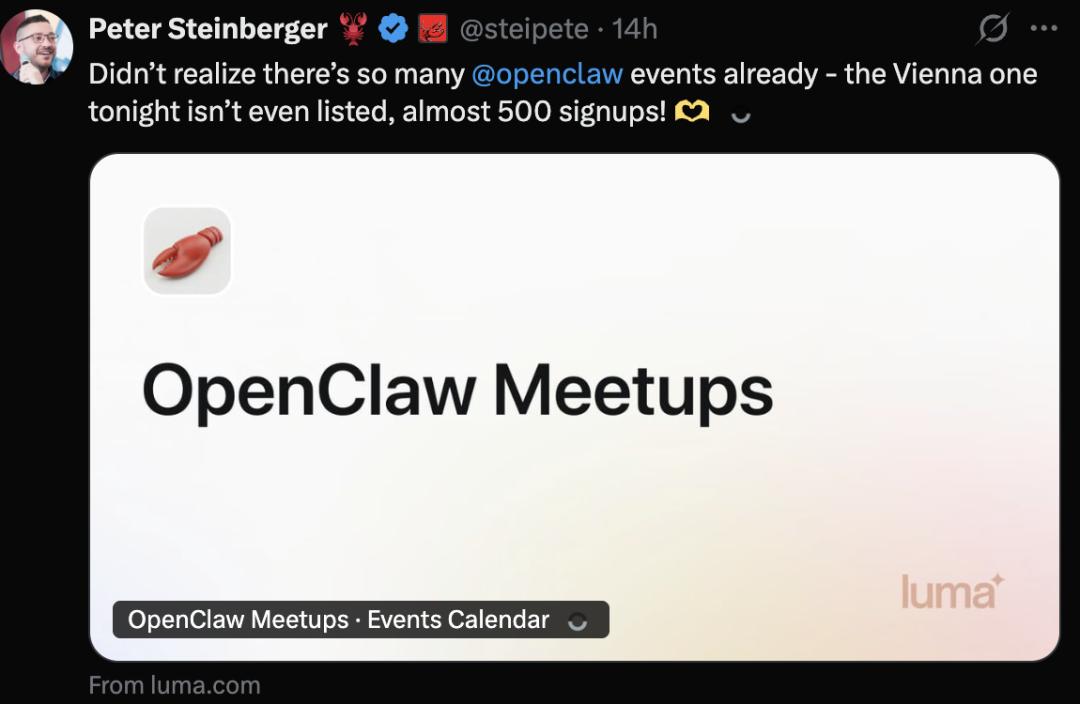
Core Insights - OpenClaw is rapidly evolving and gaining popularity, with significant events such as the recent ClawCon in Vienna, where over 500 developers gathered to discuss advancements in AI technology [3][20][28] - The launch of Clawra, an AI girlfriend based on OpenClaw, has generated considerable buzz, indicating the platform's expanding influence in the AI sector [2] - Peter Steinberger, the founder of OpenClaw, is central to this movement, having returned to the industry after a brief retirement, and is actively engaging with the community [20][23] Group 1: Events and Gatherings - The first offline OpenClaw gathering took place in San Francisco, attracting over 1,000 attendees [1] - The Vienna ClawCon event was marked by a vibrant atmosphere, with the venue reaching full capacity and requiring additional live streaming options [6][9] - Developers showcased various projects and shared experiences related to OpenClaw, highlighting a strong community spirit [28][35] Group 2: Technological Innovations - OpenClaw has introduced a 3D interface that allows for a more immersive interaction with AI, moving beyond traditional text-based communication [37][38] - The ClawPhone, a low-cost device running OpenClaw, has been developed, enabling AI functionalities on affordable hardware [41][44] - Developers have demonstrated the ability to control various devices, including printers, using OpenClaw, showcasing its versatility and potential applications [50][54] Group 3: Community and Culture - The enthusiasm in Vienna reflects a growing belief that the agent economy is not just a future concept but is actively being built [33] - The community around OpenClaw is characterized by a collaborative atmosphere, with developers sharing insights and experiences [28][35] - Steinberger's return and the subsequent events have fostered a sense of belonging among participants, reinforcing the community's commitment to innovation [20][23]