GPU生态

Search documents
GPU四小龙忙上市:“中国英伟达”的较量,才刚刚开始
3 6 Ke· 2025-12-29 10:29
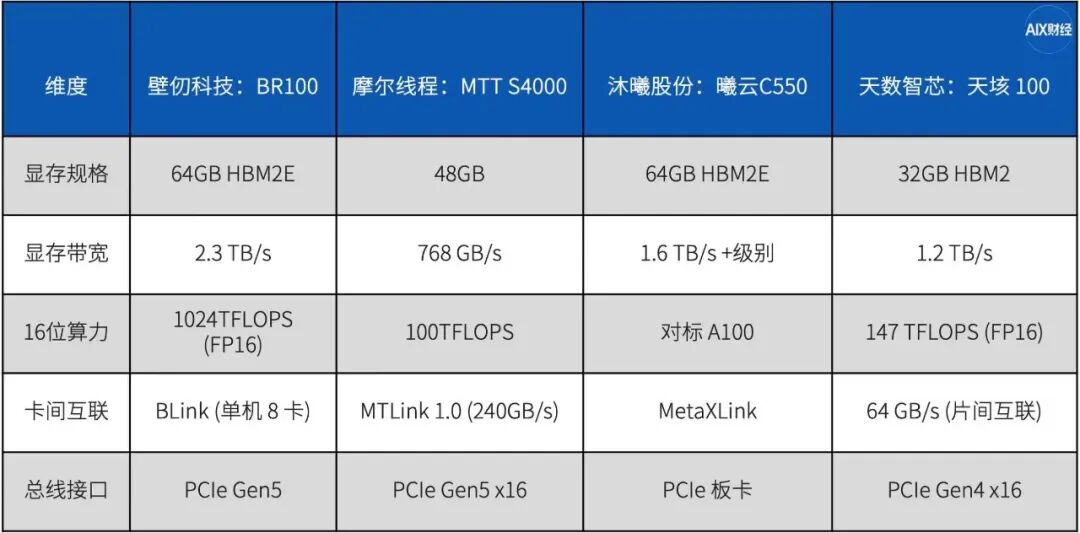
Core Viewpoint - The emergence of the "Four Little Dragons" of domestic GPUs—Mole Thread, Muxi Technology, Bilan Technology, and Tensu Zhixin—marks a significant moment in the capital market, raising questions about their sustainable growth amidst international competition [1][8]. Group 1: Company Profiles and Strategies - Mole Thread, with a team rooted in Nvidia, emphasizes ecosystem compatibility and parallel development of graphics rendering and AI computing, utilizing its self-developed MUSA architecture [2][3]. - Muxi Technology and Tensu Zhixin adopt a pragmatic approach similar to AMD, focusing on high-performance parallel computing while sacrificing complex graphics rendering capabilities [2][3]. - Bilan Technology stands out with its original architecture and Chiplet technology, aiming for extreme computing performance and flexibility in product offerings [3][4]. Group 2: Market Position and Performance - The "Four Little Dragons" have begun to establish their presence in various sectors, with Bilan achieving commercial success in heterogeneous training solutions, Mole Thread securing large-scale delivery contracts, Muxi reporting significant orders, and Tensu being the first to achieve mass production of 7nm GPGPU [7][8]. - The competitive landscape is characterized by overlapping targets among the four companies, particularly in securing contracts from major internet firms and local government data centers [15][16]. Group 3: Financial Insights and Challenges - All four companies exhibit high growth accompanied by significant losses, with R&D expenses consuming a large portion of their revenues, particularly for Muxi and Tensu [19][20]. - The R&D expenditure for 2024 shows that Mole Thread has 886 R&D personnel with a rate of 309.88%, while Muxi has 706 personnel with a rate of 121.24% [21]. - The timeline for achieving profitability is projected around 2026-2027, mirroring Nvidia's early growth trajectory [22]. Group 4: Ecosystem and Market Dynamics - The competition extends beyond hardware performance to include software ecosystems, with each company developing its own software stack to attract developers and enhance product value [23][24]. - The ability to expand customer bases and maintain high repurchase rates will be crucial for validating the true value of their products in a market increasingly driven by performance and cost [24][25]. - The stability of supply chains is critical, as the GPU industry is interconnected with various sectors, and any disruptions could significantly impact production and market presence [25].


上市15天,摩尔线程剑指英伟达腹地
虎嗅APP· 2025-12-20 13:20
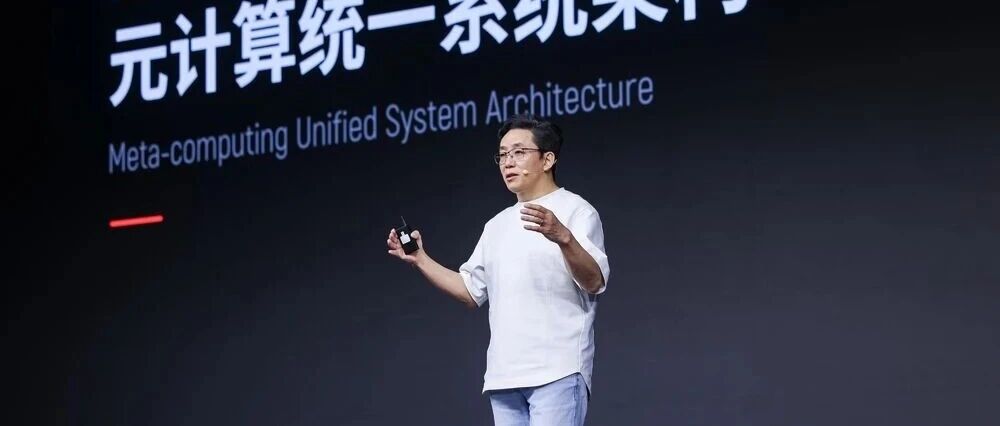
Core Viewpoint - The article discusses the recent developments by Moore Threads, including the launch of their new GPU architecture "Huagang" and AI training and inference chip "Hushan," highlighting their ambition to build a comprehensive ecosystem similar to NVIDIA's CUDA [2][4]. Group 1: New Technologies and Innovations - Moore Threads introduced the intermediate language MTX, part of the MUSA 5.0 software stack, which allows compatibility across different generations of GPUs, significantly reducing adaptation costs for developers [5][7]. - The "Huagang" architecture represents a substantial upgrade, with a 50% increase in computing power density compared to the previous "Pinghu" generation, and it supports full precision calculations from FP4 to FP64 [11][10]. - The new architecture also features asynchronous programming and supports large-scale interconnections, enabling the expansion of intelligent computing clusters to over 100,000 nodes [11][10]. Group 2: Chip Launches and Performance - Two new chips were launched based on the "Huagang" architecture: "Lushan," designed for AI training and inference, and "Hushan," aimed at high-performance graphics rendering [14][13]. - The "Lushan" chip can adapt to various protocols and supports expansion with up to 1,024 super nodes, while the "Hushan" chip boasts a 64-fold increase in AI computing performance and a 50-fold improvement in ray tracing capabilities [16][14]. Group 3: Ecosystem Expansion - The company is focusing on building a self-sufficient ecosystem while exploring new boundaries, exemplified by the introduction of the "Changjiang" SoC, which combines CPU, GPU, and NPU to provide up to 50 TOPS of heterogeneous AI computing power [21][20]. - Moore Threads is also developing the MT Robot intelligent solution and the MT Lambda simulation training platform, aiming to integrate various engines to enhance research and development efficiency [23][25]. - The company's strategy reflects an ambition to establish a competitive ecosystem in the GPU industry, akin to NVIDIA's, while facing significant challenges in building a robust domestic ecosystem [26][25].
“国产GPU第一股” 再传利好
Shang Hai Zheng Quan Bao· 2025-11-28 09:30
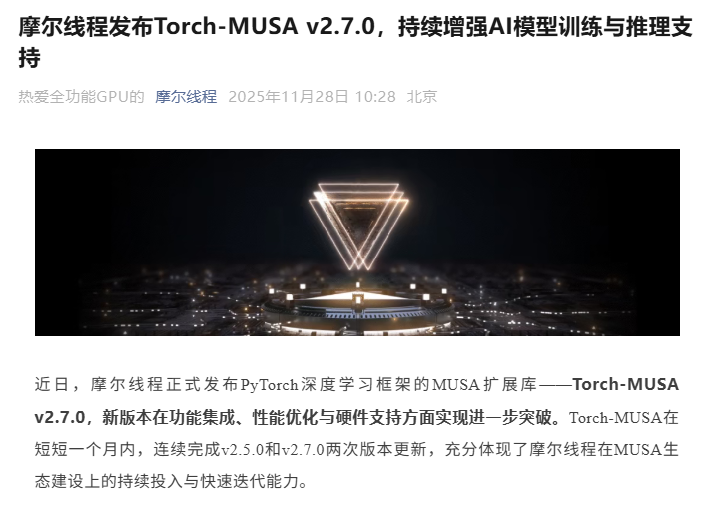
Core Viewpoint - The company, Moole Technology, is set to launch on the STAR Market and has recently announced significant updates to its Torch-MUSA deep learning framework, showcasing its commitment to rapid development and ecosystem enhancement [1][4]. Group 1: Product Development - Moole Technology has released the Torch-MUSA v2.7.0, which includes over 1,050 operators, enhancing performance and stability for large model training and inference [5][6]. - The new version introduces features such as Dynamic Double Cast and Distributed Checkpoint, further optimizing the system's capabilities [6]. - The company has integrated additional computational acceleration libraries like muSolver and muFFT, significantly improving the efficiency of complex computational tasks [10]. Group 2: Strategic Positioning - The MUSA architecture, developed by Moole Technology, represents a comprehensive GPU computing acceleration system that integrates hardware and software, aiming to replace the dominant NVIDIA and CUDA ecosystems [12][15]. - The company has built a complete software stack for developers, including MUSA SDK and Torch-MUSA, to maximize the performance of its GPUs across various applications [15]. - Moole Technology's IPO process was notably swift, taking only 88 days from acceptance to approval, with an expected fundraising total of 8 billion yuan [17]. Group 3: Strategic Partnerships - Moole Technology has entered into a strategic cooperation agreement with the National Information Center to advance research and development in computing power and contribute to the national integrated computing network [18][20].