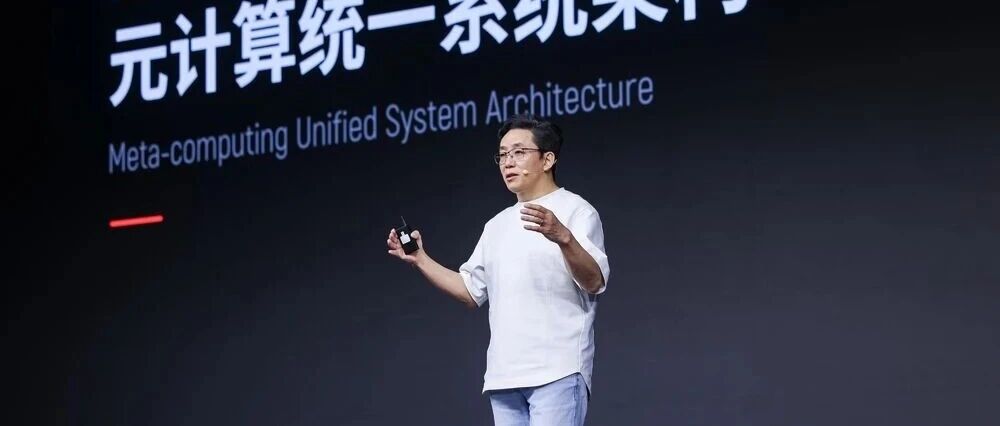
花港架构

Search documents
首届开发者大会,让摩尔线程全功能GPU的独特优势更「具像化」
雷峰网· 2025-12-26 00:25
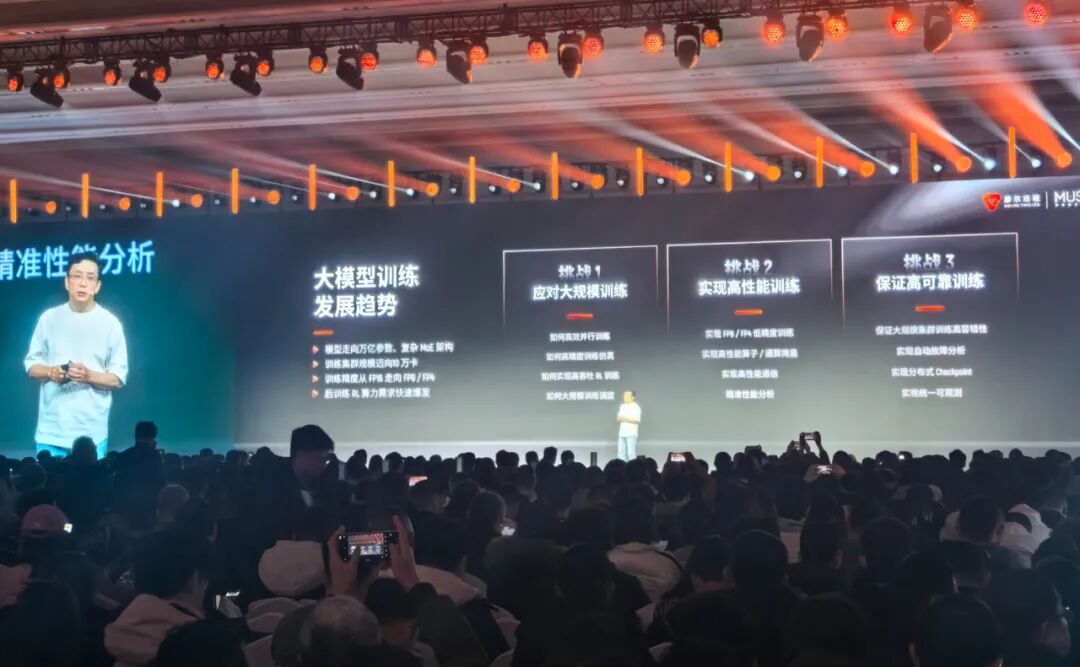
Core Viewpoint - The article discusses the advancements made by Moores Threads in the field of full-function GPUs, highlighting the launch of the new Huagang architecture, which enhances computing density by 50% and improves performance by 10 times, showcasing the company's rapid development and broad application potential in various industries [1][22]. Group 1: Moores Threads' Innovations - Moores Threads has showcased its full-function GPU capabilities, which span from consumer applications to vertical industries, integrating graphics, AI, and high-performance computing [3][7]. - The company has introduced the Huagang architecture, along with new AI training and inference chip Huashan and professional graphics chip Lushan, which significantly enhance performance metrics [22][29]. - The Huashan chip features advanced floating-point performance and supports over 100,000 card computing clusters, while Lushan offers substantial improvements in gaming and AI computation performance [29][31]. Group 2: Application Cases and Market Impact - The article highlights nearly 100 application cases that demonstrate the unique capabilities of Moores Threads' full-function GPUs across various sectors, including gaming, healthcare, and AI [15][49]. - The integration of AI capabilities with graphics rendering allows for complex applications in fields such as medical imaging and industrial design, showcasing the versatility of the technology [11][15]. - Moores Threads has achieved 100% compatibility with the top 50 popular games in China since the launch of its consumer-grade graphics card, indicating strong market acceptance [9]. Group 3: MUSA Ecosystem and Developer Engagement - The MUSA (Meta-computing Unified System Architecture) is a comprehensive technology stack developed by Moores Threads, aimed at fostering a robust developer ecosystem [33][49]. - The company aims to attract a large number of developers to build applications on the MUSA platform, emphasizing the importance of collaboration between manufacturers and developers [35][38]. - Moores Threads has set a goal of reaching one million MUSA developers, indicating its commitment to expanding its ecosystem and enhancing the value of its technology [47][49].

技术突围与资本共振: 人工智能赛道涌现上市潮
Zhong Guo Zheng Quan Bao· 2025-12-22 20:37
Core Insights - The Chinese AI industry is experiencing a significant capital market influx, with companies like Zhipu and MiniMax aiming for IPOs, indicating a critical phase of commercialization in AI technology [1][2] - The AI sector is projected to grow rapidly, with the core industry expected to exceed 900 billion yuan in 2024 and potentially surpass 1.2 trillion yuan in 2025, reflecting a 24% growth rate [1][6] - Despite the rapid growth, challenges such as high costs and low returns in AI applications persist, necessitating patience from investors [1][7] Company Summaries - Zhipu, established in 2019, has empowered over 12,000 enterprise clients and 80 million terminal devices, leading the independent general-purpose AI model market in China with a 6.6% market share [2] - MiniMax, founded in early 2022, has rapidly developed a product matrix for both C-end and B-end users, reaching over 2.12 million personal users and 130,000 enterprise clients across more than 200 countries [2] - Both Zhipu and MiniMax have shown substantial revenue growth, with Zhipu's revenue increasing from 57.4 million yuan in 2022 to 312.4 million yuan in 2024, and MiniMax's revenue projected to grow from 3.46 million USD in 2023 to 30.52 million USD in 2024 [5] Market Trends - The demand for AI models is surging, with daily token consumption in China exceeding 30 trillion by mid-2023, reflecting a 300-fold increase within a year [5] - The AI chip market is also thriving, with companies like MoEr Thread and MuXi achieving significant market valuations, indicating a robust demand for underlying computational power [2][3] - The global AI market is expected to reach 900 billion USD by 2026, with China being one of the fastest-growing markets, projected to exceed a 30% growth rate [6] Application Challenges - The integration of AI into various industries is facing structural challenges, particularly in manufacturing, where AI's penetration remains limited due to data accessibility and reliability issues [7][8] - The high consumption of data and computational resources raises concerns about the unclear commercial return paths for AI investments, with many companies currently operating at a loss [8][9] - There is a pressing need for improved data sharing and high-quality datasets to enhance AI model performance and facilitate broader adoption, especially among SMEs [7][8]
摩尔线程,走英伟达的路,也走自己的路
Tai Mei Ti A P P· 2025-12-22 01:37
Core Insights - The core message of the news is that Moore Threads is evolving from a GPU manufacturer to a comprehensive computing infrastructure company, similar to Nvidia, but tailored to address the unique challenges of the Chinese market [2][3]. Group 1: Product Development and Strategy - Moore Threads introduced its full-featured GPU architecture "Huagang" and the MUSA (Meta-computing Unified System Architecture) at the MDC 2025, emphasizing a shift towards a more integrated approach to computing [2][5]. - The company aims to support a wide range of applications, including graphics, AI, HPC, and video processing, through its full-featured GPU, which is designed to handle mixed computing tasks rather than focusing solely on AI [2][5][6]. - The MUSA architecture encompasses a complete technology stack, from chip architecture to software frameworks, allowing for versatile applications across different industries [7][8][10]. Group 2: Technical Innovations - The full-featured GPU integrates multiple computing engines, including AI computation, 3D graphics rendering, high-performance computing, and intelligent video encoding, to meet diverse computational needs [6][7]. - The latest MUSA upgrade to version 5.0 enhances compatibility with various programming languages and significantly improves performance metrics, such as achieving over 98% efficiency in core computation libraries [10][11]. - The "Huagang" architecture boasts a 50% increase in computing density and substantial improvements in energy efficiency, supporting a wide range of precision from FP4 to FP64 [12][14]. Group 3: Market Position and Future Outlook - Moore Threads is positioning itself as a key player in the domestic GPU market, leveraging its unique methodologies to tackle challenges such as supply chain uncertainties and technological barriers [3][5]. - The company is set to release two new chips, "Huashan" for AI training and "Lushan" for high-performance graphics rendering, which are expected to significantly enhance capabilities in their respective fields [14][15]. - The launch of the "Kua'a" supercomputing cluster marks a significant milestone, achieving floating-point performance of 10 Exa-Flops and demonstrating high efficiency in AI training and inference tasks [15][16].
中国机器人在格斗机器人大赛中夺冠;摩尔线程发布新一代GPU架构|周末要闻速递
21世纪经济报道· 2025-12-21 09:50
Key Points - The State Council emphasized the need for all departments to align their actions with the central government's economic work requirements for the upcoming year, enhancing responsibility and urgency in implementing specific plans [2] - The Ministry of Finance and the Ministry of Industry and Information Technology issued guidelines for establishing domestic product standards in government procurement, focusing on accurate definitions and regulatory oversight [3] - New rules on pricing behavior for internet platforms were released, prohibiting forced price reductions and promotional tactics that could pressure sellers [4] - The Ministry of Commerce highlighted plans to boost consumption and trade innovation in 2026, including support for service exports and the development of digital and green trade [5] - The National Internet Information Office and the China Securities Regulatory Commission took action against accounts spreading false information related to the capital market [6] - The State Administration for Market Regulation revised the regulations on anti-competitive agreements, specifying exemption thresholds for certain vertical agreements [7] - Chang'an Automobile received the first L3-level autonomous driving license in Chongqing, marking a significant milestone in the development of autonomous vehicles [8] - Moore Threads launched a new GPU architecture, "Huagang," which reportedly improves computing density by 50% and efficiency by ten times [10] - Samsung unveiled the world's first 2nm smartphone chip, Exynos 2600, representing a significant advancement in mobile processing technology [11] - China Shenhua announced plans to acquire various assets from the State Energy Group for a total transaction price of 133.598 billion yuan [12] - ByteDance's projected annual profit of approximately $50 billion was disputed by insiders, indicating discrepancies in reported financial data [13] - The World Trade Organization's report suggested that AI could boost global trade by 34% to 37% by 2040, significantly impacting GDP growth [14] - Ongoing constructive talks between the U.S. and Russia regarding the Ukraine conflict were reported, indicating potential diplomatic progress [15] Industry Insights - CITIC Securities remains optimistic about the AI computing power sector, noting strong demand and the ongoing evolution of AI models [24] - Galaxy Securities anticipates a "small surge" in the A-share market around New Year's, driven by structural opportunities in policy-driven sectors and industries recovering from downturns [25]
中国机器人在格斗机器人大赛中夺冠;摩尔线程发布新一代GPU架构|周末要闻速递
2 1 Shi Ji Jing Ji Bao Dao· 2025-12-21 08:57
Group 1 - The State Council emphasized the need for all departments to align their actions with the central government's economic decisions and policies for the upcoming year, enhancing responsibility and urgency in task execution [1] - The Ministry of Finance and the Ministry of Industry and Information Technology issued guidelines for the implementation of domestic product standards in government procurement, focusing on accurate definitions and regulatory oversight [2] - The National Development and Reform Commission, along with other agencies, released rules governing pricing behavior on internet platforms, prohibiting coercive pricing practices starting April 10, 2026 [3] Group 2 - The Ministry of Commerce held a meeting to discuss strategies for boosting consumption and trade in 2026, including promoting service exports and digital trade, and enhancing foreign investment mechanisms [4] - The National Internet Information Office and the China Securities Regulatory Commission took action against accounts spreading false information related to the capital market, targeting those involved in illegal stock recommendations [5] - The State Administration for Market Regulation revised the regulations on anti-competitive agreements, setting specific thresholds for exemptions related to vertical agreements, effective February 1, 2026 [6] Group 3 - Chang'an Automobile announced the issuance of the first L3-level autonomous driving license in Chongqing, marking a significant milestone in the development of autonomous driving technology [7] - Moore Threads launched its next-generation GPU architecture "HuaGang," which reportedly improves computing density by 50% and efficiency by ten times, supporting large-scale intelligent computing clusters [8] - Samsung Electronics unveiled its Exynos 2600 mobile processor, the world's first smartphone chip manufactured using 2nm technology, showcasing advancements in semiconductor technology [9] Group 4 - China Shenhua announced plans to acquire various assets from the State Energy Group for a total transaction price of 133.598 billion yuan, including multiple energy and coal companies [10] - ByteDance's projected annual profit for 2025 is around $50 billion, although a spokesperson indicated that previous reports on quarterly profits were inaccurate [11] - The World Trade Organization's report suggests that artificial intelligence could boost global trade by 34% to 37% by 2040, significantly impacting GDP growth [12]
全新架构、万卡集群、智算平台 摩尔线程开发者大会还有哪些亮点?
Zhong Jin Zai Xian· 2025-12-21 07:42
Core Insights - The core focus of the article is the rapid expansion of the domestic GPU leader, Moore Threads, highlighted by the launch of their new GPU architecture "Huagang" at the first MUSA Developer Conference [1][2]. Group 1: Technological Advancements - The "Huagang" architecture represents a significant technological evolution, with a 50% increase in computing density and a 10-fold improvement in energy efficiency compared to the previous generation, set for mass production next year [2]. - The architecture supports full precision from FP4 to FP64 and integrates the first-generation AI generative rendering architecture (AGR) and second-generation ray tracing hardware acceleration engine [2]. - Two core chips based on the "Huagang" architecture were announced: "Huashan," designed for AI training and inference, and "Lushan," focused on high-performance graphics rendering, with AI computing performance improved by 64 times and geometric processing performance enhanced by 16 times [3]. Group 2: Infrastructure and Performance - The "Kua'e" supercomputing cluster was introduced, achieving a floating-point computing capability of 10 Exa-Flops, with a training efficiency of 60% for Dense models and 40% for MOE models [5]. - The MTT S5000 single card achieved a Prefill throughput of over 4000 tokens/s and a Decode throughput of over 1000 tokens/s, indicating substantial breakthroughs in handling large-scale parameter models [6]. Group 3: Software Ecosystem - The MUSA architecture underwent a full-stack software upgrade, with the core computing library muDNN achieving over 98% efficiency in GEMM/FlashAttention and 97% in communication efficiency [7]. - The company plans to open-source key components of its computing acceleration library, communication library, and system management framework to the developer community [7]. Group 4: Market Position and Strategy - Moore Threads officially entered the personal intelligent computing terminal hardware market with the launch of the MTT AIBOOK, priced at 9999 yuan, featuring the self-developed SoC chip "Changjiang" [9]. - The company aims to create a closed-loop for code debugging and application development by bringing its MUSA ecosystem from cloud to desktop [9]. - The stock price of Moore Threads has shown volatility, closing at 664.10 yuan per share on December 19, with a cumulative decline of 29.4% from its peak on December 11, yet maintaining a market capitalization of 312.146 billion yuan [10].
国产GPU第一股,周末大动作!
Jin Rong Shi Bao· 2025-12-21 02:19
Core Insights - The focus on "Mole Thread," the first domestic GPU stock, is shifting from its high valuation to its technological advancements, product iterations, and operational performance following its debut on the Sci-Tech Innovation Board [1] Group 1: Technological Developments - Mole Thread held its first MUSA Developer Conference on December 20, showcasing its full-function GPU technology roadmap and announcing a series of technological and product advancements, including the new GPU architecture "Huagang" [1] - The new architecture boasts a 50% increase in density and a 10-fold improvement in efficiency, supporting intelligent computing clusters of over 100,000 cards [1] - Future products based on this architecture will include the high-performance AI training and inference chip "Huashan" and the graphics rendering-focused chip "Lushan" [1] - The company also introduced the AI computing power notebook "Changjiang," equipped with an intelligent SoC chip, serving as a core entry point for developers into the MUSA ecosystem [1] Group 2: Industry Context - The development of "sovereign AI" is deemed crucial for enhancing national competitiveness, focusing on achieving a complete system of "autonomous computing power, self-reliant algorithms, and independent ecosystems [2] - The performance gap between domestic graphics cards and foreign mainstream products is narrowing, although building ultra-large-scale intelligent computing systems remains a significant challenge [2] - The current Chinese GPU industry is in the early stages of constructing a core technology stack and a complete ecosystem, facing challenges such as high R&D difficulty and the construction of computing ecological barriers [2] Group 3: Market Performance - Mole Thread's stock has seen recent adjustments, with a 5.9% drop on December 19, closing at 664.10 yuan per share, marking a cumulative decline of 29.4% from its peak of 941.08 yuan on December 11 [2] - Despite the recent decline, the stock remains over 480% higher than its issue price, with a total market capitalization exceeding 300 billion yuan [2]
全新架构、万卡集群、智算平台,摩尔线程(688795.SH)开发者大会还有哪些亮点?
智通财经网· 2025-12-20 23:23
Core Insights - The core focus of the article is the rapid expansion of the domestic GPU leader, Moore Threads, highlighted by the launch of their new GPU architecture "Huagang" at the first MUSA Developer Conference [1][2]. Group 1: Product Development - Moore Threads introduced the "Huagang" architecture, which boasts a 50% increase in computing density and a 10-fold improvement in energy efficiency compared to the previous generation, set for mass production next year [1]. - The "Huagang" architecture supports full precision from FP4 to FP64 and integrates the first-generation AI generative rendering architecture (AGR) and second-generation ray tracing hardware acceleration engine [1]. - Two core chips based on the "Huagang" architecture were announced: "Huashan," designed for AI training and inference, and "Lushan," focused on high-performance graphics rendering, with AI computing performance improved by 64 times and geometric processing performance increased by 16 times [2]. Group 2: Infrastructure and Performance - The "Kua'e" supercomputing cluster was launched, achieving a floating-point computing capability of 10 Exa-Flops, with a training efficiency of 60% on Dense models and 40% on MOE models [4]. - The MTT S5000 single card achieved a Prefill throughput of over 4000 tokens/s and a Decode throughput of over 1000 tokens/s on the DeepSeek R1 671B model, indicating significant breakthroughs in system-level engineering optimization for large-scale parameter models [5]. Group 3: Software Ecosystem - The MUSA architecture received a full-stack software upgrade, with the core computing library muDNN achieving over 98% efficiency in GEMM/FlashAttention and 97% in communication efficiency [6]. - The company plans to open-source key components of its computing acceleration library, communication library, and system management framework to the developer community [6]. - A new intermediate language, MTX, compatible with cross-generation GPU instruction architectures, and a programming language, muLang, aimed at rendering and AI integration, will be introduced to lower adaptation barriers for developers [6]. Group 4: Market Position and Strategy - Moore Threads officially entered the personal intelligent computing terminal hardware market with the launch of the MTT AIBOOK, priced at 9999 yuan, expected to be available on January 10, 2026 [7][8]. - The MTT AIBOOK features the self-developed intelligent SoC chip "Changjiang," integrating a high-performance CPU and full-function GPU, with heterogeneous AI computing power reaching 50 TOPS [8]. - The company aims to transition from a single hardware supplier to a platform-level computing infrastructure provider, as reflected in the showcased "Huagang" architecture and the "chip-edge-end-cloud" full-stack system [9]. Group 5: Financial Performance - The company's stock price closed at 664.10 yuan per share on December 19, down 5.9%, with a cumulative decline of 29.4% from the peak on December 11, although it remains up over 481% from the issue price, maintaining a market capitalization of 312.146 billion yuan [9].
摩尔线程,发布新一代GPU架构
21世纪经济报道· 2025-12-20 13:32
Core Viewpoint - The article highlights the launch of the "Huagang" GPU architecture by Moer Thread, showcasing its advancements in AI training and high-performance graphics rendering, as well as the company's commitment to developing a comprehensive computing ecosystem based on its MUSA architecture [1][2][11]. Group 1: Product Launches and Innovations - Moer Thread introduced the "Huagang" architecture, which features a new instruction set that enhances computing density by 50% and improves efficiency by 10 times under the same manufacturing conditions [2]. - The "Huashan" chip, designed for AI training and inference, offers floating-point computing power, memory bandwidth, and high-speed interconnect capabilities that are competitive with NVIDIA's Blackwell and Hopper architectures [4][5]. - The "Lushan" chip focuses on high-performance graphics rendering, achieving a 64-fold increase in AI computing performance and a 50% improvement in ray tracing performance [5]. Group 2: Infrastructure and Ecosystem Development - The "Kua'e" supercomputing cluster, based on the "Huagang" architecture, boasts a floating-point computing capability of 10 Exa-Flops, with a 60% utilization rate for Dense models and 40% for MoE models [5][8]. - Moer Thread upgraded its MUSA architecture to version 5.0, achieving over 98% efficiency in core computing libraries and planning to open-source key components [8]. - The company is also developing a MUSA ecosystem center to support research and innovation in cutting-edge fields such as quantum technology and AI for 6G [10]. Group 3: Market Position and Financial Performance - Moer Thread, founded in October 2020, has seen significant market interest, with its stock price increasing by 481% since its debut on the STAR Market at 114.28 CNY per share, reaching approximately 664.10 CNY per share and a market capitalization of about 312.15 billion CNY [11].
上市15天,摩尔线程剑指英伟达腹地
虎嗅APP· 2025-12-20 13:20
Core Viewpoint - The article discusses the recent developments by Moore Threads, including the launch of their new GPU architecture "Huagang" and AI training and inference chip "Hushan," highlighting their ambition to build a comprehensive ecosystem similar to NVIDIA's CUDA [2][4]. Group 1: New Technologies and Innovations - Moore Threads introduced the intermediate language MTX, part of the MUSA 5.0 software stack, which allows compatibility across different generations of GPUs, significantly reducing adaptation costs for developers [5][7]. - The "Huagang" architecture represents a substantial upgrade, with a 50% increase in computing power density compared to the previous "Pinghu" generation, and it supports full precision calculations from FP4 to FP64 [11][10]. - The new architecture also features asynchronous programming and supports large-scale interconnections, enabling the expansion of intelligent computing clusters to over 100,000 nodes [11][10]. Group 2: Chip Launches and Performance - Two new chips were launched based on the "Huagang" architecture: "Lushan," designed for AI training and inference, and "Hushan," aimed at high-performance graphics rendering [14][13]. - The "Lushan" chip can adapt to various protocols and supports expansion with up to 1,024 super nodes, while the "Hushan" chip boasts a 64-fold increase in AI computing performance and a 50-fold improvement in ray tracing capabilities [16][14]. Group 3: Ecosystem Expansion - The company is focusing on building a self-sufficient ecosystem while exploring new boundaries, exemplified by the introduction of the "Changjiang" SoC, which combines CPU, GPU, and NPU to provide up to 50 TOPS of heterogeneous AI computing power [21][20]. - Moore Threads is also developing the MT Robot intelligent solution and the MT Lambda simulation training platform, aiming to integrate various engines to enhance research and development efficiency [23][25]. - The company's strategy reflects an ambition to establish a competitive ecosystem in the GPU industry, akin to NVIDIA's, while facing significant challenges in building a robust domestic ecosystem [26][25].