
OTA召回

Search documents
不足半数召回车辆为企业主动
Di Yi Cai Jing· 2025-10-20 10:08
Core Insights - The automotive industry in China is shifting focus from rapid technological advancement to prioritizing quality and safety, with regulatory bodies emphasizing the need for a robust safety baseline [1][4] Group 1: Recall Data and Trends - As of September 2025, China has implemented 3,230 vehicle recalls affecting 120 million vehicles, with 652 recalls influenced by the market regulatory authority, involving 63.79 million vehicles, accounting for 53.18% of total recalls [1] - In 2024, recalls related to advanced driver-assistance systems reached 2.56 million vehicles, representing 23% of the total recalls for that year [1] - Xiaomi, BYD, and Geely have recently announced recalls due to safety and environmental defects, with Xiaomi recalling 117,000 vehicles and BYD and Geely recalling 116,000 and 46,000 vehicles respectively [2] Group 2: Quality Improvement Initiatives - The National Market Supervision Administration has initiated quality enhancement projects for electric vehicles, supercharging batteries, and automotive chips, resulting in 61 safety performance improvements [3] - A total of 19 national standards related to automotive product safety and recall management have been published, addressing issues such as information defects and over-the-air (OTA) updates [3] Group 3: Regulatory Developments - The regulatory environment is evolving to address the complexities of smart connected vehicles, with a focus on enhancing safety oversight and innovative regulatory measures [4] - The Ministry of Industry and Information Technology has increased scrutiny on high-risk vehicle models, emphasizing compliance with national standards [3] Group 4: Industry Challenges and Responsibilities - The complexity of software development for smart driving features poses significant risks, with companies under pressure to innovate rapidly, sometimes at the expense of thorough testing [5][6] - Companies are urged to prioritize safety in their development processes, avoiding the temptation to rush unverified technologies to market [6] - OTA recalls have become a significant method for addressing vehicle defects, with 4,047 OTA upgrade activities reported by the end of 2024, affecting 486 million vehicles [6][7]
从小米OTA召回11万台SU7,我们能看到什么?
3 6 Ke· 2025-09-22 11:21
Core Points - Xiaomi announced a recall of 116,887 SU7 standard electric vehicles due to insufficient recognition and response capabilities of the L2 highway navigation assistance feature, which may increase collision risks if the driver does not intervene in time [1][4] - The recall is conducted through an Over-The-Air (OTA) update, a method that has been increasingly formalized in recent years for addressing software issues in vehicles [1][5] Summary by Sections Recall Details - The recall specifically targets the standard version of the SU7 model, excluding the SU7 Pro and Max versions, which utilize different technology [4] - The standard version is powered by an NVIDIA Orin chip with a computing power of 84 TOPS, while the Pro and Max versions use two NVIDIA Orin X chips with a total computing power of 508 TOPS [4] - The OTA update aims to enhance the reliability of the driving assistance feature, including optimizing speed control strategies and adding dynamic speed functions [4][9] OTA Recall Context - In 2024, there were 233 automotive recalls in China, affecting 11.237 million vehicles, with 19 of those recalls involving OTA updates, impacting 4.068 million vehicles, a 246.8% increase from the previous year [5] - The National Market Supervision Administration has established regulations requiring companies to report OTA recalls to ensure safety and transparency [7][9] Regulatory Environment - The regulatory framework for OTA recalls has evolved since 2020, emphasizing the need for companies to report software-related recalls to prevent hidden defects from being overlooked [7][9] - Recent guidelines from the Ministry of Industry and Information Technology stress the importance of obtaining necessary permissions for OTA upgrades related to autonomous driving features [9][11] - The shift towards OTA technology for defect resolution reflects a broader trend in the automotive industry, where software is becoming a critical safety element, necessitating improved safety verification and user communication [11]


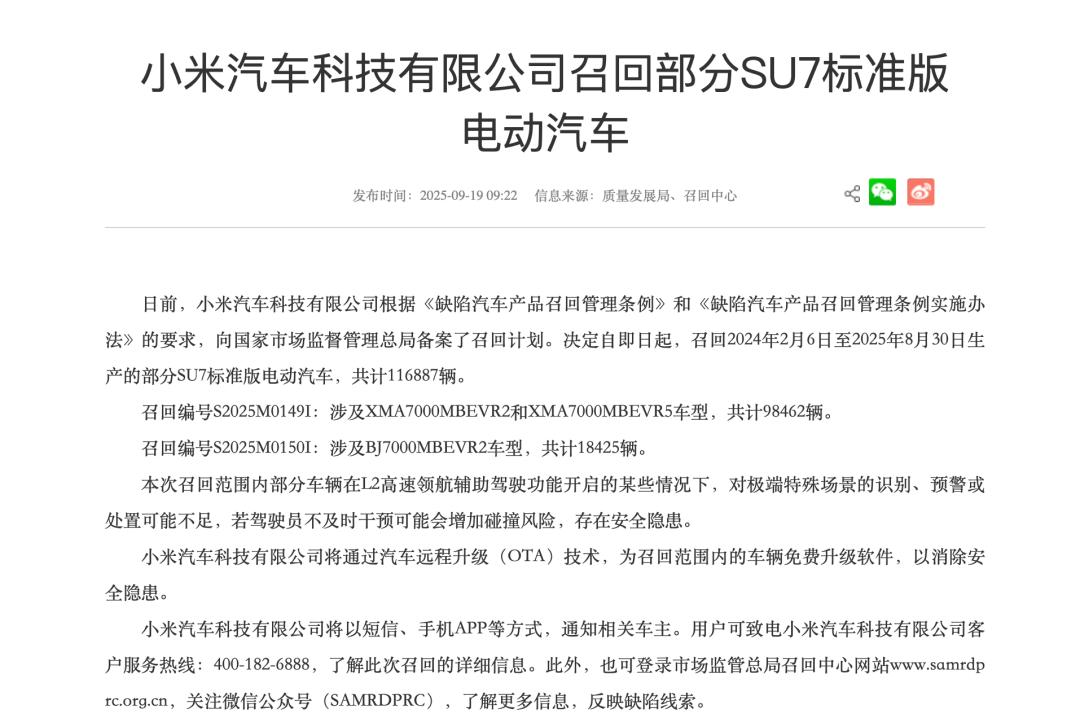
谁在模糊OTA与召回的边界?
Di Yi Cai Jing· 2025-09-20 07:58
Core Viewpoint - The recall of Xiaomi's SU7 vehicles, involving 117,000 units, aims to enhance the reliability of the advanced driving assistance system, despite not requiring physical part replacements, raising questions about the nature of recalls and the role of OTA upgrades in addressing safety issues [2][4]. Group 1: Recall Definition and Implementation - A recall is predicated on the existence of defects, and OTA upgrades are a method of executing recalls, which can improve efficiency and reduce costs [3][8]. - The National Market Supervision Administration has received 4,047 reports of OTA upgrade activities affecting 486 million vehicles by the end of 2024, with 19 OTA recalls involving 4.068 million vehicles in 2024, marking a 246.8% increase from the previous year [3]. - The definition of a recall includes actions taken by manufacturers to eliminate defects in sold vehicles, which can involve free repairs, replacements, or refunds [4]. Group 2: Nature of Xiaomi's Recall - Xiaomi's SU7 recall is classified as a passive recall, initiated under the investigation of the National Market Supervision Administration, rather than an active recall [5]. - The recall number for Xiaomi's SU7 indicates a safety defect, categorized as "I" for investigation-influenced recall, contrasting with other manufacturers like FAW Toyota and Xpeng, which have conducted active recalls [6]. Group 3: OTA vs. Recall - OTA upgrades are not equivalent to recalls and should not replace them; they are merely a technical service method that can be used to address defects [9]. - Tesla exemplifies the use of OTA upgrades to resolve defects, having recalled 1.1 million vehicles in 2023, primarily addressing software issues through OTA rather than physical recalls [7]. - The National Market Supervision Administration emphasizes that while OTA can enhance recall completion rates and reduce costs, it should not be used to evade the responsibilities associated with recalls [9].
小米召回超11万辆SU7,软件OTA成智能汽车召回常见方式
2 1 Shi Ji Jing Ji Bao Dao· 2025-09-19 14:26
Core Points - Xiaomi Auto announced a recall of 116,887 units of its SU7 standard electric vehicles due to safety concerns related to the L2 highway navigation assistance feature [2] - The recall is being conducted through over-the-air (OTA) software updates, eliminating the need for vehicle owners to visit service centers [3][8] - The recall was initiated in compliance with the regulations set by the National Market Supervision Administration [2] Group 1: Recall Details - The recall affects vehicles produced between February 6, 2024, and August 30, 2025, due to insufficient recognition and response to extreme scenarios, which may increase collision risks [2] - Vehicle owners will be notified via SMS and mobile apps regarding the recall and the necessary software updates [3] Group 2: Software Update Features - The OTA update requires upgrading the vehicle's system to Xiaomi HyperOs 1.10.0, which includes enhancements to the speed control strategy and parking assistance features [5] - The update optimizes the vehicle's performance on highways and urban fast roads, improving the experience of avoiding large vehicles and dynamically adjusting target speeds [5] Group 3: Industry Context - The trend in automotive recalls is shifting from mechanical issues to software and algorithm-related problems, highlighting the importance of intelligent driving systems [7] - Previous recalls by Xiaomi and Tesla also involved software issues, indicating a growing concern over "invisible hazards" in vehicle safety [8][11] - The speed and transparency of the recall process are crucial for maintaining consumer trust, as demonstrated by Xiaomi's quick response time compared to industry averages [12]

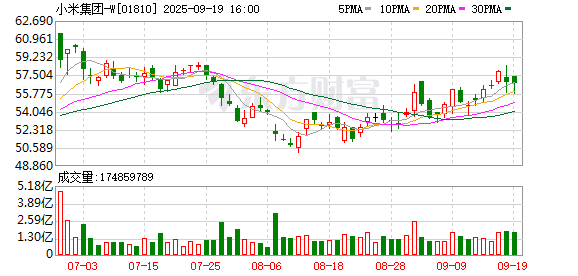
小米汽车召回11.7万辆SU7标准版,未来OTA形式召回或成新常态
Xin Hua Cai Jing· 2025-09-19 04:14
Core Viewpoint - Xiaomi Auto Technology Co., Ltd. has initiated a recall of 116,887 units of its SU7 standard electric vehicles due to potential safety risks associated with the L2 highway navigation assistance feature [2][5] Group 1: Recall Details - The recall affects vehicles produced between February 6, 2024, and August 30, 2025 [2] - The identified issue involves insufficient recognition, warning, or handling of extreme scenarios, which may increase the risk of collision if the driver does not intervene promptly [5] - Xiaomi will utilize over-the-air (OTA) technology to provide free software upgrades to the affected vehicles, eliminating the need for owners to visit service centers [5] Group 2: Regulatory Context - Since mid-2023, the regulatory environment for intelligent vehicles has tightened, with a focus on production consistency and recall management [6] - A joint notice from the State Administration for Market Regulation and the Ministry of Industry and Information Technology emphasizes the need for thorough defect investigations and stricter management of intelligent connected electric vehicles [6] - The notice mandates that companies must accurately report key information in the vehicle qualification certificate system and adhere to strict management of OTA upgrade activities [6] Group 3: Industry Implications - Industry experts suggest that OTA recalls should not be viewed as a temporary fix but must be thoroughly validated before implementation [7] - There is a pressing need to address non-compliance issues in the rapidly evolving industry, shifting the focus from functionality to safety and compliance [7] - The increased regulation of software quality management and OTA recalls may become a new norm in the industry [8]
