first - in - class

Search documents
首创新药时代:2025年FDA新药全景透视
3 6 Ke· 2026-01-04 04:56
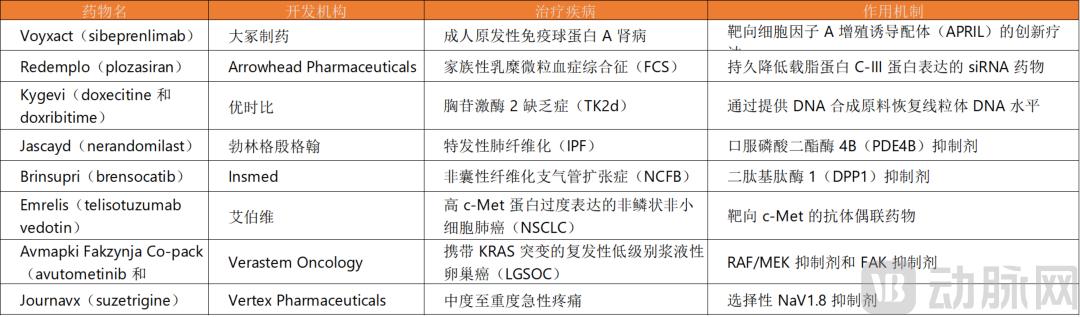
Core Insights - The FDA's CDER approved 44 new drugs by 2025, with over half being "first-in-class" drugs, indicating a shift from "incremental" to "disruptive" treatment paradigms in drug development [1][3][24] - The rise of small molecules continues, but their development is evolving from broad inhibition to precision modulation, enhancing efficacy while reducing side effects [6][7][9][10] First-in-Class Drugs - The approval of "first-in-class" drugs is driven by unmet clinical needs, particularly in rare and complex chronic diseases, where existing treatments are inadequate [3][4] - Brinsupri (brensocatib) is a notable example, targeting Dipeptidyl Peptidase 1 (DPP1) to address non-cystic fibrosis bronchiectasis, providing a new mechanism of action that significantly improves patient outcomes [3][20] - Eight drugs received breakthrough therapy designation, reflecting their innovative mechanisms and potential for substantial clinical improvement [5] Small Molecule Innovations - Small molecules accounted for 66% of new drug approvals, maintaining their central role in drug development while shifting towards precision approaches [6][10] - Aficamten (Myqorzo) exemplifies this trend as a selective allosteric modulator for obstructive hypertrophic cardiomyopathy, demonstrating improved safety and efficacy [7] - Covalent drugs, such as Zegfrovy (sunvozertinib), show promise in overcoming resistance issues by forming stable bonds with targets, enhancing therapeutic effectiveness [8] Peptide and Nucleic Acid Therapies - Peptide and nucleic acid therapies are emerging as significant players, with multiple innovative drugs approved in 2025, marking a shift towards RNA-targeted treatments [10][11] - Qfitlia (fitusiran) offers a revolutionary preventive solution for hemophilia by significantly reducing annual bleeding rates [10][12] - Dawnzera (donidalorsen) provides a long-acting preventive treatment for hereditary angioedema, demonstrating substantial reductions in attack frequency [11] Antibody-Drug Conjugates (ADCs) - ADCs are evolving beyond cancer treatment, with Datroway (datopotamab deruxtecan) showcasing innovative mechanisms and expanding indications [14][15] - Datroway's "bystander effect" allows it to target heterogeneous tumor populations effectively, improving treatment outcomes in breast cancer and non-small cell lung cancer [15][16] Future Directions - The landscape of drug development is shifting towards a broader understanding of drug value, emphasizing patient outcomes and treatment paradigms over traditional sales metrics [19][23] - The integration of advanced technologies like AI and gene editing into drug development processes is expected to yield therapies that fundamentally alter disease progression [24]

维立志博康小强:不卷PD-1,领跑肿瘤免疫治疗2.0 | 进击的创新药企
Jing Ji Guan Cha Wang· 2025-10-10 08:58
Core Insights - The article discusses the rise of innovative drug companies in China, particularly in the field of cancer immunotherapy, as they shift from following trends to pioneering original research and development [2] Company Overview - Leads Biolabs, a Chinese company focused on tumor immunotherapy, is currently in clinical stages and aims to address diseases that existing PD-(L)1 therapies cannot treat [3][5] - The company has 14 candidate innovative drugs, with 4 in the top three of global clinical progress, potentially becoming first-in-class drugs [5] Market Context - The PD-(L)1 target has become highly competitive, with 20 approved monoclonal antibodies in China, yet the response rate for PD-(L)1 monotherapy is only about 20%, leaving a significant portion of patients without effective treatment [4][10] - The global sales of the PD-1 drug "K" reached approximately $32.056 billion in 2024, highlighting the lucrative nature of immunotherapy [3] Strategic Focus - The company has chosen to focus on LAG-3 and other targets instead of PD-(L)1, aiming to develop unique therapies that can address the limitations of existing treatments [10][11] - The company has established three core technology platforms: IO2.0 (4-1BB), TCE (CD3), and ADC (antibody-drug conjugates), which are expected to define the future of oncology [10][16] Clinical Development - The PD-L1/4-1BB dual antibody (code LBL-024) is currently in Phase III clinical trials in China, showing promising results with a 75% objective response rate and a 92.3% disease control rate in a recent study [11][12] - The company plans to submit a biological product license application to the Chinese regulatory authority in Q3 2026, with conditional approval expected by Q2 2027 [17] Financing and IPO - Leads Biolabs has completed 8 rounds of financing, raising a total of 1.084 billion yuan, with a significant increase in valuation from 40 million yuan in 2015 to 3.1 billion yuan in 2024 [13][14] - The company went public in July 2025, initially aiming to raise $100 million but increasing the target to $189 million due to market conditions, achieving a record subscription rate on its first trading day [15] Future Outlook - The company aims to expand its indications from rare cancers to larger cancer types, with plans to target 8 indications this year and 10 next year [17] - The commercialization strategy involves a light asset approach, collaborating with CDMOs for production while considering establishing its own manufacturing base in the future [18]

医药“暖春”悬而未决:临床需求与市场周期博弈之解在哪?
2 1 Shi Ji Jing Ji Bao Dao· 2025-08-30 07:44
Core Viewpoint - The pharmaceutical industry, particularly biotech companies, is expected to experience a significant market upturn from late 2024 to mid-2025, supported by global market growth and strong performance in the Chinese pharmaceutical market [1][3]. Market Trends - The rapid growth of BD (business development) activities, the reopening of the Sci-Tech Innovation Board, and the performance of Hong Kong's secondary market indicate that the industry is entering a valuation recovery phase [1]. - Despite some biotech companies experiencing substantial stock price increases, many investors have not yet recouped their costs due to the timing of investments [1][2]. Investment Landscape - High-quality companies that address clinical needs are more likely to survive market downturns, while many biotech firms have failed to navigate the recent market challenges [2]. - The current secondary market appears prosperous, but from the perspective of primary market entrepreneurs, it is still in a winter phase [2]. Challenges and Opportunities - The difficulty of listing biotech companies in both China and the U.S. has led to diversified financing channels, with investors focusing on asset quality and clinical research data [3]. - The demand for high-quality, cost-effective products is increasing due to global aging populations and limited healthcare funding [4]. Global Positioning - Chinese innovators have significantly narrowed the development gap with the U.S., with a reported 38% year-on-year increase in overseas licensing deals, totaling $60.8 billion in the first half of 2025 [5][6]. - The shift from generic to original drug development in China is expected to have a profound impact on the global pharmaceutical market [6]. R&D Efficiency - China leads globally in R&D efficiency from "1 to 10," while the U.S. remains dominant in "0 to 1" development [6]. - The ability to produce unique products, particularly in ADC (antibody-drug conjugates), is attributed to China's strong engineering capabilities [9]. Future Growth Areas - The most promising research areas for capital investment are in immunology and metabolic/cardiovascular fields [7]. - The market is witnessing a divide, with leading companies leveraging innovation and digital empowerment, while smaller firms face greater pressure due to homogenized competition [6][10]. Strategic Directions - Companies are encouraged to explore new financing models, such as RWA (Real World Asset) tokenization, to better access markets [11]. - The focus on license-out opportunities and the promotion of inclusive healthcare are critical strategies for pharmaceutical companies [12].

从海外授权到NewCo,美元基金变相杀回中国创新药
Di Yi Cai Jing· 2025-08-27 13:02
Group 1 - The focus of US funds on Chinese innovative drugs has not diminished, but the approach has shifted to overseas asset placement to reduce compliance risks and enhance capital efficiency [1][5] - The recent surge in Hong Kong's 18A projects is driven by high-frequency BD collaborations, NewCo models, and mergers and acquisitions, fundamentally changing the underlying logic of the innovative drug sector [1][3] - In 2024, the number of innovative drugs under development in China is projected to reach 3,575, surpassing the United States and establishing China as a global leader in this area [3] Group 2 - The NewCo model has gained traction, particularly in oncology and autoimmune disease treatment, allowing Chinese companies to collaborate with US funds to establish new entities for global development [2][4] - The BD and NewCo strategies are key drivers of the innovative drug market, with significant overseas licensing deals becoming commonplace, exceeding $1 billion [3][4] - The NewCo model allows Chinese pharmaceutical companies to retain equity while receiving upfront payments, milestones, and revenue sharing, thus mitigating direct investment risks for US funds [4][5] Group 3 - The investment landscape for US funds in China is evolving, with a focus on incubating NewCo and injecting assets into these entities to avoid direct investment risks associated with Chinese companies [5][6] - Despite a decrease in direct investments by US funds in Chinese biotech, the understanding of the market has deepened, leading to a strategic shift towards acquiring Chinese assets and forming US-based companies [6][7] - The trend of Chinese innovative drugs going global is accelerating, with an emphasis on having clear "going out" strategies to attract international partnerships and acquisitions [8][9] Group 4 - The current focus of capital is on large products and indications, particularly in oncology and autoimmune diseases, with a notable trend towards metabolic drugs driven by successful GLP-1 products from multinational companies [9][10] - The innovative drug market in China is increasingly recognized for its potential to be acquired by global pharmaceutical companies, moving away from a reliance on domestic sales and channels [8][9]

创新药行情还没结束!华福证券陈铁林:国内将催生数家具有全球竞争力的大型药企
券商中国· 2025-07-19 07:48
Core Viewpoint - The current surge in China's innovative drug sector is supported by long-term industry trends and has entered a harvest phase after over a decade of policy and capital market support [1][3]. Group 1: Industry Trends - The innovative drug market is experiencing a significant uptrend, driven by favorable industry cycles and business development (BD) transactions [2]. - Since the reform of the drug review system in 2014, China's innovative drug sector has become the second-largest source of innovative drugs globally, following the U.S. [3][7]. - The upcoming expiration of patents for major U.S. pharmaceutical products will create demand for new drugs, positioning Chinese innovative drugs as attractive options due to their cost-effectiveness and advanced development timelines [3][6]. Group 2: Market Dynamics - The innovative drug sector has shown the highest growth among various sub-sectors in the pharmaceutical industry, with continuous revenue growth over several quarters [3]. - The improvement in macro liquidity has significantly boosted the valuation of Hong Kong-listed innovative drug companies, which had previously been undervalued [3][4]. Group 3: Competitive Position - China has cultivated a large pool of biopharmaceutical talent, ranking high globally in the number of graduates in related fields, which enhances its competitive edge in the industry [8]. - The large population and extensive healthcare infrastructure in China allow for rapid clinical trials, reducing clinical costs significantly compared to the U.S. [9]. Group 4: Future Outlook - The innovative drug sector is transitioning from quantitative to qualitative growth, with expectations of significant BD transactions and potential mergers and acquisitions in the coming years [13]. - The next 5-10 years are anticipated to be a period of explosive growth for Chinese innovative drugs, both domestically and internationally, with several companies expected to emerge as globally competitive players [13]. Group 5: Investment Strategy - For individual investors, focusing on high-growth sub-sectors and long-term holding strategies is recommended to capitalize on industry trends [14][15]. - Professional investors should concentrate on specific stocks, particularly during the research and development phase, and monitor BD transactions for potential investment opportunities [14].