提振消费

Search documents
“谷子”引流 服务“上新” 新供给推动线下零售回暖
Shang Hai Zheng Quan Bao· 2026-01-16 18:34
Core Viewpoint - The article highlights the recovery of offline retail driven by new supply and consumer engagement, particularly through popular products and experiential shopping environments. Group 1: Offline Retail Trends - The popularity of the "Right Right Sauce" character and related blind boxes has attracted significant consumer interest, with over 7,000 units sold in a month at a single store in Wuhan [4] - The national business conference emphasized "expanding domestic demand and boosting consumption" as a key focus for the year, enhancing confidence among retail operators [4] - New supply is creating demand, as seen in the rise of snack retail stores where consumers engage with products in innovative ways [4] Group 2: Emerging Retail Formats - By 2025, retail channels are expected to show significant differentiation, with traditional supermarkets under pressure while new formats like bulk snack stores and membership supermarkets are experiencing growth [5] - The parent company of "Snack Busy" is set to become the first bulk snack stock in Hong Kong, with plans to expand its store count to 19,500 by September 2025, focusing on store expansion and supply chain optimization [6] - The snack retail leader, Wancheng Group, anticipates a continued market recovery in 2026, emphasizing refined operations and innovative consumer experiences [6] Group 3: Traditional Retail Adaptation - Traditional retail companies are adapting by enhancing service and product offerings to meet changing consumer trends, such as transforming some supermarkets into food-themed stores [7] - Wu Shang Group is entering the membership retail space, focusing on personalized consumer needs and plans to open two new stores by 2026 based on the success of its first membership store [7] - The integration of cultural and experiential elements in retail is becoming a focus, with plans to introduce more popular IP content and toys in the future [7] Group 4: Consumer Supply Shift - Industry experts note a shift in consumer supply from "scale expansion" to "quality enhancement and scene refinement," with opportunities arising in green and health-conscious consumption [8] - The combination of supply-side innovation and policy support is expected to further boost offline retail recovery [8]


静水流深:茅台“不变”中的战略定力
Zhong Guo Jing Ji Wang· 2025-12-23 00:02
Core Viewpoint - The article emphasizes that despite the fluctuations in the liquor market, Kweichow Moutai (600519) remains strategically focused on quality and long-term value, adapting to the evolving industry landscape while maintaining its core principles [1][8]. Group 1: Market Dynamics - The price of Moutai liquor has been volatile, with the retail price of Feitian Moutai reported at 1827 yuan per bottle, reflecting an increase in both price and sales [2]. - The liquor industry is undergoing a deep adjustment phase, characterized by high channel inventory, price discrepancies, and slowing growth, which presents challenges for many liquor companies [2]. - Moutai's management acknowledges the existence of challenges but emphasizes the importance of recognizing structural opportunities while maintaining brand value [2]. Group 2: Supply and Demand Management - Moutai has maintained normal shipments of 500ml Feitian Moutai, while reducing allocations for certain non-standard products by 30%-50% [3]. - The company is focused on adapting supply to meet demand, ensuring that product releases are based on market conditions rather than blanket decisions [3]. Group 3: Innovation and Consumer Engagement - Moutai's approach to innovation is strategic, aiming to enhance real consumption and cultural heritage rather than pursuing innovation for its own sake [4]. - The company is building a brand ecosystem that resonates with younger consumers through immersive experiences and digital engagement, transitioning from merely selling liquor to promoting a lifestyle [4]. - Moutai is also addressing digital challenges by collaborating with e-commerce platforms to enhance consumer access and ensure product authenticity [4]. Group 4: Cultural and Ecological Commitment - Moutai is reinforcing its cultural identity by integrating traditional craftsmanship with modern aesthetics, promoting Chinese liquor culture through innovative products [5]. - The company is committed to ecological sustainability, implementing a "green development" strategy that focuses on environmental protection and sustainable practices [6]. Group 5: Long-term Strategic Vision - Moutai's stability is rooted in its deep systemic capabilities, including ecological protection, production capacity, and talent development [6][7]. - The company is actively enhancing its talent pool through partnerships with educational institutions, ensuring a blend of traditional brewing techniques and modern innovation [7]. - Moutai's consistent approach aligns with national strategies to boost domestic demand, positioning the company to respond effectively to market fluctuations [7][8].

赵刚主持召开省政府第三十七次常务会议
Shan Xi Ri Bao· 2025-11-06 00:25
Group 1 - The provincial government is focusing on addressing issues raised by the central environmental protection inspection, emphasizing the importance of effective rectification and the need for a comprehensive approach to environmental governance [1] - The government plans to implement a special action to boost consumption, leveraging national policies and promoting various consumption activities to stabilize major consumption sectors and enhance service consumption potential [2] - A draft proposal for deepening the provincial zero-based budgeting reform has been discussed, aiming to improve budget management and ensure financial resources are allocated effectively to strategic tasks and basic livelihood guarantees [2] Group 2 - The meeting also addressed other matters, indicating ongoing governance and administrative activities within the provincial government [3]
食品饮料行业周报:育儿补贴落地,长期有望撬动整体消费-20250804
Guohai Securities· 2025-08-04 13:33
Investment Rating - The report maintains a "Recommended" rating for the food and beverage industry [1][4]. Core Insights - The implementation of the national childcare subsidy is expected to stimulate overall consumption in the long term, particularly benefiting the infant food sector [8]. - Recent policy signals from the Political Bureau meeting indicate a commitment to proactive fiscal and monetary policies aimed at boosting domestic demand and consumption [5]. - The food and beverage sector has underperformed compared to the broader market, with a decline of 1.45% over the past two weeks, while the Shanghai Composite Index rose by 0.72% [3][17]. Summary by Sections Industry Performance - Over the past year, the food and beverage sector has shown a 5.7% increase, but it has lagged behind the Shanghai Composite Index in the short term [3][17]. - The health products segment experienced the smallest decline of 0.01%, while processed foods and meat products fell by 0.16% and 0.30%, respectively [17]. Key Companies and Recommendations - Recommended stocks in the liquor segment include Kweichow Moutai, Wuliangye, Luzhou Laojiao, Shanxi Fenjiu, and others [28]. - In the consumer goods segment, recommended stocks include BaiRun Co., WeiLong, Salted Fish, Nongfu Spring, and others [28]. Market Trends - The report highlights a significant drop in the number of banquet reservations for graduation ceremonies, indicating a shift in consumer behavior due to recent restrictions [5]. - New product launches by companies like Qiaqia are accelerating, with a focus on innovative and differentiated products to capture market share [9]. Financial Performance - Dongpeng Beverage reported a revenue of 10.737 billion yuan for H1 2025, a year-on-year increase of 36.4%, with a net profit of 2.375 billion yuan, up 37.2% [10]. - The report notes that the beverage market is facing pressure from price wars, particularly in the bottled water segment, impacting profitability [11]. Valuation Metrics - As of August 1, 2025, the dynamic price-to-earnings ratio for the food and beverage sector stands at 20.23x, indicating a relatively low valuation compared to historical averages [23].



收入水平全国第三,浙江如何提振消费?|活力中国调研行
2 1 Shi Ji Jing Ji Bao Dao· 2025-08-04 08:05
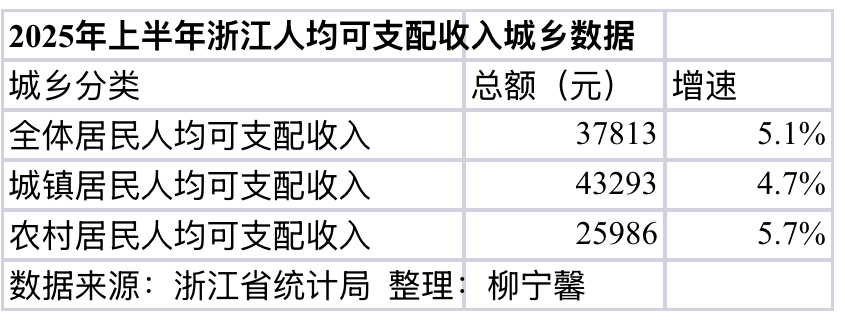
Core Viewpoint - The article emphasizes the importance of effectively releasing domestic demand potential in China, particularly through enhancing consumer spending and improving living standards, with a focus on Zhejiang province as a case study for successful implementation [1][5]. Group 1: Income Growth and Consumer Demand - In the first half of the year, the per capita disposable income of all residents in Zhejiang reached 37,813 yuan, a nominal increase of 5.1% year-on-year, ranking third nationally [2][3]. - Urban residents in Zhejiang had a per capita disposable income of 43,293 yuan, growing by 4.7%, while rural residents saw a higher growth rate of 5.7%, with their income reaching 25,986 yuan [2][3]. - The income disparity between urban and rural residents in Zhejiang is narrowing, with an income ratio of 1.67, indicating a reduction in consumer concerns and a stronger motivation for spending [2][5]. Group 2: Regional Economic Development - Zhejiang is recognized as the first province in China to establish a common prosperity demonstration zone, aiming to achieve common prosperity by 2035, with plans to reach income levels comparable to developed economies [5][6]. - The "Ten Million Project" aims to promote rural industrial integration and reduce development gaps between regions, while ensuring high-quality public services are shared [5][6]. Group 3: Innovative Consumption Scenarios - Zhejiang has launched a summer consumption promotion plan focusing on cultural tourism, sports events, night economy, and dining services, aiming to create distinctive consumption brands [8][9]. - The integration of various consumption scenarios, such as combining shopping with cultural and entertainment experiences, is a key focus for enhancing consumer engagement, particularly among younger demographics [8][9]. Group 4: Rural Revitalization and New Business Models - In rural areas, innovative business models are emerging, such as the transformation of old buildings into creative workshops and cafes, which have significantly boosted local income and tourism [9][10]. - The development of a "homestay + health + culture" industry chain in rural areas has led to a substantial increase in local employment and income, demonstrating the potential of rural tourism [10].