化学材料

Search documents
烟台今年入选省级重点项目152个总投资首次突破万亿元大关
Qi Lu Wan Bao· 2026-01-30 11:23
Core Insights - Yantai City has been selected for 152 provincial key projects this year, with total investment exceeding 1 trillion yuan for the first time [1][3] - The city aims to lead the province in economic development by focusing on key project construction as a primary driver [1] - The construction of key projects has shown significant progress, with investments exceeding annual targets and a strong emphasis on new industries [1][3] Group 1: Project Management and Investment - Yantai City has implemented a "list management and responsibility implementation" approach for key projects, ensuring accountability and timely progress [1] - The city has achieved a total investment of 1,214.5 million yuan in 139 provincial key projects and 1,030 million yuan in 200 municipal key projects, both exceeding annual goals [1] - The city has maintained a leading position in the province for four consecutive years in terms of the number and scale of major projects [1][3] Group 2: Resource Allocation and Support - The city has adopted a "resources follow projects" strategy, ensuring precise support for land, funding, and energy resources for key projects [2] - In 2025, Yantai City will secure over 19,000 acres of land for key project construction, meeting all land needs for significant projects [2] - The city has successfully obtained over 50 billion yuan in various policy funds, marking a historical high for financial support [2] Group 3: Future Project Planning - Yantai City has a robust pipeline of projects, with 300 municipal key projects totaling over 600 billion yuan and an annual planned investment exceeding 700 million yuan [3] - The city is home to four projects with investments exceeding 1 billion yuan and 26 projects with investments over 100 million yuan, indicating a solid project construction framework [3] - These projects are expected to provide strong support for investment growth and high-quality development in the next 3-5 years [3]
烟台今年入选省级重点项目152个,总投资首次突破万亿元大关
Qi Lu Wan Bao· 2026-01-26 08:21
Core Viewpoint - Yantai City has achieved significant progress in its economic and social development, with a focus on key projects that have led to a total investment exceeding 1 trillion yuan for the first time in 2025 [1][3]. Group 1: Key Project Development - Yantai City has selected 152 provincial key projects for 2025, with a total investment surpassing 1 trillion yuan, marking a historical milestone [1][3]. - The city has implemented a "list management and responsibility implementation" approach for key projects, resulting in advanced progress and improved quality in project construction [1]. - In 2025, all 139 provincial key construction projects are expected to commence and complete investments of 121.45 billion yuan, while 200 municipal key projects will also meet their investment targets of 103 billion yuan [1]. Group 2: Resource Allocation and Support - The city has adopted a strategy of "resources following projects," ensuring precise support for land, funding, and energy resources to facilitate the early implementation and production of key projects [2]. - In 2025, over 19,000 acres of land have been secured for key project construction, ensuring that land needs for major projects like the nuclear power plant and railway upgrades are met [2]. - The city has successfully secured over 50 billion yuan in various policy-based funding, setting a historical record for financial support [2]. Group 3: Future Investment Outlook - Yantai City has a robust project pipeline, with 300 municipal key projects totaling over 600 billion yuan and an annual planned investment exceeding 70 billion yuan [3]. - The presence of four projects with investments exceeding 1 billion yuan and 26 projects over 100 million yuan indicates a solid foundation for future investment growth [3]. - The project construction framework of "billion-level leadership, hundred-million support, and ten-million drive" is expected to provide strong momentum for Yantai's high-quality development in the next 3-5 years [3].
广东英联包装股份有限公司关于子公司江苏英联复合集流体与LG化学签署《联合实验室战略协议》暨复合集流体项目进展的公告
Shang Hai Zheng Quan Bao· 2026-01-22 19:50
Core Viewpoint - Jiangsu Yinglian Composite Fluid Co., Ltd. has signed a strategic agreement with LG Chem to establish a joint laboratory, aiming to enhance collaboration in the development of innovative polymer materials for composite fluids used in lithium batteries, thereby accelerating the global lithium battery innovation materials market [2][3]. Group 1: Project Overview - Jiangsu Yinglian is focused on the research, production, and sales of composite aluminum and copper foils for new energy vehicle lithium batteries, with a total planned investment of 3.089 billion RMB, targeting an annual production capacity of 100 million square meters of composite aluminum foil and 500 million square meters of composite copper foil [3]. - The composite aluminum and copper foil products have been tested by downstream clients in various battery applications, including power batteries, consumer batteries, and energy storage batteries, with some achieving deeper cooperation with leading clients [3]. Group 2: Cooperation Background - LG Chem, established in 1947, is a diversified global leader in science and is a subsidiary of LG Group, ranking fourth among the "25 Most Valuable Chemical Brands" in 2025, with a projected global sales revenue of approximately 48.9 trillion KRW in 2024 [4]. - The joint laboratory aims to leverage the strengths of both companies to develop next-generation polymer materials for composite fluids, focusing on high-performance applications in lithium batteries [10]. Group 3: Agreement Details - The joint laboratory will be established with locations in both Gaoyou (for Jiangsu Yinglian) and Wuxi (for LG Chem), facilitating resource sharing and collaborative research on new products and technologies [7]. - The cooperation will include research on industry-leading technologies for lithium battery materials, addressing key performance indicators and development directions for next-generation products [10]. Group 4: Impact on the Company - The establishment of the joint laboratory is expected to positively influence the company's future development and aligns with its strategic planning, although it is not anticipated to have a significant impact on the current year's financial performance [11]. - The collaboration is designed to enhance the innovation and application of composite fluid materials, responding to the increasing market demand for high safety, high energy density, and high cycle life batteries [11].
“造小”的艺术,用分子构筑新材料
Xin Lang Cai Jing· 2025-12-22 00:52
Core Insights - A recent collaboration between Chinese and Dutch scientists has successfully synthesized a dynamic polymer with a distinct double-helix structure, inspired by the Shanghai Tower, marking a significant advancement in biomimetic smart materials [2][10] - The polymer exhibits dynamic behavior similar to natural proteins, allowing it to expand and contract with temperature changes, fully unwind under specific conditions, and degrade into absorbable small molecules, presenting new avenues for material development [2][4] Research Background - The research was conducted by the Nobel Prize-winning team at East China University of Science and Technology, inspired by the architectural design of the Shanghai Tower, which is the tallest building in China and the third tallest in the world [2] - The team aimed to create artificial polymers with similar geometric features and dynamic functions as biological helical polymers, which play critical roles in information storage and structural support in living organisms [2][3] Methodology - The researchers began with basic small molecules, using natural, biocompatible "molecular building blocks" like amino acids and disulfide bonds, connected through dynamic reversible chemical bonds to form stable helical structures [3] - Initial designs relied on weak interactions, leading to structural collapse under heat or environmental changes, but breakthroughs were achieved by combining dynamic covalent bonds with rigid amino acid backbones, resulting in a flexible yet stable helical structure [3][4] Applications - The new polymer demonstrates potential in biocompatible materials, suitable for next-generation wearable or implantable medical devices, capable of adapting to complex mechanical environments within the body and safely metabolizing after use [4] - Its excellent mechanical flexibility, biocompatibility, and complete degradability position it as an ideal candidate for applications in flexible neural interfaces, targeted drug delivery systems, and tissue engineering scaffolds [4] Broader Implications - The research highlights the importance of bridging physical laws and biological phenomena, showcasing how simple molecular components can lead to complex structures and functionalities, a principle that has driven significant scientific advancements [5][6] - The ongoing development of molecular machines and nanotechnology, as evidenced by previous Nobel Prize-winning work, underscores the potential for these innovations to revolutionize various fields, including medicine and environmental science [6][9]

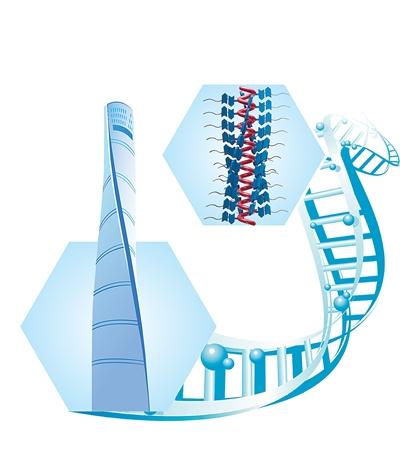
以上海中心大厦为设计灵感,科学家首次合成具有内外双层螺旋结构的动态高分子—— “造小”的艺术,用分子构筑新材料(国际科技前沿)
Ren Min Ri Bao· 2025-12-21 22:57
Core Insights - A recent collaboration between Chinese and Dutch scientists has successfully synthesized a dynamic polymer with a distinct double-helix structure, inspired by the Shanghai Tower, marking a significant advancement in biomimetic smart materials [1][2]. Research and Development - The research team, based at East China University of Science and Technology, was inspired by the unique aerodynamic stability of the Shanghai Tower, which is the tallest building in China and the third tallest in the world [1]. - The team aimed to create artificial polymers with similar geometric features and dynamic functions as natural helical polymers, which play critical roles in biological systems [1][2]. - Initial designs relied on weak interactions like hydrogen bonds, leading to structural collapse under heat or environmental changes. The breakthrough came from combining dynamic covalent bonds, particularly reversible disulfide bonds, with rigid amino acid backbones, resulting in a stable helical structure [2]. Applications and Potential - The synthesized polymer exhibits excellent mechanical flexibility, biocompatibility, and complete degradability, making it a promising candidate for next-generation wearable or implantable medical devices [2]. - Potential applications include flexible neural interfaces, targeted drug delivery systems, and tissue engineering scaffolds, which can adapt to complex mechanical environments within the body and safely metabolize after fulfilling their purpose [2]. Nanotechnology and Molecular Engineering - The research highlights the importance of bridging physical laws and biological phenomena, showcasing how simple molecular building blocks can lead to complex structures and functionalities [3]. - The concept of "molecular machines" has evolved, with previous advancements in molecular motors and vehicles, which can perform tasks at the nanoscale, indicating a growing field of molecular engineering [4][5]. Future Prospects - The ongoing development of nanorobots aimed at targeted cancer cell destruction represents a significant leap in molecular medicine, although challenges remain in enhancing specificity and penetration capabilities [6]. - The integration of artificial intelligence in molecular design and automated synthesis platforms is expected to accelerate the transition of these technologies into scalable applications across various sectors, including sustainable energy, smart wearables, precision medicine, and environmental management [6].
爱敬化学完成硬碳负极材料研发 推进全州工厂扩建
Shang Wu Bu Wang Zhan· 2025-12-10 18:23
Core Viewpoint - Aekyung Chemical has completed the research and development of hard carbon anode materials and plans to expand its production line at the Jeonju factory to meet the growing demand in the sodium-ion battery market [1] Industry Summary - Hard carbon is a material used for anodes in sodium-ion batteries, primarily applied in electric vehicles and energy storage systems [1] - The market for hard carbon anode materials is expected to grow at an annual rate of over 30%, driven by the expanding applications of lithium-ion and sodium-ion batteries [1] - The demand for hard carbon is anticipated to increase further due to material diversification and cost competitiveness of sodium-ion batteries [1] Company Summary - Aekyung Chemical aims to accelerate product testing with domestic and international clients to capture market leadership [1] - The company plans to implement a phased approach to expand production capacity and factory operations [1]
陶氏化学,全球首个“热管理材料科学实验室”揭幕
DT新材料· 2025-11-06 16:05
Core Insights - The establishment of the Cooling Science Studio in Shanghai marks a significant step for Dow in the thermal management materials sector, aiming to foster innovation in cooling technologies through collaboration with partners in the value chain [2][3]. Group 1: Laboratory Functions and Objectives - The Cooling Science Studio is designed for collaborative innovation, integrating three functional areas to provide comprehensive technical support and one-stop services throughout the product development lifecycle [5]. - It offers systematic evaluation and testing capabilities across key components in sectors such as consumer electronics, communications, and renewable energy, providing reliable data support for clients [5]. - The lab showcases diverse application capabilities and cross-industry demonstrations, allowing clients to assess various application processes to identify the most suitable solutions [5]. Group 2: Industry Context and Challenges - The rapid advancement of AI technology is reshaping various industries, creating significant opportunities while simultaneously posing severe challenges in thermal management due to exponential growth in computing power demands [3]. - There is an urgent need for innovative cooling technologies and thermal management materials that effectively manage thermal loads while ensuring long-term reliability and sustainability [3]. Group 3: Upcoming Events - The 6th Thermal Management Industry Conference and Exposition will focus on six major application themes, including data centers, new energy vehicles, humanoid robots, consumer electronics, eVTOL/unmanned aerial vehicles, and energy storage [7].

雅克科技:10月29日召开董事会会议
Mei Ri Jing Ji Xin Wen· 2025-10-30 23:10
Group 1 - The core point of the article is that Yake Technology (SZ 002409) held its 16th meeting of the 6th Board of Directors on October 29, 2025, to review proposals regarding the formulation and revision of certain governance systems [1] - For the first half of 2025, Yake Technology's revenue composition was as follows: electronic materials accounted for 59.95%, chemical materials for 30.27%, equipment leasing for 7.91%, and others for 1.88% [1]

MOF结构36年终获诺奖:当AI读懂化学,金属有机框架正迈向生成式研究时代
3 6 Ke· 2025-10-17 03:49
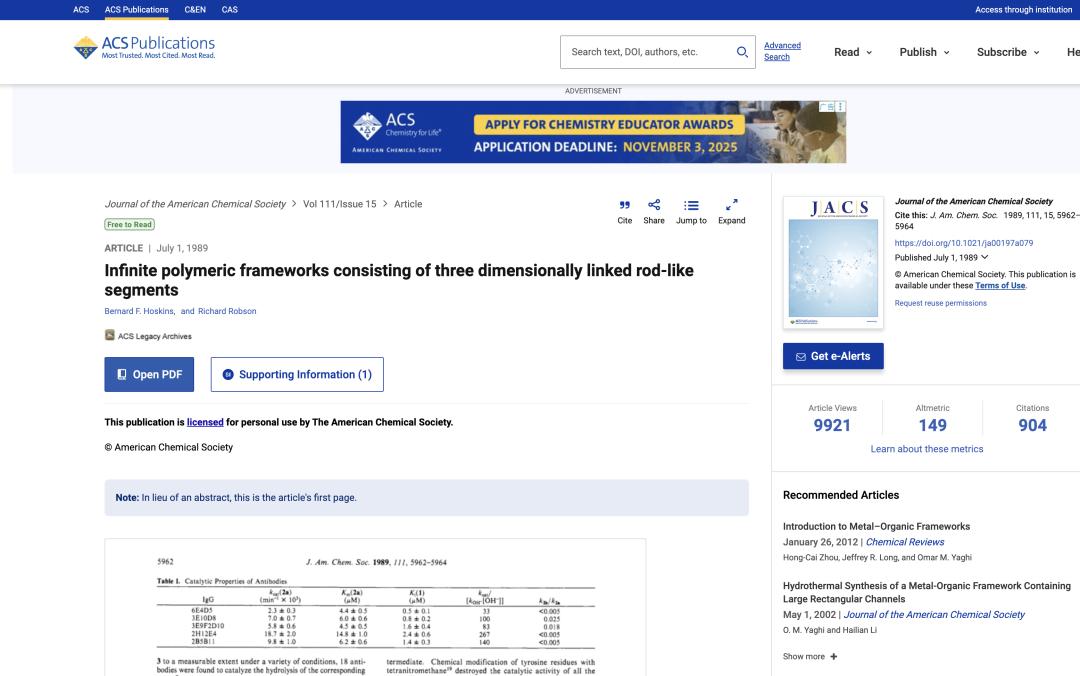
Core Insights - The 2025 Nobel Prize in Chemistry was awarded to researchers S. Kitagawa, Richard Robson, and Omar Yaghi for their contributions to the field of Metal-Organic Frameworks (MOFs), marking a significant milestone in over 30 years of research and development in this area [1][2][11] - The advancements in MOF research have transitioned from structural design to industrial applications, with artificial intelligence (AI) now playing a crucial role in reshaping the field [1][12] Group 1: Historical Development of MOFs - Richard Robson proposed the concept of three-dimensional coordination polymers in 1989, which laid the groundwork for the development of MOFs [3] - Over the next 15 years, Omar Yaghi and S. Kitagawa made significant breakthroughs in structural construction and functional regulation, establishing MOFs as a new class of porous materials [3][4] - The introduction of flexible frameworks and tunable pores by S. Kitagawa transformed MOFs from rigid materials to dynamic structures, enhancing their applicability [4] Group 2: Industrial Applications and Innovations - MOFs have shown potential in various applications, including gas storage, carbon capture, and biomedical fields, with commercial structures like the Zr-based UiO series being developed for high thermal stability [8][10] - The CALF-20 MOF, developed by the University of Calgary, has been utilized for carbon capture in cement production, demonstrating the material's effectiveness in challenging environments [10][11] Group 3: AI Integration in MOF Research - The integration of AI in MOF research has led to significant advancements, with a notable increase in publications on the topic since 2016, indicating a growing interest in the intersection of AI and MOFs [12][14] - Recent developments include the MOFFlow model, designed specifically for predicting MOF structures, and the MOFGen system, which utilizes various AI techniques for generating and validating MOF structures [21][24][26] - The modular and parameterizable nature of MOFs makes them ideal candidates for AI-driven research, allowing for a more systematic approach to material discovery and design [16][18]
002643,分拆上市新进展
Shang Hai Zheng Quan Bao· 2025-09-19 07:21
Core Viewpoint - Wanrun Co., Ltd. announced that its subsidiary, Yantai Jiumu Chemical Co., Ltd. (Jiumu Chemical), has received the acceptance notice from the Beijing Stock Exchange for its application to publicly issue shares and list on the exchange [1][3]. Company Overview - Wanrun Co., Ltd. holds 85 million shares of Jiumu Chemical, representing a 45.33% stake, making it the controlling shareholder [3]. - Jiumu Chemical, established in 2005, specializes in the research, production, and sales of OLED front-end materials and is recognized as a national key specialized and innovative "little giant" enterprise [4]. - Wanrun Co., Ltd. operates in four main sectors: environmental materials, electronic information materials, new energy materials, and life sciences and pharmaceuticals [4]. Financial Performance - Jiumu Chemical's revenue from 2022 to Q1 2025 was 706 million yuan, 878 million yuan, 962 million yuan, and 208 million yuan, respectively, with net profits of 197 million yuan, 203 million yuan, 246 million yuan, and 46 million yuan [5]. - The company has increased its R&D investment from 58.78 million yuan in 2022 to 83.03 million yuan in 2024, with R&D expenses accounting for 8.33%, 7.47%, and 8.63% of revenue in the respective years [5]. Market Position and Industry Outlook - Jiumu Chemical is expected to capture approximately 23% of the global OLED front-end materials market in 2024 [4]. - The demand for OLED front-end materials is anticipated to grow due to the increasing market penetration of OLED panels in consumer electronics such as smartphones and smart home products [4]. - Jiumu Chemical's overseas sales accounted for 92.69% of its main business revenue in 2024, with key markets including South Korea, Germany, and Japan [5]. Customer Concentration Risk - The company has a high customer concentration risk, with sales to its top five customers accounting for 72.93%, 71.40%, and 77.45% of its revenue from 2022 to 2024 [5].