
无人机

Search documents
拓竹科技创始人「炮轰」大疆:人才都离开了,碰触了逆鳞
Xin Lang Ke Ji· 2025-11-17 05:45
Core Viewpoint - The founder of Tuozhu Technology, Tao Ye, expressed concerns about talent loss to competitors, particularly in the context of a recent investment by his former employer in a 3D printing company, indicating a shift in competitive dynamics within the industry [1][3][4]. Group 1: Talent Competition - Tao Ye believes that the recent investment by the former employer is largely due to talent migration, which has become a significant issue for the company [1][3]. - He noted that the competitive landscape has changed, with candidates increasingly choosing Tuozhu over the former employer, which may have prompted a reaction from the latter [1][4]. - The founder emphasized that the competition for talent is critical in the tech industry, and the loss of employees could indicate deeper issues within the former employer [5][6]. Group 2: Industry Preparedness - Tuozhu Technology has been preparing for increased competition in the 3D printing sector for the past five years, anticipating a more intense competitive environment by the end of 2023 [2][7]. - The company secured funding at the end of 2022, despite not being in immediate need of capital, as a proactive measure against future challenges [2][7]. - Tao Ye expressed confidence in Tuozhu's product capabilities, asserting that the industry ultimately relies on product quality, which the company believes it can deliver [2][7]. Group 3: Market Dynamics - The founder pointed out that the current market conditions have led to a fear of missing out (FOMO) among investors, which has resulted in high valuations for projects associated with the former employer [4][5]. - He suggested that the former employer's strategy appears to be more about aggressive competition rather than value investment, as indicated by their choice of investment targets [4][5]. - The competitive pressure is expected to increase as more players enter the market, making it essential for companies to focus on product development and innovation [2][7].
拓竹科技创始人“炮轰”大疆:人才都离开了,碰触了逆鳞
Xin Lang Ke Ji· 2025-11-17 04:26
Core Viewpoint - The founder of Tuozhu Technology, Tao Ye, expressed concerns about competition from DJI in the 3D printing sector, indicating that the recent investment by his former employer in a 3D printing company is a reaction to talent loss to Tuozhu [1][3][4]. Group 1: Talent Competition - The shift in DJI's attitude towards Tuozhu is attributed to increased competition for talent, with candidates choosing Tuozhu over DJI despite similar compensation [1][4]. - Tao Ye emphasized that the competition for talent is critical in the tech industry, and the loss of talent from DJI suggests deeper issues within the company [5][6]. Group 2: Market Dynamics - The investment by DJI in a 3D printing company is seen as a strategic move rather than a value investment, indicating a competitive response to Tuozhu's growth [4][5]. - The capital market's current enthusiasm for "DJI-related" projects has led to a surge in entrepreneurship, with former DJI employees starting their own ventures and attracting talent from DJI [4][5]. Group 3: Preparedness and Strategy - Tuozhu Technology has been preparing for increased competition for the past five years, anticipating a significant market shift by the end of 2023 [2][6][7]. - The company secured funding at the end of 2022, despite not needing it at the time, as a proactive measure against future challenges [2][7]. - Tao Ye expressed confidence in Tuozhu's product capabilities, asserting that the 3D printing industry ultimately relies on product quality [2][7].
四川安擎无人机科技有限公司成立 注册资本100万人民币
Sou Hu Cai Jing· 2025-11-16 21:12
天眼查App显示,近日,四川安擎无人机科技有限公司成立,法定代表人为何建,注册资本100万人民 币,经营范围为一般项目:航空运营支持服务;智能无人飞行器制造;智能无人飞行器销售;人工智能 行业应用系统集成服务;人工智能硬件销售;人工智能公共数据平台;人工智能通用应用系统;人工智 能双创服务平台;人工智能基础软件开发;人工智能基础资源与技术平台;劳务服务(不含劳务派 遣);技术服务、技术开发、技术咨询、技术交流、技术转让、技术推广。(除依法须经批准的项目 外,凭营业执照依法自主开展经营活动)。 ...
上海金山:着力打造现代化转型新高地
Zhong Guo Xin Wen Wang· 2025-11-16 13:04
Core Insights - Jinshan District is focusing on transforming its industrial structure and improving its image, aiming to shed outdated labels associated with pollution and underdevelopment [1][2] - The district's GDP is projected to exceed 120 billion yuan (approximately 12 billion USD) in 2024, with a per capita GDP of 21,500 USD [1] - Jinshan is recognized for its manufacturing capabilities, with industrial output surpassing 300 billion yuan (approximately 30 billion USD) and several industries being designated as national-level characteristic industrial clusters [1] Economic Development - The district is undergoing a significant transformation with a focus on modernizing its industrial base, including the launch of major projects such as the Shanghai Petrochemical's technical upgrades and the establishment of a new energy project by Lexus [1] - Jinshan has been successful in attracting high-tech agricultural projects and has received multiple national honors for its advancements in agricultural technology and rural development [2] Environmental and Social Initiatives - Jinshan District is leading in green manufacturing initiatives and has been recognized as a national ecological civilization demonstration area, maintaining high public satisfaction regarding environmental quality [2] - The district is implementing rural revitalization strategies, with several towns being recognized for their innovative approaches to rural development and environmental conservation [2] Future Outlook - Looking ahead, Jinshan aims to enhance its role as a growth engine for Shanghai's economy and a key player in the Yangtze River Delta's integrated development [3] - The district is committed to furthering its transformation strategy, focusing on emerging industries and innovation to solidify its position as a modern urban area [3]
青少年选手超七成 首届世界无人机足球锦标赛启幕
Xin Hua Wang· 2025-11-16 03:09
Core Points - The first World Drone Football Championship, organized by the Fédération Aéronautique Internationale (FAI), has opened in Shanghai, marking it as the first international Class A drone football event globally [1][3] - The drone football project combines drone technology with traditional football, where participants control drones equipped with spherical protective frames to score by shooting a drone football into the opponent's goal [1][3] - The competition features real-time 5v5 or 3v3 team matches, showcasing precise flying and tactical cooperation, blending competitive sports with innovative technological breakthroughs [1][3] Participation and Demographics - The championship includes two main categories, F9A-A and F9A-B, with 46 teams from 18 countries and regions, including France, Germany, Japan, Singapore, Turkey, and Australia [3] - Over 70% of the participants are youth pilots, and female pilots account for 16.9% of the total [3] - China will field four teams in the competition, with the finals scheduled for November 18 [3] Related Events and Exhibitions - The second Shanghai Science and Technology Sports Expo is being held concurrently, featuring multiple domestic drone-related companies [5] - The expo showcases Shanghai's unique sports projects and offers product displays and interactive experiences, enhancing the convenience and service quality of the event [5] - Attendees can enjoy close-up views of the international championship and participate in interactive areas to experience emerging tech sports like drone football and robot combat [5]


首届世界无人机足球锦标赛启幕
Jie Fang Ri Bao· 2025-11-16 00:04
Core Points - The 2025 World Drone Football Championship opened in Shanghai, featuring 46 elite teams from 18 countries and regions across four continents competing for the highest honor in "aerial football" [1] - This event is the first international Class A drone football competition organized by the Fédération Aéronautique Internationale (FAI), combining drone technology with traditional football [1] - The championship includes two main categories, F9A-A and F9A-B, with a significant youth participation rate of over 70%, and female participants making up 16.9% of the competitors [1] Group 1 - The event showcases real-time 5v5 or 3v3 team matches, emphasizing precision flying and tactical cooperation in a closed low-altitude environment [1] - Teams from countries such as France, Germany, Japan, Singapore, Turkey, and Australia are participating, with the host country China fielding four teams [1] - Hong Kong, Macau, and Taiwan teams are also participating in the championship [1]
第二十七届高交会打造科技盛宴 展高新产品魅力
Zhong Guo Xin Wen Wang· 2025-11-15 11:31
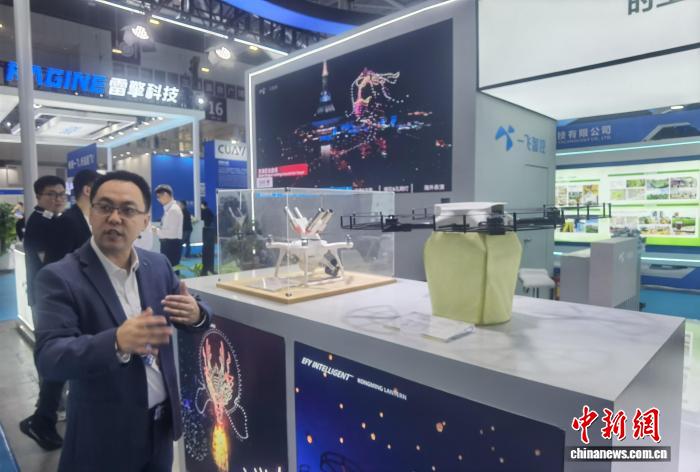
Core Insights - The 27th China International High-tech Achievements Fair is being held in Shenzhen, featuring over 5,000 renowned companies and international industry organizations from more than 100 countries and regions, showcasing cutting-edge technologies, products, and achievements [1] Group 1: Drone Technology - The newly launched "Agile Bee II Fireworks Edition Drone" by Yifei Zhikong has significantly increased its payload capacity from 2 to 6 fireworks, allowing for more efficient performances with fewer drones, thus reducing costs and enhancing visual effects [3] - The modular architecture of the drone has been upgraded with high compatibility interface designs, enabling flexible switching between various components like fireworks and Kongming lanterns, catering to diverse scenarios such as celebrations and cultural tourism [3] Group 2: Artificial Intelligence - Artificial intelligence, particularly AI agents and digital employees, is a focal point at the fair, driving digital productivity into a new phase [3] - The B2B Agent from Tanjin Technology integrates sales, marketing, outreach, and analysis capabilities, helping B2B companies enhance customer acquisition efficiency and conversion rates [4] - Tanjin Technology has also launched the overseas version of "Futern," a global sales AI agent that leverages global business data and localized insights to assist Chinese manufacturers in overcoming challenges in overseas markets [5] Group 3: Industrial Intelligence - Simo Technology, an AI unicorn nurtured by the Shenzhen-Hong Kong collaboration, has developed over 60 original industrial intelligent devices, achieving large-scale production of industrial-grade embodied intelligence and serving 300 leading companies globally [5] - The IndustryGPT, developed by Simo Technology, is the world's first industrial multimodal large model, encompassing various functionalities such as AIGC defect generation and multimodal defect detection, with its application range and influence continuously expanding [5]
华强北亮相高交会,新质生产力应用场景打造未来城市试验场
Nan Fang Du Shi Bao· 2025-11-15 10:22
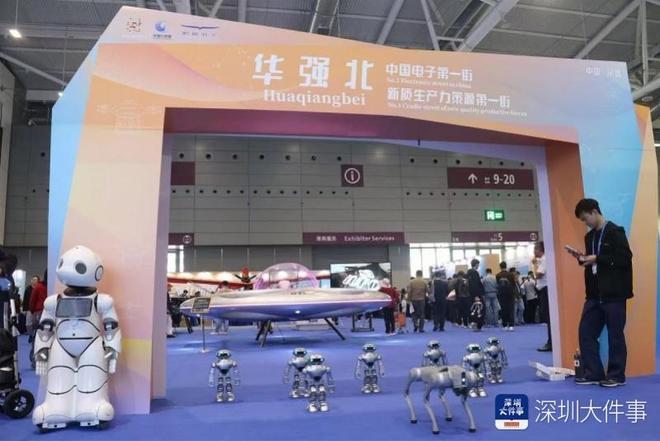
Core Insights - The 27th China International High-tech Achievements Fair opened in Shenzhen, showcasing Huqiangbei as a "future city experimental field" with a focus on new productive forces [1][3] Group 1: Low-altitude Economy - The exhibition featured a "city sky" panoramic display, highlighting a low-altitude economy operational network with smart air routes and emergency rescue capabilities [3] - A high-altitude drone demonstrated cleaning and firefighting tasks, showcasing the future safety standards for urban operations [3] Group 2: Robotics - Robots are becoming integral to urban life, with welcoming robots and inspection robots demonstrating advanced capabilities in customer service and complex terrain navigation [4][5] - A robot band performed, illustrating the artistic potential of robotics and their role as new urban participants [5] Group 3: Artificial Intelligence - AI applications were prominently displayed, including health monitoring devices and customizable laser engraving machines, emphasizing the practical capabilities of AI in various sectors [6] - The exhibition showcased a vision of AI as a "second brain" for future cities, integrating into public safety, healthcare, and retail [6] Group 4: Future Transportation - The exhibition presented a vision of integrated transportation with water planes, flying cars, and vertical take-off drones, indicating a shift towards multi-dimensional mobility [7] - Huqiangbei's display was not merely an exhibition but a demonstration of a functioning future, highlighting the rapid iteration and deployment of new technologies [7]
纵横股份与中国海洋大学深圳研究院签署战略合作框架协议
Zheng Quan Shi Bao Wang· 2025-11-15 05:44
Core Viewpoint - The 27th China International High-tech Achievements Fair was held in Shenzhen, where a strategic cooperation framework agreement was signed between Zongheng Co., Ltd. and the Shenzhen Research Institute of Ocean University of China, focusing on the integration of low-altitude and marine economies [1] Group 1: Strategic Cooperation - Zongheng Co., Ltd. and the Shenzhen Research Institute of Ocean University of China will collaborate on marine ranching scenarios [1] - The partnership aims to promote the deep integration of low-altitude economy and marine economy [1] Group 2: Research and Development Focus - The collaboration will focus on key scenarios such as deep-sea aquaculture feed transportation, security inspection, emergency communication, and maritime support [1] - Both parties will conduct research on the applicability of drones in marine environments and tackle technical challenges [1] Group 3: Infrastructure Development - A "Drone Marine Applicability Research Laboratory" will be jointly established [1] - The partners will actively promote the application for and construction of national-level key laboratories [1]

中航(成都)无人机系统股份有限公司关于召开2025年第二次临时股东大会的提示性公告
Shang Hai Zheng Quan Bao· 2025-11-14 20:07
Core Points - The company, AVIC (Chengdu) Unmanned Systems Co., Ltd., is holding its second extraordinary general meeting of shareholders in 2025 on November 20, 2025 [2][6] - The meeting will be conducted both in-person and via the Shanghai Stock Exchange's online voting system [5][3] - The company aims to enhance participation from minority investors by providing reminder services through SMS and other means [7] Meeting Details - The meeting will take place on November 20, 2025, at 14:30 in Chengdu, Sichuan Province [2][9] - The online voting will be available on the same day from 9:15 to 15:00 [3][4] - Shareholders must register to attend the meeting, with specific requirements for both individual and corporate shareholders [11][12] Voting Procedures - Voting will be conducted through a combination of on-site and online methods [5][6] - Shareholders can vote via the Shanghai Stock Exchange's online platform or through designated trading terminals [3][8] - The company will ensure that the first vote cast will be considered valid in case of duplicate voting [8] Attendance and Registration - Only shareholders registered by the close of trading on the day before the meeting are eligible to attend [9][11] - Registration for attendance must be completed by November 19, 2025, with specific documentation required for both individual and corporate shareholders [11][12] Additional Information - Attendees are responsible for their own travel and accommodation expenses [13] - Contact information for inquiries regarding the meeting is provided [15]
