Real Estate

Search documents
高盛:中国房地产周报-第17周总结-订阅量更大幅度下滑
Goldman Sachs· 2025-05-06 02:27
Investment Rating - The report does not explicitly state an investment rating for the industry Core Insights - The report highlights a deeper pullback in subscription-based volume and visitor traffic in export-centric cities, with subscription-based secondary sales in approximately 15 monitored cities falling by 7% week-over-week (wow) and 9% in export-reliant cities [1] - Primary markets with the highest export exposure underperformed peers, showing an improvement of only 11% wow compared to 19% and 15% for cities with the least exposure and other peers respectively [1] - Secondary visitor traffic in export-centric cities dropped sharply by 13% wow, indicating a significant decline in market activity [2] Summary by Sections Sales Volume - New homes sales volume increased by 6% wow but decreased by 11% year-over-year (yoy), with tier-1 and Yangtze River Delta (YRD) cities outperforming [5] - Secondary transactions averaged an increase of 11% wow and 4% yoy, despite negative price appreciation expectations from agents and homeowners [5] - Year-to-date (YTD) primary gross floor area (GFA) sold averaged a 1% yoy increase but was down 31% and 12% compared to 2023 and 2022 levels respectively [6] Market Trends - Property sales in around 75 cities suggest that top-100 developers' presales are likely to decline by 4% yoy in April, compared to an 11% decline in March [7] - The GSPC tracker indicates a high-single-digit to teen-level yoy decline in completions for April 2025, with a projected 3% yoy increase for FY25E [7] - New starts are expected to record a high-teens level yoy decline in April, based on land sales trends and cement shipment ratios [7] Visitor Traffic and Sentiment - The latest new home search demand heat index edged up by 0.2% wow, remaining below the levels seen in 1Q25 and post-September 2024 easing [18] - Secondary listing supply in export-reliant cities decreased by 3% wow, while visitor traffic fell by 13% wow, indicating a decline in market engagement [20] Inventory and Valuation - Inventory levels remained flattish week-over-week and decreased by 2.6% from the end of 2024, with inventory months at 26.3 [50] - The report notes that offshore developers are trading at an average 35% discount to end-2025E NAV, while onshore developers are at a 19% discount [63]
深圳“五一”楼市热度持续 一二手房成交较去年同期活跃
Nan Fang Du Shi Bao· 2025-05-05 15:45
Group 1 - The "May Day Good Housing Festival" attracted over 100,000 visitors and showcased more than 50 real estate brands and financial institutions, featuring nearly 100 projects including commercial housing and affordable housing [2][3] - From May 1 to May 5, the city recorded 826 new housing subscriptions, with 317 signed contracts, marking a year-on-year increase of 23.89% [3][4] - The "Old for New" program significantly boosted second-hand housing transactions, with 20,684 viewings leading to 367 transactions, and 63 contracts signed, reflecting a year-on-year growth of 36.96% [4] Group 2 - The hot property "Pengchen Yunzhu" launched 250 residential units, achieving a 92% sales rate on the opening day [3] - The "Old for New" 3.0 subsidy program has seen over 2,000 homeowners apply for the "sell old house" subsidy, contributing to a 19% increase in second-hand housing viewings and a 25% increase in signed contracts [4] - The festival is seen as the kickoff for the "May Home Buying Season," with ongoing promotional policies and services expected to benefit homebuyers [4]
一线城市房价或迎补跌,45%多套房家庭如何应对?给您4点建议
Sou Hu Cai Jing· 2025-05-05 07:50
Core Insights - The average price of commercial housing in China is projected to decline by 32% from its historical peak by 2025, with the total number of second-hand homes listed exceeding 120 million [1] - A significant portion of families owning two or more properties (45%) are facing unprecedented asset protection challenges due to the ongoing real estate market downturn [1] Market Dynamics - Since 2022, the domestic housing market has entered a technical bear market, with prices in cities like Langfang halving and Yanjiao experiencing a 58% drop [1] - Even first-tier cities are affected, with prices outside Beijing's Fifth Ring Road falling by 18% from their 2021 peak, and second-hand home prices in suburban Shanghai often below cost [1] Asset Impact - A central bank survey indicates that 45% of families have over 70% of their total assets tied up in real estate, meaning a 10% drop in housing prices results in a 7% decrease in total assets [1] - For a typical family with two properties valued at 5 million yuan each, a price drop to 4 million yuan would lead to a loss of 200,000 yuan in total assets [1] Supply and Demand Imbalance - As of March 2025, major cities in China have recorded unprecedented second-hand home listings, including: - Chongqing: 338,000 units - Wuhan: 196,000 units - Guangzhou: 172,000 units - Beijing: 134,000 units [3] - This supply-demand imbalance has significantly extended transaction cycles, with the average transaction period for second-hand homes reaching 278 days in Q1 2025, an increase of 93 days from 2021 [3] Cost Pressures on Property Owners - Multi-property owners are facing a "triple squeeze" on costs, including: - Rising property management fees, with fees in a mid-range community in Beijing increasing from 2.8 yuan to 4.2 yuan per square meter [5] - Expansion of property tax trials, with rates in Shanghai and Chongqing reaching 0.4% [4] - These challenges exacerbate the survival environment for multi-property owners, intensifying the pressure to protect their assets and necessitating the search for viable strategies to navigate future uncertainties [6]

人工智能与机器人大赛举办 探讨智慧社区应用
Zhong Guo Xin Wen Wang· 2025-05-04 02:38
Group 1 - The "Co-Creation Cup" AI and Robotics Innovation Competition was recently held by Zhujiang Real Estate, focusing on innovative applications of intelligent logistics and waste recycling robots in smart communities [2][4] - The competition attracted over 50 university teams from various regions, including Guangzhou, Shenzhen, and Hunan, with 10 teams reaching the finals after preliminary evaluations and technical presentations [2][4] - The final judging panel consisted of industry experts from Zhujiang Real Estate, Guangzhou Urban Investment Real Estate, Tianhe Investment Group, Huawei, and the Hong Kong Smart Construction Center, who evaluated the projects based on technical feasibility, scene adaptability, and innovative value [4] Group 2 - The first phase of the Zhujiang Real Estate smart living project, Zhujiang Tianhe Du Hui, achieved sales of over 200 units on its opening day, with a nearly 50% sales rate [6] - The project aims to implement AI and robotics technology breakthroughs in property services and health management, leveraging solutions incubated from the competition [6]



墨尔本多个富人区房价大跌!中介:高端房产依然坚挺
Sou Hu Cai Jing· 2025-05-02 04:16
Core Insights - The luxury property market in Melbourne shows a significant disparity, with high-end properties maintaining their value despite overall declines in certain suburbs [1][5][10] Price Trends - Toorak experienced a dramatic annual price drop of 26.7%, with the median house price now at AUD 4.25 million [4] - Other suburbs like South Yarra (down 18% to AUD 1.8 million), Armadale (down 16.7% to AUD 2.1 million), and Brighton (down 10% to AUD 2.75 million) also saw notable declines [4][3] - The Mornington Peninsula also faced significant price drops, with Sorrento down 23.9% to AUD 1.75 million and Blairgowrie down 15.7% to AUD 1.34 million [3][4] Market Dynamics - The luxury market remains active, with high-value transactions continuing, such as the sale of the Coonac estate for between AUD 115 million and AUD 150 million, setting a new record for Victoria [7][10] - The top-tier market is characterized by limited buyer pools, and while the lower end of the market has weakened, savvy buyers are seizing opportunities in the high-end segment [5][8] - The shift from a seller's market to a buyer's market is evident, influenced by rising land taxes and changing buyer sentiment [8][10] Transaction Characteristics - High-end transactions often occur privately, making them less visible in public data, which tends to reflect lower-end market activity [12] - The presence of both affordable and ultra-luxury properties in areas like Toorak creates a unique market dynamic, allowing for a wide range of buyer options [12]

Rayonier(RYN) - 2025 Q1 - Earnings Call Transcript
2025-05-01 14:00
Financial Data and Key Metrics Changes - The company reported adjusted EBITDA of $27 million for the first quarter, a 39% decline compared to the prior year quarter, primarily due to lower results in the Southern Timber and Real Estate segments [9][10] - The net loss attributable to the company was $3 million, or $0.02 per share, reflecting a challenging start to the year [15][16] - Cash available for distribution (CAD) decreased to $20 million from $31 million in the prior year period, driven by lower adjusted EBITDA [16] Business Line Data and Key Metrics Changes - In the Southern Timber segment, adjusted EBITDA was $27 million, down from the prior year, with harvest volumes declining by 21% and weighted average net stumpage realizations down 19% [10][19] - The Pacific Northwest Timber segment saw adjusted EBITDA increase to $6 million, despite an 18% decrease in harvest volumes, due to lower costs and higher net stumpage realizations [11][24] - The Real Estate segment generated adjusted EBITDA of $2 million, down from $5 million in the prior year, driven by fewer acres sold [12][26] Market Data and Key Metrics Changes - The Southern Timber segment faced challenging market conditions, with lower demand from mills and a shift in geographic mix to lower-priced regions [10][20] - In the Pacific Northwest, average delivered domestic sawlog pricing increased by 7% to $91 per ton, reflecting stronger demand from sawmills [24] - The company anticipates improved pricing in the second half of the year as salvage efforts moderate and operating conditions normalize [11][35] Company Strategy and Development Direction - The company is focused on enhancing shareholder value through the sale of its New Zealand business for $710 million, which will allow for capital concentration in core markets with favorable long-term growth prospects [5][8] - The proceeds from the New Zealand sale are expected to be used for debt reduction and shareholder returns through share repurchases and a special dividend [8][9] - The company aims to streamline its portfolio and improve financial reporting, positioning itself for future growth opportunities in the U.S. [7][8] Management's Comments on Operating Environment and Future Outlook - Management expressed optimism about the second half of the year, expecting improvements in timber pricing and demand as the impact of salvage volume subsides [35][36] - The company remains focused on long-term value creation despite current economic uncertainties, with a positive outlook for housing demand and timber pricing driven by an underbuilt housing market [70][71] - Management highlighted the importance of navigating market headwinds while advancing strategic initiatives to build long-term shareholder value [34][37] Other Important Information - The company has completed or announced pending dispositions totaling $1.45 billion, significantly exceeding its original target of $1 billion [9] - The company plans to provide high-level quarterly guidance for adjusted EBITDA and EPS moving forward to manage expectations around variability in real estate segment results [33] Q&A Session Summary Question: How significant are labor constraints in logging and hauling today? - Management acknowledged that labor is a constant concern but noted improvements in productivity and long-term relationships with loggers could provide a competitive advantage if demand increases [40][42] Question: Can you provide more color around the attractiveness of options for the New Zealand proceeds? - Management indicated that share repurchases are viewed as a compelling use of capital, with significant remaining authorization for buybacks post-New Zealand transaction [43][44] Question: What is the outlook for lumber prices in response to higher Canadian import duties? - Management noted positive sentiment among sawmill customers, with some taking steps to secure more volume, but emphasized that current market uncertainty tempers immediate actions [50][52] Question: Can you elaborate on the negative mix shift within Southern Timber? - Management explained that the negative mix shift was due to a higher percentage of lower-priced Gulf Region timber and a shift towards pulpwood, impacting overall pricing [56][59] Question: Any updates on natural climate solutions like solar or carbon capture? - Management reported ongoing optimism regarding carbon capture storage opportunities and continued interest in solar leasing, with significant potential for future revenue streams [75][78]

周六大选前,澳大利亚房价创历史新高
news flash· 2025-04-30 15:13
Core Insights - Despite rising uncertainties regarding the economic impact of global trade turmoil initiated by the U.S., Australian housing prices have reached a historical high for the third consecutive month [1] - According to the real estate consultancy Cotality (formerly CoreLogic Inc.), the housing value index increased by 0.2% in April, with all major cities recording gains [1] - Darwin and Hobart experienced the largest increases in housing prices, rising by 1.1% and 0.9% respectively, while Sydney saw a modest increase of 0.2% [1]
1—2月份主要用钢行业运行月报显示:建筑业继续下行 制造业平稳增长
Zhong Guo Chan Ye Jing Ji Xin Xi Wang· 2025-04-30 01:06
Construction Industry - In January-February, key indicators of the real estate market continued to decline year-on-year, with real estate development investment down by 9.8%, new construction area down by 29.6%, construction area down by 9.1%, sales area of commercial housing down by 5.1%, and completed housing area down by 15.6%, although the decline was narrower compared to the same period last year [2] - Infrastructure investment grew by 5.6% year-on-year, with water management investment up by 39.1%, air transport investment up by 13.4%, public facility management investment up by 2.6%, road transport investment down by 3.2%, and railway transport investment up by 0.2% [2] - National major power generation enterprises completed an investment of 75.3 billion yuan in power source projects, a year-on-year increase of 0.2%, while grid projects saw an investment of 43.6 billion yuan, up by 33.5% [2] Machinery Industry - In January-February, the machinery industry maintained growth, with most product outputs increasing year-on-year. The export value of electromechanical products totaled 2.3 trillion yuan, a year-on-year increase of 5.4%, accounting for 60.0% of total exports [3] Automotive Industry - In January-February, 4.553 million vehicles were produced, a year-on-year increase of 16.2%, with passenger car production at 3.936 million (up 17.2%) and commercial vehicle production at 617,000 (up 10.2%) [4] - New energy vehicle production continued to grow rapidly, increasing by 52.0%, with sales accounting for 40.3% of total vehicle sales. Vehicle exports reached 910,000, a year-on-year increase of 10.9%, although the growth rate slowed [4] - In February, vehicle production was 2.1 million, a year-on-year increase of 39.6%, but a month-on-month decrease of 14.1% [5] Home Appliance Industry - In January-February, the production of the three major white goods (washing machines, air conditioners, refrigerators) increased year-on-year, with washing machine production at 18.52 million units (up 12.7%), air conditioner production at 41.28 million units (up 9.0%), and refrigerator production at 15.12 million units (up 11.7%) [6] - Home appliance exports increased by 9.4% year-on-year, although the growth rate was narrower compared to the same period last year [6] Container Industry - In January-February, container production reached 3.519 million cubic meters, a year-on-year increase of 51.3%, although the growth rate was significantly narrower compared to the same period last year, with export volume increasing by 21.2% [7]
24个大中城市环比上涨:房价开始要涨了吗?
Sou Hu Cai Jing· 2025-04-29 00:53
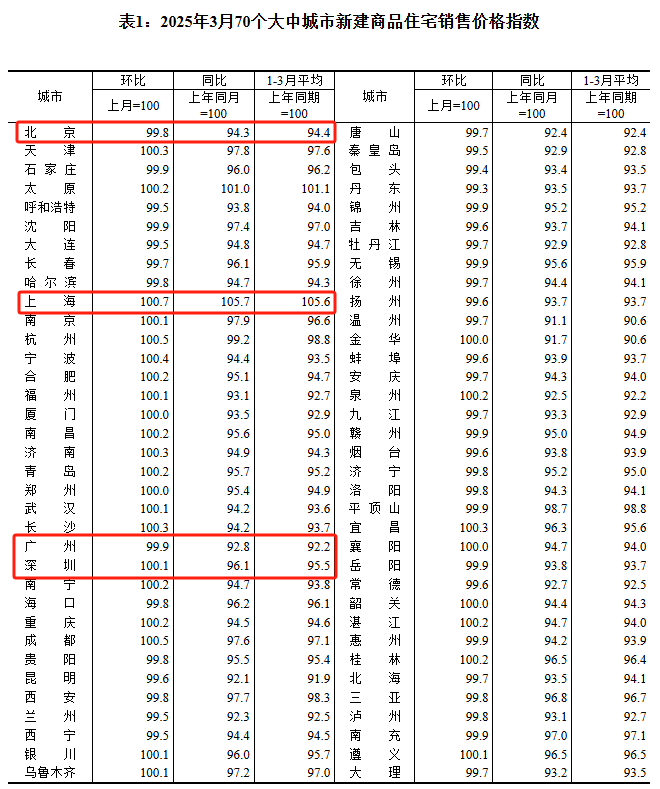
Core Viewpoint - The article discusses the recent trends in the Chinese real estate market, highlighting the mixed signals regarding property price increases and the overall market stability amid economic conditions [1][10]. Group 1: Recent Market Data - The latest data from the National Bureau of Statistics shows that in March 2025, 24 out of 70 major cities experienced a month-on-month increase in new residential property prices, an increase of 6 cities compared to the previous month [5]. - In the second-hand housing market, 10 cities saw price increases, which is 7 more than the previous month [5]. - However, the four first-tier cities showed inconsistent data, with Shanghai and Shenzhen experiencing slight increases of 0.7% and 0.1%, while Beijing and Guangzhou saw decreases of 0.2% and 0.1% respectively [6]. Group 2: Economic Factors Influencing the Market - The article identifies two main reasons for the current discussions about rising property prices: recent market data and commentary from real estate bloggers suggesting that monetary easing will lead to a property market boom [11]. - It argues that while monetary easing is expected, it does not guarantee that the funds will flow into the real estate market, as the focus may be more on supporting businesses and increasing employment [13][14]. Group 3: Consumer Behavior and Debt Trends - Data from the central bank indicates a decline in the number of credit cards and loans, suggesting that consumers are reducing their debt levels, which may hinder the potential for property price increases [15][17]. - The trend of consumers reducing debt is not new and may take years to reverse, impacting the overall demand in the housing market [15]. Group 4: Market Dynamics and New Regulations - The article highlights a significant trend in Guangzhou, where new housing regulations allow for higher usage rates in new developments, leading to a competitive edge over older properties [24][32]. - This shift in regulations is expected to impact the second-hand housing market negatively, as new properties offer better space efficiency, making it harder for older properties to compete [44]. Group 5: Overall Market Outlook - The current state of the real estate market is described as "stabilizing," with the achievement of halting price declines seen as a significant accomplishment [10][18]. - The article concludes with a cautious outlook, emphasizing that without improvements in consumer income and debt levels, any perceived market recovery may be superficial [46][47].
Deep Seek分析:未来5年,钱放黄金、存银行、买房哪个更划算?
Sou Hu Cai Jing· 2025-04-28 22:51
Group 1: Gold Investment - Gold prices have experienced significant fluctuations, with a notable increase during geopolitical tensions, such as a 12% rise during the escalation of the Russia-Ukraine conflict in 2024 [3] - The selling of physical gold can be challenging, as banks typically do not buy back gold bars, and gold shops offer significantly lower buyback prices compared to market value [3] - Investors should be cautious about blindly chasing gold prices, as high entry points can lead to long-term losses [3] Group 2: Real Estate Investment - Average housing prices have dropped by 30% compared to 2021, leading some to believe it is a good time to buy [5] - Despite the price drop, there are still bubbles in certain markets, such as Shanghai and Shenzhen, where the price-to-income ratio is as high as 40, indicating potential for further declines [5][7] - The demand for investment properties has decreased significantly, with many investors either selling or holding cash, suggesting that now may not be the best time for real estate investment [7] Group 3: Bank Deposits - Major banks have significantly reduced deposit interest rates since 2024, leading to lower returns for savers [7] - The purchasing power of savings is declining due to rising prices, making bank deposits less attractive compared to other investment options [7] - While bank deposits may result in slow asset depreciation, they are considered less risky compared to investments in gold and real estate [9] Group 4: Diversified Asset Allocation - A diversified asset allocation strategy is recommended to mitigate risks and enhance wealth preservation over the next five years [9] - An example of diversification includes splitting funds into three parts: one-third in low-risk investments like government bonds, another third in low-risk products like structured deposits, and the final third in medium-risk investments like mixed funds [9]