
化学纤维制造业

Search documents
裕兴股份:电子光学用聚酯薄膜经下游加工后可用于终端电子消费相关产品中
Zheng Quan Ri Bao Wang· 2025-08-04 09:20
Group 1 - The company Yuxing Co., Ltd. (300305) stated on August 4 that its electronic optical polyester film can be used in terminal electronic consumer products after downstream processing [1] - The polyester film is specifically designed for electronic optical applications, indicating its relevance in the electronics industry [1] - This development highlights the company's role in the supply chain of electronic consumer products, potentially enhancing its market position [1]

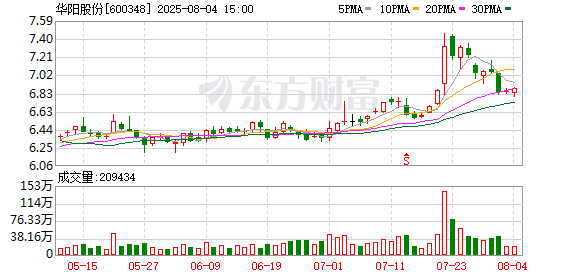
华阳股份:公司一期年产200吨高性能碳纤维项目,目前处于设备联合调试阶段
Mei Ri Jing Ji Xin Wen· 2025-08-04 08:06
Core Viewpoint - The company is in the process of developing a high-performance carbon fiber project, specifically targeting the aerospace and high-end equipment manufacturing sectors, with an annual production capacity of 200 tons planned for the first phase [2]. Group 1 - The company has confirmed that its titanium fiber project is aimed at producing T1000 grade high-performance carbon fiber [2]. - The project is currently in the equipment joint debugging stage, indicating that production has not yet commenced [2]. - The intended applications for the carbon fiber include aerospace, robotics, and other high-tech fields [2].


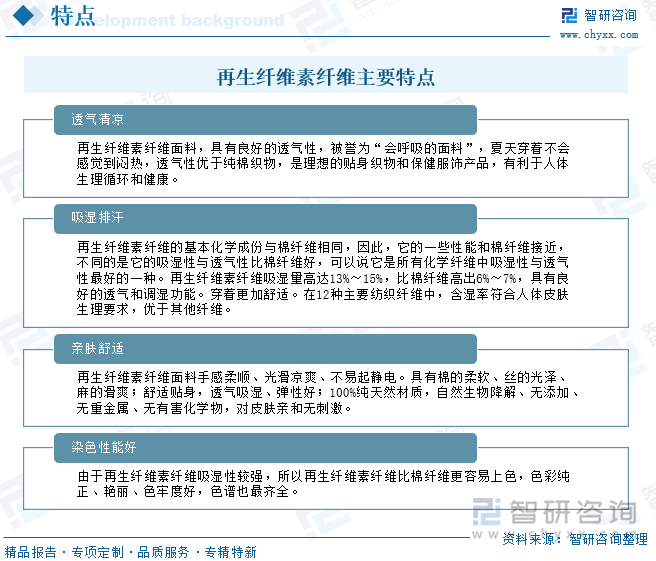
2025年中国再生纤维素纤维行业发展历程、产业链、产量、竞争格局及发展趋势研判:绿色可持续发展理念深入人心,再生纤维素纤维产量达到515.5万吨[图]
Chan Ye Xin Xi Wang· 2025-08-04 06:33
Core Viewpoint - The demand for regenerated cellulose fibers is increasing due to rising environmental awareness and government policies, leading to expanded production and market opportunities in the industry [1][13]. Industry Overview - Regenerated cellulose fibers are made from natural cellulose sources without altering their chemical structure, resulting in improved physical properties such as moisture absorption and breathability compared to cotton [3][5]. - The production of regenerated cellulose fibers in China is projected to reach 5.155 million tons in 2024, representing a year-on-year increase of 7.5% [1][13]. - The main categories of regenerated cellulose fibers include viscose fibers and differentiated fibers, with viscose fibers dominating the market, expected to reach 4.435 million tons in 2024, accounting for 86% of the total production [14]. Industry Chain - The industry chain encompasses the procurement of raw materials like cotton, hemp, bamboo, and trees, leading to applications in clothing and home textiles [9][11]. - Regenerated cellulose fibers are widely used in clothing due to their breathability and moisture absorption, as well as in home textiles like towels and curtains [9]. Competitive Landscape - Leading companies in the regenerated cellulose fiber industry include Xinjiang Zhongtai Chemical Co., Ltd., Nanjing Chemical Fiber Co., Ltd., and New乡化纤股份有限公司, which leverage technology and brand strength to maintain market share [16][17]. - Smaller and medium-sized enterprises are also emerging, focusing on technological upgrades and niche market development [16]. Development Trends - The industry is expected to undergo intelligent upgrades, with technologies like vortex spinning enhancing production efficiency and product quality [21]. - Market demand for regenerated cellulose fibers is anticipated to grow across various sectors, including apparel, home textiles, and medical applications, driven by increasing environmental consciousness [22]. - There is a trend towards product diversification, with companies developing functional fibers to meet specific consumer needs, such as temperature-regulating and antibacterial properties [24].


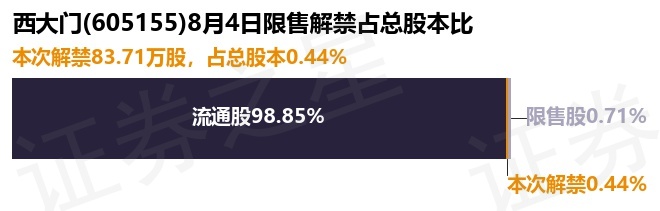
西大门83.71万股限售股将于8月4日解禁,占总股本0.44%
Zheng Quan Zhi Xing· 2025-08-04 00:40
Group 1 - The core point of the news is that Xidamen (605155) will have 837,100 restricted shares unlocked on August 4, accounting for 0.44% of the total share capital [1] - In the past year, a total of 937,400 shares have been unlocked, representing 0.49% of the total share capital [1] - After this unlocking, there will still be 1,363,600 restricted shares remaining, which is 0.71% of the total share capital [1] Group 2 - The details of the shareholders involved in the unlocking include: Dong Yuting, Liu Ying, Zhou Li, Shen Huafeng, and middle management, with a total unlocking of 336,000 shares for each of the first three and 966,000 shares for Shen Huafeng, while middle management and core personnel will unlock 639,700 shares [2] - The total market value of the unlocked shares is approximately 8.1 million yuan for middle management and core personnel [2] Group 3 - Xidamen's financial data for Q1 2025 shows a main revenue of 187 million yuan, a year-on-year increase of 13.33%, while the net profit attributable to the parent company is 23.03 million yuan, a decrease of 1.14% [3] - The company has a debt ratio of 6.93%, investment income of 735,400 yuan, financial expenses of -2.04 million yuan, and a gross profit margin of 44.0% [3] - Xidamen's main business involves the research, production, and sales of functional shading materials [3]

惠通科技: 董事会战略委员会工作细则(2025年8月)
Zheng Quan Zhi Xing· 2025-08-03 16:18
Core Points - The article outlines the establishment and operational guidelines of the Strategic Committee of Yangzhou Huitong Technology Co., Ltd, aimed at ensuring the scientific nature of the company's strategic decisions and enhancing sustainable development capabilities [3][10]. Group 1: General Provisions - The Strategic Committee is set up by the Board of Directors to research and formulate the company's long-term development strategy [3]. - The committee's resolutions must comply with the company's articles of association and relevant laws [3]. - The committee consists of three members, including at least one independent director, with the chairman of the company serving as a permanent member [3][5]. Group 2: Responsibilities and Authority - The committee is responsible for researching and proposing suggestions on the company's long-term development plans, operational goals, and major investment decisions [12]. - It has the authority to track and check the implementation of its proposed strategies and other matters authorized by the Board of Directors [12][15]. Group 3: Meeting Procedures - Meetings should be notified to all members at least three days in advance, with the option for urgent notifications [6]. - A quorum of two-thirds of the members is required for meetings to be held [23]. - Decisions are made through a voting process, with each member having one vote [4][28]. Group 4: Documentation and Record Keeping - Meeting records must be kept for at least ten years and should accurately reflect the discussions and decisions made [9][40]. - The committee's resolutions become effective upon signing by the attending members [8][36].
惠通科技: 累积投票制细则(2025年8月)
Zheng Quan Zhi Xing· 2025-08-03 16:18
Core Points - The article outlines the detailed rules for the cumulative voting system for the election of directors at Yangzhou Huitong Technology Co., Ltd, aiming to enhance corporate governance and protect the interests of minority shareholders [2][4]. Chapter Summaries Chapter 1: General Principles - The cumulative voting system is defined as a voting method where shareholders have voting rights equal to the number of shares they hold multiplied by the number of directors to be elected [2]. Chapter 2: Nomination of Director Candidates - The nomination process for director candidates must comply with the Company Law, Securities Law, and the company's articles of association [2]. - Candidates must provide detailed personal information and confirm their eligibility and independence if applicable [2]. - The board of directors is responsible for reviewing and approving the qualifications of nominated candidates [2]. Chapter 3: Voting and Election of Directors - Directors are elected through individual voting, with separate voting for independent and non-independent directors [3]. - The calculation of cumulative voting rights is based on the number of shares held multiplied by the number of directors to be elected [3]. Chapter 4: Supplementary Provisions - Voting procedures are specified, including the issuance of ballots and the validity of votes based on the number of shares held [4]. - The election principles state that candidates must receive more than half of the valid votes to be elected, and provisions for re-elections are established if necessary [4].

惠通科技: 董事、高级管理人员离职管理制度(2025年8月)
Zheng Quan Zhi Xing· 2025-08-03 16:18
Core Points - The article outlines the management system for the resignation of directors and senior management personnel at Yangzhou Huitong Technology Co., Ltd, aiming to ensure corporate governance stability and protect shareholders' rights [1][2]. Group 1: General Provisions - The system applies to all directors (including independent directors) and senior management personnel regarding resignation, term expiration, and dismissal [1]. - Directors can resign before their term expires by submitting a written resignation report to the board, which becomes effective upon receipt unless otherwise specified [2]. Group 2: Resignation Conditions and Procedures - Directors automatically leave office if not re-elected at the end of their term, effective from the date of the shareholders' meeting resolution [2]. - The board can dismiss directors, with the dismissal taking effect on the date of the resolution [2]. - Senior management personnel can also resign before their term ends, with specific procedures outlined in their labor contracts [2]. Group 3: Transfer Procedures and Unresolved Matters - Resigning directors and senior management must transfer all relevant documents, seals, data assets, and unresolved matters to the board within three working days after resignation [3]. - If the departing personnel are involved in significant investments or financial decisions, an audit committee may initiate a departure audit [3]. Group 4: Obligations of Departing Directors and Senior Management - Departing directors and senior management retain their fiduciary duties for two years post-resignation [4]. - They are restricted from transferring more than 25% of their shares annually during their term and cannot transfer shares for six months after leaving [4]. Group 5: Accountability Mechanism - The board will review any breaches of commitments or transfer issues by departing personnel and may pursue compensation for losses incurred [5]. - Departing personnel can appeal the board's accountability decisions within 15 days of notification [5].
神马股份,尼龙资产收购
DT新材料· 2025-08-03 16:04
Group 1 - The core viewpoint of the article highlights the acquisition of a 10.27% minority stake in Nylon Chemical by Shenma Co., which will increase its ownership from 61.79% to 72.06% for a transaction price of 9.52 billion yuan [2] - Nylon Chemical, established in 1996, has a registered capital of 4.384 billion yuan and primarily produces nylon 66 salt, which is used in nylon fibers and engineering plastics [2] - In 2024, Nylon Chemical reported an operating income of 6.875 billion yuan and a net profit of 221 million yuan, while in the first quarter of 2025, it achieved an operating income of 1.586 billion yuan and a net profit of 16.66 million yuan [2][3] Group 2 - The acquisition is expected to enhance Shenma Co.'s profitability and competitive strength in the nylon chemical sector [2] - In 2024, Shenma Co. experienced a significant decline in net profit, reporting 33.53 million yuan, a decrease of 77.57% year-on-year, with a non-recurring net profit of approximately -92.4 million yuan, marking the first loss in 12 years [3] - The financial forecast for the first half of 2025 indicates a further decline in net profit to approximately -37.5 million yuan and a non-recurring net profit of -67.4 million yuan [3]

2025年上半年内蒙古自治区原保险保费收入共计572.87亿元,同比增长5.26%
Chan Ye Xin Xi Wang· 2025-08-03 09:25
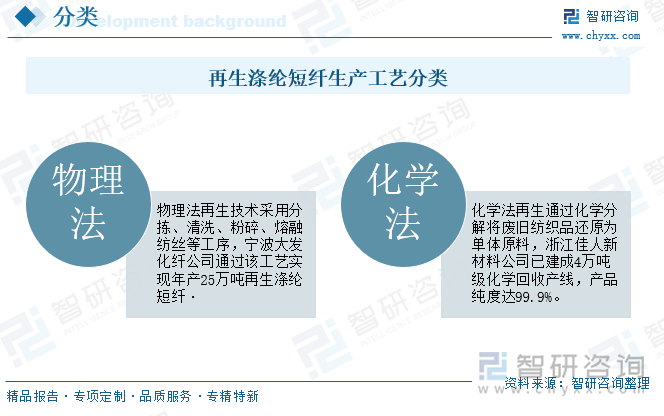
Core Viewpoint - The development of recycled polyester staple fiber is rapidly advancing due to increasing global resource shortages and environmental issues, with a projected production increase in China from 2020 to 2024, reaching 4.21 million tons in 2024, a year-on-year growth of 5.8% [1][14]. Industry Overview - Recycled polyester staple fiber is produced from waste polyester bottle flakes and spinning waste through physical or chemical regeneration processes, with lengths typically ranging from 32 to 102 mm and various specifications [3]. - The fiber is widely used in furniture, toys, bedding, and clothing industries due to its low cost and good performance [3]. Industry Policies - The Chinese government has implemented several policies to promote the development of recycled polyester staple fiber, including encouraging textile companies to prioritize the use of green fiber materials and enhancing the standards and certification systems for green products [5][7]. - Specific policies include the 2022 implementation opinions on accelerating the recycling of waste textiles and the 2024 notice on promoting high-quality recycling of waste textiles and bottle flakes [5][7]. Industry Chain - The upstream of the recycled polyester staple fiber industry includes raw materials such as polyester fabrics, waste polyester bottle flakes, and spinning waste, which directly affect production costs and profitability [8]. - The downstream applications primarily include clothing, home textiles, and industrial textiles, with clothing being the largest demand market [8]. Market Demand - China's waste textile recycling volume is projected to grow from 4 million tons in 2019 to 5.15 million tons in 2024, indicating a significant potential for recycled polyester staple fiber as a key application area [10]. - The textile industry in China is expected to achieve a revenue of 48,353.66 billion yuan in 2024, a year-on-year increase of 3.87%, further driving the demand for recycled fibers [12]. Competitive Landscape - Key players in the recycled polyester staple fiber industry include Yangzhou Tianfu Long Group, Youcai Environmental Resources Technology, and Fujian Minrui New Fiber, which possess large production scales and advanced technologies [16][17][19]. - Smaller enterprises are also emerging, offering high-quality and innovative products that appeal to consumers [16]. Development Trends - The demand for recycled polyester staple fiber is expected to continue growing due to stricter global environmental policies and increasing consumer awareness of sustainability [23]. - Differentiated products, such as recycled colored polyester staple fiber, are anticipated to see significant growth due to their low carbon emissions and cost advantages [24]. - Quality improvements and technological innovations will enhance the competitiveness of recycled polyester staple fiber, with a focus on resource efficiency and reduced environmental impact [26].


研判2025!中国再生涤纶短纤行业政策汇总、产业链、发展现状、竞争格局及发展趋势分析:政策积极推动再生纤维应用,推动行业产量增长至421万吨[图]
Chan Ye Xin Xi Wang· 2025-08-03 03:24
Core Viewpoint - The development of recycled polyester staple fiber is accelerating in response to global resource shortages and environmental issues, with production expected to reach 4.21 million tons in 2024, a year-on-year increase of 5.8% [1][14]. Industry Overview - Recycled polyester staple fiber is produced from waste polyester bottle flakes and spinning waste through physical or chemical regeneration processes, with lengths typically ranging from 32 to 102 mm and various specifications [3]. - The industry is driven by strong market demand and a stable supply of raw materials, particularly from the recycling of waste textiles and bottle flakes [1][14]. Industry Policies - The Chinese government has implemented several policies to promote the development of recycled polyester staple fiber, including encouraging textile companies to prioritize the use of green fiber materials and enhancing standards for green products [5][7]. - Key policies include the 2022 implementation opinions on accelerating the recycling of waste textiles and the 2024 notice on promoting high-quality recycling of waste textiles and bottle flakes [5][7]. Industry Chain - The upstream of the recycled polyester staple fiber industry includes the collection of raw materials such as waste polyester bottle flakes and spinning waste, which directly impacts production costs and profitability [8]. - The downstream applications primarily include clothing, home textiles, and industrial textiles, with clothing being the largest market segment [8]. Market Demand - The demand for recycled polyester staple fiber is expected to continue growing due to increasing consumer awareness of environmental issues and government support for sustainable practices [23]. - The recycling volume of waste textiles in China is projected to rise from 4 million tons in 2019 to 5.15 million tons in 2024, providing ample raw material for production [10]. Competitive Landscape - The industry features several leading companies such as Yangzhou Tianfu Long Group, Youcai Environmental Resources Technology, and Fujian Minrui New Fiber, which possess significant market influence and advanced production capabilities [16][17][19]. - Smaller enterprises are also emerging, offering high-quality and innovative products that appeal to consumers [16]. Future Trends - The market for differentiated products, such as recycled colored polyester staple fiber, is expected to expand due to their low carbon emissions and cost advantages [24]. - Continuous improvements in quality and technological innovation will enhance the competitiveness of recycled polyester staple fiber, with a focus on resource efficiency and reduced environmental impact [26].