
电视广播

Search documents
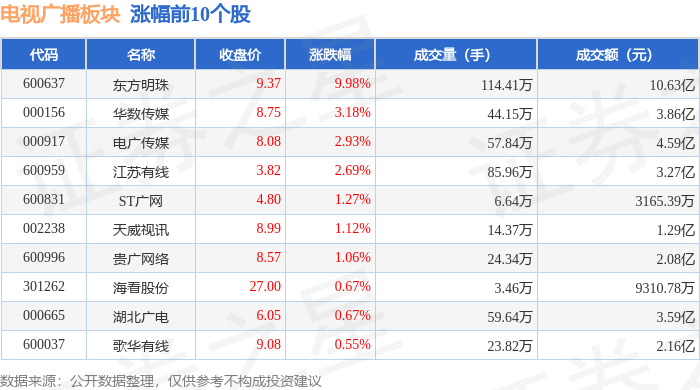
电视广播板块8月22日涨2.42%,东方明珠领涨,主力资金净流入1774.5万元
Zheng Xing Xing Ye Ri Bao· 2025-08-22 08:46
| 代码 | 名称 | 收盘价 | 涨跌幅 | 成交量(手) | 成交额(元) | | | --- | --- | --- | --- | --- | --- | --- | | 600637 | 东方明珠 | 9.37 | 9.98% | 114.41万 | | 10.63亿 | | 000156 | 华数传媒 | 8.75 | 3.18% | 44.15万 | | 3.86亿 | | 000917 | 电广传媒 | 8.08 | 2.93% | 57.84万 | | 4.59亿 | | 600959 | 江苏有线 | 3.82 | 2.69% | 85.96万 | | 3.27亿 | | 600831 | ST广网 | 4.80 | 1.27% | 6.64万 | | 3165.39万 | | 002238 | 天威视讯 | 66'8 | 1.12% | 14.37万 | | 1.29亿 | | 600996 | 蛊广网络 | 8.57 | 1.06% | 24.34万 | | 2.08亿 | | 301262 | 海量股份 | 27.00 | 0.67% | 3.46万 | | 9310.78万 | | ...


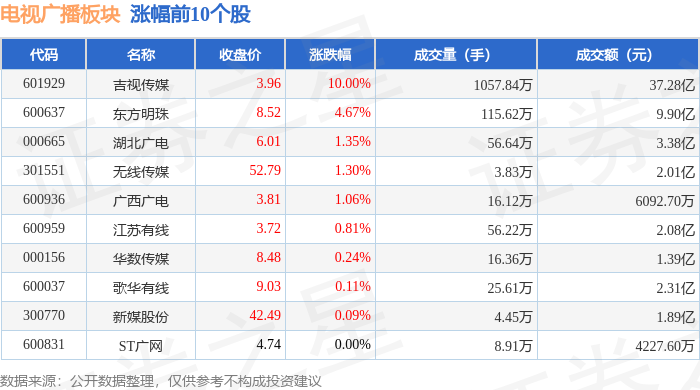
电视广播板块8月21日涨1.88%,吉视传媒领涨,主力资金净流入5309.34万元
Zheng Xing Xing Ye Ri Bao· 2025-08-21 08:38
Market Overview - The television broadcasting sector increased by 1.88% compared to the previous trading day, with Jishi Media leading the gains [1] - The Shanghai Composite Index closed at 3771.1, up 0.13%, while the Shenzhen Component Index closed at 11919.76, down 0.06% [1] Stock Performance - Jishi Media (601929) closed at 3.96, up 10.00% with a trading volume of 10.58 million shares and a transaction value of 3.728 billion [1] - Other notable performers include: - Oriental Pearl (600637) at 8.52, up 4.67% [1] - Hubei Broadcasting (000665) at 6.01, up 1.35% [1] - Wireless Media (301551) at 52.79, up 1.30% [1] - Guangxi Broadcasting (600936) at 3.81, up 1.06% [1] Capital Flow - The television broadcasting sector saw a net inflow of 53.09 million from institutional investors, while retail investors experienced a net outflow of 5.65 million [2] - The capital flow for key stocks includes: - Oriental Pearl had a net outflow of 55.07 million from institutional investors [3] - Jishi Media experienced a net inflow of 19.98 million from institutional investors [3] - New Media Co. (300770) had a net inflow of 18.42 million from institutional investors [3]


电视广播板块8月20日跌0.88%,吉视传媒领跌,主力资金净流出4.27亿元
Zheng Xing Xing Ye Ri Bao· 2025-08-20 08:52
Core Viewpoint - The television broadcasting sector experienced a decline of 0.88% on the trading day, with Jishi Media leading the drop, while the overall market indices showed positive performance with the Shanghai Composite Index rising by 1.04% and the Shenzhen Component Index increasing by 0.89% [1] Group 1: Market Performance - The television broadcasting sector fell by 0.88% on the previous trading day [1] - The Shanghai Composite Index closed at 3766.21, up 1.04% [1] - The Shenzhen Component Index closed at 11926.74, up 0.89% [1] Group 2: Capital Flow - The television broadcasting sector saw a net outflow of 427 million yuan from main funds, while retail investors contributed a net inflow of 420 million yuan [2] - The table provided details the capital flow for individual stocks within the sector, highlighting varying levels of net inflow and outflow among different companies [2]



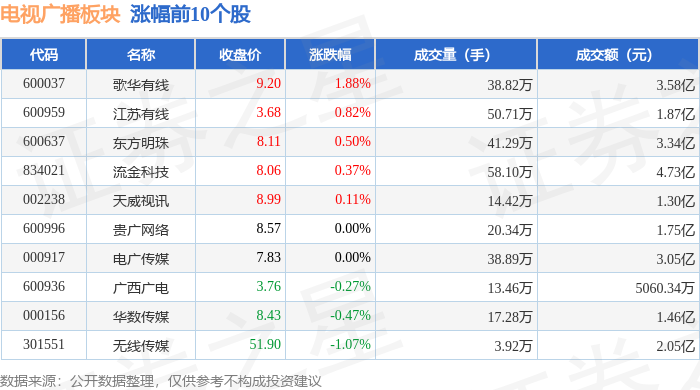
电视广播板块8月19日跌0.76%,吉视传媒领跌,主力资金净流出6.5亿元
Zheng Xing Xing Ye Ri Bao· 2025-08-19 08:37
Market Overview - The television broadcasting sector experienced a decline of 0.76% on the previous trading day, with Jishi Media leading the drop [1] - The Shanghai Composite Index closed at 3727.29, down 0.02%, while the Shenzhen Component Index closed at 11821.63, down 0.12% [1] Individual Stock Performance - Gohua Cable (600037) rose by 1.88% to close at 9.20, with a trading volume of 388,200 shares and a transaction value of 358 million yuan [1] - Jiangsu Cable (600959) increased by 0.82% to 3.68, with a trading volume of 507,100 shares and a transaction value of 187 million yuan [1] - Dongfang Mingzhu (600637) saw a slight increase of 0.50% to 8.11, with a trading volume of 412,900 shares and a transaction value of 334 million yuan [1] - Jishi Media (601929) fell by 7.42% to 66.5, with a trading volume of 8.5763 million shares and a transaction value of 348.2 million yuan [2] Capital Flow Analysis - The television broadcasting sector saw a net outflow of 650 million yuan from institutional investors, while retail investors contributed a net inflow of 538 million yuan [2] - The capital flow for individual stocks indicates that Jishi Media experienced significant selling pressure, with a net outflow of 21.67 million yuan from retail investors [3] Summary of Stock Flows - Hai Liang Co. (301262) had a net inflow of 6.99 million yuan from institutional investors, while retail investors saw a net outflow of 16.65 million yuan [3] - Tianwei Video (002238) experienced a net inflow of 2.02 million yuan from institutional investors, but a net outflow of 7.51 million yuan from retail investors [3] - Guangxi Broadcasting (600936) faced a net outflow of 5.39 million yuan from institutional investors, while retail investors had a net inflow of 5.43 million yuan [3]
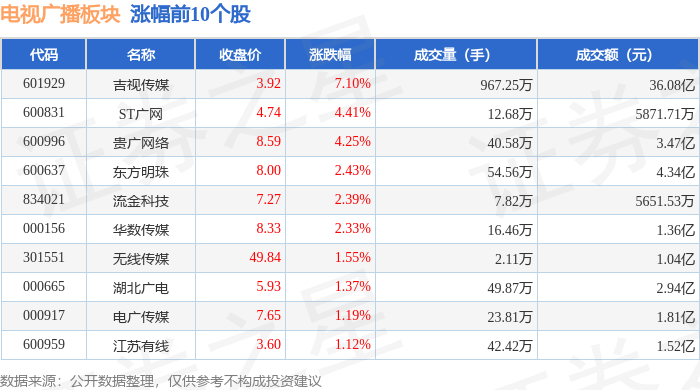
电视广播板块8月15日涨2.17%,吉视传媒领涨,主力资金净流出2668.73万元
Zheng Xing Xing Ye Ri Bao· 2025-08-15 08:44
证券之星消息,8月15日电视广播板块较上一交易日上涨2.17%,吉视传媒领涨。当日上证指数报收于 3696.77,上涨0.83%。深证成指报收于11634.67,上涨1.6%。电视广播板块个股涨跌见下表: | 代码 | 名称 | 收盘价 | 涨跌幅 | 成交量(手) | 成交额(元) | | --- | --- | --- | --- | --- | --- | | 601929 | 吉视传媒 | 3.92 | 7.10% | 967.25万 | 36.08亿 | | 600831 | ST广网 | 4.74 | 4.41% | 12.68万 | 5871.71万 | | 600996 | 贵广网络 | 8.59 | 4.25% | C 40.58万 | 3.47 Z | | 600637 | 东方明珠 | 8.00 | 2.43% | 54.56万 | 4.34亿 | | 834021 | 流金科技 | 7.27 | 2.39% | 7.82万 | 5651.53万 | | 000156 | 化数传媒 | 8.33 | 2.33% | 16.46万 | 1.36亿 | | 301551 | 元线传媒 | 4 ...
国信证券:反内卷,更要买高门槛资产
Zhi Tong Cai Jing· 2025-08-15 00:25
Core Viewpoint - The report from Guosen Securities emphasizes the importance of focusing on investment opportunities that are immune to "involution," highlighting three high-barrier sectors: monopolistic industries like public utilities and rare earths, industries with exclusive products and global competitiveness in hard technology, and sectors where AI accelerates the replacement of repetitive tasks [1][2][3]. Group 1: High-Barrier Industries - Monopolistic barrier assets, such as public utilities (electricity, water) and strategic rare resources (like rare earths), effectively avoid intense market competition and provide stable cash flow and pricing power, making them excellent defensive investments [2][11]. - Global competitive assets are characterized by technological innovation and product exclusivity, allowing companies to successfully expand into overseas markets and create unique advantages, primarily found in high-end manufacturing and hard technology sectors [2][11]. - AI-driven efficiency revolution assets are transforming traditional industries by replacing repetitive labor, significantly enhancing productivity and accelerating the "involution" process in certain sectors [3][19]. Group 2: Market Phases of "Involution" - The "involution" market is currently transitioning from the first phase (involution 1.0) to the second phase (involution 2.0), where the focus shifts from broad industry recovery to individual stock selection based on self-discipline and competitive differentiation [4][6]. - The first phase is characterized by supply-side contraction leading to a supply-demand gap, benefiting upstream resource sectors like steel and coal [4][6]. - The second phase sees a focus on high-quality companies that can achieve market share and profitability recovery through strict production discipline, while smaller firms must innovate and create unique competitive advantages [4][6]. Group 3: Long-Term Investment Strategy - The long-term strategy emphasizes investing in industries with natural high barriers to entry, which can provide stable and higher returns compared to short-term "involution" opportunities [11][13]. - Historical data indicates that monopolistic industries, such as public utilities and strategic rare resources, have shown resilience and sustained performance compared to emerging industries that have faced downturns [11][13]. - The report suggests prioritizing sectors with high entry barriers, such as public utilities and strategic resources, which offer stable cash flows and are less affected by economic cycles [11][13].
策略解读:反内卷,更要买高门槛资产
Guoxin Securities· 2025-08-14 13:39
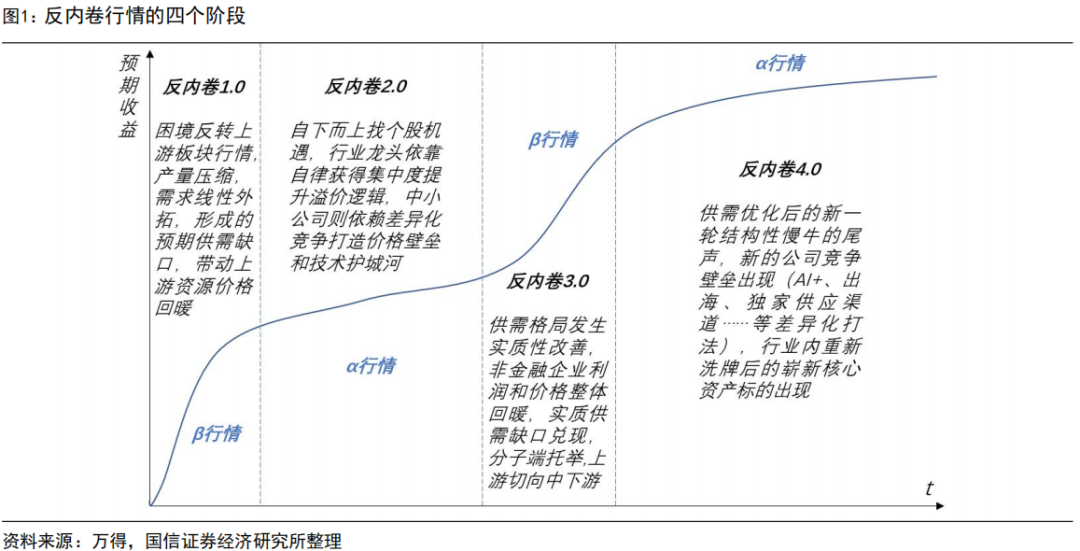
Core Insights - The current "anti-involution" market trend represents a phase of reversal from difficulties, characterized by a clear four-stage evolution, alternating between systematic market opportunities (β) and individual stock excess returns (α) [3][5] - Investors are encouraged to focus on high-barrier assets that are naturally immune to "involution," identifying three core long-term investment themes: monopolistic barrier assets, globally competitive assets, and AI-enabled efficiency revolution assets [3][4][19] Group 1: Four Stages of "Anti-Involution" Market - The first stage (Anti-Involution 1.0) is driven by supply-side contraction expectations, benefiting upstream resource sectors like steel and coal, leading to a typical β opportunity [5][6] - The second stage (Anti-Involution 2.0) sees a shift in focus from industry-wide gains to individual stock differentiation, where leading firms gain market share through strict production discipline, creating α opportunities [6][7] - The third stage (Anti-Involution 3.0) involves a fundamental improvement in supply-demand relationships, leading to a recovery in overall corporate profits and product prices, marking a new round of market upturn [7][8] - The fourth stage (Anti-Involution 4.0) features the emergence of new core assets in a stabilized competitive landscape, driven by technological innovations and global expansion [8][9] Group 2: Current Market Positioning - The market is transitioning from Anti-Involution 1.0 to 2.0, necessitating a dual focus on both β opportunities in specific sectors and the identification of high-quality stocks with strong α characteristics [8][13] - The current "anti-involution" differs fundamentally from the 2015 policy-driven "three reductions" approach, relying more on market-driven self-discipline rather than administrative mandates [8][13] Group 3: Long-Term Investment Themes - The report emphasizes the importance of investing in industries with natural high barriers to entry, such as public utilities and strategic rare resources, which provide stable cash flows and are less affected by economic cycles [19][27] - The three core elements supporting high-barrier industries include licensing barriers, resource barriers, and network effect barriers, which create exclusive pricing power and stable cash flows [27][28] - Companies that successfully "go global" and break overseas monopolies are identified as key players in the "anti-involution" narrative, particularly in high-tech sectors [29][30] Group 4: AI Empowerment - The rise of AI technology is seen as a transformative force accelerating the "anti-involution" process by enhancing productivity and driving market clearing [33][35] - Industries that can effectively leverage AI to reduce costs and reshape competitive dynamics are positioned to thrive in the evolving market landscape [35][36]
电视广播板块8月13日涨1.76%,吉视传媒领涨,主力资金净流入2732.12万元
Zheng Xing Xing Ye Ri Bao· 2025-08-13 08:37
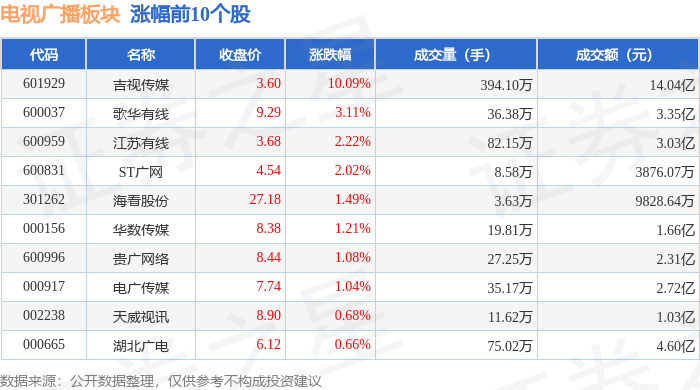
Core Viewpoint - The television broadcasting sector experienced a rise of 1.76% on August 13, with Jishi Media leading the gains, reflecting positive market sentiment in this industry [1]. Group 1: Market Performance - The Shanghai Composite Index closed at 3683.46, up 0.48%, while the Shenzhen Component Index closed at 11551.36, up 1.76% [1]. - Jishi Media's stock price increased by 10.09%, closing at 3.60, with a trading volume of 3.941 million shares and a transaction value of 1.404 billion yuan [1]. - Other notable performers included Gehua Cable, which rose by 3.11% to 62.6, and Jiangsu Cable, which increased by 2.22% to 3.68 [1]. Group 2: Capital Flow - The television broadcasting sector saw a net inflow of 27.32 million yuan from institutional investors, while retail investors contributed a net inflow of 62.51 million yuan [2]. - Conversely, there was a net outflow of 89.83 million yuan from speculative funds, indicating a mixed sentiment among different investor types [2].
电视广播板块8月12日涨0.62%,吉视传媒领涨,主力资金净流出8811.58万元
Zheng Xing Xing Ye Ri Bao· 2025-08-12 08:28
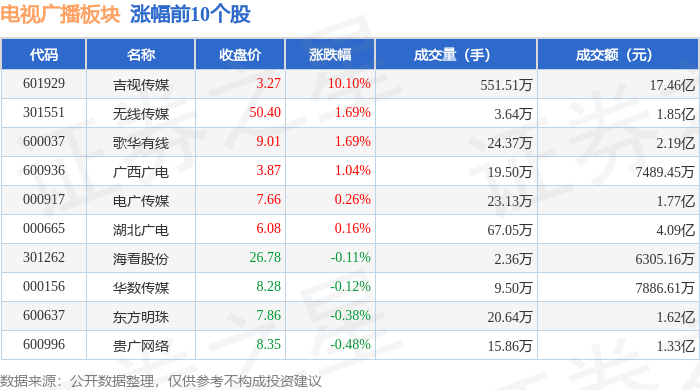
Market Overview - The television broadcasting sector increased by 0.62% compared to the previous trading day, with Jishi Media leading the gains [1] - The Shanghai Composite Index closed at 3665.92, up by 0.5%, while the Shenzhen Component Index closed at 11351.63, up by 0.53% [1] Stock Performance - Jishi Media (601929) closed at 3.27, with a significant increase of 10.10% and a trading volume of 5.5151 million shares, amounting to a transaction value of 1.746 billion [1] - Other notable performers include Wireless Media (301551) and Gehua Cable (600037), both up by 1.69% [1] - The overall performance of the television broadcasting stocks showed mixed results, with some stocks experiencing slight declines [1][2] Capital Flow - The television broadcasting sector saw a net outflow of 88.1158 million from institutional investors, while retail investors contributed a net inflow of 64.1961 million [2] - The capital flow data indicates that retail investors were more active in the market compared to institutional investors [2] Individual Stock Capital Flow - Gehua Cable (600037) had a net inflow of 23.1039 million from institutional investors, while it faced a net outflow from retail investors [3] - Wireless Media (301551) experienced a net inflow of 15.8387 million from institutional investors, but also saw significant outflows from retail investors [3] - Other stocks like Hubei Broadcasting (000665) and Electric Broadcasting (000917) also showed varied capital flows, with some facing net outflows from both institutional and retail investors [3]
电视广播行业董秘薪酬观察:贵广网络董秘黄宗文未勤勉尽责收警示函年薪32万元逆势大涨48.91%
Xin Lang Cai Jing· 2025-08-08 07:36
Core Insights - The report highlights that in 2024, the total salary of A-share listed company secretaries reached 4.086 billion yuan, with an average annual salary of 700,000 yuan [1] - The television broadcasting industry has a total salary of 10.1446 million yuan for secretaries, with an average salary of 676,300 yuan [1] - The report indicates that 21% of secretaries earn over 1 million yuan annually, with only 2 companies in the television broadcasting sector meeting this criterion [1] Salary Analysis - New Media Co., Ltd. has the highest-paid secretary, earning 2.1134 million yuan, which is 3.1 times the industry average, with a slight increase of 1.14% from the previous year [2] - The lowest-paid secretary is from Jishi Media, earning 189,600 yuan, which is less than one-third of the industry average [2] - Jiangsu Cable's secretary saw the highest salary increase of 68.39%, with a current salary of 962,200 yuan compared to 571,400 yuan last year [2] Demographics and Tenure - In the television broadcasting sector, 53.85% of secretaries hold a master's degree, while 46.15% have a bachelor's degree [1] - Most secretaries in this industry are over 40 years old, with the youngest being Xu Wenhai from Liujin Technology, born in 1987 [1] - Zhang Chao from Guangxi Broadcasting has the longest tenure at 11 years, while Ding Yinglei from Gehua Cable has the shortest tenure, having started in November 2023 [1] Regulatory Issues - As of 2024, only one secretary in the television broadcasting industry, Huang Zongwen from Guiguang Network, has faced regulatory penalties [3]
