Semiconductor

Search documents
Edgecore Networks and Synaptics Announce Strategic Collaboration to Advance Scalable Edge AI and AIoT Platforms
Businesswire· 2026-01-05 15:00
Core Insights - Edgecore Networks and Synaptics have announced a strategic collaboration aimed at advancing scalable Edge AI and AIoT platforms [1] Company Collaboration - The partnership focuses on integrating Edgecore's networking solutions with Synaptics' AI technologies to enhance performance and scalability in edge computing [1] - This collaboration is expected to drive innovation in the AIoT sector, providing more efficient and effective solutions for various applications [1] Market Implications - The strategic alliance positions both companies to capitalize on the growing demand for Edge AI and AIoT technologies, which are increasingly being adopted across multiple industries [1] - By leveraging each other's strengths, the companies aim to accelerate the development of next-generation edge solutions that meet the evolving needs of customers [1]



AI Bubble or Not, These 3 Stocks Make Excellent Long-Term Plays to Buy in January
Yahoo Finance· 2026-01-05 14:40
Group 1: Market Overview - The S&P 500 has increased by 79% over the last three years, raising concerns among investors about a potential sell-off in 2026 [1] - Investing in fundamentally sound companies, even at high valuations, can be an effective long-term wealth growth strategy [1] Group 2: AI Investment Sentiment - According to The Motley Fool's 2026 AI Investor Outlook Report, 60% of respondents believe AI-focused companies will yield strong long-term results, with higher optimism among Gen Z (67%), millennials (63%), and high earners (70%) [2] Group 3: ASML - ASML is a semiconductor equipment manufacturer that uniquely produces extreme ultraviolet (EUV) lithography machines, essential for advanced chip manufacturing [4] - Demand for ASML's EUV machines is expected to grow for decades, as advanced chips require precision that general-purpose fabs cannot achieve [5] - ASML's advanced machines are critical for producing next-generation AI chips [7] Group 4: Nvidia - Nvidia remains the leader in designing graphics processing units and solutions for hyperscale data centers, despite increasing competition from companies like Broadcom and AMD [6] - Nvidia's investment thesis is strong, as it benefits from increased AI adoption across various sectors, maintaining a high net profit margin of 53% [8] Group 5: Microsoft - Microsoft provides investors with exposure to AI infrastructure and applications, complementing the growth potential in the AI sector [7]



S&P 500 Continues Its Stellar Run to Open New Year: 4 Solid Picks
ZACKS· 2026-01-05 14:15
Group 1: S&P 500 Performance - The S&P 500 had a remarkable 2025, gaining 16.4%, driven by a tech rally focused on AI stocks [6] - The index recorded its eighth consecutive month of gains and the eleventh quarter of gains in thirteen quarters [6] - The S&P 500 surged 24% in 2023 and 23% in 2024, totaling nearly 80% gains over the past three years [7] Group 2: Economic Context - The S&P 500 started 2025 positively due to optimism surrounding President Trump's pro-business agenda, despite later concerns over tariffs and a potential global trade war [4] - After a significant drop of almost 18% by April, the index rebounded following a pause on tariffs and new trade deals [5] Group 3: Investment Opportunities - Recommended stocks for investment include Amazon.com, Inc. (AMZN), Analog Devices, Inc. (ADI), AppLovin Corporation (APP), and Cadence Design Systems, Inc. (CDNS), all showing strong potential for 2026 [2] - Amazon.com, Inc. has an expected earnings growth rate of 29.7% for the current year and holds a Zacks Rank 2 [10] - Analog Devices, Inc. has an expected earnings growth rate of 25.7% and also holds a Zacks Rank 2 [12] - AppLovin Corporation is expected to see earnings growth of over 100% and has a Zacks Rank 1 [13] - Cadence Design Systems, Inc. has an expected earnings growth rate of 18.3% and holds a Zacks Rank 2 [14]


Silicon Labs Accelerates the Future of Connected Intelligence at CES 2026
Prnewswire· 2026-01-05 14:00
Core Insights - Silicon Labs has launched the Simplicity SDK for Zephyr, enhancing its offerings in the open-source real-time operating system (RTOS) space for connected embedded systems [1][2][6] - The new SDK aims to provide enterprise-grade support and features, addressing long-term security, performance, and compliance needs for large-scale IoT deployments [2][7] Group 1: Product Launch and Features - The Simplicity SDK for Zephyr is designed to deliver a vetted version of the Zephyr codebase, ensuring quality assurance and additional features [7] - Initial support includes Bluetooth LE across popular Silicon Labs SoCs and combined WiFi + Bluetooth on select devices [7] - The SDK facilitates low-friction migration for existing Zephyr applications to Silicon Labs devices, allowing for minimal firmware changes and faster time-to-market [7] Group 2: Company Background and Market Position - Silicon Labs is a leading innovator in low-power connectivity, providing integrated SoCs, software, and tools for smart home, industrial IoT, and smart city applications [4] - The company operates in over 16 countries and is headquartered in Austin, Texas, emphasizing its global reach and influence in the embedded technology market [4]


Here Are Monday’s Top Wall Street Analyst Research Calls: Adobe, Arista Networks, ASML, Coinbase Global, IBM, Marvell Technology, NetFlix, and More
Yahoo Finance· 2026-01-05 13:02
Market Overview - Futures are trading higher as the first full week of trading in 2026 begins, with the S&P 500 closing at 6,858, up 0.19%, and the Dow Jones up 0.66% at 48,382, while the Nasdaq closed slightly lower at 23,235 [2] - Analysts expect heightened volatility in 2026 after three consecutive years of double-digit gains for the S&P 500 [2][5] Treasury Bonds - Treasury yields increased on Friday, with the 30-year bond closing at 4.87% and the benchmark 10-year note at 4.20%, down from 4.80% a year ago, marking the first annual decline in yield in five years [3] - Traders are anticipating a significant amount of economic data and do not expect another rate cut until possibly summer, which may lead to higher yields in the near term [3] Oil and Gas - Oil prices were modestly lower, with Brent Crude down 0.16% at $60.75 and West Texas Intermediate down 0.17% at $57.32, following a year where oil prices hit five-year lows [4] - Expectations for WTI are to trade in the $55-$60 range this year, with potential volatility due to the recent capture of Venezuelan President Maduro [4] - Natural gas prices fell 1.8% to $3.62, coinciding with a record U.S. LNG production of 100 million tons in 2025 [4]
最强赛道“吊车尾”:前海开源人工智能基金为何逆市折戟?
Jing Ji Guan Cha Wang· 2026-01-05 12:56
Core Insights - In 2025, the AI-themed funds surged, but the Qianhai Kaiyuan AI Fund ended the year with a loss, making it the only fund in its category to do so [2][3] - The fund's A-class share net value growth rate was -4.15%, significantly underperforming compared to the benchmark return rate of 12.55% [3][4] Performance Comparison - Among 18 AI-themed funds that have been established for over a year, Qianhai Kaiyuan AI Fund was the only one to report a loss, while others saw annual gains exceeding 40%, with the highest return surpassing 100% [2][3] - The fund ranked 2242 out of 2274 flexible allocation funds in the market, indicating poor performance relative to peers [3][4] Management and Strategy - The fund was established in May 2016 and focused on selecting stocks of companies with significant growth potential related to AI, investing at least 80% of non-cash assets in AI-related securities [3] - Star fund manager Qu Yang managed the fund until June 2025, when he stepped down due to internal adjustments, with his management yielding a total return of 13.43% over nine years [4][5] Investment Strategy Issues - The fund's underperformance was attributed to its focus on end-side AI sectors like electronics and communications, while the market was led by AI computing infrastructure such as chips and optical modules [5][6] - In Q2 2025, the fund made significant changes to its portfolio, replacing six of its top ten holdings, which coincided with a market downturn for those stocks [6][7] Market Trends and Future Outlook - Despite the fund's struggles, the manager Wei Chun expressed optimism about the AI hardware market entering a rapid growth phase in 2026, driven by advancements in AI models and user experience improvements [8]

Mobileye secures deal with major US automaker, boosting production outlook
Reuters· 2026-01-05 12:02
Core Insights - Mobileye has secured a major U.S. automaker as a customer for its next-generation chip, which is expected to enhance production outlook and integrate self-driving technology as standard equipment [1] Company Summary - Mobileye's partnership with a significant U.S. automaker indicates a strong demand for its advanced chip technology, potentially leading to increased production and market presence [1]


Ceva Enhances NeuPro-Nano NPU Ecosystem with Addition of Sensory's TrulyHandsfree Voice Activation
Prnewswire· 2026-01-05 12:00
Core Insights - Ceva, Inc. is expanding its AI ecosystem by integrating Sensory's TrulyHandsfree voice activation technology into its NeuPro-Nano NPU, aimed at enhancing voice-first user experiences in ultra-low power devices [1][4] - The collaboration allows for seamless, on-device keyword spotting in battery-constrained consumer devices, ensuring privacy and performance without reliance on cloud connectivity [1][3] Company Overview - Ceva, Inc. specializes in AI-driven products, providing a portfolio of silicon and software IP that enables devices to connect, sense, and infer, essential for intelligent edge applications [6][7] - Sensory, Inc. develops on-device AI technologies, powering over 2 billion devices globally, with innovations spanning various industries including automotive and consumer electronics [5] Product Features - NeuPro-Nano is Ceva's smallest and most power-efficient Embedded AI NPU, designed for AI inference in AIoT devices, now enhanced with Sensory's voice activation models for applications like TWS earbuds and smartwatches [2] - The integration of TrulyHandsfree technology into Ceva's NeuPro-Studio AI ecosystem allows developers to quickly prototype and deploy voice-enabled features optimized for NeuPro-Nano [3] Market Impact - The collaboration is expected to accelerate the development of AI-driven, voice-controlled devices, transforming consumer experiences in smart home, automotive, and wearable applications [4]


深圳将跑出一个卫星导航IPO,半年营收4亿,比亚迪、格力身影浮现
21世纪经济报道· 2026-01-05 10:45
Core Viewpoint - Shenzhen Huada Beidou Technology Co., Ltd. is making a second attempt to list on the Hong Kong Stock Exchange, with updated financial data showing a revenue of 403 million yuan, a 20% year-on-year increase, but a net loss of 64 million yuan, which is a 16% increase in losses compared to the previous year [1][3]. Group 1: Company Background and Financials - Huada Beidou originated from the navigation chip design business of China Electronics Corporation (CEC) and has attracted significant investments from major companies like BYD and Bosch [1]. - The company has reported net losses of 93 million yuan in 2022, 289 million yuan in 2023, and 141 million yuan in 2024, with a cumulative net loss of 588 million yuan over the past three and a half years [3][4]. - Research and development costs have exceeded 330 million yuan over the past three years, accounting for more than 14% of revenue [4]. Group 2: Market Position and Product Applications - Huada Beidou's GNSS chips hold over 60% of the Chinese shared bicycle market, covering major platforms like Meituan and Qingju [3][4]. - The company is the sixth largest GNSS service provider globally, with a market share of 4.8%, and ranks second among domestic companies [3]. - The self-developed GNSS chip business, which has a higher gross margin of 26%, currently accounts for only 32.2% of total revenue [4]. Group 3: Future Growth Strategies - The company is focusing on smart driving and low-altitude economy sectors, with expectations of significant growth in GNSS chip shipments in these areas [7][8]. - The low-altitude economy is projected to have a compound annual growth rate of 34.5% from 2024 to 2029 for GNSS chips and modules [8]. - Huada Beidou is in discussions with leading drone manufacturers to explore potential applications of GNSS chips in consumer drones [8]. Group 4: Competitive Landscape - In the smart driving and low-altitude economy sectors, Huada Beidou faces competition from established players like Beidou Xingtong and Huace Navigation, which have already secured significant market shares [9]. - The average selling price of standard precision chips has decreased from 7.4 yuan to 4.8 yuan from 2022 to 2024, indicating competitive pricing pressures [9]. Group 5: Financial Outlook and Funding - As of June 30, 2025, the company had cash and cash equivalents of 244 million yuan, which is less than its R&D expenditure for 2024 [10]. - The funds raised from the upcoming IPO are intended to enhance R&D capabilities, expand product offerings, and improve sales networks [10].

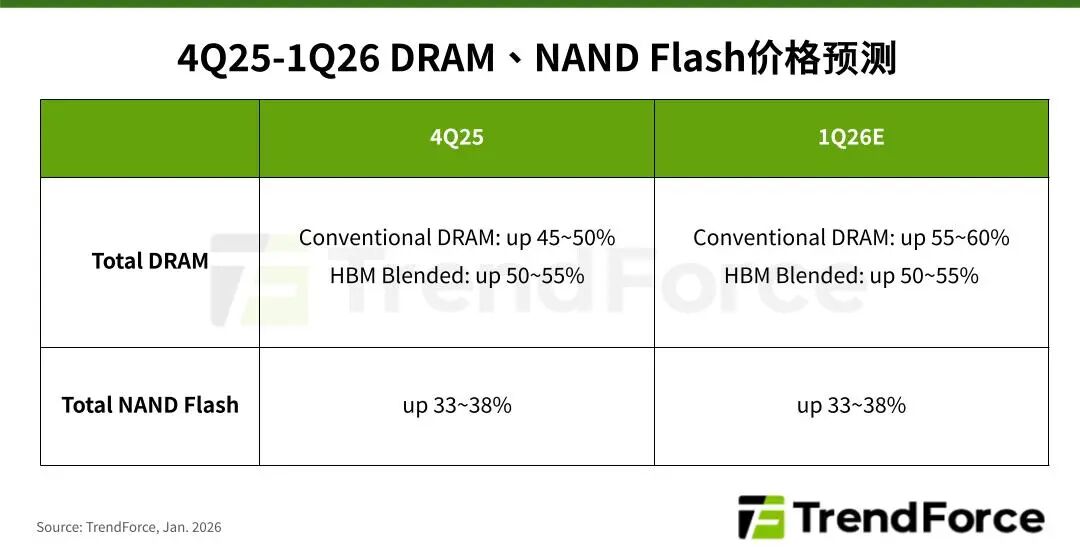
TrendForce集邦咨询:预计2026年第一季度各类存储器产品价格全面持续上涨
Zhi Tong Cai Jing· 2026-01-05 09:23
Group 1: DRAM Market Insights - The first quarter of 2026 is expected to see a significant increase in PC DRAM prices due to tightened supply from manufacturers, despite a slowdown in overall demand for PC units [2] - Server DRAM demand is projected to grow substantially as cloud service providers (CSPs) increase their purchases, with a forecasted price increase of over 60% in the first quarter [3] - Mobile DRAM supply remains tight, leading to strong purchasing power from brands, with expectations of rising contract prices for LPDDR4X and LPDDR5X [3] - Graphics DRAM prices are expected to rise due to supply constraints, despite a conservative demand outlook influenced by NVIDIA's sales target adjustments [3] - Consumer DRAM customers are willing to pay higher prices for prioritized supply in the first quarter, as supply continues to lag behind demand [3] Group 2: NAND Flash Market Insights - The NAND Flash market is anticipated to grow significantly, driven by AI applications, with Enterprise SSD demand expected to surpass mobile applications for the first time by 2026 [4] - Client SSD demand is projected to decline in the first quarter due to reduced laptop shipments and capacity downgrades in lower-end models, yet contract prices are expected to increase by at least 40% [4] - The supply of NAND Flash products is tightening as manufacturers prioritize high-margin products, leading to increased prices for Enterprise SSDs [4] - eMMC/UFS demand is showing signs of weakness due to inventory adjustments, although Chromebook shipments are benefiting from government projects [5] - NAND Flash wafer supply is constrained as manufacturers focus on high-margin product lines, resulting in continued price increases despite weak demand in consumer markets [5]