
通用设备

Search documents
前5个月利润同比增长7.2% 装备制造业 “压舱石”作用凸显
Shang Hai Zheng Quan Bao· 2025-06-27 19:53
Core Viewpoint - The gradual recovery of industrial product prices and the implementation of domestic demand expansion policies are expected to maintain a positive trend in domestic demand, leading to a slight recovery in the profit growth of large-scale industrial enterprises in the second half of the year, influenced by a low base from the previous year [1][3]. Group 1: Industrial Profit Trends - In the first five months, the total profit of large-scale industrial enterprises reached 27,204.3 billion yuan, an increase of 6,034.1 billion yuan compared to the first four months, but a year-on-year decline of 1.1% [1]. - The profit of large-scale industrial enterprises in May alone saw a year-on-year decline of 9.1% [1]. - Despite the decline in profit, the gross profit and revenue of industrial enterprises continued to grow, with gross profit increasing by 1.1% year-on-year, contributing to a 3 percentage point increase in overall profit [1]. Group 2: Sector Performance - The equipment manufacturing sector showed strong performance, with profits increasing by 7.2% year-on-year, contributing 2.4 percentage points to the overall profit of large-scale industrial enterprises [2]. - Among the eight industries in equipment manufacturing, seven reported profit growth, with significant increases in the electronics, electrical machinery, and general equipment sectors, achieving year-on-year growth rates of 11.9%, 11.6%, and 10.6% respectively [2]. - The aerospace, aviation, and maritime industries experienced rapid growth, with profits increasing by 56.0% year-on-year, and the shipbuilding and related equipment manufacturing sector saw an impressive profit growth of 85% [2]. Group 3: Policy Impact and Future Outlook - The implementation of "two new" policies has effectively stimulated domestic demand, leading to positive profit performance in related industries [3]. - The general and specialized equipment sectors benefited from large-scale equipment renewal policies, with profits increasing by 10.6% and 7.1% year-on-year, respectively, contributing 0.6 percentage points to the overall profit growth [3]. - The outlook for the next phase suggests that with ongoing recovery in market conditions and industrial product prices, along with strengthened domestic demand policies, the profit growth of large-scale industrial enterprises may show slight recovery in the second half of the year [3].
【新华解读】前5月规上工业毛利润保持增长 “上天入海”表现亮眼
Xin Hua Cai Jing· 2025-06-27 14:05
Core Insights - Despite facing uncertainties from trade tensions and market expectations, China's industrial enterprises above designated size maintained a stable and positive development trend in the first five months of the year, particularly in the aerospace, aviation, and maritime industries, which are entering a rapid growth phase [1][2] Group 1: Industrial Profit Trends - In the first five months, industrial enterprises achieved a total profit of 27,204.3 billion yuan, an increase of 6,034.1 billion yuan compared to January-April, but a year-on-year decline of 1.1% due to insufficient effective demand and falling industrial product prices [1][2] - The gross profit of industrial enterprises above designated size grew by 1.1% year-on-year, contributing to a 3.0 percentage point increase in overall profits [1] - Revenue from industrial enterprises increased by 2.7% year-on-year, indicating a sustained growth trend that creates favorable conditions for future profit recovery [1] Group 2: Sector-Specific Performance - The aerospace, aviation, and maritime industries saw significant profit growth, with profits in the railway, shipbuilding, and aerospace sectors increasing by 56.0% year-on-year [2] - Profits in aircraft manufacturing and spacecraft and rocket manufacturing grew by 120.7% and 28.6%, respectively, while related equipment manufacturing profits rose by 68.1% [2] - The shipbuilding and related equipment manufacturing sector experienced an 85.0% profit increase, with metal ship manufacturing profits soaring by 111.8% [2] Group 3: Economic Policy and Financing - The decline in profit growth for industrial enterprises indicates ongoing constraints from insufficient effective demand, necessitating more proactive macroeconomic policies and increased government investment in public goods [3] - The average interest rate for newly issued loans in May was approximately 3.2%, down about 50 basis points from the previous year, highlighting the need to boost effective financing demand [3] - The central bank's recent interest rate cut is expected to lower loan market rates, reducing the financial burden on industrial enterprises and aiding their recovery [3] Group 4: Policy Implementation and Sector Growth - Various regions and departments have intensified efforts to implement "two new" policies, effectively releasing domestic demand [4] - Profits in general and specialized equipment industries grew by 10.6% and 7.1% year-on-year, respectively, contributing 0.6 percentage points to overall industrial profit growth [4] - The "old-for-new" consumption policy has shown significant effects, with profits in smart consumer device manufacturing and other household electrical appliance manufacturing increasing by 101.5% and 31.2%, respectively [4]
多维数据传递经济运行积极信号 工业高质量发展活力显现
Yang Shi Wang· 2025-06-27 07:29
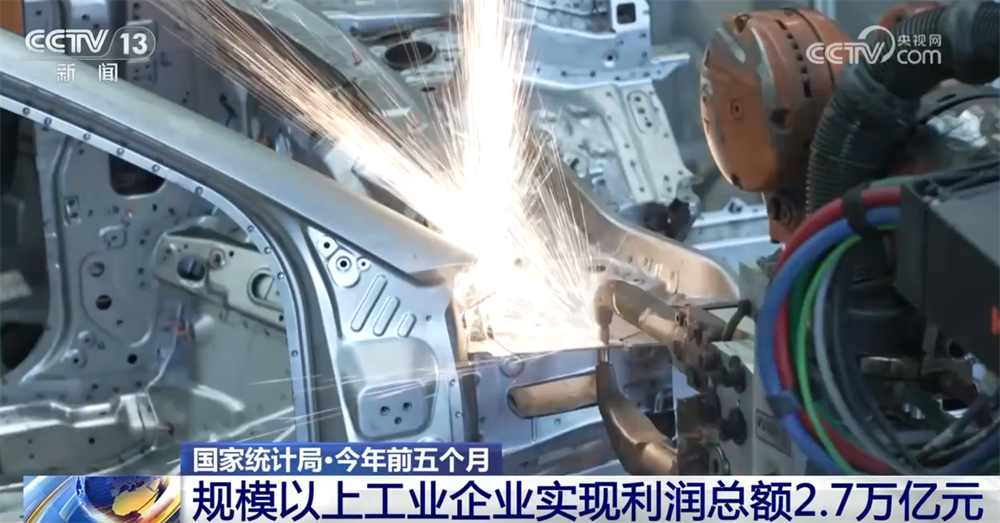
Group 1 - The total profit of industrial enterprises in China reached 2.7 trillion yuan in the first five months of this year, with a year-on-year decline of 1.1% [1] - The revenue of industrial enterprises above designated size was 54.76 trillion yuan, showing a year-on-year growth of 2.7%, indicating a sustained growth trend in industrial revenue [1] - The equipment manufacturing industry maintained a high level of profitability, with profits increasing by 7.2% year-on-year in the first five months [3] Group 2 - The aerospace, aviation, and maritime industries experienced rapid growth, leading to a 56.0% year-on-year increase in profits for the railway, shipping, and aerospace sectors [5] - Specific industries such as aircraft manufacturing, spacecraft and launch vehicle manufacturing, and shipbuilding saw profit increases of 120.7%, 28.6%, and 85.0% respectively [5] Group 3 - The integration of technological and industrial innovation is enhancing the technical content of industrial products, with a continuous release of market demand for smart, green, and high-quality products, contributing to profit growth for related enterprises [7] - Proactive macroeconomic policies are expected to support stable industrial economic operations and create favorable conditions for improving industrial enterprise profitability [7] Group 4 - The total revenue of China's cultural industry reached 19.1423 trillion yuan in 2024, marking a year-on-year growth of 7.1% [13] - The profit of the cultural industry totaled 1.7737 trillion yuan, an increase of 1.291 trillion yuan, reflecting a 7.9% growth [13]

国家统计局:实施好更加积极有为的宏观政策,着力做强国内大循环
news flash· 2025-06-27 01:36
Core Insights - In the first five months, the total profit of industrial enterprises above designated size reached 27,204.3 billion yuan, showing a year-on-year decline of 1.1% despite an increase of 6,034.1 billion yuan compared to the first four months [1] Group 1: Profit Trends - The profit of industrial enterprises decreased year-on-year due to multiple factors including insufficient effective demand, declining industrial product prices, and short-term fluctuations [1] - Although the total profit declined, the gross profit calculated by deducting operating costs from operating income increased by 1.1% year-on-year, contributing to a 3.0 percentage point increase in overall profits for industrial enterprises [1] Group 2: Policy Impact - The "Two New" policy has shown continuous effects, with various regions and departments intensifying efforts to implement the policy, effectively releasing domestic demand vitality [1] - Under the influence of large-scale equipment renewal policies, the profits of the general equipment and specialized equipment industries increased by 10.6% and 7.1% year-on-year, respectively, collectively contributing 0.6 percentage points to the growth of profits for industrial enterprises above designated size [1] Group 3: Future Outlook - The next phase will focus on thoroughly implementing the decisions and deployments of the Central Committee and the State Council, adopting more proactive macro policies, strengthening domestic circulation, enhancing innovation-driven development, and solidifying the foundation for the recovery of industrial enterprise efficiency [1]
国家统计局工业司统计师于卫宁解读2025年1—5月份工业企业利润数据
Guo Jia Tong Ji Ju· 2025-06-27 01:34
Group 1 - In the first five months of 2025, industrial enterprises above designated size achieved a total profit of 27,204.3 billion yuan, showing a year-on-year decline of 1.1% due to multiple factors such as insufficient effective demand and declining industrial product prices [1] - Despite the profit decline, the gross profit margin for these enterprises increased by 1.1% year-on-year, contributing to a 3.0 percentage point increase in overall profits [1] - The operating revenue for industrial enterprises grew by 2.7% year-on-year, indicating a sustained growth trend that creates favorable conditions for future profit recovery [1] Group 2 - The equipment manufacturing industry demonstrated significant resilience, with profits increasing by 7.2% year-on-year, contributing 2.4 percentage points to the overall industrial profit growth [2] - Among the eight sectors within the equipment manufacturing industry, seven reported profit growth, with notable increases in electronics, electrical machinery, and general equipment sectors, achieving growth rates of 11.9%, 11.6%, and 10.6% respectively [2] - The aerospace, aviation, and maritime industries experienced rapid growth, with profits increasing by 56.0% year-on-year, driven by successful commercial operations of domestic large aircraft and advancements in space exploration [2] Group 3 - The "two new" policy effects are becoming increasingly evident, with significant profit growth in general and specialized equipment sectors, achieving increases of 10.6% and 7.1% respectively [3] - The consumer goods sector benefited from policies promoting the replacement of old equipment, with profits in smart consumer devices and kitchen appliances growing by 101.5% and 20.7% respectively [3] - Private and foreign-invested enterprises also saw profit growth, with increases of 3.4% and 0.3% year-on-year, surpassing the average growth rate of all industrial enterprises [3]
浙江力诺: 累积投票制实施细则(2025年6月)
Zheng Quan Zhi Xing· 2025-06-25 17:45
Core Points - The implementation rules for the cumulative voting system aim to protect the interests of minority shareholders and regulate the company's governance structure [1] - The cumulative voting system allows shareholders to concentrate their voting rights on a single candidate or distribute them among multiple candidates during the election of directors [1][2] - The rules specify that the cumulative voting system is mandatory when a single shareholder or their concerted actors hold more than 30% of the voting shares during the election of two or more directors [2] Chapter Summaries Chapter 1: General Principles - The cumulative voting system grants each shareholder voting rights equal to the number of shares they hold multiplied by the number of directors to be elected [1] - The term "directors" includes both independent and non-independent directors, with specific provisions for employee representatives [1][2] Chapter 2: Nomination of Directors - Director candidates must meet the qualifications set forth in relevant laws and regulations, typically nominated by the board of directors [8] - Candidates must provide written consent and personal information before the shareholder meeting [3][9] Chapter 3: Voting Principles of Cumulative Voting - The voting process must be clearly communicated to shareholders, and appropriate ballots must be prepared [13][22] - Separate voting is required for independent and non-independent directors [14] Chapter 4: Principles for Election of Directors - Directors are elected based on the number of votes received, requiring a majority of valid voting rights [17] - In case of a tie, specific procedures are outlined for re-election [19][20] Chapter 5: Special Procedures for Cumulative Voting - The use of cumulative voting must be explicitly stated in the notice for the shareholder meeting [21] - Shareholders can vote in person or delegate their voting rights to others [23][24] Chapter 6: Supplementary Provisions - Any matters not covered by these rules will follow national laws and the company's articles of association [24] - The board of directors is responsible for interpreting these rules [25]

浙江力诺: 信息披露暂缓与豁免管理制度(2025年6月)
Zheng Quan Zhi Xing· 2025-06-25 17:36
Core Viewpoint - The article outlines the information disclosure deferral and exemption management system of Zhejiang Lino Fluid Control Technology Co., Ltd, emphasizing the need for compliance with legal obligations and the protection of investors' rights [1][2]. Group 1: General Principles - The system aims to regulate the deferral and exemption of information disclosure by the company and other obligated parties, ensuring compliance with relevant laws and regulations [1]. - Information disclosure obligations must be fulfilled truthfully, accurately, completely, timely, and fairly, without misuse of deferral or exemption to mislead investors [2]. Group 2: Conditions for Deferral and Exemption - Deferral or exemption from disclosure is permitted if the information involves state secrets or could violate confidentiality regulations [2]. - Business secrets can be deferred or exempted if disclosure could lead to unfair competition or harm the interests of the company or others [2][3]. Group 3: Internal Review Procedures - The company must carefully determine the need for deferral or exemption and follow internal review procedures to prevent unauthorized disclosure [4][5]. - The board of directors oversees the management of deferral and exemption matters, with the board secretary responsible for coordinating these activities [4]. Group 4: Registration and Reporting - The company must maintain a record of deferred or exempted disclosures, including the type of information and the reasons for deferral or exemption [5][6]. - Relevant materials must be submitted to the regulatory authorities within ten days after the announcement of periodic reports [6]. Group 5: Accountability and Compliance - The company must not abuse the deferral or exemption procedures and will hold responsible parties accountable for any violations that negatively impact the company or investors [6][7]. - The management system must comply with the rules of the Shenzhen Stock Exchange and other relevant regulations [8].
浙江力诺: 独立董事工作制度(2025年6月)
Zheng Quan Zhi Xing· 2025-06-25 17:36
Core Viewpoint - The independent director system of Zhejiang Lino Fluid Control Technology Co., Ltd. aims to enhance corporate governance, protect the interests of minority shareholders, and ensure independent decision-making within the board of directors [1][2]. Group 1: General Principles - The independent director is defined as a board member who does not hold any other position within the company and has no direct or indirect interests that could affect their independent judgment [1][2]. - Independent directors are required to fulfill their duties independently and are not influenced by the company or its major shareholders [2][4]. Group 2: Qualifications and Appointment - Independent directors must maintain independence and cannot be individuals with certain relationships or interests in the company, including family ties to major shareholders or significant business relationships [5][6]. - The board must include independent directors making up at least one-third of its members, with at least one being a professional accountant [2][6]. Group 3: Responsibilities and Duties - Independent directors are responsible for participating in board decisions, supervising potential conflicts of interest, and providing professional advice to enhance decision-making [15][16]. - They must attend board meetings in person or delegate their voting rights to another independent director if unable to attend [18][19]. Group 4: Performance and Reporting - Independent directors are required to submit an annual report detailing their attendance, participation in committees, and communication with minority shareholders [26][27]. - The company must provide necessary support and resources for independent directors to perform their duties effectively [15][17]. Group 5: Compensation and Rights - Independent directors are entitled to compensation that reflects their responsibilities, which must be approved by the board and disclosed in the annual report [33][34]. - They have the right to access information and resources necessary for their role, ensuring they can perform their duties without obstruction [31][32].
港迪技术收盘上涨1.24%,滚动市盈率43.53倍,总市值39.05亿元
Jin Rong Jie· 2025-06-23 10:41
Company Overview - Wuhan Gangdi Technology Co., Ltd. specializes in the research, development, production, and sales of products in the industrial automation sector, including frequency converters, industry-specific machines, and intelligent control systems for containers and bulk goods [1] - The company has received several honors, including being ranked among the "Top 10 Intelligent Information Enterprises in the Cement Industry" in 2021 and "Top 100 Innovative Building Material Enterprises" in 2022 [1] Financial Performance - As of the latest quarterly report for Q1 2025, the company reported revenue of 60.78 million yuan, a year-on-year decrease of 5.50%, and a net loss of approximately 5.19 million yuan, representing a year-on-year decline of 878.31% [1] - The gross profit margin for the company stands at 35.45% [1] Market Position - The company's stock closed at 70.14 yuan on June 23, with a PE ratio of 43.53, while the average PE ratio for the general equipment industry is 73.86 [1][2] - The total market capitalization of the company is approximately 3.905 billion yuan [1][2] Capital Flow - On June 23, the net inflow of main funds into the company was 781,400 yuan, although there has been an overall outflow of 6.47 million yuan over the past five days [1]
发电量为什么和工业增加值“脱节”?
2025-06-23 02:09
Summary of Conference Call Notes Industry or Company Involved - The discussion primarily revolves around the electricity generation industry and its relationship with industrial value-added growth in the context of the broader economy. Core Points and Arguments - There is a significant divergence between electricity generation growth and industrial value-added growth, attributed to differences in statistical scope, as data from small-scale enterprises (such as renewable energy and distributed photovoltaic) is not fully captured in the statistics [1][3] - Industrial electricity consumption growth is approximately 3%, while the growth of industrial value-added for large-scale enterprises is around 6%, indicating a disparity in development between large and small enterprises [1][4] - The domestic economic growth target of 5% is likely achievable, but tail risks remain, particularly for low-income residents, small enterprises, and local governments with heavy debt burdens [1][5] - The divergence in growth rates is particularly pronounced in the electrical machinery, chemical, non-metallic minerals, and general equipment sectors, where capacity utilization rates are at historical lows [1][6] - In 2025, risk warnings in various industries, especially electrical machinery, chemicals, non-metallic minerals, and communication equipment, are higher than in 2024, indicating significant changes on the supply side with little improvement on the demand side [1][7] - The phenomenon of divergence is expected to continue, with a proposed solution being to strengthen supply-side clearing efforts and improve capacity utilization rates [1][8] Other Important but Possibly Overlooked Content - The rapid growth of small-scale enterprises in electricity generation is not reflected in overall statistics, leading to a misleading picture of the industry [3][4] - The performance of large enterprises is significantly better than that of small and medium-sized enterprises, contributing to the observed divergence in data [4][6] - The need for policy support to mitigate risks faced by low-income residents and small enterprises is emphasized, highlighting the importance of addressing these tail risks for overall economic stability [5]