
生物制品

Search documents
安旭生物:上半年净利润5930.59万元,同比下降48.57%
Zheng Quan Shi Bao Wang· 2025-08-19 11:10
人民财讯8月19日电,安旭生物(688075)8月19日晚间披露2025年半年报,公司上半年实现营业收入2.3亿 元,同比下降7.42%;归母净利润为5930.59万元,同比下降48.57%。基本每股收益0.47元。报告期内, 归属于上市公司股东净利润较上年同期下降,主要系本年汇率波动引起的汇兑损失及政府补助减少。 ...

ST未名: 浙江天册(深圳)律师事务所关于山东未名生物医药股份有限公司2023年股票期权激励计划注销部分股票期权事项的法律意见书
Zheng Quan Zhi Xing· 2025-08-19 11:09
Core Viewpoint - The legal opinion letter from Zhejiang Tiance (Shenzhen) Law Firm confirms that Shandong Weiming Bio-Pharmaceutical Co., Ltd. has complied with relevant laws and regulations regarding the cancellation of certain stock options under its 2023 stock option incentive plan [1][9]. Group 1: Implementation of the Incentive Plan - The company has implemented the 2023 stock option incentive plan and has obtained necessary approvals from the board and independent directors [3][4]. - The supervisory board has verified that the individuals included in the incentive plan meet the qualifications as per the Company Law and relevant regulations [6][7]. Group 2: Approval and Authorization for Cancellation - The company has conducted necessary meetings to approve the cancellation of stock options that were not exercised during the first exercise period [7][8]. - The first exercise period for the stock options is set from May 30, 2024, to May 29, 2025, with a total of 16,617,396 stock options remaining unexercised by the end of this period [8][9]. Group 3: Compliance with Regulations - The cancellation of stock options is in accordance with the provisions of the Management Measures and the draft incentive plan [8][9]. - The company is required to fulfill its information disclosure obligations and complete related procedures following the cancellation [9].

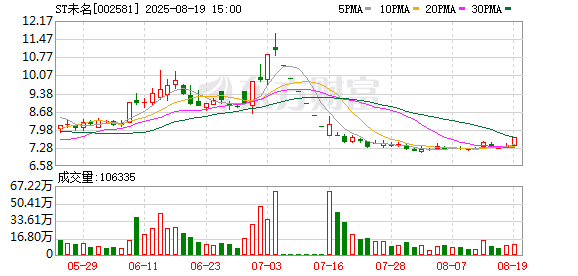
ST未名:2025年半年度净利润亏损约6730万元
Mei Ri Jing Ji Xin Wen· 2025-08-19 11:03
(文章来源:每日经济新闻) ST未名(SZ 002581,收盘价:7.69元)8月19日晚间发布半年度业绩报告称,2025年上半年营业收入约 7077万元,同比减少66.42%;归属于上市公司股东的净利润亏损约6730万元;基本每股收益亏损0.102 元。 ...

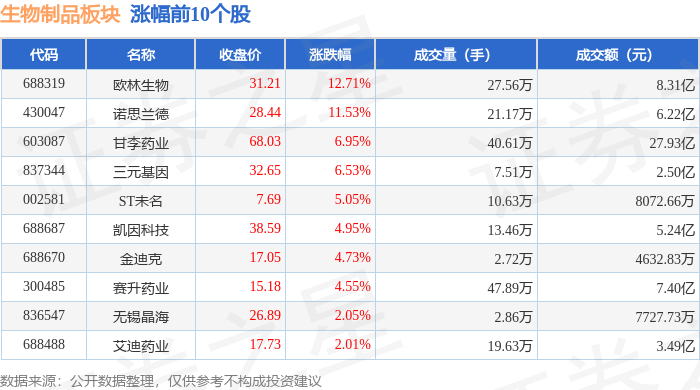
生物制品板块8月19日涨0.27%,欧林生物领涨,主力资金净流入2.5亿元
Zheng Xing Xing Ye Ri Bao· 2025-08-19 08:32
Market Overview - The biopharmaceutical sector increased by 0.27% on August 19, with Olin Bio leading the gains [1] - The Shanghai Composite Index closed at 3727.29, down 0.02%, while the Shenzhen Component Index closed at 11821.63, down 0.12% [1] Top Performers - Olin Bio (688319) closed at 31.21, up 12.71% with a trading volume of 275,600 shares and a transaction value of 831 million [1] - Nossland (430047) closed at 28.44, up 11.53% with a trading volume of 211,700 shares and a transaction value of 622 million [1] - Ganli Pharmaceutical (603087) closed at 68.03, up 6.95% with a trading volume of 406,100 shares and a transaction value of 2.793 billion [1] Underperformers - Junshi Biosciences (688180) closed at 45.32, down 3.70% with a trading volume of 210,400 shares and a transaction value of 977 million [2] - ZhiXiangQuanTai (688443) closed at 33.05, down 3.42% with a trading volume of 77,200 shares and a transaction value of 260 million [2] - SanShengGuoJian (688336) closed at 54.10, down 2.50% with a trading volume of 85,900 shares and a transaction value of 477 million [2] Capital Flow - The biopharmaceutical sector saw a net inflow of 250 million from institutional investors, while retail investors experienced a net outflow of 379 million [2][3] - Major stocks like Shenzhou Cell (688520) had a net inflow of 1.39 billion from institutional investors, but a net outflow of 1.08 billion from retail investors [3]


136只个股连续5日或5日以上获主力资金净买入
Zheng Quan Shi Bao Wang· 2025-08-19 03:09
Core Insights - As of August 18, a total of 136 stocks in the Shanghai and Shenzhen markets have experienced net buying from major funds for five consecutive days or more [1] - The stock with the longest streak of net buying is Jichuan Pharmaceutical, which has seen net buying for 13 consecutive trading days [1] - Other notable stocks with significant net buying days include Dingyang Technology, Suzhou Bank, Zhongchi Co., Everbright Jiabao, Jinko Technology, ST Guangwu, Tebao Biological, and Zheshang Bank, with 12, 11, 11, 10, 10, 10, 9, and 9 days of net buying respectively [1]
20cm速递|创业板医药ETF国泰(159377)涨超1.3%,板块估值与政策红利引关注
Sou Hu Cai Jing· 2025-08-19 02:26
Group 1 - The pharmaceutical and biotechnology industry is focusing on Q2 performance and the progress of traditional Chinese medicine companies in innovative drug development, while monitoring the impact of policies such as the special governance of "Four Same Drugs" and centralized procurement of traditional Chinese medicine [1] - The valuation of some vaccine companies in the biopharmaceutical sector is at historical lows, and there is a trend of valuation recovery due to the spillover of innovative drug market sentiment [1] - The medical device sector is gradually recovering in terms of performance and valuation as the industry reaches a turning point, with recognized innovation capabilities and internationalization potential [1] Group 2 - Recent centralized procurement policies from multiple provinces or alliances have optimized rules, introducing price correction mechanisms and bottom price mechanisms, leading to some product renewal prices being increased [1] - The brain-computer interface sector is performing well, with China being relatively advanced in technology research in this field [1] - The pharmaceutical industry is showing good performance, with the release of important data and progress in research pipelines by multiple companies during the 2025 WCLC regular summary, enhancing international competitiveness and rapid development driven by new technologies and supportive national policies for innovative drug development [1] Group 3 - The Guotai Innovation Pharmaceutical ETF (159377) tracks the Innovation Pharmaceutical Index (399275), which can have a daily fluctuation of up to 20%, focusing on innovative pharmaceutical fields and selecting listed company securities from biopharmaceuticals, chemical pharmaceuticals, traditional Chinese medicine, and medical services to reflect the overall performance of the pharmaceutical industry's innovation development [1]

国海证券晨会纪要-20250819
Guohai Securities· 2025-08-19 00:03
Group 1 - The report highlights that Kaiyin Technology achieved a year-on-year increase in net profit of 11.75% in the first half of 2025, despite a slight decline in revenue [3][4] - The company reported a revenue of 5.66 billion yuan in H1 2025, with a net profit of 0.47 billion yuan, indicating a strong performance in profitability [4][5] - The company is increasing its R&D investment, with a total of 71.41 million yuan in H1 2025, which is expected to support the launch of innovative products [5] Group 2 - Dingyang Technology reported a revenue of 2.79 billion yuan in H1 2025, representing a year-on-year growth of 24.61%, and a net profit of 0.77 billion yuan, up 31.54% [6][7] - The company’s high-end products saw a revenue increase of 71.92%, with high-end products now accounting for 30% of total revenue [7][8] - The overall gross margin for Dingyang Technology was 60.06%, with a net margin increase to 27.57% [8] Group 3 - Baiya Co. achieved a revenue of 17.64 billion yuan in H1 2025, a 15.12% increase year-on-year, with a net profit of 1.88 billion yuan, up 4.64% [9][10] - The company is focusing on optimizing its product structure and expanding its offline channels, which have shown steady growth despite challenges in online sales [10][11] - The gross margin for Baiya Co. was 53.24%, with a net margin of 10.66% [11][12] Group 4 - Darentang reported a revenue of 26.51 billion yuan in H1 2025, a decrease of 33.15%, but a significant net profit increase of 193.08% to 19.28 billion yuan due to asset transfers [13][14] - The company’s core product sales, particularly the fast-acting heart-saving pill, showed robust growth, with sales reaching 11.28 billion yuan [14][15] - Darentang is actively expanding its retail presence and promoting new retail strategies to drive growth [15] Group 5 - The automotive industry saw a 14.7% year-on-year increase in passenger car wholesale sales in July 2025, with a total of 228.7 million units sold [17][19] - The new Wanjie M7 model is set to launch in September 2025, indicating ongoing innovation in the automotive sector [18][19] - The report suggests a positive outlook for the automotive sector, driven by policies supporting vehicle upgrades and a shift towards high-end and intelligent vehicles [20] Group 6 - Beite Technology reported a revenue of 11.13 billion yuan in H1 2025, a 15% increase year-on-year, with a net profit of 0.55 billion yuan, up 45% [22][23] - The company is focusing on cost reduction and efficiency improvements, which have positively impacted its profitability [23][24] - Beite Technology is expanding its global production capacity, particularly in the robotics sector, which is expected to contribute significantly to future growth [24][25] Group 7 - Geely Automobile achieved a revenue of 150.28 billion yuan in H1 2025, a 26.5% increase, with a core net profit of 66.6 billion yuan, up 101.7% [26][27] - The company is launching several new models in the second half of 2025, which is expected to boost sales further [28][29] - Geely's strategy includes integrating its resources with Zeekr to enhance operational efficiency and reduce costs [29][30] Group 8 - Jingfeng Mingyuan reported a revenue of 7.31 billion yuan in H1 2025, with a net profit of 15.76 million yuan, marking a significant turnaround [32][33] - The company’s high-performance computing power supply and motor drive chips have seen substantial growth, contributing to improved profitability [33][34] - Jingfeng Mingyuan is planning to acquire Yichong Technology to enhance its product offerings and market competitiveness [35][36] Group 9 - China Hongqiao reported a revenue of 81.04 billion yuan in H1 2025, a 10.1% increase, with a net profit of 12.36 billion yuan, up 35% [39][40] - The growth in revenue is attributed to increased sales and prices of aluminum and alumina products [40][41] - The company plans to repurchase shares worth at least 3 billion HKD, reflecting confidence in its long-term prospects [41][42]




嘉必优: 嘉必优生物技术(武汉)股份有限公司2025年半年度募集资金存放与使用情况专项报告
Zheng Quan Zhi Xing· 2025-08-18 16:30
Fundraising Overview - The company raised a total of RMB 717 million from the issuance of 30 million shares at RMB 23.90 per share, with a net amount of RMB 648.33 million after deducting issuance costs [1] - As of June 30, 2025, the company had a remaining balance of RMB 7.30 million in its fundraising account [3] Fund Management - The company has established a management system for fundraising in accordance with regulatory guidelines to ensure proper use and protection of investor rights [1] - A tripartite supervision agreement was signed with the underwriter and banks to ensure the funds are used specifically for their intended purposes [2][3] Fund Utilization - The company completed the investment projects related to the expansion of microbial oil and polyunsaturated fatty acid microencapsulation production lines in 2023, with final payments made during the reporting period [4][5] - The research center construction project has fully utilized the committed fundraising amount, with excess funding derived from interest income [4][8] Financial Management - The company has not used any excess fundraising to permanently supplement working capital or repay bank loans during the reporting period [5][6] - The board approved the temporary use of up to RMB 12 million of idle funds for cash management, ensuring it does not affect ongoing projects [5] Compliance and Reporting - The company has adhered to all relevant laws and regulations regarding the use of fundraising and has disclosed the usage status in a timely manner [7]

嘉必优: 嘉必优生物技术(武汉)股份有限公司2025年度“提质增效重回报”行动方案的半年度评估报告
Zheng Quan Zhi Xing· 2025-08-18 16:30
Core Viewpoint - The company has implemented a "Quality Improvement, Efficiency Enhancement, and Return to Investors" action plan, achieving significant growth in net profit and expanding its product offerings in various sectors, including infant nutrition, animal nutrition, and beauty care [1][2][5]. Group 1: Business Development - The company achieved a net profit of 108 million yuan, a year-on-year increase of 59.01% [1]. - In the infant nutrition sector, the demand for ARA and algal oil DHA products has steadily increased, with significant contributions from core customer sales growth [1]. - The company has successfully advanced collaborations with major international clients such as Danone, Nestlé, and Abbott, focusing on algal oil DHA products and HMOs [1][2]. Group 2: Product Innovation - The company has developed EncapDHA algal oil emulsion, which can be used in various functional food applications [2]. - In the animal nutrition sector, the company launched 27 new fatty acid products, enhancing its B2C business through integrated operations [2]. - The company is actively developing high-value products such as 2'-FL, 3-FL, and EPA, with successful pilot tests and regulatory submissions [4]. Group 3: Research and Development - The company invested 19.76 million yuan in R&D in the first half of 2025, employing 97 R&D personnel and holding 191 authorized patents [2][3]. - The company is advancing its AI and synthetic biology strategy, enhancing its intelligent R&D platform and bioinformatics capabilities [3]. Group 4: Operational Efficiency - The company has implemented a digital transformation strategy, improving supply chain data analysis and decision-making capabilities [5]. - The company achieved record production levels through capacity optimization and digital management [5]. Group 5: Corporate Governance - The company has maintained effective governance practices, holding multiple board meetings and enhancing its ESG governance framework [6][7]. - The company is focused on improving the capabilities of its key personnel through training and development initiatives [7]. Group 6: Investor Relations - The company emphasizes shareholder returns through cash dividend distributions and potential share buybacks, with plans to repurchase shares within a specified range [8][9]. - The company is actively engaging with investors through various communication channels and events to ensure transparency and information dissemination [10].
欧林生物: 成都欧林生物科技股份有限公司关于以简易程序向特定对象发行人民币普通股(A股)股票募集资金使用可行性分析报告(二次修订稿)
Zheng Quan Zhi Xing· 2025-08-18 16:17
Fundraising Plan - The company plans to raise a total of up to RMB 300 million, with a net amount of RMB 125.29 million allocated for specific projects after deducting related issuance costs [1] - The total investment for the projects is RMB 290 million, which aligns with national industrial policies and does not involve overcapacity or high-energy-consuming industries [1] Project Overview - The fundraising project focuses on the "Vaccine R&D Production Base Technical Renovation Project," which includes upgrading production lines for major products such as tetanus and polysaccharide vaccines [2] - The project aims to replace old production lines with new automated and intelligent production lines while maintaining overall production capacity stability [2][3] Necessity of the Project - The project is necessary to adapt to industry trends and improve production management, ensuring compliance with vaccine production quality management standards [2][3] - The renovation will enhance production efficiency and product quality, which is crucial for the company's main revenue sources [3] Competitive Advantage - The vaccine industry is technology-intensive, requiring continuous innovation and improvement to maintain competitiveness [4] - The project will support the stable production of core products, providing cash flow for ongoing research and development of new products [4] Feasibility of the Project - The project aligns with national policies promoting equipment upgrades in the pharmaceutical industry, enhancing production quality and efficiency [5] - The company has established a robust quality management system that complies with various regulations, ensuring product quality throughout the production lifecycle [6] Implementation and Economic Impact - The project will be implemented over four years, with funding allocated based on project progress [8] - The project is expected to enhance the company's production capabilities and financial health, leading to improved long-term profitability and reduced financial risks [12] Conclusion - The fundraising project is in line with national policies and industry trends, aiming to optimize production processes and enhance product quality, thereby ensuring the company's competitive advantage and sustainable growth [12][13]