
服装

Search documents
天猫双11:近600品牌成交破亿,超3万品牌增长翻倍
Xin Lang Cai Jing· 2025-11-14 16:09
2025年天猫双11以实现四年来最好增长收官。天猫双11全周期,近600个品牌成交破亿,34091个品牌同 比去年增长翻倍,18048个同比增长超3倍,13081个同比增长超5倍,均超去年同期。其中,苹果、海 尔、美的、源氏木语、小米、斐乐、老铺黄金、骆驼、华为、耐克等品牌成交破10亿。 ...
国家贴息促消费显现杠杆效应,“双11”人均分期消费金额提升18%
Guo Ji Jin Rong Bao· 2025-11-14 12:25
Core Insights - The "Double 11" shopping festival this year saw significant consumer engagement due to government subsidy policies, with over 100 million interest-free installment products offered by platforms and merchants [1][3] - The implementation of the personal consumption loan subsidy policy has effectively reduced consumer credit costs, leading to an 18% increase in per capita installment spending compared to September [1][3] Group 1: Government Policies - The introduction of the "Personal Consumption Loan Fiscal Subsidy Policy" in September aims to stimulate market activity and consumer spending by lowering credit costs [3] - The "National Subsidy" product section on Taobao and Tmall has attracted 65 million views since its launch on October 30, highlighting increased consumer awareness of the subsidy policy [4] Group 2: Consumer Behavior - There was a 19% increase in the number of consumers benefiting from the national subsidy during "Double 11," with nearly 2 million first-time users of interest-free installments [4] - Consumers are increasingly opting for installment payments, as evidenced by a significant rise in the use of these options during the shopping festival [7] Group 3: Merchant Response - Merchants have responded positively to the subsidy, with many reporting increased sales and higher coverage of interest-free installment options [6] - For example, Bosideng reported a 97.8% coverage of interest-free installments for products over 100 yuan, with installment payments accounting for 12.7% of total sales [6] - Brands offering full-store interest-free options saw substantial growth, with some reporting an 80% increase in installment sales and nearly 20% growth in overall sales [6] Group 4: Market Dynamics - The collaboration between government subsidies and merchant strategies has created a win-win situation, enhancing consumer purchasing power while driving sales growth for businesses [8] - The recent emphasis on boosting consumption in the "14th Five-Year Plan" underscores the importance of collaborative efforts in stimulating economic activity [8]

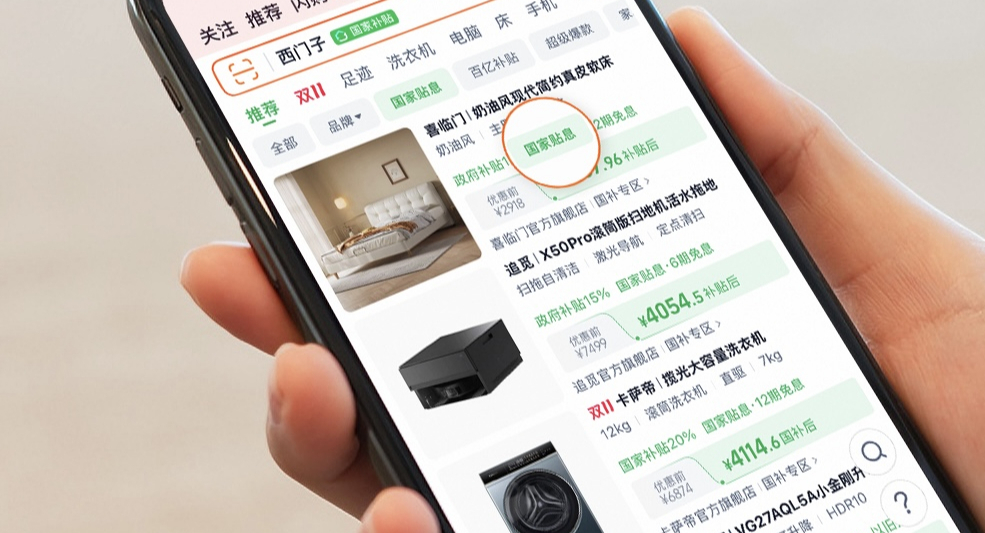
6500万人关注!“双11”这一数据最新披露
券商中国· 2025-11-14 11:56
Core Viewpoint - The article highlights the positive impact of the "National Subsidy" policy on consumer spending during the "Double 11" shopping festival, showcasing a collaborative effort among the government, platforms, merchants, and consumers to stimulate the economy through innovative financial practices [1][2]. Policy Impact - The Chinese government has been actively enhancing its consumer support policies, including a 1% financial subsidy for eligible personal consumption loans, which has led to a rapid market response since its implementation [2][6]. - The introduction of the "National Subsidy" section on e-commerce platforms has attracted 65 million consumers, with a 19% increase in the number of consumers benefiting from the subsidy during the "Double 11" period compared to September [2][4]. Consumer Experience - A typical consumer experience is illustrated by a case where a consumer was able to purchase a refrigerator through a combination of a trade-in subsidy and interest-free installment payments, significantly reducing financial pressure [3][5]. Market Dynamics - The collaboration between the government and market players has created a robust synergy, with platforms and merchants actively participating in promotional activities, leading to a 97.8% coverage of interest-free installment payments for certain products [4][6]. - Brands that offered full-store interest-free options saw significant sales increases, with one furniture brand reporting an 80% growth in installment sales and a nearly 20% increase in overall sales [6][8]. Consumer Behavior - The trend of interest-free installments has become a new norm, with a notable increase in consumer usage during the "Double 11" festival, indicating a shift towards more calculated spending [7][8]. - Research indicates that products with interest-free installment options experienced an average sales increase of 30%, while overall store sales rose by 15% [8].

安正时尚:郑安政累计质押公司股份为2470万股
Mei Ri Jing Ji Xin Wen· 2025-11-14 11:11
Core Viewpoint - Anzheng Fashion (SH 603839) announced that its controlling shareholder, Zheng Anzheng, holds approximately 118 million shares, accounting for 30.38% of the total share capital as of the announcement date [1] Group 1: Shareholding and Pledge Information - Zheng Anzheng has pledged 24.7 million shares, which is 20.9% of his holdings and 6.35% of the total share capital [1] - Zheng Anzheng and his concerted parties collectively hold about 241 million shares, representing 61.88% of the total share capital [1] - The total number of pledged shares by Zheng Anzheng and his concerted parties is 64.7 million, which is 26.88% of their total holdings and 16.63% of the total share capital [1] Group 2: Revenue Composition - For the first half of 2025, Anzheng Fashion's revenue composition is as follows: clothing accounts for 64.07% and e-commerce operation services account for 35.93% [1] Group 3: Market Capitalization - As of the announcement, Anzheng Fashion's market capitalization is 3.6 billion yuan [1]

九牧王:公司内外部经营环境未发生重大变化
Xin Lang Cai Jing· 2025-11-14 10:15
Core Viewpoint - The company has issued a risk warning announcement, stating that its daily operations are normal and there have been no significant changes in the market environment or industry policies [1] Summary by Relevant Categories Company Operations - The company confirms that its daily business activities are operating normally [1] - There have been no significant fluctuations in production costs and sales [1] - The internal production and operational order of the company remains normal [1] Market Environment - The market environment has not undergone any major adjustments [1] - There are no significant changes in the external business environment [1]

三连板九牧王:公司内外部经营环境未发生重大变化
Ge Long Hui· 2025-11-14 10:15
Core Viewpoint - Jomoo King issued a risk warning announcement, stating that the company's daily operations are currently normal, with no significant changes in the market environment or industry policies [1] Group 1: Company Operations - The company has conducted a self-inspection and confirmed that all daily operational activities are functioning normally [1] - There have been no major fluctuations in production costs or sales [1] - The internal production and operational order of the company remains normal [1] Group 2: Market Environment - The external business environment has not undergone significant changes [1]
海澜之家:徐兴福辞任公司副总经理职务
Xin Lang Cai Jing· 2025-11-14 09:09
Core Viewpoint - The company announced the resignation of Xu Xingfu from the position of Deputy General Manager of the Ninth Board of Directors due to personal reasons, effective immediately upon delivery of the resignation report [1] Group 1 - Xu Xingfu will continue to serve as the head of the Channel Operations Center within the company and its subsidiaries after his resignation [1]

奢侈品牌涌入户外的当下,Canada Goose加拿大鹅讲了一个自己的故事
36氪· 2025-11-14 09:07
Core Viewpoint - Canada Goose is successfully evolving its brand identity and product offerings in the luxury outdoor apparel market, emphasizing a blend of functionality and fashion while maintaining its roots in extreme weather protection [1][62]. Group 1: Brand Evolution and Market Positioning - Canada Goose has transformed from a brand associated with extreme weather gear for specific groups to a lifestyle symbol among Chinese consumers [3][24]. - The brand's entry into the Chinese market was marked by significant consumer interest, evidenced by long queues and resale activities during its first store openings in 2018 [3][24]. - The brand's narrative remains closely tied to its origins in extreme environments, reinforcing its credibility and trust among consumers [5][9]. Group 2: Product Diversification and Fashion Integration - Since 2015, Canada Goose has shifted its strategy towards diversification, aiming to become a comprehensive high-end lifestyle brand rather than just a winter apparel company [27][30]. - The brand has expanded its product range to include lightweight down jackets, spring/summer raincoats, footwear, and eyewear, creating a year-round product ecosystem [30][32]. - The appointment of Haider Ackermann as the first creative director signals a commitment to integrating fashion with functionality, exploring new design possibilities [32][37]. Group 3: Local Market Engagement and Cultural Integration - Canada Goose has actively engaged with the Chinese market through culturally relevant initiatives, such as the "HUMANATURE" outdoor festival in 2021, which emphasized its brand philosophy [39][42]. - The brand has collaborated with local designers and artists to create products that resonate with Chinese culture, enhancing its local relevance [46][50]. - Canada Goose's corporate responsibility initiatives, such as the project in Qinghai, demonstrate its commitment to ecological sustainability and community involvement in China [49][55]. Group 4: Financial Performance and Market Strategy - Canada Goose's revenue in the Asia-Pacific region has shown significant growth, with the Greater China area becoming its largest market by the 2024 fiscal year [59][60]. - The brand's global revenue increased by 1.8% year-on-year in the second quarter of the 2026 fiscal year, with notable performance in North America and China [59][60]. - The dual strategy of product diversification and localized market engagement has positioned Canada Goose favorably amidst global consumption slowdowns, highlighting its resilience and adaptability [64].


杉杉品牌在宁波成立树屿服饰公司
Xin Lang Cai Jing· 2025-11-14 08:21
Group 1 - Ningbo Shuyu Clothing Co., Ltd. has been established with a registered capital of 10 million yuan [1] - The company's business scope includes wholesale and retail of sports goods and equipment, enterprise management consulting, and outdoor product sales [1] - Shuyu Clothing is wholly owned by the Shanshan brand, which is held 19.37% by Shanshan Co., Ltd. [1]
杀疯了的迪桑特,统一东北大哥审美
3 6 Ke· 2025-11-14 07:14
Core Viewpoint - The article discusses the rising popularity of the outdoor brand Descente in Northeast China, where it has become a cultural phenomenon and is often referred to as the "provincial uniform" of the region during winter. Group 1: Brand Recognition and Cultural Significance - Descente has become ubiquitous in Northeast China, with locals frequently encountering the brand in various settings, leading to a perception that it is a form of local identity [2][6][20] - The brand's logo symbolizes practicality and a connection to the grassroots, making it a preferred choice among professionals in the region [11][12][20] - Wearing Descente is seen as a sign of belonging and mutual understanding among locals, with "matching outfits" not being a source of embarrassment but rather a shared identity [9][20] Group 2: Market Position and Consumer Behavior - Descente has gained high recognition among various demographics, including government employees and business professionals, who view it as a reliable choice for both casual and formal settings [7][11][20] - The brand's pricing range of 1,000 to 8,000 yuan allows it to cater to both budget-conscious consumers and those seeking high-end options, making it accessible to a wide audience [17][20] - The brand's strategic placement in high-end shopping areas has reinforced its premium image, attracting consumers who associate it with status and quality [43][44] Group 3: Competitive Landscape - While Descente is a dominant player, other outdoor brands like Arc'teryx and KAILAS are also popular in the region, contributing to a diverse market landscape [22][24] - The article highlights a shift in local fashion preferences, moving away from traditional luxury items to functional outdoor wear, reflecting changing consumer values [24][28] Group 4: Marketing and Expansion Strategy - Descente's entry into the Chinese market was marked by a strategic decision to open its first store in Changchun, which has proven to be a successful move [39][41] - The brand has effectively utilized high-profile endorsements and experiential marketing to enhance its visibility and appeal among target consumers [46][47] - The expansion strategy includes a significant number of stores in Northeast China, with 59 locations across the three provinces, indicating a strong commitment to the region [36][38]
