锂矿
Search documents
大越期货碳酸锂期货早报-20250818
Da Yue Qi Huo· 2025-08-18 02:45
1. Report Industry Investment Rating No relevant content provided. 2. Core Viewpoints of the Report - The supply - demand pattern of lithium carbonate is characterized by strong supply and weak demand due to capacity mismatch, and the downward trend is difficult to change [14]. - Lithium carbonate 2511 is expected to fluctuate in the range of 85,000 - 88,800 [10]. 3. Summary by Relevant Catalogs 3.1 Daily Views - **Supply - side**: Last week, lithium carbonate production was 19,980 tons, a 2.16% week - on - week increase, higher than the historical average [8]. In July 2025, production was 81,530 physical tons, and next - month production is predicted to be 84,200 tons, a 3.27% increase [10]. - **Demand - side**: Last week, the inventory of lithium iron phosphate sample enterprises was 95,081 tons, a 0.51% week - on - week increase, and the inventory of ternary material sample enterprises was 17,296 tons, a 4.45% week - on - week increase [8]. - **Cost - side**: The cost of purchased lithium spodumene concentrate is 79,952 yuan/ton, a 0.28% daily increase, with a production profit of 1,579 yuan/ton; the cost of purchased lithium mica is 84,292 yuan/ton, a 0.69% daily increase, with a production loss of 4,868 yuan/ton; the production cost of the recycling end is close to that of the ore end, and the production enthusiasm is average; the quarterly cash production cost of the salt lake end is 31,745 yuan/ton, with sufficient profit margins and strong production motivation [9]. - **Fundamentals**: Neutral [9]. - **Basis**: On August 15, the spot price of battery - grade lithium carbonate was 82,700 yuan/ton, and the basis of the 11 - contract was - 4,200 yuan/ton, with the spot at a discount to the futures. Bearish [9]. - **Inventory**: The smelter inventory was 49,693 tons, a 2.56% week - on - week decrease, lower than the historical average; the downstream inventory was 48,283 tons, a 0.26% week - on - week increase, higher than the historical average; other inventories were 44,280 tons, a 2.36% week - on - week increase, higher than the historical average; the total inventory was 142,256 tons, a 0.11% week - on - week decrease, higher than the historical average. Neutral [9]. - **Market trend**: MA20 is upward, and the futures price of the 11 - contract closed above MA20. Bullish [11]. - **Main positions**: The main positions are net short, and short positions increased. Bearish [11]. - **Positive factors**: Manufacturers' shutdown and production reduction plans, a month - on - month decrease in the amount of lithium carbonate imported from Chile, and a decline in lithium spodumene imports [12]. - **Negative factors**: High - level supply at the ore/salt lake end with limited decline, and insufficient willingness of the power battery end to take delivery [13]. 3.2 Lithium Carbonate Market Overview - **Prices**: The prices of various lithium - related products such as lithium spodumene, lithium mica concentrate, battery - grade lithium carbonate, and lithium hexafluorophosphate showed different degrees of increase or remained stable [17]. - **Supply - demand data**: The weekly operating rate of lithium carbonate was 63.92%, unchanged from the previous value; the monthly operating rate of lithium iron phosphate increased by 5.36%, and the monthly production increased by 9.70% [19]. 3.3 Supply - Lithium Ore - **Prices**: Lithium ore prices have shown fluctuations over the years [24]. - **Production**: The production of Chinese sample lithium spodumene mines and domestic lithium mica has changed over different years [24]. - **Imports**: Lithium concentrate imports have fluctuated, with imports from Australia and other regions varying [24]. - **Supply - demand balance**: The supply - demand balance of domestic lithium ore has shown different situations in different months and years [26]. 3.4 Supply - Lithium Carbonate - **Operating rate**: The weekly operating rate of lithium carbonate production from different sources (lithium spodumene, lithium mica, salt lake, recycling materials) has changed over time [29]. - **Production**: Lithium carbonate production has shown an upward or fluctuating trend over different years and months [29]. - **Imports**: The import volume of lithium carbonate from different countries (Chile, Argentina, etc.) has changed [29]. - **Supply - demand balance**: The monthly supply - demand balance of lithium carbonate has shown different situations in different months and years [34]. 3.5 Supply - Lithium Hydroxide - **Capacity utilization**: The weekly capacity utilization rate of domestic lithium hydroxide has changed over different years [37]. - **Production**: The production of lithium hydroxide from different sources (smelting, causticizing) has changed [37]. - **Exports**: China's lithium hydroxide export volume has shown an upward trend over different years [37]. - **Supply - demand balance**: The monthly supply - demand balance of lithium hydroxide has shown different situations in different months and years [40]. 3.6 Lithium Compound Cost - Profit - **Cost - profit of different raw materials**: The cost - profit of purchasing lithium spodumene concentrate, lithium mica concentrate, and various recycled materials for lithium carbonate production has changed over time [43][46][49]. - **Processing cost - profit**: The cost - profit of processing lithium hydroxide from different forms (coarse - grained to fine - grained), and the cost - profit of various lithium compound conversion processes have changed [49]. 3.7 Inventory - **Lithium carbonate inventory**: The inventory of lithium carbonate in smelters, downstream, and other aspects has changed over time [51]. - **Lithium hydroxide inventory**: The inventory of lithium hydroxide in downstream and smelters has changed [51]. 3.8 Demand - Lithium Battery - **Prices**: The prices of lithium batteries have changed over time [55]. - **Production**: The monthly production of power cells and energy - storage cells has changed [55]. - **Exports**: The export volume of lithium batteries has shown an upward trend over different years [55]. 3.9 Demand - Ternary Precursor - **Prices**: The prices of ternary precursors have changed over time [60]. - **Production**: The monthly production of ternary precursors of different series has changed [60]. - **Supply - demand balance**: The monthly supply - demand balance of ternary precursors has shown different situations in different months and years [63]. 3.10 Demand - Ternary Material - **Prices**: The prices of ternary materials have changed over time [66]. - **Cost - profit**: The cost - profit of ternary materials has changed [66]. - **Operating rate**: The weekly operating rate of ternary materials has changed over different years [66]. - **Exports and imports**: The export and import volumes of ternary materials have changed [68]. 3.11 Demand - Iron Phosphate/Iron Phosphate Lithium - **Prices**: The prices of iron phosphate and iron phosphate lithium have changed over time [70]. - **Cost - profit**: The cost - profit of iron phosphate lithium has changed [70]. - **Production**: The monthly production of iron phosphate and iron phosphate lithium has changed [73]. - **Exports**: The monthly export volume of iron phosphate lithium has shown an upward trend over different years [73]. 3.12 Demand - New Energy Vehicles - **Production**: The production of new energy vehicles (plug - in hybrids and pure - electric vehicles) has changed over different years [78]. - **Exports**: The export volume of new energy vehicles has shown an upward trend over different years [78]. - **Sales**: The sales volume of new energy vehicles (plug - in hybrids and pure - electric vehicles) and the sales penetration rate have changed over different years [78][79]. - **Inventory indicators**: The retail - wholesale ratio, inventory warning index, and inventory index of new energy vehicles have changed over different years [82].
供应扰动尚未完全解除,下游买盘逐步释放
Dong Zheng Qi Huo· 2025-08-17 13:46
1. Report Industry Investment Rating - The investment rating for lithium carbonate is "Bullish" [1] 2. Core Viewpoints of the Report - Last week, lithium salt prices rebounded strongly, with significant increases in the closing prices of LC2509 and LC2511 contracts and the spot average prices of battery - grade and industrial - grade lithium carbonate. The price of lithium hydroxide also continued to rise [2][11]. - After the suspension of production at Jianxiaowo on August 9th, the market shifted from expected trading to real - time trading, and the balance sheet for the third quarter will turn into a de - stocking phase. In August, the market is in a tight balance, while the gap will widen in September. Longer - term production suspension will significantly narrow the annual surplus [3][12]. - The supply - side disturbances are not completely resolved, and there are concerns about potential production cuts in other projects in Qinghai and Jiangxi. On the demand side, the third - quarter is characterized by "off - season not so off", with the production of cells and materials increasing monthly driven by energy - storage demand. In the short term, prices are expected to remain strong. It is recommended to hold existing long positions, look for opportunities to go long on dips, and avoid mid - term short positions for now [3][13][14] 3. Summary by Relevant Catalog 3.1 Supply Disturbances Not Fully Resolved, Downstream Buying Interest Gradually Released - From August 11th to 15th, lithium salt prices rebounded strongly. The closing price of LC2509 increased by 13.4% to 86,900 yuan/ton, and that of LC2511 increased by 12.9% to 86,900 yuan/ton. The spot average prices of SMM battery - grade and industrial - grade lithium carbonate increased by 15% to 82,700 and 80,400 yuan/ton respectively. The average prices of SMM coarse - particle and micron - powder battery - grade lithium hydroxide increased by 12% to 74,000 and 79,000 yuan/ton respectively [11]. - After the production suspension at Jianxiaowo on August 9th, the market moved from expected trading to real - time trading, with a 13% increase in the week. The production loss will lead to de - stocking in the third - quarter balance sheet. In August, the market is in a tight balance, and the gap will widen in September. Longer - term suspension will narrow the annual surplus. After the actual production cut, downstream purchasing interest recovered, and the acceleration of SMM price adjustments and the narrowing of the basis and monthly long - term contract spread stimulated downstream buying [12]. 3.2 Week - to - Week Industry News Review - In July, China's power - battery loading volume was 55.9GWh, a 4.0% month - on - month decrease but a 34.3% year - on - year increase. Among them, ternary battery loading volume was 10.9GWh (19.6% of the total, up 1.9% month - on - month and down 3.8% year - on - year), and lithium iron phosphate battery loading volume was 44.9GWh (80.4% of the total, down 5.3% month - on - month and up 49.0% year - on - year) [15]. - CATL's Yichun project suspended mining operations after the mining license expired on August 9th and is applying for a renewal. The impact on the company's overall operations is small [15]. - US - based Piedmont Lithium's North American Lithium (NAL) set a new production record in the second quarter, producing 58,500 tons of lithium concentrate and shipping about 67,200 tons. Piedmont expects lithium - spodumene shipments to reach 113,000 - 125,000 tons by 2025 [15]. - The Lithium Industry Branch issued an initiative to strengthen upstream - downstream cooperation, maintain industrial safety, and promote the high - quality development of the lithium industry [16]. - Sigma Lithium's lithium production increased by 38% in the second quarter, and the total sustaining cash cost decreased by 24% year - on - year. However, the total sales volume decreased by 23%, and the net loss widened [16]. 3.3 Key High - Frequency Data Monitoring of the Industry Chain 3.3.1 Resource End: Spot Quotes of Lithium Concentrate Rebound - The spot average price of lithium - spodumene concentrate (6%, CIF China) increased by 21.0% to 940 US dollars/ton [12]. 3.3.2 Lithium Salts: The Market Rebounds Strongly Again - The closing prices of lithium - carbonate futures contracts, including LC2509 and LC2511, and spot average prices of battery - grade and industrial - grade lithium carbonate all increased significantly [11][12]. - The price of lithium hydroxide continued to rise, and the price difference between battery - grade lithium hydroxide and battery - grade lithium carbonate widened [11]. 3.3.3 Downstream Intermediate Products: Quotes Slightly Rebound - The prices of downstream materials such as lithium iron phosphate, ternary materials, and cobalt - acid lithium all increased to varying degrees [12]. 3.3.4 Terminal: China's New - Energy Vehicle Penetration Rate Slightly Increased in July - In July, China's new - energy vehicle penetration rate slightly increased, and the power - battery loading volume showed certain changes in structure and scale [15]
一周概念股:多家上市公司并购切入半导体,屹唐股份亮剑起诉应用材料
Ju Chao Zi Xun· 2025-08-17 13:19
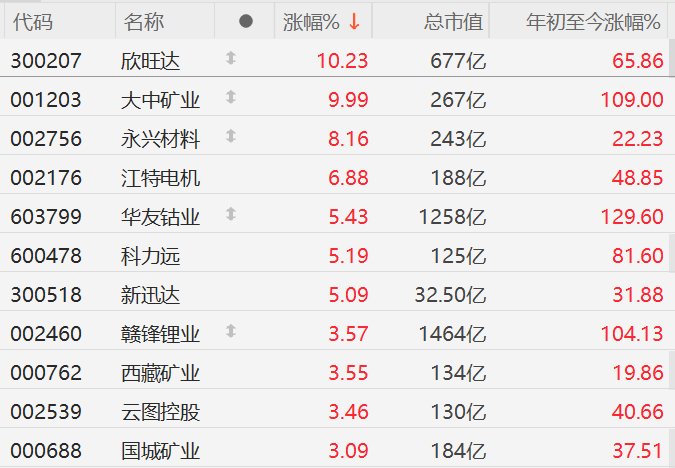
Group 1: Mergers and Acquisitions in Semiconductor Sector - Multiple A-share listed companies are engaging in cross-industry mergers and acquisitions, particularly in the semiconductor sector, including companies like Wantong Development, Quzhou Development, Kaipu Cloud, Yongji Co., and Kanda New Materials [2][3] - Wantong Development plans to invest approximately 854.45 million yuan to acquire a 62.98% stake in Beijing Shudu Information Technology Co., which specializes in high-speed interconnect chip design and development [3] - Quzhou Development intends to purchase 95.46% of the shares of Guangdong Xiandao Rare Materials Co. and raise up to 3 billion yuan in supporting funds, with the estimated valuation of the target company not exceeding 12 billion yuan [4] - Yongji Co. is planning to acquire control of Nanjing Tena Fei Electronic Technology Co. through a combination of share issuance and cash payment [4] - Kanda New Materials aims to acquire 51% of Chengdu Zhongke Huamei Electronics Co. for 275 million yuan, making it a subsidiary [5] Group 2: Legal Disputes in Semiconductor Industry - Yitang Co., a leading domestic equipment manufacturer with a market value of 60 billion yuan, has filed a lawsuit against global semiconductor equipment leader Applied Materials for "illegally obtaining and using its core technical secrets," seeking 99.99 million yuan in damages [6][7] - The lawsuit highlights the competitive landscape between Chinese and American semiconductor equipment giants and reflects the determination of Chinese semiconductor companies to protect their innovations through legal means [6][7] Group 3: Lithium Mining and Market Reactions - Ningde Times' subsidiary, Yichun Times New Energy Mining Co., has temporarily halted operations at its lithium mine following the expiration of its mining rights, with plans to apply for an extension [8][9] - The suspension has led to a significant rise in lithium stocks, with companies like Tianqi Lithium and Jiangte Electric experiencing substantial gains, indicating a positive market reaction to the supply disruption [9]
宁德时代旗下一矿区停产,碳酸锂持续大涨
2 1 Shi Ji Jing Ji Bao Dao· 2025-08-17 13:14
Group 1: Market Overview - Domestic commodity futures experienced mixed performance from August 11 to August 15, with lithium carbonate and palm oil leading gains, while the European shipping index saw the largest decline [1] - In the energy and chemical sector, fuel oil fell by 2.71%, crude oil by 0.71%, and lithium carbonate rose by 12.92% [1] - The black metal sector saw slight fluctuations, with coking coal up by 0.24% and iron ore by 0.32%, while coking coal decreased by 0.26% [1] Group 2: Lithium Market Dynamics - The recent suspension of operations at the Jiangxiawo mine due to expired mining licenses has raised concerns about lithium carbonate supply, leading to a significant price increase [2] - Supply disruptions continue with the suspension of operations at the Qinghai Zhongxin Guoan salt lake, although the impact from the Yichun lithium mine is currently limited due to inventory levels [3] - In June, Chile exported approximately 10,200 tons of lithium carbonate to China, with exports increasing by 43% month-on-month in July [3] Group 3: Demand and Inventory Trends - In July, the demand for new energy vehicles and lithium batteries showed a slowdown in growth, but remains at high levels, with production and sales of new energy vehicles reaching 1.243 million and 1.262 million units, respectively [3] - Domestic lithium carbonate inventory decreased slightly to 142,256 tons, with a week-on-week reduction of 162 tons [4] - The overall supply-demand balance for lithium carbonate has not significantly improved, and prices are expected to remain volatile until supply disruptions are resolved [4] Group 4: Future Market Expectations - Analysts suggest that supply-side factors will be the market focus, with emotional fluctuations driven by news rather than fundamental changes [5] - The next critical date for the market will be September 30, when a reserve verification report is due, which may influence production changes at smelting plants [5] - Long-term projections indicate that overseas lithium mines are raising production targets for FY2026, which may exert pressure on lithium carbonate prices [5]
宁德时代旗下一矿区停产,碳酸锂持续大涨
21世纪经济报道· 2025-08-17 13:09
Group 1 - The core viewpoint of the article highlights the fluctuations in domestic commodity futures, with lithium carbonate and palm oil leading the gains, while the shipping sector, particularly the European routes, faced declines [1] - In the energy and chemical sector, there was a notable increase in lithium carbonate prices by 12.92%, while fuel and crude oil prices decreased by 2.71% and 0.71% respectively [1] - The black series and basic metals experienced slight fluctuations, with coking coal rising by 0.24% and iron ore by 0.32%, while coking coal saw a minor decline of 0.26% [1] Group 2 - The supply side is affected by the suspension of operations at the Jiangxiawo mine due to the expiration of its mining license, raising concerns about lithium carbonate supply [3][5] - In July, China's lithium carbonate imports from Chile reached approximately 10,200 tons, with a 43% month-on-month increase in exports from Chile expected by July 2025 [5] - The demand for lithium remains high, with July's production and sales of new energy vehicles reaching 1.243 million and 1.262 million units, respectively, marking year-on-year growth of 26.3% and 27.4% [5] Group 3 - Domestic lithium carbonate inventory slightly decreased to 142,256 tons, reflecting a 0.1% reduction week-on-week, primarily due to the flow from processing plants to downstream sectors [6] - The overall supply-demand balance for lithium carbonate has not significantly improved, with expectations of continued price volatility until supply disruptions are resolved [6] - Analysts suggest that the next critical date for market observation is September 30, when a reserve verification report will be submitted, which may increase market fluctuations [7]
2025Q2sigmalithium锂精矿产销量分别同比增长38%、同比下降23%至6.8万吨、4万吨
HUAXI Securities· 2025-08-16 14:56
Investment Rating - The industry rating is "Recommended" indicating a positive outlook for the sector with expectations of outperforming the benchmark index by 10% or more in the upcoming period [6]. Core Insights - In Q2 2025, the production of lithium concentrate reached 68,368 tons, a year-on-year increase of 38%, while sales volume decreased by 23% to 40,350 tons due to a strategic decision to halt supply during price volatility [1][2]. - The company's cash operating cost was reported at $442 per ton, a decrease of 14% year-on-year, maintaining the lowest cost in the industry [2]. - The financial performance showed a significant decline, with revenue dropping 62% year-on-year to $2.115 million, and a net loss of $1.886 million [3][4]. Summary by Sections Production and Sales - Q2 2025 lithium concentrate production was 68,368 tons, exceeding the target of 67,500 tons, with a 38% year-on-year growth [1]. - Sales volume for Q2 2025 was 40,350 tons, reflecting a 23% year-on-year decline and a 34% quarter-on-quarter decline due to a cautious supply strategy [1]. Cost Structure - The unit sales cost was $584 per ton, up 3% year-on-year and 5% quarter-on-quarter [1]. - The cash operating cost was $442 per ton, down 14% year-on-year and 3% quarter-on-quarter, remaining below the target of $500 per ton for 2025 [2]. - The all-in sustaining cost (AISC) was $594 per ton, a 24% decrease year-on-year and 4% decrease quarter-on-quarter, also below the annual target of $660 per ton [2]. Financial Performance - Revenue for Q2 2025 was $2.115 million, down 62% year-on-year and 56% quarter-on-quarter [3]. - EBITDA for Q2 2025 was -$1.688 million, indicating a loss compared to previous periods [4]. - The company reported a net loss of $1.886 million, widening year-on-year and turning negative quarter-on-quarter [4]. Operational Updates - The company is advancing its Phase II expansion project, which is expected to add 250,000 tons per year of lithium capacity, bringing total annual capacity to 520,000 tons by 2026 [8].
全球锂市场迎来审慎回暖信号
Shang Wu Bu Wang Zhan· 2025-08-16 13:31
Core Insights - The suspension of lithium mining in Yichun, China, has reignited market expectations, potentially alleviating the previous oversupply situation [1] - JPMorgan forecasts a 10%-20% rebound in the lithium price index, with prices on the Shenzhen Stock Exchange expected to reach between $12,410 and $13,538 per ton by November [1] - Current spot prices for battery-grade lithium in Asia are around $9,900 per ton, with expectations for prices to fluctuate between $9,000 and $13,000 per ton in the short term [1] - Analysts agree that the extreme pessimism from 2023 to early 2024 is dissipating, leading to a more balanced market, although confidence remains fragile [1] - The industry continues to monitor inventory levels, production capacity, and electric vehicle sales data [1] - Experts emphasize the need for Chile to clarify its lithium mining concession framework and shorten the mining permit approval process to avoid missing economic and industrial development opportunities [1]
本轮商品热潮见顶了吗?
对冲研投· 2025-08-16 13:10
Group 1: Market Analysis - The article analyzes the "anti-involution" trend in the futures market, focusing on seven representative commodities: coking coal, iron ore, glass, soda ash, industrial silicon, polysilicon, and lithium carbonate [2] - It highlights that while the futures market is a zero-sum game, overall speculation benefits from rising commodity prices, with traditional cyclical commodities being the main profit sources [2] - Polysilicon is identified as an outlier, showing a negative correlation between daily profit performance and price fluctuations, suggesting significant differences in trading behavior compared to other commodities [2] Group 2: Price Dynamics - The article discusses the price limits for various commodities, indicating that the lower price limit is based on the full cost of leading enterprises, while the upper limit is anchored to recent peak prices [5] - It notes that when prices approach the lower limit, bullish sentiments arise, while bearish sentiments emerge near the upper limit, indicating a cyclical nature of market reactions [5] - The article emphasizes the importance of maintaining reasonable profit levels for leading enterprises to foster innovation and economic stability [6] Group 3: Lithium Market Insights - The article reports on the significant impact of the Jiangxia Mine's production status on lithium carbonate prices, with a potential supply gap if the mine ceases operations [15] - It mentions that the mine's output accounts for 9.4% of the national total, and historical data shows that production halts lead to sharp price increases [15] - Current supply dynamics indicate a tight market, with increased demand in the lithium sector and a notable rise in consumption of lithium in August [16] Group 4: Regulatory Impact - The article discusses the preliminary anti-dumping ruling on Canadian canola seeds, which imposes a 75.8% anti-dumping deposit on all Canadian companies, indicating significant regulatory impacts on the domestic canola industry [10] - It highlights that this ruling could lead to tighter supply conditions for canola, affecting related markets such as canola oil and meal [10][11] Group 5: Economic Context - The article contextualizes the current market dynamics within China's economic transition from investment-driven to innovation-driven growth, emphasizing the need for a bull market to alleviate debt pressures on local governments and enterprises [9] - It suggests that a bull market can enhance asset prices, improve balance sheets, and stimulate consumer and investment confidence, creating a positive economic feedback loop [9]
基差方向周度预测-20250815
Guo Tai Jun An Qi Huo· 2025-08-15 14:04
Group 1: Report Core View - This week, domestic financial data declined due to seasonal factors, but the market didn't focus on it. The personal consumer loan interest - subsidy policy had limited impact. The main market drivers were news - related, like the shutdown of CATL's important lithium mine boosting the ChiNext and Sino - US chip competition strengthening domestic substitution expectations and driving up the STAR Market. The Shanghai - Shenzhen Composite Index and STAR Market Index led the gains among core indices [2]. - Overseas, the Stockholm economic and trade talks between China and the US postponed reciprocal tariffs and counter - measures for 90 days, having a small impact on the market. The US July CPI was lower than expected, while the PPI exceeded expectations, causing repeated expectations of a September interest rate cut in the US, large fluctuations in the US dollar index, and increased disturbances to global assets [2]. - Leveraged funds continued to flow in this week, with the margin trading balance exceeding 2 trillion on Monday and then having a net inflow of over 40 billion. The market trading volume increased rapidly, with the total A - share trading volume exceeding 2 trillion for three consecutive days. The market divergence widened, and the excess returns of heavy - weight stocks relative to the index were significant. The performance of individual stocks was far inferior to the prosperity shown by the index. The Shanghai Composite Index repeatedly touched the key level of 3,700 points and then fell back, losing the 3,700 - point level again at the end - of - day call auction on Friday [2]. - Large - cap sectors were still dragged down by sectors such as banks and coal. The Shanghai 50 and CSI 300 had small gains, while small - and medium - cap stocks performed better. The CSI 500 and CSI 1000 rose nearly 4%, and micro - cap stocks fell continuously, significantly underperforming small - and medium - cap stocks [2]. - In terms of basis, the annualized basis of each variety strengthened significantly. IF returned to a premium state, and the annualized discounts of IC and IM converged from 10% to around 7%, moving out of the historical bottom range. As the basis strengthened, the near - month contracts in the term structure rose significantly. After the August contracts expired, the September contracts had obvious hedging cost advantages. The September contracts of IH and IF had large premiums, providing large profit margins for cash - and - carry arbitrage. Meanwhile, the inter - term spread increased significantly this week, and the inter - term reverse arbitrage had realized considerable returns, with the strategy's cost - effectiveness further declining [2]. Group 2: Weekly Forecast Conclusion - The model's judgment on the movement directions of the bases of IH, IF, IC, and IM next week is: strengthening, weakening, strengthening, and weakening respectively [3] Group 3: Recent Forecast Conclusion - There are historical data on the real basis changes and predicted basis changes of IH, IF, IC, and IM, but no specific conclusions are clearly summarized from the data presented [4]
宁德时代 枧下窝矿停产
Guo Ji Jin Rong Bao· 2025-08-15 13:00
Group 1 - The core viewpoint of the articles highlights the significant fluctuations in lithium carbonate prices, which peaked at 400,000 yuan/ton in early 2022 and dropped to 60,000 yuan/ton before rebounding due to supply concerns following the suspension of operations at a key mine [1][3] - On August 13, lithium carbonate futures prices surged to nearly 90,000 yuan/ton, marking a new high since July 2024, driven by fears of supply shortages after the suspension of mining operations at the Jiangxi province mine [3] - The Jiangxi mine, operated by CATL, has an annual production capacity equivalent to 60,000 tons of lithium carbonate, accounting for approximately 6% of China's total production capacity in 2024 [3] Group 2 - The new amendments to the Mineral Resources Law, effective July 1, have significant implications for lithium mining, including classifying lithium as an independent mineral and raising the lithium oxide grade threshold for by-product lithium resources [5] - Several lithium companies are facing operational suspensions due to regulatory issues, with some companies voluntarily halting production for upgrades or compliance, indicating a trend towards reducing excessive competition in the industry [4][5] - Analysts suggest that once lithium mining companies suspend operations, it will be challenging to resume production quickly, which may keep lithium carbonate prices elevated for a while, despite some optimistic market sentiments [6][7] Group 3 - Some industry participants express skepticism about the sustainability of lithium carbonate prices above 80,000 yuan/ton, citing that the suspension of one mine may not significantly impact overall supply and that current production levels remain high [8] - There are concerns that increased imports of lithium from overseas could further affect domestic prices, potentially leading to downward pressure on lithium carbonate prices in the future [8]