芯片设计

Search documents
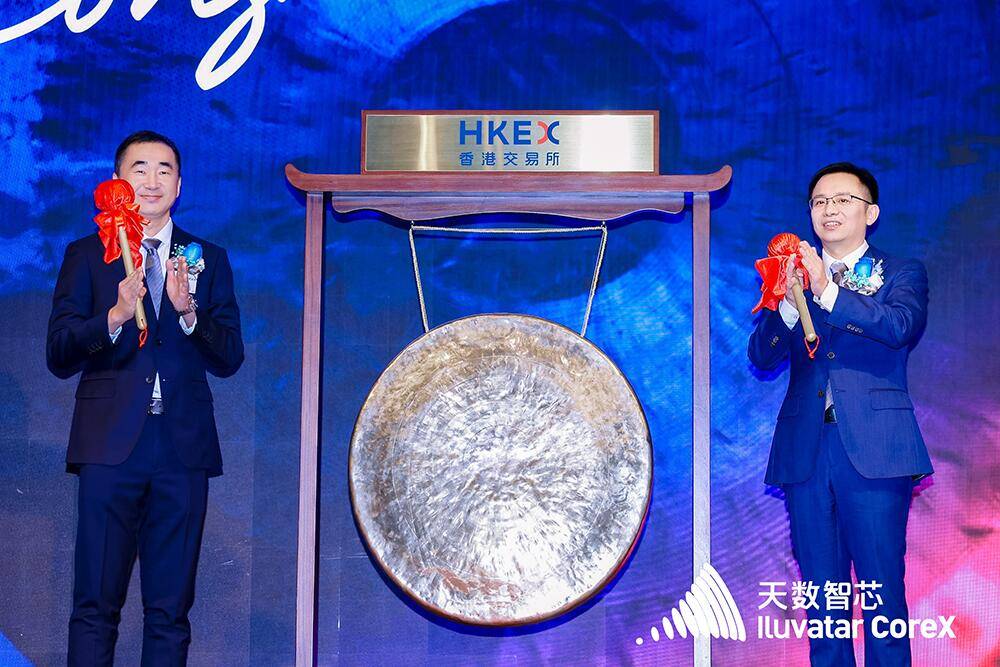
热烈祝贺天数智芯成功在港交所挂牌上市
Sou Hu Cai Jing· 2026-01-11 08:00
Core Viewpoint - Shanghai Tensu Zhixin Semiconductor Co., Ltd. successfully listed on the Hong Kong Stock Exchange main board on January 8, 2026, marking a significant milestone for the company and the industry [1] Company Overview - Tensu Zhixin, established in 2015, specializes in general-purpose GPU products and AI computing solutions tailored for various industries [1] - The company's product portfolio includes general-purpose GPU chips, accelerator cards, and customized AI computing solutions, integrating hardware with proprietary software stacks to meet specific customer needs in training and inference scenarios [1] Industry Milestones - Tensu Zhixin is the first Chinese chip design company to achieve mass production of inference general-purpose GPU chips and training general-purpose GPU chips [1] - The company is also the first to reach these milestones using advanced 7nm process technology [1] IPO Details - The IPO involved a global offering of approximately 25.43 million shares, raising about 3.677 billion HKD [1] - As of the finalization, the company's market capitalization stands at 40.843 billion HKD [1] - Huatai International acted as the sole sponsor for the IPO [1] Impact of Listing - The successful listing on the Hong Kong Stock Exchange is expected to significantly enhance Tensu Zhixin's industry influence, promote its brand globally, and facilitate more standardized and transparent corporate governance [1]

“耐心资本”助力科创企业加速跑
Bei Jing Ri Bao Ke Hu Duan· 2026-01-09 22:17
Group 1 - The core viewpoint of the articles highlights the significant role of patient capital from financial institutions in supporting the growth of technology-driven enterprises in Beijing, with a focus on long-term partnerships and tailored financial solutions [1][2][3] - Beijing Bank has achieved a technology finance loan balance exceeding 440 billion yuan, serving over 30,000 specialized and innovative enterprises, indicating a strong commitment to supporting the local economy [1] - The Chinese government's emphasis on developing technology finance, green finance, inclusive finance, pension finance, and digital finance is reflected in the strategic initiatives of Beijing Bank, which aims to empower the industrial ecosystem [1] Group 2 - The successful IPO of Moer Technology, a domestic GPU manufacturer, was supported by Beijing Bank through initial loans and flexible financing solutions, showcasing the importance of sustained financial backing for long-cycle, capital-intensive enterprises [2] - Beijing Bank has developed a "Science and Technology Radar" evaluation system to identify promising startups and offers a variety of financial products tailored to different stages of enterprise development, including loans for research and development and equity financing [3] - The bank has provided credit funding exceeding 1.45 trillion yuan to nearly 60,000 technology-oriented small and medium-sized enterprises, with a significant percentage of listed companies on various stock exchanges having received financial support from Beijing Bank [3]


天普股份遭遇大利空!证监会:立案调查
Zheng Quan Shi Bao Wang· 2026-01-09 15:48
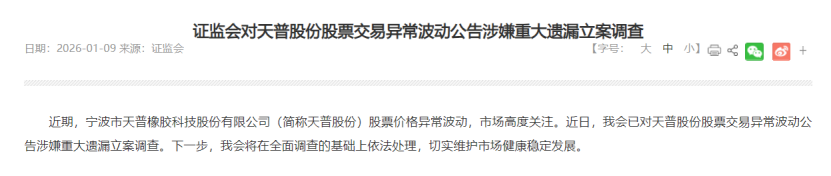
Core Viewpoint - Tianpu Co., Ltd. is under investigation by the China Securities Regulatory Commission (CSRC) for significant omissions in its announcements regarding abnormal stock price fluctuations, raising concerns in the market [2]. Group 1: Investigation and Company Response - The CSRC has initiated an investigation into Tianpu Co., Ltd. due to abnormal stock price fluctuations and potential significant omissions in announcements [2]. - Tianpu Co., Ltd. has stated that it will cooperate with the CSRC's investigation and will fulfill its information disclosure obligations according to relevant laws and regulations [2]. - The company confirmed that its production and operational activities are ongoing and that the investigation will not have a significant impact on its management [2]. Group 2: Stock Performance and Market Reaction - Tianpu Co., Ltd. experienced a remarkable stock price increase of 1,663.20% in 2025, making it the second-best performing stock of the year [4]. - The stock price surged after announcements regarding a potential change in control involving AI chip design company Zhonghao Xinying, which led to multiple trading halts due to price limits [3][4]. - Despite the lack of any AI-related business plans, the stock price continued to rise significantly, with a cumulative increase of 718.39% from August 22 to December 30, 2025 [4]. Group 3: Regulatory Actions and Penalties - Prior to the CSRC investigation, Tianpu Co., Ltd. and some former executives received regulatory warnings from the Shanghai Stock Exchange for inadequate disclosures related to the establishment of a subsidiary involved in AI and integrated circuit design [5][7]. - The establishment of the subsidiary, Tianpu Xincai, raised market speculation about the company's involvement in AI, despite the company stating it had no plans for such business [5][6]. - The Shanghai Stock Exchange criticized Tianpu Co., Ltd. for failing to clarify its position and adequately disclose risks associated with the subsidiary's activities, which could mislead investors [6].

一年大涨16倍 605255被立案调查
Mei Ri Jing Ji Xin Wen· 2026-01-09 13:53
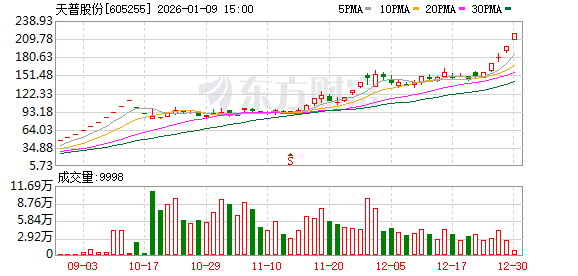
Group 1 - The core issue revolves around the abnormal stock price fluctuations of Ningbo Tianpu Rubber Technology Co., Ltd. (Tianpu Shares), which has led to an investigation by the China Securities Regulatory Commission (CSRC) for potential significant omissions in their announcements [2] - Tianpu Shares' stock has been suspended multiple times, with the latest suspension occurring on December 31, 2025, marking the fifth suspension in four months. The stock price surged from 12.59 yuan per share at the beginning of the year to 218.02 yuan per share by year-end, representing a cumulative increase of 1645.35% [2] - The Shanghai Stock Exchange (SSE) issued a regulatory warning to Tianpu Shares and its responsible individuals due to the company's failure to adequately disclose risks associated with its business operations, particularly in relation to its plans involving artificial intelligence (AI) [4][5] Group 2 - The SSE highlighted that the company had previously planned a change in control involving AI-related business entities, which led to multiple instances of abnormal stock price fluctuations. Despite these fluctuations, the company did not disclose any significant changes in its main business operations [5] - The company established a wholly-owned subsidiary with a business scope that includes AI-related activities, which may have fueled market speculation about its involvement in the AI sector. However, the company did not clarify its lack of plans to engage in AI-related business after the establishment of the subsidiary [6] - The acquisition of Tianpu Shares by Zhonghao Xinying, an AI chip design firm, was executed through a combination of share transfer and capital increase, with the acquiring company claiming to be the only domestic entity capable of producing high-performance AI-specific chips [6]
晶丰明源:拟32.83亿元购买易冲科技100%股权并募集配套资金
Zheng Quan Shi Bao Wang· 2026-01-09 13:52
Group 1 - The company, Jingfeng Mingyuan, announced on January 9 that it plans to acquire 100% equity of Sichuan Yichong Technology Co., Ltd. from 50 transaction parties for a total price of 3.283 billion yuan [1] - The transaction will be financed through a combination of issuing shares and cash payment, with the share consideration amounting to 2.033 billion yuan [1] - The company aims to raise an additional 1.8 billion yuan in supporting funds to cover cash payments, intermediary fees, and to supplement working capital [1] Group 2 - Yichong Technology specializes in the research, design, and sales of high-performance analog chips and mixed-signal chips, including wireless charging chips, general charging chips, automotive power management chips, and AC/DC protocol chips [1]

突发暴雷,证监会立案调查
Zhong Guo Ji Jin Bao· 2026-01-09 13:43
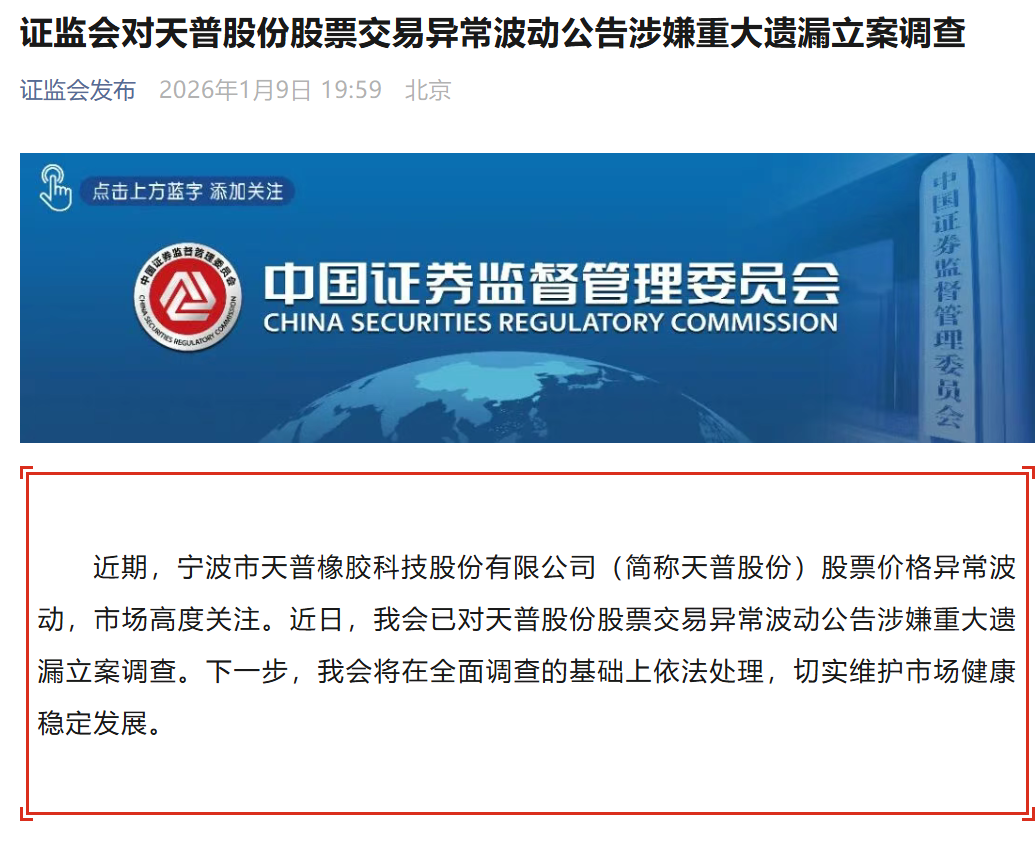
Core Viewpoint - The China Securities Regulatory Commission (CSRC) has launched an investigation into Ningbo Tianpu Rubber Technology Co., Ltd. (Tianpu) due to abnormal fluctuations in its stock price, indicating potential significant omissions in disclosures [2] Group 1: Company Background - Tianpu is a popular stock in the market, primarily engaged in the production of automotive rubber hoses. The company saw a dramatic increase in its stock price after announcing a takeover by Zhonghao Xinying Technology Co., Ltd. in August 2022, leading to a 1663.20% increase in stock price by the end of 2025, making it the second-best performing stock of the year [5] - Zhonghao Xinying, the acquiring company, is an AI chip design firm founded by Yang Gongyifan, a former Google chief engineer, claiming to be the only domestic company capable of developing and mass-producing high-performance TPU architecture AI chips [5] Group 2: Stock Price Movement and Investigation - Following the completion of the acquisition and the establishment of a chip design subsidiary, Tianpu's stock price surged, reaching 218.02 yuan per share by December 31, 2025, with its market capitalization skyrocketing from under 4 billion yuan to 29.232 billion yuan [5] - On January 5, the Shanghai Stock Exchange issued a regulatory warning to Tianpu for inaccurate and incomplete information disclosure, as well as insufficient risk warnings [6] - The CSRC's investigation is focused on Tianpu's failure to adequately disclose its lack of plans for AI-related business despite knowing the potential impact on stock price, which may mislead investors [9]
突发!暴雷!证监会立案调查
Zhong Guo Ji Jin Bao· 2026-01-09 13:03
Core Viewpoint - The China Securities Regulatory Commission (CSRC) has launched an investigation into Tianpu Co., Ltd. due to abnormal stock price fluctuations, raising concerns in the market [2]. Group 1: Company Background - Tianpu Co., Ltd. is primarily engaged in the production of automotive rubber hoses and has recently gained significant attention in the market [4]. - The company experienced a dramatic stock price increase of 1663.20% within a year, making it the second-best performing stock of the year [4]. - The surge in stock price was largely attributed to the acquisition by Zhonghao Xinying Technology Co., an AI chip design firm founded by a former Google engineer [4]. Group 2: Stock Performance and Market Reaction - As of December 31, prior to suspension, Tianpu's stock price reached 218.02 CNY per share, with its market capitalization soaring from under 4 billion CNY to 29.232 billion CNY [5]. - The stock price experienced consecutive trading days of limit-up increases on December 29 and 30, driven by news of the establishment of a chip design subsidiary [8]. Group 3: Regulatory Actions and Concerns - The Shanghai Stock Exchange issued a regulatory warning to Tianpu Co. for inaccurate and incomplete information disclosure, as well as insufficient risk warnings [6]. - The CSRC's investigation focuses on the company's failure to adequately disclose its lack of plans for AI-related business, which may have misled investors during the stock price fluctuations [9].
突发!暴雷!证监会立案调查
中国基金报· 2026-01-09 12:57
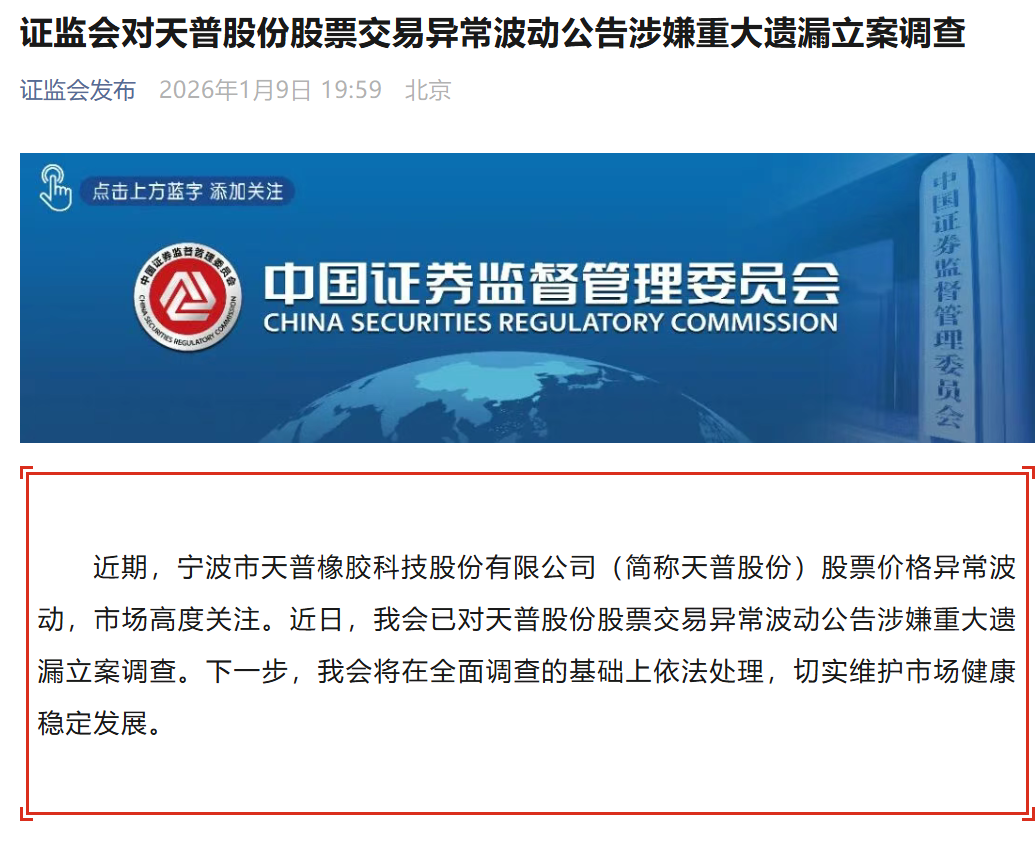
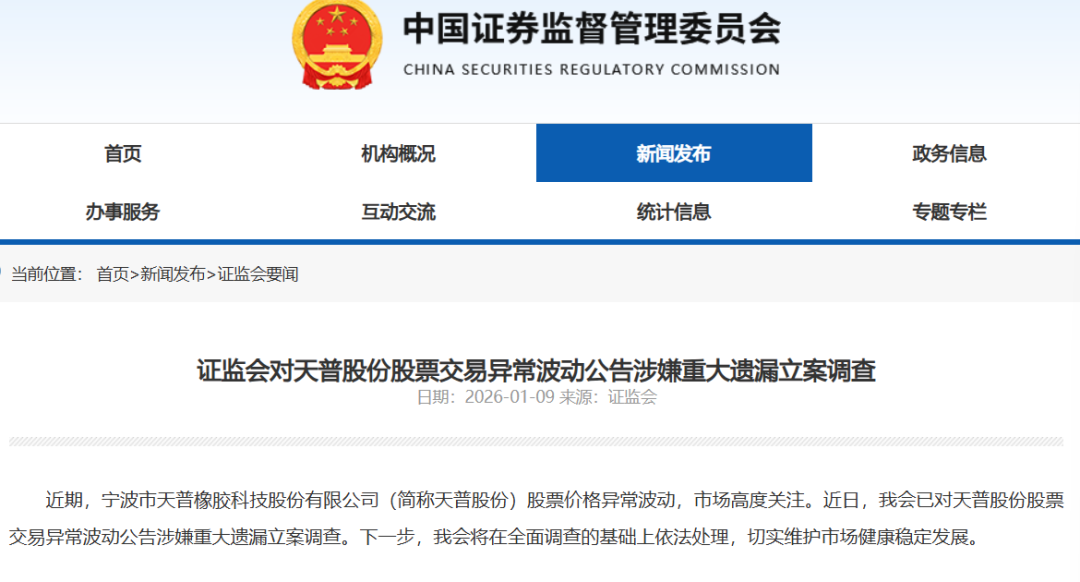
【导读】16倍大牛股天普股份暴雷 中国基金报记者 泰勒 兄弟姐妹们啊,16倍大牛股出大事了,刚刚证监会宣布立案调查。 证监会对天普股份立案调查 收购方中昊芯英则是一家AI芯片设计企业,由曾任谷歌主任工程师的"80后"杨龚轶凡创办。该公司自称是国内唯一掌握高性能TPU架 构AI专用算力芯片研发技术并实现量产的企业。 随后在2025年12月底,由于要约收购公司股份交割完成,上市公司设立芯片设计子公司等消息刺激,再度股价大涨。 1月9日晚间,证监会突然发布公告称,近期,宁波市天普橡胶科技股份有限公司(以下简称天普股份)股票价格异常波动,市场高度 关注。"近日,我会已对天普股份股票交易异常波动公告涉嫌重大遗漏立案调查。下一步,我会将在全面调查的基础上依法处理,切 实维护市场健康稳定发展。" 16倍大牛股为何被查? 天普股份是近期市场上的热门股之一, 天普股份原本是一家 主营汽车橡胶管路的公司,去年 8月21日 天普股份 公告, 中昊芯英 (杭州)科技有限公司 拟入主公司,自此开启本轮股价上涨。2025年内大涨1663.20%,成为年度涨幅榜上的"第二大牛股"。 截至12月31日停牌前,股价已经涨至218.02元/股, ...

16倍大牛股被立案调查
2 1 Shi Ji Jing Ji Bao Dao· 2026-01-09 12:50
Group 1 - The China Securities Regulatory Commission (CSRC) announced an investigation into Ningbo Tianpu Rubber Technology Co., Ltd. (Tianpu Shares) due to abnormal stock price fluctuations and potential significant omissions in disclosures [1] - Tianpu Shares, primarily engaged in automotive rubber tubing manufacturing, saw its stock price rise dramatically from less than 4 billion yuan to 29.232 billion yuan, marking a 718.39% increase from August 22 to December 31, 2025, and a total annual increase of 1663.2% [3] - The company received a regulatory warning from the Shanghai Stock Exchange on January 5, 2026, for inaccurate and incomplete information disclosure, leading to accountability for the acting chairman and the secretary [5] Group 2 - The acquirer, Zhonghao Xinying, is an AI chip design company founded by Yang Gongyifan, a former Google senior engineer, claiming to be the only domestic enterprise capable of developing and mass-producing high-performance TPU architecture AI chips [6] - The acquisition and the background of the acquirer have generated significant market interest, with Tianpu Shares being perceived as linked to the "artificial intelligence chip" concept, resulting in a 15 consecutive trading day increase in stock price in 2025 [6] - Following the completion of the share acquisition and the establishment of a chip design subsidiary, Tianpu Shares experienced another surge in stock price at the end of December 2025 [6]
16倍大牛股被立案调查
21世纪经济报道· 2026-01-09 12:44
Core Viewpoint - The article discusses the recent abnormal stock price fluctuations of Ningbo Tianpu Rubber Technology Co., Ltd. (Tianpu Shares) and the subsequent regulatory actions taken by the China Securities Regulatory Commission (CSRC) to investigate potential significant omissions in disclosures [1][4]. Group 1: Company Overview - Tianpu Shares is a traditional manufacturing enterprise primarily engaged in automotive rubber hose production [3]. - The company's stock price experienced a dramatic increase from August 22, 2025, to December 30, 2025, rising from a market value of less than 4 billion yuan to 29.232 billion yuan, marking a cumulative increase of 718.39% [3]. Group 2: Regulatory Actions - On January 5, 2026, Tianpu Shares received a regulatory warning from the Shanghai Stock Exchange due to inaccurate and incomplete information disclosures, leading to accountability for the then-acting chairman and the company secretary [4]. Group 3: Acquisition and Market Impact - The abnormal stock price movement originated from the acquisition of Tianpu Shares by Zhonghao Xinying and its concerted parties through a combination of share transfer, capital increase of the controlling shareholder, and a comprehensive offer [5]. - Zhonghao Xinying, an AI chip design company founded by a former Google chief engineer, is perceived to bring significant market potential to Tianpu Shares, which was reflected in the stock's performance, including a 15 consecutive trading day increase in 2025 [5].