
脑机接口

Search documents
4只脑机接口概念股年内涨幅翻倍
2 1 Shi Ji Jing Ji Bao Dao· 2025-09-28 12:48
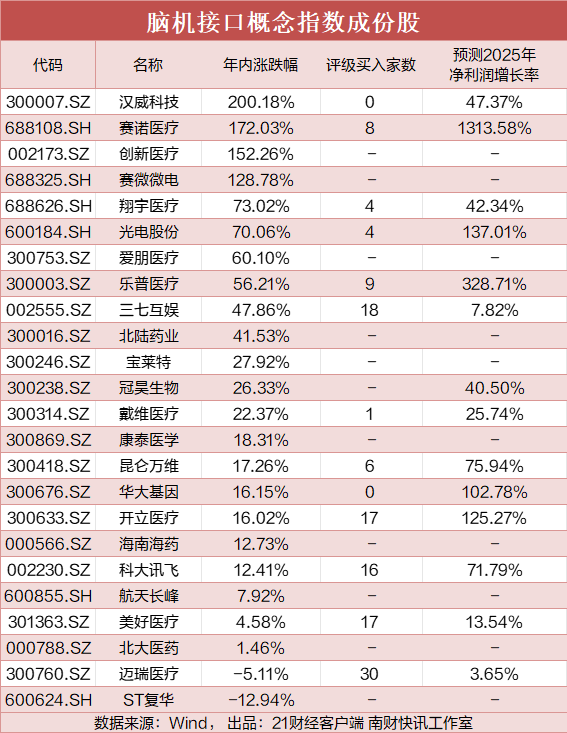
9月28日,国家药监局正式发布YY/T1996—2025《采用脑机接口技术的医疗器械具备闭环功能的植入式 神经刺激器感知与响应性能测试方法》医疗器械行业标准,被业内人士视为脑机接口技术产业化加速的 又一利好。 21财经·南财快讯记者梳理发现,截至9月26日,脑机接口概念指数(8841700.WI)年内涨幅超55%,汉 威科技(300007)、赛诺医疗、创新医疗(002173)、赛微微电等4股年内股价翻倍,翔宇医疗、光电 股份(600184)、爱朋医疗(300753)等多只股涨幅超50%,迈瑞医疗(300760)、美好医疗 (301363)、科大讯飞(002230)、开立医疗(300633)和三七互娱(002555)均获10家以上机构评级 为买入,部分成份股被预测年内净利润增长率翻倍。 将有100万至200万中国患者受益 脑机接口(Brain Computer Interface,BCI)是在大脑与外部设备之间创建信息通道,是生命科学和信息 科学融合发展的前沿技术和科技创新及产业创新深度融合的重要领域。 可关注两方面机会 医疗是目前脑机产业下游商业应用最成熟、产业规模最大的行业。 2024年,国内脑机相关临床试 ...
4只脑机接口概念股年内涨幅翻倍
21世纪经济报道· 2025-09-28 12:44
见习记者丨林健民 9月28日,国家药监局正式发布YY/T1996—2025《采用脑机接口技术的医疗器械具备闭环功 能的植入式神经刺激器感知与响应性能测试方法》医疗器械行业标准, 被业内人士视为脑机 接口技术产业化加速的又一利好。 可关注两方面机会 21财经·南财快讯记者梳理发现,截至9月26日,脑机接口概念指数(8841700.WI)年内涨幅 超55%,汉威科技、赛诺医疗、创新医疗、赛微微电等4股年内股价翻倍,翔宇医疗、光电股 份、爱朋医疗等多只股涨幅超50%,迈瑞医疗、美好医疗、科大讯飞、开立医疗和三七互娱 均获10家以上机构评级为买入,部分成份股被预测年内净利润增长率翻倍。 编辑丨叶映橙 | | | 脑机接口概念指数成份股 | | | | --- | --- | --- | --- | --- | | 代码 | 名称 | 年内涨跌幅 | 评级买入家数 | 预测2025年 | | | | | | 净利润增长率 | | 300007.SZ | 汉威科技 | 200.18% | O | 47.37% | | 688108.SH | 赛诺医疗 | 172.03% | 8 | 1313.58% | | 002173 ...


又一标准发布!脑机接口概念指数年内涨超55% 4股翻倍
2 1 Shi Ji Jing Ji Bao Dao· 2025-09-28 11:40
Core Viewpoint - The release of the YY/T1996—2025 standard for medical devices utilizing brain-computer interface (BCI) technology is seen as a significant boost for the commercialization of BCI technology in China [1] Industry Overview - The BCI concept index has increased by over 55% year-to-date as of September 26, with several stocks doubling in price, indicating strong market interest and investment potential [1] - The global BCI market is projected to grow from $1.2 billion in 2019 to $2 billion in 2023, and is expected to reach $7.63 billion by 2029, highlighting the rapid expansion of this industry [4] Company Performance - Notable companies in the BCI sector include: - Hanwei Technology: 200.18% increase in stock price, with a projected net profit growth rate of 47.37% for 2025 [2] - Sainuo Medical: 172.03% increase, with an extraordinary projected net profit growth rate of 1313.58% for 2025 [2] - Innovative Medical: 152.26% increase [2] - Other companies like Xiangyu Medical and Guangdian Co. also showed significant stock price increases of over 70% [2] Policy Support - The Chinese government has prioritized BCI technology, with policies aimed at fostering innovation and development in this field, potentially benefiting 1 to 2 million patients [3][4] - Local governments in regions like Shanghai and Guangdong are also implementing policies to support the BCI industry [4] Market Opportunities - The medical sector is currently the most developed application area for BCI technology, with 31 clinical trials planned for 2024 covering various diseases [5] - There is a growing focus on both invasive and non-invasive BCI applications, with companies like Xiangyu Medical and Weisi Medical positioned to benefit from increasing rehabilitation demands and insurance payment facilitation [5]
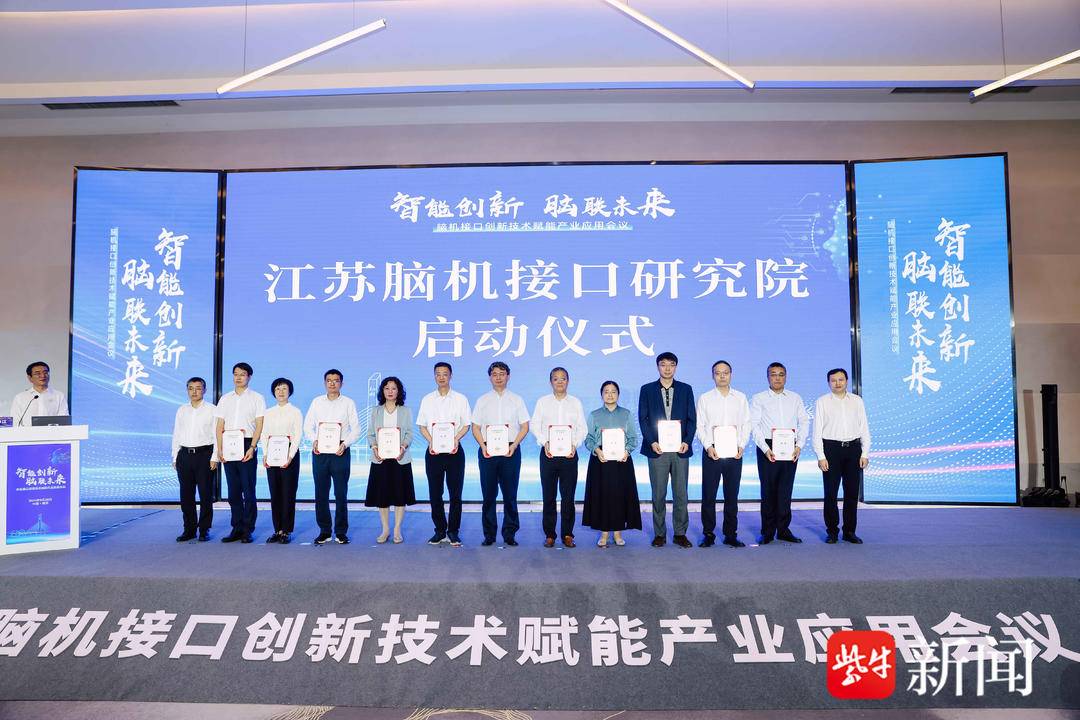
江苏脑机接口研究院在南京栖霞区成立,打造国内脑机接口“产学研医”融合新范式
Yang Zi Wan Bao Wang· 2025-09-28 08:59
9月28日,主题为"智能创新脑联未来"的脑机接口创新技术赋能产业应用会议在南京市栖霞区举行。会议由栖霞区人民政府、南京经济技术开发区管委 会、仙林大学城管委会、江苏省人民医院、南京市生物医药产业攻坚推进办公室联合主办。 省级平台落子栖霞,构筑脑机接口创新核心引擎 当前,全球科技革命与产业变革加速演进,脑机接口技术作为融合了神经科学、信息科技、材料工程等多学科智慧的尖端领域,近年来在基础理论突破和 实际应用拓展上均取得了令人瞩目的成就,尤其在医疗健康、智能康复、人机交互等方面展现出巨大的应用潜力和广阔的发展前景。 会议现场,江苏脑机接口研究院正式启动。该研究院定位为省级脑机接口共性技术和产业服务平台,由江苏省人民医院、栖霞区人民政府、仙林大学城管 委会联合多方共建,旨在聚焦脑机接口科技创新和产业创新关键环节,推动脑机接口技术创新、服务产业发展和临床转化。据悉,该平台是今年全国立项 金额最大的脑机接口公共服务平台项目,也是唯一以临床为牵引的"产学研用"枢纽。 江苏脑机接口研究院落子栖霞,得益于其独特的"三区联动"优势。近年来,栖霞区聚焦智能制造、生物医药等主导产业,形成了大学城创新圈、行政区孵 化圈、经开区产业圈 ...
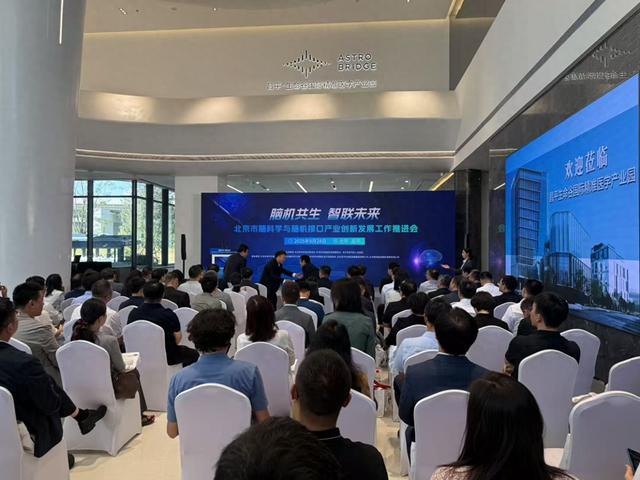
中关村(昌平)脑科学与脑机接口产业园揭牌启用
Bei Jing Ri Bao Ke Hu Duan· 2025-09-28 07:20
Core Viewpoint - The rapid development of brain science and brain-machine interface technology is becoming a significant direction for future industrial transformation, with Beijing's Changping District seizing this opportunity through the establishment of dedicated industrial zones and initiatives [1][4]. Group 1: Industrial Development Initiatives - The first brain science and brain-machine interface industrial cluster in Beijing, located in Changping, was officially launched, aiming to create a "one core, one city" industrial structure [3]. - The Changping District is leveraging the Changping Life Science Park's innovative resources to accelerate enterprise incubation and result transformation, fostering a rapid formation of industrial clusters [3]. - A strategic partnership has been formed between Chang Development Group and Daoyuan Capital to establish a fund for the development of the brain science and brain-machine interface industry, injecting financial resources into the sector [3][4]. Group 2: Future Goals and Plans - By 2027, the industrial cluster is expected to take shape, promoting the application of new technologies, products, and models across various scenarios [4]. - The goal is to fully establish the industrial cluster by 2030, enhancing innovation capabilities and overall strength to reach an international first-class level, aiming to form a new billion-level future industry cluster [4]. Group 3: Current Industry Landscape - Currently, 22 key enterprises in the brain-machine interface sector, including Xinzhida, Weiming Brain, and Walnut Medical, have settled in Changping, demonstrating increasing industrial clustering effects [6]. - Changping has been recognized for its significant contributions to the field, with two major technological achievements in brain-machine interfaces selected at the 2025 Zhongguancun Forum [6].

阅峰 | 光大研究热门研报阅读榜 20250921-20250927
光大证券研究· 2025-09-28 02:22
Group 1 - The brain-computer interface (BCI) industry is projected to reach USD 7.63 billion by 2029, driven by policy support and demand from medical conditions such as stroke and ALS [4] - The industry is entering a "policy-research-application" closed loop, with a clearer commercialization path [4] - Recommended companies in the BCI sector include Xiangyu Medical, Weisi Medical, Chengyitong, Mailande, Aipeng Medical, and Sanbo Neurosurgery [4] Group 2 - Mengke Pharmaceutical plans to issue 164 million shares at a price of 6.3 CNY per share, raising up to 1.033 billion CNY, which will make Haiqing Pharmaceutical the controlling shareholder [9] - The projected net profit for Mengke Pharmaceutical from 2025 to 2027 is estimated to be -241 million, -190 million, and -99 million CNY respectively, maintaining a "buy" rating [9] Group 3 - The cobalt export quota system in the Democratic Republic of the Congo (DRC) is expected to lead to a significant reduction in cobalt supply, positively impacting cobalt prices [13] - The DRC accounted for 76.3% of global cobalt production in 2024, and the supply constraints are likely to benefit companies like Huayou Cobalt and Luoyang Molybdenum [13] Group 4 - China Railway Assembly reported stable revenue growth and improved cash flow in H1 2025, with a projected net profit of 2 million, 44 million, and 68 million CNY for 2025 to 2027 [16] - The company maintains an "overweight" rating based on its financial performance [16] Group 5 - The dividend yield of Midea Group has exceeded 7%, indicating a potential bottoming out, with a projected profit of 33 billion CNY for 2025 and a 52% cash dividend rate [18] - The company maintains a "buy" rating with a target price of 54.10 CNY [18] Group 6 - The real estate market in Shanghai is experiencing increased transaction volumes due to favorable policies, with a 62.5% increase in daily average transactions post-policy implementation [29] - The top three companies in Shanghai's new home transaction value from January to August 2025 are Poly Developments, China Merchants Shekou, and China Resources Land [29] Group 7 - PetroChina has signed a USD 359 million contract with Total for the design, procurement, supply, construction, and commissioning of a project in Iraq, with projected net profits of 909 million, 1.099 billion, and 1.315 billion CNY from 2025 to 2027 [33] - The company maintains an "overweight" rating for both its A-shares and H-shares [33]





【医药】解码大脑交互密码,开启人机协同纪元——脑机接口行业研究报告(王明瑞/黎一江)
光大证券研究· 2025-09-25 23:06
点击注册小程序 本订阅号中所涉及的证券研究信息由光大证券研究所编写,仅面向光大证券专业投资者客户,用作新媒体形势下研究 信息和研究观点的沟通交流。非光大证券专业投资者客户,请勿订阅、接收或使用本订阅号中的任何信息。本订阅号 难以设置访问权限,若给您造成不便,敬请谅解。光大证券研究所不会因关注、收到或阅读本订阅号推送内容而视相 关人员为光大证券的客户。 报告摘要 政策与技术双轮驱动,百亿蓝海市场加速开启 脑机接口作为生命科学与信息技术融合的前沿领域,已从实验室走向产业化临界点。全球市场规模从2019 年12亿美元增至2023年20亿美元,2029年预计达76.3亿美元。政策端七部门联合发布《关于推动脑机接口 产业创新发展的实施意见》,明确2027年技术突破、2030年产业生态成型的目标,叠加卒中、渐冻症等刚 需驱动,行业进入"政策-研发-应用"闭环,商业化路径逐渐清晰。 临床产品有望加速落地,医疗+消费打造行业双增长曲线 医疗是目前脑机产业下游商业应用最成熟、产业规模最大的行业,2024年国内临床试验达31项,覆盖卒中 康复、意识障碍、抑郁症等10类疾病。政策端医保定价打通支付链路,有望推动脑机接口相关设备落地 ...

【光大研究每日速递】20250926
光大证券研究· 2025-09-25 23:06
Group 1 - As of the end of August 2025, the total bond custody amount in China reached 174.54 trillion yuan, with a net increase of 1.51 trillion yuan month-on-month, although this was a decrease of 0.24 trillion yuan compared to the end of July [5] - The Democratic Republic of the Congo announced an extension of the cobalt export ban until October 15, 2025, transitioning to a quota system thereafter, with the country accounting for 76.3% of global cobalt production in 2024 [5] - USAC received a five-year exclusive contract from the US Department of Defense worth up to $245 million for the supply of antimony metal ingots, highlighting the strategic value of antimony [5] Group 2 - In the first eight months of 2025, the export growth rates for electric tools, hand tools, and lawn mowers were 1%, -5%, and 45% respectively, while forklifts, machine tools, and industrial sewing machines saw growth rates of 1%, 14%, and 16% respectively [7] - The export growth rates for major engineering machinery categories, including excavators, tractors, and mining machinery, were 14%, 25%, 30%, and 23% respectively [7] Group 3 - The global market size for brain-computer interfaces is expected to reach $7.63 billion by 2029, driven by policy support and demand from conditions like stroke and ALS [8] - The expected dividend yield for Gree Electric exceeded 7% in 2025, with a historical trend indicating a bottoming characteristic, supported by a projected profit of 33 billion yuan and a 52% cash dividend rate [8]

晚报 | 9月26日主题前瞻
Xuan Gu Bao· 2025-09-25 14:35
Group 1: Copper Industry - The China Nonferrous Metals Industry Association emphasizes the need to control the expansion of copper smelting capacity and is researching specific measures for standardized management [1] - Tianfeng Securities believes that the key to "anti-involution" in the copper smelting industry lies in optimizing capacity, which includes eliminating outdated capacity and enhancing efficiency through advanced smelting technologies [1] - The expectation is that the copper smelting industry will return to profitability in the long term, with improved capacity layout through supply-side reform [1] Group 2: Digital Currency - The Digital Renminbi International Operation Center has officially started operations in Shanghai, launching three major platforms: cross-border digital payment, blockchain service, and digital asset platforms [2] - Research institutions highlight that the Digital Renminbi, as a legal digital currency, utilizes advanced technologies to ensure security and stability, enhancing transaction transparency and user privacy [2] - The future development potential of Digital Renminbi is significant, presenting opportunities for technology and service companies within the industry [2] Group 3: Advanced Packaging - Intel showcased its next-generation Xeon processors at the 2025 Cloud Summit, utilizing new process technology and advanced packaging techniques to enhance performance and efficiency [3] - The advanced packaging market is expected to grow rapidly, driven by AI market demand, with a projected market size increase from $44.3 billion in 2022 to $78.6 billion by 2028, reflecting a compound annual growth rate of 10% [3] - FC packaging currently holds the largest market share at 51% in 2022, but it is expected to decrease to 47% by 2028, while 2.5D/3D packaging will see an increase from 21% to 33% [3] Group 4: AI Video Generation - Baidu has upgraded its Steam Engine model to support the generation of unlimited-length AI videos, breaking previous limitations of short video generation [4] - The new pricing strategy significantly reduces the cost of video generation, enhancing the competitiveness of Baidu's Steam Engine in the market [4] - The introduction of long video generation capabilities is expected to broaden the application scenarios for AI video generation tools, including film-level effects and digital content creation [4] Group 5: Brain-Machine Interface Technology - Qiangnao Technology has unveiled a groundbreaking wireless bionic hand that allows users to control it with their thoughts, addressing various self-care challenges for disabled individuals [5] - The product represents a shift from traditional prosthetics to a non-invasive brain-machine interface technology, enabling high-level paraplegics to perform tasks without external devices [5] - Qiangnao Technology focuses on enhancing human capabilities through non-invasive brain-machine interface technology, with plans to develop smart bionic legs in the future [5]


山西证券研究早观点-20250925
Shanxi Securities· 2025-09-25 01:31
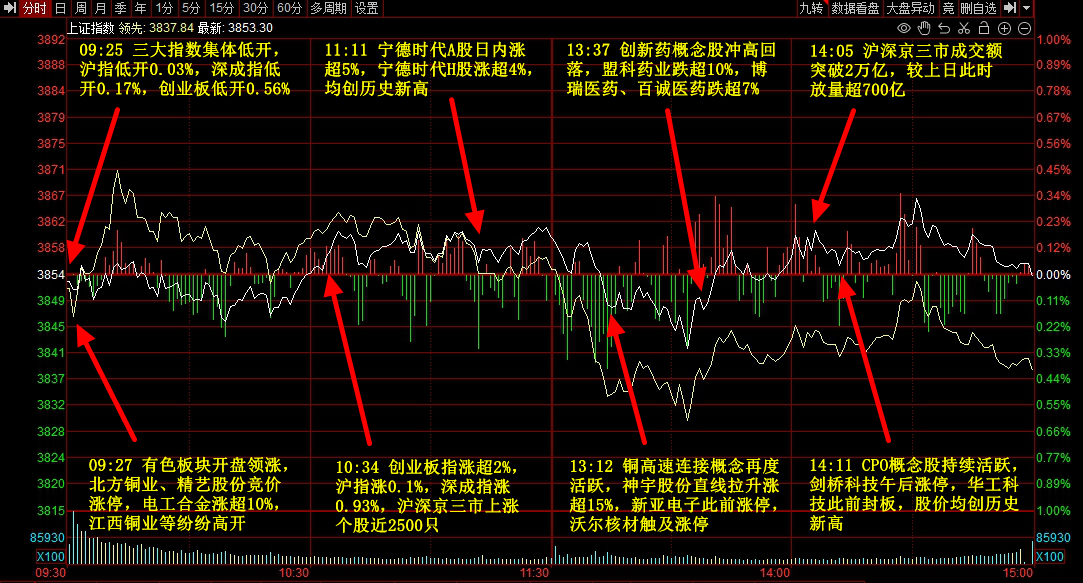
Market Overview - The domestic market shows significant trading activity with the Shanghai Composite Index closing at 3,853.64, up 0.83% [2] - The Shenzhen Component Index increased by 1.80%, closing at 13,356.14, while the ChiNext Index rose by 2.28% to 3,185.57 [2] Non-Bank Financial Sector - The trading activity in the non-bank financial sector has improved, with a notable increase in the average daily trading volume, which surpassed 20 trillion in August [6] - The securities transaction stamp duty reached 118.7 billion, marking an 81.7% year-on-year increase [6] - The fundamentals of brokerage firms are stabilizing and improving, with a recommendation to focus on investment opportunities in this sector [6] Biomedicine Sector - The release of the YY/T 1987-2025 standard for medical devices using brain-computer interface technology marks a significant milestone for industry standardization, expected to accelerate industrialization [7][8] - This standard aims to resolve long-standing issues of concept ambiguity and lack of standards, facilitating innovation and regulatory compliance [11] - The policy framework supporting the brain-computer interface industry is evolving, with strategic initiatives from national to local levels aimed at fostering innovation and market growth [11] Company Analysis: Fulaite (601865.SH) - Fulaite is positioned in the top tier of the photovoltaic glass industry, with expected EPS of 0.31, 0.46, and 0.84 for 2025-2027, corresponding to PE ratios of 53.9, 36.1, and 19.8 [14] - The company is anticipated to benefit from an improved supply-demand balance in the photovoltaic glass market, leading to a recovery in profitability [13][14] Company Analysis: Xianghe Industrial (603500.SH) - Xianghe Industrial reported a revenue of 3.81 billion, a year-on-year increase of 6.49%, with a net profit of 640 million, up 96.56% [20] - The company is focusing on core business areas, including rail transportation products, which have shown significant growth due to participation in major railway projects [20] - The demand for intelligent railway detection equipment is expected to grow, with the company actively developing related technologies [20]

