
Funds

Search documents
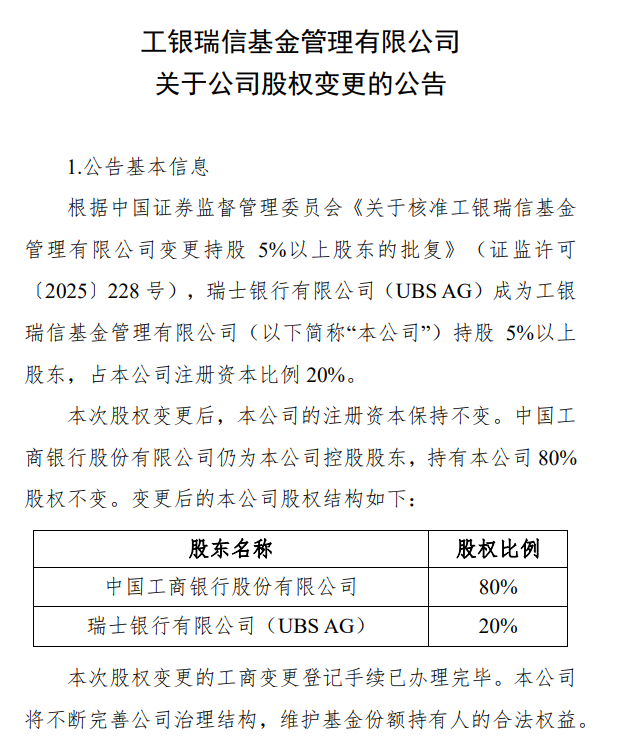
瑞银正式接棒工银瑞信20%股权,外资布局中国市场再加速
Di Yi Cai Jing· 2025-06-13 05:51
Core Viewpoint - The shareholder change of ICBC Credit Suisse Asset Management has been finalized after 10 months, with UBS becoming the second-largest shareholder holding 20% of the shares, while ICBC retains 80% [1][4]. Shareholder Change Details - UBS officially became a shareholder with over 5% stake in ICBC Credit Suisse Asset Management, with the change in ownership registered [4]. - The change in ownership was a passive result of UBS's acquisition of Credit Suisse, which included the 20% stake in ICBC Credit Suisse Asset Management [5]. - The entire process took approximately 10 months, from the submission of the application to the approval by the regulatory authority [5]. Company Operations and Governance - ICBC Credit Suisse Asset Management plans to enhance corporate governance and investment research capabilities while maintaining compliance and risk management [5]. - UBS has not appointed management personnel to ICBC Credit Suisse Asset Management, indicating no substantial impact on daily operations [5]. - The name of ICBC Credit Suisse Asset Management will remain unchanged in Chinese, with only adjustments made to the English name and website domain [6]. Market Position and Growth - ICBC Credit Suisse Asset Management, established in June 2005, manages 257 funds with a total net asset value of 792.8 billion yuan, ranking 13th in the industry [6]. - UBS has previously invested in the Chinese public fund market, holding a 49% stake in Guotai Junan Fund, which has a fund asset scale of 248.4 billion yuan [7]. - UBS has expressed a strong commitment to the Chinese market, viewing it as a key strategic area for growth [7]. Industry Trends - Several foreign institutions are increasingly interested in the Chinese public fund market, with multiple foreign entities accelerating their investments [8]. - As of now, there are 9 wholly foreign-owned public fund managers and 42 joint venture fund companies in China, indicating a growing foreign presence in the market [8]. - Recent capital increases by foreign-owned public funds reflect their expanding business and capital needs in the Chinese market [9].



ETF分红热潮涌动!年内派发“红包”超 120 亿元,规模最大产品将加入
Huan Qiu Wang· 2025-06-13 03:09
Core Viewpoint - Huatai-PB Fund announced a cash dividend for its Huatai-PB CSI 300 ETF, with a distribution of 0.880 yuan per 10 fund shares, marking a significant event in the ETF market [1][3]. Group 1: Dividend Announcement - The dividend record date is set for June 17, with the ex-dividend date on June 18, and the cash dividend payment date on June 27 [1]. - The Huatai-PB CSI 300 ETF is currently the largest ETF product in the market, with a size close to 380 billion yuan as of June 10 [3]. - The total dividend amount for this distribution is expected to exceed 8 billion yuan, assuming no significant changes in fund shares before the record date [3]. Group 2: Historical Context - Since its establishment on May 4, 2012, the Huatai-PB CSI 300 ETF has distributed dividends 13 times, with a total dividend amount projected to surpass 16 billion yuan after this distribution [3]. - Other ETFs under Huatai-PB Fund, including the Huatai-PB CSI Hong Kong Stock Connect High Dividend Investment ETF and others, also announced dividend distributions [3]. Group 3: Market Trends - The total dividend amount for all ETFs in the market has exceeded 12 billion yuan this year, a significant increase from approximately 5 billion yuan in the same period last year, setting a historical high for the same timeframe [3]. - Major contributors to this year's dividend growth include broad-based and dividend-themed ETFs, with several funds reporting dividends exceeding 2 billion yuan [3]. Group 4: Industry Insights - The surge in equity ETF dividends is attributed to multiple factors, including enhanced cash dividend regulations for listed companies and a growing emphasis on investor experience by public funds [4]. - The thriving ETF market provides a solid foundation for large-scale dividend distributions [4].

公募FOF2025年中观察:多家基金公司FOF产品业绩稳健攀升,精细化发展明显
和讯· 2025-06-12 11:29
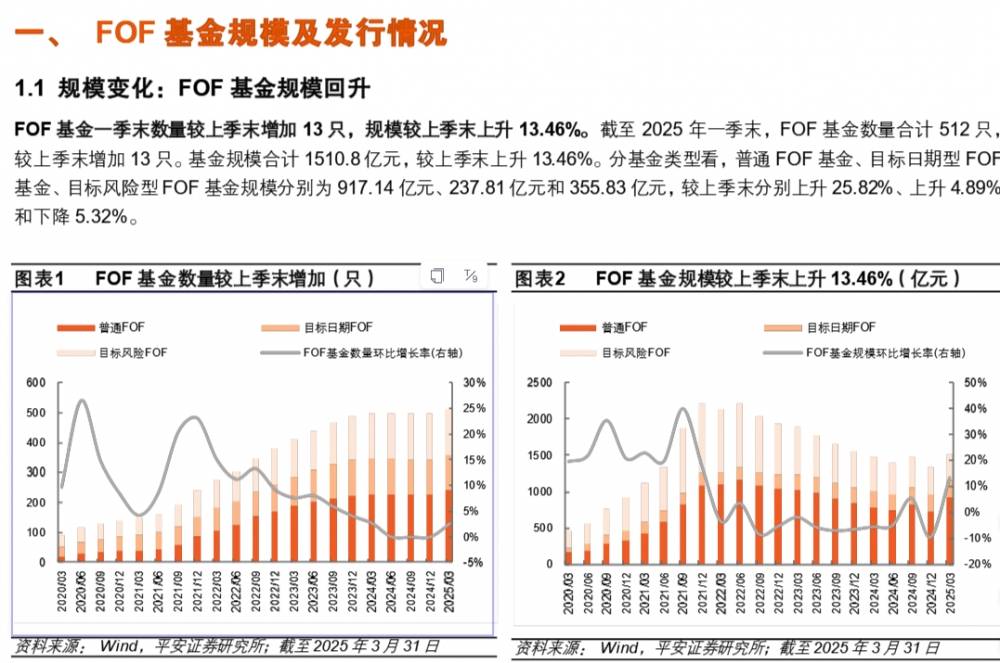
Core Viewpoint - The domestic public FOF (Fund of Funds) market is experiencing a resurgence in issuance and product structure diversification, reflecting increasing investor recognition of these products as A-share indices stabilize and recover [1] Group 1: Market Performance - As of the end of Q1 2025, the total scale of domestic FOF funds increased by 13.46% to 1510.8 billion yuan, with 86% of FOF funds achieving positive returns, particularly in equity-oriented FOFs [1] - By June 4, 2025, the scale further grew to 1618.52 billion yuan, with leading performance from funds managed by ICBC Credit Suisse, Qianhai Kaiyuan, Tongtai, and Penghua [1][2] - The FOF market is being driven by institutional investors accelerating their layouts, supported by the high liquidity and low fees of ETFs, which are becoming core components of FOF portfolios [1] Group 2: Fund Performance - Multiple FOF products have shown stable performance, with ICBC's "Rui Zhi Jin Qu Yi Nian A" leading the equity FOF category with a return of 11.36% as of June 4, 2025 [3] - Other notable performers include "Qianhai Kaiyuan Yu Yuan" and "Tongtai You Xuan Pei Zhi" funds, with returns of 9.57% and 9.28% respectively [3] - ICBC's various pension FOF products, such as "ICBC Pension 2050Y" and "ICBC Pension 2045Y," are also ranking highly in their respective categories [5][6] Group 3: Investment Strategy and Trends - The FOF market is increasingly recognized as a key tool for personal pension investments, with a focus on target date and target risk FOFs to meet diverse investor needs [5] - ICBC Credit Suisse has established a comprehensive product line covering various retirement goals and risk profiles, demonstrating a long-term commitment to pension FOFs [8] - The dual strategy of "investment research platformization and track specialization" is crucial for FOFs to adapt to market changes and enhance their appeal to investors [9]

金融“李鬼”升级!大成基金等多家基金公司密集发布防诈公告
Nan Fang Du Shi Bao· 2025-06-12 11:23
Core Viewpoint - Recently, Dacheng Fund Management Co., Ltd. issued a fraud alert revealing a surge in new types of financial scams targeting investors [2] Group 1: Fraudulent Activities - Fraudsters are impersonating the company or its employees using instant messaging tools like DingTalk and Qianxin to create chat groups, claiming to share stock knowledge and facilitate stock subscriptions and bulk transactions [2] - These scams involve fake investment platforms and counterfeit apps that lure investors into depositing funds [2] - Dacheng Fund has previously issued similar warnings, emphasizing that it has never authorized any individual or organization to conduct investment management or consulting services in its name [4][5] Group 2: Industry-Wide Issue - Other funds, including Nuonuo Fund, Furong Fund, Nanhua Fund, Xingyin Fund, and others, have also released clarifications regarding similar fraudulent methods since May [5] - Furong Fund reported that fraudsters have been using forged business licenses and securities business permits to gain investor trust and direct them to download fake investment apps [5] - Nanhua Fund issued two announcements in May, exposing fraudsters who impersonated the company's app and website to solicit funds under the guise of investment exchanges and training fee refunds [5] Group 3: Sophistication of Scams - Some fraudulent methods exhibit "professionalization" and "refined packaging," with counterfeit apps closely mimicking legitimate platforms in design and functionality [5] - Xingyin Fund highlighted a fake app named "Xingyin After-Sales APP," which not only misappropriated the company's name but also included misleading features like "Dragon and Tiger List" and "Limit-Up Funds" [5] - Hongde Fund reported that fraudsters have been using fake interview articles to attract investors, leading them to join chat groups or download fraudulent securities apps [6]

海富通半年3只基金清盘,还有三成困在“生死线”
Sou Hu Cai Jing· 2025-06-12 09:56
Core Viewpoint - Three funds managed by Hai Futong Fund Management Co., Ltd. are set to be liquidated due to continuous decline in scale despite positive returns [2][3][4] Fund Performance and Liquidation - Hai Futong Xin Ying 6-Month Holding Period Mixed Fund, established in March 2024, saw its scale shrink by 84.39% to 32 million yuan by March 2025, despite a positive return [3][4] - Hai Futong ESG Leading Stock Fund, launched in March 2024, experienced a drastic reduction in net asset value, with A class dropping to 31.14 thousand yuan and C class to 10.27 thousand yuan by Q3 2024, leading to large-scale redemptions [4][6] - Hai Futong Quantitative Multi-Factor Mixed Fund, established in April 2018, had a cumulative return of 41.58% but faced a decline of 5.71% in 2025, with continuous outflows leading to a scale reduction to 1 million yuan [4][5][6] Common Issues Across Funds - All three funds faced challenges in attracting and retaining investors, leading to a persistent decline in scale, which hindered operational efficiency and profitability [6][7] - Over 30% of Hai Futong's 172 funds have scales below 50 million yuan, indicating potential liquidation risks for more products [7] Company Overview and Strategic Changes - Hai Futong Fund, established in 2003, is undergoing a significant transformation following the merger with Guotai Junan Securities, which may lead to a restructuring of its product offerings [10][12] - The company has a high proportion of bond funds, with 83.4% of total assets in bond and money market funds, while mixed fund scales have been declining [12][13] - The new leadership under Xie Lebin faces the challenge of balancing regulatory requirements and enhancing market competitiveness [10][20] ETF Performance - Hai Futong has seen significant growth in its ETF segment, with non-money market ETF assets increasing from 3.17 billion yuan to 54.08 billion yuan over four years, indicating a successful strategy in this area [19][20] - The company has established a competitive edge in specific sectors like short-term bonds and urban investment bonds, with individual products exceeding 10 billion yuan in scale [20]
基本功 | 挖到“宝藏纯债基”?先等等,三招快速鉴别“纯度”!
中泰证券资管· 2025-06-12 09:35
基本功的基,就是基金的基。 做好投资、买对基金, 从夯实投资基金的基本功开始。 1分钟GET一个知识点, 起步更轻松。 如何快速签别 产品是不是细质基金? 主要可以从投资范围、名称及 业绩基准三处识别。 名字有 "债", 年化收益率8%, 挖到 "宝藏纯债基" ? 不, 也可能是固收+产品。如何区别两者?可从三点看: 1)看投资范围,纯债基金会明确不投资股票、可 持有人首次认证有礼啦!只要在2025年5月30日前买入中泰资管产品并持有至今的新朋友,长按识别 下方二维码前往认证,即可获得 影音会员 月卡一份 本材料不构成投资建议,观点具有时效性。本公司承诺以诚实信用、勤勉尽责的原则管理和运用基金资产,但不 保证基金一定盈利,也不保证最低收益。投资有风险,基金过往业绩不代表其未来表现。基金管理人管理的基金 的业绩不构成对其他基金业绩表现的保证。投资者投资基金时应认真阅读基金的基金合同、招募说明书、基金产 品资料概要等法律文件。基金管理人提醒投资者基金投资的"买者自负"原则,请投资者根据自身的风险承受能力 选择适合自己的基金产品。基金有风险,投资须谨慎。 扫码进入基本功专栏 ...

公募FOF2025年中观察:多家基金公司FOF产品业绩稳健攀升,精细化发展明显
Sou Hu Cai Jing· 2025-06-12 07:16
Core Viewpoint - The domestic public offering of Fund of Funds (FOF) is experiencing significant growth and diversification, reflecting increasing investor recognition and confidence in these products as A-share indices stabilize and recover [1][4][17]. Group 1: Market Performance - As of the end of Q1 2025, the total scale of domestic FOF funds increased by 13.46% to 1510.8 billion yuan, with 86% of FOF funds achieving positive returns during the quarter [1]. - By June 4, 2025, the scale further grew to 1618.52 billion yuan, with leading performance from funds managed by companies like ICBC Credit Suisse, Qianhai Kaiyuan, and Penghua [4]. - The performance of various FOF products has shown stability and improvement, with a notable focus on equity and mixed-asset funds [5][6]. Group 2: Product Structure and Types - The FOF market is characterized by a diverse product structure, with mixed-asset FOFs dominating in number and asset value, accounting for 93.58% of the total [5]. - Target date FOFs and target risk FOFs are becoming increasingly important for retirement planning, catering to different investor needs [12][13]. Group 3: Investment Strategies and Manager Insights - The investment strategy of ICBC Credit Suisse's FOFs emphasizes a high allocation to equity assets, with a focus on diversification across sectors such as technology, healthcare, and commodities [12][14]. - The recent appointment of Zhou Yan as the fund manager for ICBC's FOF has continued the trend of strong performance, with a year-to-date return of 8.77% reported for the fund [7][12]. - The investment team at ICBC Credit Suisse is committed to providing tailored retirement investment solutions, with several of their products ranking highly in performance [13][18]. Group 4: Industry Trends and Future Outlook - The FOF sector is positioned as a core component of personal pension accounts, driven by policy support and market demand for long-term, secure investment options [17][19]. - The trend towards "platform-based" investment research and specialized strategies is seen as key to the FOF's competitive advantage, allowing for effective asset allocation and risk management [18][19].
持续推动金融高水平开放
Jing Ji Ri Bao· 2025-06-11 22:15
Group 1 - The core viewpoint is that China's financial industry has made significant progress in opening up, with substantial relaxation of market access and deepening interconnectivity between domestic and foreign financial markets [1][2] - The People's Bank of China and other regulatory bodies have jointly issued an action plan to enhance cross-border financial services, focusing on improving settlement efficiency, optimizing hedging services, strengthening financing services, enhancing insurance protection, and refining comprehensive financial services [1][2] - The removal of foreign ownership limits in banking, securities, fund management, futures, and life insurance sectors marks a major step in financial service market access [2] Group 2 - The "Bond Connect" program achieved a total trading volume of 10.4 trillion yuan in 2024, facilitating foreign investors in allocating Chinese assets and managing risks through various hedging tools [2] - The concept of institutional opening is emphasized, transitioning from the flow of goods and factors to the opening of rules and systems, which aids in international cooperation and aligns with high international standards [2][3] - The State Administration of Foreign Exchange has implemented reforms to streamline foreign exchange business processes, enhancing the experience for quality clients by reducing documentation requirements [3] Group 3 - There is a strong emphasis on balancing openness with security, with plans to enhance regulatory capabilities and risk prevention measures in the context of increased openness [3] - The establishment of a robust risk prevention system is crucial to avoid systemic risks, including the improvement of macro-prudential policy frameworks and monitoring systems for cross-border capital flows [3]
ETF密集提示清盘风险 百余只场内成交不足百万元
2 1 Shi Ji Jing Ji Bao Dao· 2025-06-11 12:00
Core Viewpoint - The ETF market is experiencing a significant disparity, with some ETFs showing high trading volumes while many others face low liquidity and potential liquidation risks [1][5]. Group 1: ETF Market Performance - On June 10, certain ETFs like the Hong Kong Innovative Drug ETF and the Hang Seng Technology ETF had trading volumes exceeding 10 billion yuan, while over 500 ETFs had trading volumes below 10 million yuan [1]. - A total of 513 ETFs had trading volumes below 10 million yuan on June 10, with 129 ETFs trading below 1 million yuan [4][3]. - The concentration of market resources is evident, with the top ten ETFs accounting for nearly 40% of the total market size, while over 20% of ETFs have sizes below 100 million yuan [5]. Group 2: Liquidity and Risk Factors - The number of ETFs with net asset values below 50 million yuan has been increasing, indicating higher liquidity and liquidation risks [2][5]. - Analysts emphasize that low liquidity can lead to a vicious cycle where smaller ETFs struggle to attract investors, further diminishing their liquidity and increasing the likelihood of liquidation [5]. Group 3: Strategies to Enhance Liquidity - Fund companies are increasingly adding liquidity providers to improve ETF trading efficiency and attract more investors [7][8]. - The introduction of liquidity providers aims to reduce bid-ask spreads and enhance trading volumes, which can lead to scale effects [7][8]. - Improving liquidity is seen as essential for enhancing investor experience and attracting long-term capital [9]. Group 4: Recommendations for ETF Companies - Companies are advised to focus on product differentiation to avoid homogeneous competition, including not launching new ETFs in crowded index spaces and innovating product offerings [12][13]. - Providing value-added services, such as investment strategy reports and interactive investor engagement, can enhance investor experience and loyalty [13][14]. - Companies should also consider lowering management fees through increased ETF scale and exploring new themes like ESG and digital economy ETFs to meet diverse investor needs [14].
ETF最牛分红来了,“巨无霸”基金分红或超80亿元
2 1 Shi Ji Jing Ji Bao Dao· 2025-06-11 09:05
Group 1 - The largest equity ETF in the market, Huatai-PB CSI 300 ETF, announced a cash dividend plan of 0.880 yuan per 10 fund shares, with a total dividend amount expected to exceed 8 billion yuan, potentially setting a record for the highest single dividend in domestic ETF history [1] - Since its establishment on May 4, 2012, the Huatai-PB CSI 300 ETF has distributed dividends 13 times, with a total dividend amount expected to surpass 16 billion yuan, maintaining a stable record of returning profits to shareholders [1] - Other ETFs under Huatai-PB, including Huatai-PB CSI Hong Kong Stock Connect High Dividend Investment ETF, Huatai-PB CSI Central Enterprises Dividend ETF, and Huatai-PB SSE Dividend ETF, also announced dividend plans, contributing to a total of 14.5 billion yuan in dividends from four major ETFs, accounting for 70% of all ETF dividends [1] Group 2 - The A-share market's dividend ecosystem has been continuously optimized due to regulatory guidance on cash dividends, with a significant increase in cumulative dividend amounts for ETFs since 2025 compared to the previous year [2] - Major "giant" broad-based ETFs, including Huatai-PB CSI 300 ETF, E Fund CSI 300 ETF, Huaxia CSI 300 ETF, and Harvest CSI 300 ETF, received substantial increases in holdings from the "national team," indicating a supportive stance towards the capital market [2]