
脑机接口

Search documents
脑机接口“接”入现实要多久
Ren Min Ri Bao· 2025-09-07 22:11
Core Insights - Brain-computer interface (BCI) technology is advancing rapidly, enabling applications such as controlling robotic arms and playing video games through brain waves [1][2] - The BCI industry is experiencing explosive growth, with significant improvements in decoding, control, and regulation capabilities, positioning it as a key driver for future industrial directions [1] Industry Development - The BCI system typically consists of three components: signal acquisition, signal analysis, and device control, categorized into non-invasive and invasive technologies [1] - Non-invasive BCI technology is relatively mature and has seen applications in stroke rehabilitation, fatigue monitoring, and brain health detection in China, with further expansion needed [1] - Invasive BCI technology, capable of capturing high-quality single-neuron signals, is progressing through various technical routes and has entered clinical trial phases [1][2] Technological Advancements - China is transitioning from the 1.0 phase of "perception and control separation" to the 2.0 phase of "closed-loop control and interactive perception" in BCI technology [2] - Significant achievements have been made in core components, signal decoding, and closed-loop systems, although challenges remain in standardization, decoding accuracy, and clinical sample sizes [2][3] Policy and Market Outlook - A joint initiative by multiple government departments aims to promote BCI industry innovation, setting development goals for 2027 and 2030, along with five key tasks for high-quality growth [2] - A collaborative development framework has been established in China, integrating policy guidance, technological research, ethical standards, and a standard system [3] - The BCI technology is expected to evolve into the "3.0 era" within the next 3 to 5 years, characterized by integrated perception and control, system intelligence, and interactive fusion [3] Application Potential - BCI technology is already being utilized in medical communication assistance and neuro-rehabilitation for specific populations [3] - Future applications are anticipated in emotional monitoring, brain fatigue warning, focus enhancement, cognitive training, and home automation as market demands grow [3]
清华教授高小榕:脑机接口竞速,中美在不同路径上“并跑”
3 6 Ke· 2025-09-05 11:19
Core Viewpoint - The brain-computer interface (BCI) technology is advancing rapidly, with companies like Neuralink and Synchron making significant strides in clinical trials, aiming to restore lost functions in patients with paralysis or neurological diseases [1][2][3] Group 1: Current Developments in BCI Technology - Neuralink has completed craniotomy implants in a small number of patients, focusing on restoring motor and speech functions, with plans to conduct speech cortex experiments by Q4 2025 [1] - Synchron has validated the safety and partial recovery of daily functions for paralyzed patients through minimally invasive vascular implants [1] - The public is caught between two visions: one of hope for restoring lost functions and another fueled by tech leaders' marketing, leading to concerns about the implications of BCI technology [1][2] Group 2: Ethical Considerations and Limitations - High Xiaorong, a professor at Tsinghua University, emphasizes that BCI is not a shortcut to "superhuman" capabilities but rather a technology focused on repair and assistance under ethical constraints [2][3] - The concept of "superhumanization" raises ethical issues regarding fairness and accessibility, leading to a shift in focus towards clinical applications [3][4] Group 3: Potential Applications and Future Directions - BCI technology could facilitate human-machine collaboration, addressing communication gaps between human and artificial intelligence [4] - Possible applications include memory enhancement for Alzheimer's patients and aiding communication for those unable to speak [8][9] - The technology is expected to evolve, with advancements in AI playing a crucial role in processing large data sets generated by BCI devices [10] Group 4: Challenges and Research Landscape - Current challenges include hardware and software limitations, with a need for improved signal processing capabilities [10][12] - Clinical applications are primarily focused on medical fields, with potential expansions into elder care, cognitive rehabilitation, and emotional support [15] - The research landscape shows that China leads in non-invasive and semi-invasive studies, while the U.S. excels in invasive research [16] Group 5: Timeline for Maturity - The timeline for achieving mature BCI technology has been revised from an initial estimate of 60 years to a more optimistic 15 to 20 years, although significant limitations still exist [17][18]

马斯克脑机公司Neuralink申请“心灵感应”商标,暂时被驳回
Feng Huang Wang· 2025-09-05 02:51
Core Points - Neuralink's trademark applications for "Telepathy" and "Telekinesis" were rejected by the USPTO due to existing applications from other parties [1][2] - Wesley Berry, co-founder of Prophetic, submitted a trademark application for "Telepathy" in May 2023 and for "Telekinesis" in August 2024 [1][2] - The USPTO also referenced an existing trademark for "Telepathy Labs," a company providing interactive voice and chatbot technology [2] Summary by Sections - **Trademark Applications**: Neuralink applied for trademarks "Telepathy" and "Telekinesis" in March 2023, but the USPTO rejected these applications in August 2023 due to prior submissions by Wesley Berry [1][2] - **Existing Trademarks**: The USPTO highlighted the existing "Telepathy Labs" trademark, which could lead to confusion with Neuralink's intended products [2] - **Response from Neuralink**: Neuralink submitted a response on August 28, 2023, arguing that its "Telepathy" product would not likely cause confusion with Telepathy Labs, but did not address Berry's applications [2]
万和财富早班车-20250905
Vanho Securities· 2025-09-05 02:12
Macro Economic Updates - The National Development and Reform Commission has released a notice soliciting opinions on the "Basic Rules for the Medium- and Long-term Electricity Market (Draft for Comments)", emphasizing the promotion of inter-provincial and intra-provincial trading coupling and orderly connection [6] - To implement a more proactive macro policy, the Ministry of Finance and the People's Bank of China held a second group leader meeting to strengthen the coordination between fiscal and monetary policies [6] Industry Dynamics - Strong demand for lawn mowers and window cleaning machines is predicted, with IDC forecasting high growth in sales of cleaning robots, related stocks include Ninebot (689009) and Ecovacs (603486) [8] - Zhejiang is advancing the marketization of new energy electricity prices, highlighting the importance of optimized services, related stocks include Guoneng Rixin (301162) and Longxin Group (300682) [8] - The Shanghai Stock Exchange hosted a salon on brain-computer interface industry, related stocks include Xiangyu Medical (688626) and UCloud (688158) [8] Company Focus - EVE Energy (300014) has officially unveiled its solid-state battery research institute in Chengdu, with the "Longquan No. 2" all-solid-state battery successfully rolling off the production line [10] - Anfu Technology (603031) has completed the tape-out verification of the new generation "Fuxi" architecture chip developed by Xiangdi, which shows excellent performance in graphics rendering and parallel computing [10] - Digital China (000034) stated in a research meeting that it aims to enhance its AI infrastructure, further enriching computing device forms and innovating architecture design based on its KunTai intelligent computing products [10] Market Review and Outlook - On September 4, the total trading volume of the two markets was 25,443 billion, with 2,106 stocks rising and 2,908 stocks falling. The net capital outflow from the market was 1,229.75 billion, with trading volume increasing by 1,802 billion compared to the previous day [12] - The three major indices opened slightly lower and fluctuated downwards, closing with a bearish candlestick pattern. Large-cap stocks underperformed while small-cap stocks showed relative resilience [12] - Market hotspots included significant net inflows in banking and retail sectors, while semiconductor and communication services sectors saw substantial outflows [12] - The report suggests that the market may experience further downward testing of support levels, with potential for a rebound if accompanied by reduced volume, indicating a possible short-term trading opportunity [13]



我国正牵头制定脑机接口相关国际标准
Zhong Guo Xin Wen Wang· 2025-09-05 01:45
Core Viewpoint - The article emphasizes the critical role of standards in supporting economic activities and social development, particularly in enhancing the quality of manufacturing during the "14th Five-Year Plan" period [1] Group 1: National Standards and Manufacturing Development - Since the beginning of the "14th Five-Year Plan," over 4,000 national standards have been released in key industries such as integrated circuits, new materials, new energy vehicles, robotics, and aerospace equipment [1] - In the field of intelligent manufacturing, 491 national standards have been published, providing high-quality references for the digital and intelligent transformation of manufacturing enterprises [1] - In the new energy vehicle sector, 95 national standards have been established to enhance collaboration across the automotive supply chain, improve production efficiency, and reduce costs [1] - The solar photovoltaic sector has seen the release of 221 national standards, which help prevent irrational competition and promote high-quality industry development [1] Group 2: International Standards and Global Competitiveness - During the "14th Five-Year Plan," China has taken on 26 technical secretariats in international standard organizations and proposed 880 international standard proposals in key areas such as new energy vehicles and aerospace [2] - The conversion rate of advanced applicable international standards into Chinese standards exceeds 90% in key areas [2] - International standards are seen as a means to enhance the international competitiveness of industries, particularly in emerging technologies like artificial intelligence and brain-computer interfaces [2] Group 3: New Business Models and Trade Facilitation - International standards are facilitating the development of new business models driven by digital economy and technological innovation, providing unified technical specifications for various new industries [3] - The establishment of international standards for products like photovoltaic and new energy vehicles promotes smooth international trade connections [3] - Standards related to carbon data tracing and carbon footprint accounting are aiding sustainable development by addressing cross-border comparability and verification challenges [3] Group 4: Future Directions - The focus will be on guiding more technological achievements to be transformed into international standards and enhancing practical exchanges with other countries to continuously support high-quality manufacturing development [4]
脑机接口概念股盘初走低,创新医疗跌停
Mei Ri Jing Ji Xin Wen· 2025-09-05 01:44
Group 1 - Brain-computer interface concept stocks experienced a decline at the beginning of trading on September 5, with Innovation Medical hitting the daily limit down [1] - Rock Mountain Technology fell over 7%, while other companies such as Aipeng Medical, Sanbo Brain Science, and Jihua Group also saw significant drops [1]





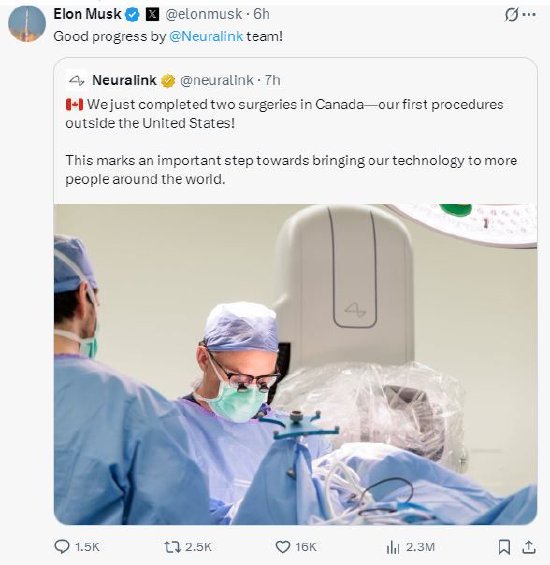
Neuralink首次在美国以外完成脑机芯片植入手术,马斯克祝贺-美股-金融界
Jin Rong Jie· 2025-09-04 23:54
Group 1 - Neuralink has successfully performed its first brain chip implant surgeries outside the United States in Canada, marking a significant milestone for the company [1] - The company announced the completion of two surgeries in Canada via its official account on the X platform, emphasizing the importance of expanding its technology to more people globally [1] - Elon Musk congratulated Neuralink on this achievement by retweeting the announcement, highlighting the company's progress and potential [1]
脑机接口领域投融资活跃、应用场景拓展
Zheng Quan Ri Bao· 2025-09-04 16:19
Core Insights - The brain-computer interface (BCI) sector is experiencing a significant increase in investment and financing activities, with notable funding rounds completed by companies such as Shanghai Brain Rhythm Technology Co., Ltd. and Guangdong Daoshi Technology Co., Ltd. [1][4] Group 1: Technological Advancements - BCI technology is rapidly transitioning from concept to practical applications, spanning areas such as medical rehabilitation, treatment of neurological diseases, cognitive enhancement, and human-machine collaboration [2] - The technology has overcome limitations of traditional interaction methods, enabling seamless conversion from "thought" to "command" by directly interpreting neural signals [2] - Significant progress has been made in 2023, including the successful implementation of the first invasive BCI clinical trial in China and the rise of non-invasive devices for consumer applications [2] Group 2: Policy Support - Various regions in China, including Beijing, Shanghai, and Sichuan, have launched action plans to develop BCI industry clusters, establish key laboratories, and promote clinical applications [3] - The Shanghai Municipal Science and Technology Commission has set ambitious goals for BCI product innovation and clinical application by 2030 [3] - The National Medical Products Administration has initiated the establishment of industry standards for medical devices utilizing BCI technology, further facilitating commercialization [3] Group 3: Investment Trends - Investment enthusiasm in the BCI sector is on the rise, with a notable increase in financing activities in the first half of 2023 compared to the entire previous year [4] - Beijing Zhiran Medical Technology Co., Ltd. successfully completed over 300 million yuan in Series A financing, indicating strong market recognition of its potential in the invasive BCI field [5] - The expansion of key technologies and broader insurance coverage is expected to enable multi-scenario applications of BCI in healthcare, consumer electronics, and industrial manufacturing [5]
脑机接口领域投融资活跃应用场景拓展
Zheng Quan Ri Bao· 2025-09-04 16:14
Core Insights - The brain-computer interface (BCI) sector is experiencing a significant increase in investment and financing activities, with notable funding rounds completed by companies like Shanghai Brain Rhythm Technology and Guangdong Daoshi Technology [1][4] - The technology is advancing from conceptual applications to real-world uses, spanning various fields such as medical rehabilitation, treatment of neurological diseases, cognitive enhancement, and human-machine collaboration [2] - Government policies are actively promoting the BCI industry, with initiatives aimed at creating industrial clusters, establishing key laboratories, and facilitating clinical applications [3] Investment Trends - Investment enthusiasm in the BCI sector is on the rise, with a notable increase in financing activities in the first half of the year, surpassing the total number from the previous year [4] - Companies like Beijing Zhiran Medical Technology have successfully raised significant funds, indicating market confidence in the potential of invasive BCI technologies [5] Technological Advancements - BCI technology is breaking traditional interaction methods, allowing for direct interpretation of neural signals and seamless conversion from "thought" to "command," which enhances its applicability across various domains [2] - Key technological breakthroughs, such as flexible electrodes and wireless power supply, are expected to facilitate multi-scenario applications in healthcare, consumer electronics, and industrial manufacturing [5] Policy Support - Various regions in China, including Beijing and Shanghai, have launched specific action plans to support the BCI industry, aiming for high-quality development and comprehensive clinical application by 2030 [3] - The establishment of industry standards and inclusion of BCI surgeries in medical insurance coverage are steps towards creating a complete commercialization loop for BCI technologies [3]

国家市场监督管理总局:正牵头制定一系列脑机接口领域国际标准
Zheng Quan Ri Bao· 2025-09-04 16:12
Core Points - The National Market Supervision Administration emphasizes the importance of advanced manufacturing standards as a fundamental and leading role in transforming the manufacturing industry from large to strong [1] - The administration has launched a series of key initiatives during the 14th Five-Year Plan period to support national strategies and industrial upgrades [1] Group 1: Key Initiatives - Strengthening top-level design to continuously improve the advanced manufacturing standard system [1] - Accelerating standard supply to create new engines for industrial upgrading [1] - Co-building international standards to enhance new competitive advantages in the industry [1] - Deepening standard implementation to actively stimulate new vitality in business entities [1] Group 2: Data and Achievements - Since the 14th Five-Year Plan, over 4,000 national standards have been released in key industries such as integrated circuits, new materials, new energy vehicles, robotics, and aerospace equipment [2] - China has taken on 26 technical secretariats in international standard organizations and has appointed 30 experts as chairs of technical bodies, along with 486 leaders for international standard revision working groups [2] - 880 international standard proposals have been made in fields like new energy vehicles and aerospace, with 532 international standards being led for development [2] - Over 4,210 advanced applicable international standards have been converted into national standards, with a conversion rate exceeding 90% in key areas [2] Group 3: International Standards in Emerging Fields - In the brain-computer interface field, Chinese experts are leading the development of international standards to unify terminology and data formats, promoting innovation and large-scale development [2] - The world's first international standard for elderly care robots has been established, providing benchmarks for design, manufacturing, testing, and certification, which will guide the high-quality development of the global elderly care robot industry [2] Group 4: Role in Belt and Road Initiative - The standardization work plays a fundamental and leading role in promoting the Belt and Road Initiative, enhancing connectivity through standards [3] - An international standard for pressure pulsation conversion of mixed-flow turbines has been crucial in the acceptance of turbine models in key Belt and Road projects [3]