Electronics

Search documents
All You Need to Know About TE Connectivity (TEL) Rating Upgrade to Strong Buy
ZACKS· 2025-07-30 17:00
TE Connectivity (TEL) could be a solid choice for investors given its recent upgrade to a Zacks Rank #1 (Strong Buy). This upgrade is essentially a reflection of an upward trend in earnings estimates -- one of the most powerful forces impacting stock prices. A company's changing earnings picture is at the core of the Zacks rating. The system tracks the Zacks Consensus Estimate -- the consensus measure of EPS estimates from the sell-side analysts covering the stock -- for the current and following years. Sin ...



VWDRY vs. ETN: Which Stock Is the Better Value Option?
ZACKS· 2025-07-30 16:41
Investors interested in Manufacturing - Electronics stocks are likely familiar with Vestas Wind Systems AS (VWDRY) and Eaton (ETN) . But which of these two companies is the best option for those looking for undervalued stocks? Let's take a closer look. Everyone has their own methods for finding great value opportunities, but our model includes pairing an impressive grade in the Value category of our Style Scores system with a strong Zacks Rank. The proven Zacks Rank emphasizes companies with positive estima ...

Fujifilm Holdings Corp. (FUJIY) is a Top-Ranked Growth Stock: Should You Buy?
ZACKS· 2025-07-30 14:45
Company Overview - FUJIFILM Holdings Corporation is based in Tokyo and utilizes its expertise in photographic film technology to explore opportunities in Healthcare, Electronics, and Imaging markets, with a diversified business model that includes imaging, healthcare, and materials [11] - The company reported revenues of ¥2,960.9 billion for fiscal 2023, reflecting a year-over-year increase of 3.6% [11] Financial Performance - FUJIFILM has a Zacks Rank of 3 (Hold) and a VGM Score of B, indicating a stable position in the market [12] - The company is projected to experience year-over-year earnings growth of 2.8% for the current fiscal year, supported by a Growth Style Score of B [12] - Recent analyst activity shows two analysts have revised their earnings estimates higher for fiscal 2026, with the Zacks Consensus Estimate increasing by $0.02 to $0.73 per share [12] - FUJIFILM has an average earnings surprise of +8.6%, suggesting a positive trend in earnings performance [12] Investment Potential - With a solid Zacks Rank and strong Growth and VGM Style Scores, FUJIFILM is recommended as a potential investment opportunity for growth investors [13]

国信证券:CoWoP有望商用 PCB工艺及设备随之升级
智通财经网· 2025-07-30 06:12
Group 1 - The core concept of CoWoP (Chip on Wafer on PCB) is to stack or place multiple chips directly on the PCB without an intermediate IC substrate, which improves electrical performance by shortening interconnection paths and reducing parasitic effects [1] - CoWoP is expected to gradually commercialize, with the PCB directly supporting the wafer, leading to reduced signal transmission loss and delay, as well as decreased packaging thickness and area, while enhancing heat dissipation [1] - SLP (Substrate-like PCB) performance is anticipated to improve significantly with the penetration of CoWoP, as it is positioned between HDI boards and IC substrates in terms of specifications and performance [2] Group 2 - SLP manufacturing relies heavily on the mSAP (Modified Semi-Additive Process) technology, which requires high precision in photolithography and laser direct imaging (LDI) to achieve fine lines [3] - Domestic companies such as Shenzhen Circuits, Pegatron, and Xingsen Technology have accumulated technology in both SLP and IC substrate processes, positioning them to benefit from future advancements [3] - Upstream equipment manufacturers like Chipbond and Dazhu CNC are also expected to benefit from production line upgrades due to the increasing demand for advanced SLP technology [3]

破壁时刻:高端覆铜板国产替代的临界点与产业链重构机遇
3 6 Ke· 2025-07-30 02:45
Core Insights - The article emphasizes the strategic importance of copper-clad laminates (CCL) as a foundational material in the electronics industry, highlighting the need for domestic production to enhance supply chain security and reduce reliance on foreign imports [4][5][7]. - The current state of the industry is characterized by a structural imbalance, where China is a major producer but lacks strength in high-end segments, with less than 20% domestic production in advanced materials [7][8]. - There is a significant opportunity for investment in the high-end CCL market, driven by the increasing demand from AI computing, communication upgrades, and automotive electronics [8][10]. Industry Position and Challenges - CCL serves as the core substrate for printed circuit boards (PCBs), crucial for signal transmission efficiency and reliability in strategic industries like 5G, AI, and automotive electronics [4]. - The industry faces challenges such as overcapacity in low-end products, high competition, and a lack of core technologies in high-end materials, leading to supply chain risks [7][8]. - The high-end CCL market is dominated by foreign companies, with significant market shares held by U.S. and Japanese firms, creating a critical need for domestic innovation and production [7][8]. Growth Drivers - The demand for high-end CCL is expected to surge due to the rapid growth of AI servers, with usage rates projected to be 3-5 times higher than traditional servers, and a 25% growth rate in millimeter-wave radar materials [8][10]. - The transition from 5G to 5.5G and the development of 6G technologies are anticipated to further drive the demand for high-frequency materials [13][14]. - The automotive sector is also a significant growth area, with increasing electronic component integration in electric vehicles and advanced driver-assistance systems [15][16]. Path to Breakthrough - Domestic companies are making strides in technological breakthroughs and capacity expansion, with several firms achieving significant advancements in high-frequency materials and IC substrates [12][19]. - The industry is witnessing a shift from being mere followers to becoming leaders in technology, with domestic firms increasingly participating in the global supply chain [19][20]. - The focus is on building a robust ecosystem that integrates materials, processes, and applications to enhance competitiveness [19][20]. Investment Opportunities - The high-end CCL market is projected to grow significantly, with estimates suggesting that the high-end segment's market share will increase from 30% to over 45% by 2027, reaching a total market size of over $20 billion [10][11]. - Investment opportunities are emerging in companies that can demonstrate technological breakthroughs and have the capacity to meet the growing demand in high-end applications [8][10]. - The article suggests that companies with strong vertical integration capabilities and those that can navigate the certification processes will be well-positioned for growth [35][42]. Policy and Technological Support - Government policies are increasingly supportive of the domestic CCL industry, with initiatives aimed at enhancing production capabilities and reducing reliance on imports [20][21]. - Significant technological advancements have been made in high-end CCL products, with domestic firms achieving performance metrics comparable to international standards [21][22]. - The industry is entering a critical phase where the focus will shift from mere technological breakthroughs to the establishment of a comprehensive ecosystem that supports sustainable growth [19][20].

电子布专家:Cowop工艺对上游材料影响怎么看?
2025-07-30 02:32
Summary of Conference Call on Electronic Fabric Industry Industry Overview - The conference discusses the electronic fabric industry, specifically focusing on quartz fiberglass fabric and its applications in high-end AI chip packaging and the impact of COP (Chip-on-Panel) technology on upstream materials [1][2][4]. Key Points and Arguments 1. **Increased Demand for Low CTE Materials**: High-end AI chip packaging is driving a surge in demand for low CTE (Coefficient of Thermal Expansion) materials, with quartz fiberglass fabric being critical due to its near-zero expansion coefficient [1]. 2. **Impact of COP Technology**: If COP technology matures, it will reduce the need for ADF (Adhesive Dielectric Film) substrates, necessitating an increase in the number of PCB (Printed Circuit Board) layers from 20-30 to 30-50 layers, which will significantly increase the usage of quartz fiberglass fabric by 10%-50% [2][14]. 3. **Purity of Quartz Fiberglass**: The purity of quartz directly affects the CP (Coefficient of Performance) value, with high-end AI chips preferring quartz sand with a purity of 4N or above. Domestic manufacturers are working to catch up, with expectations to meet these requirements by late 2025 or early 2026 [1][6]. 4. **Production Barriers**: The core barriers in electronic fabric production lie in the drawing process and raw materials. The technology for synthetic quartz sand is currently monopolized by Japan, but domestic companies like Feilihua are developing their capabilities [9][10]. 5. **Growth in LDP Demand**: The demand for LDP (Low-Density Polyethylene) is expected to peak in 2026, potentially reaching 3-5 million meters per month, driven by advancements in chip capabilities [11][12]. 6. **Future of Quartz Fiberglass Fabric**: The number of layers in quartz fiberglass fabric is expected to increase by 10%-20% as chip capabilities improve, and the value of PCB and fiberglass fabric could increase by 50% with the adoption of orthogonal backplane technology [13][14]. 7. **Material Cost and Pricing Trends**: The price of quartz fiberglass fabric is currently high due to supply-demand imbalances, but it is expected to stabilize around 200 RMB per unit in 3-5 years as production capacity expands [40][41]. Additional Important Insights - **Technological Development**: There is a need for the development of new electronic fabrics that can meet the performance and CTE requirements of COP technology, which will enhance overall performance and ensure compliance with packaging standards [5]. - **Market Dynamics**: The introduction of the Rubin series is anticipated to begin volume production by mid-2026, which will depend on sales performance and the overall market demand for quartz fiberglass fabric [31][33]. - **Competitive Landscape**: Domestic manufacturers are making strides in the electronic fabric sector, with varying strengths in different technical aspects such as raw material production and post-processing techniques [7][23]. This summary encapsulates the critical discussions and insights from the conference call regarding the electronic fabric industry, particularly focusing on the implications of technological advancements and market dynamics.
汉王科技王杰:电纸本需做好省电与性能的平衡术 AI成为关键
Huan Qiu Wang· 2025-07-30 02:11
Core Insights - The core value of Hanwang Technology's new strategy is collaboration, aiming to transform electronic paper from a reading device to a multi-functional collaborative terminal covering reading, office work, education, and meetings [3] Group 1: Product Development and Features - Hanwang's electronic paper products, such as the M10 series, can display content without power, highlighting their advantage over traditional LCD screens [1] - The company has developed a diversified revenue model combining hardware, AI, and services, which has allowed it to capture a significant share of the domestic electronic book market [3] - The newly launched Voice King App allows users to record audio and take photos of presentations simultaneously, with real-time synchronization to the electronic paper device [3] Group 2: Technology and Innovation - Hanwang addresses the long-standing "power-saving vs. performance" dilemma in the electronic paper industry through dual-stable display technology and AI quantification reasoning [3] - The company has achieved over 90% accuracy in offline voice recognition while reducing power consumption to less than one-third of traditional solutions [3] Group 3: Ecosystem and Collaboration - Hanwang emphasizes an "open but not complex" ecosystem, allowing third-party applications to utilize its handwriting pen SDK for enhanced functionality [4] - The company believes that achieving a paperless office will accelerate exponentially, aiming to make the replacement of paper a subconscious choice for users [4]

人工智能产业发展驱动 多家上市公司业绩报喜
Zheng Quan Shi Bao· 2025-07-29 22:02
Group 1: Company Performance - Shijia Photon reported a revenue of 993 million yuan for the first half of 2025, a year-on-year increase of 121.12%, and a net profit of 217 million yuan, up 1712% [1] - Willgo expects a net profit of 43 to 50 million yuan for the first half of 2025, representing a year-on-year growth of 12.55% to 30.87% [2] - Huaqin Technology anticipates revenue between 83 to 84 billion yuan, a year-on-year increase of 110.7% to 113.2%, and a net profit of 1.87 to 1.90 billion yuan, up 44.8% to 47.2% [2] - Industrial Fulian expects a net profit of 11.958 to 12.158 billion yuan for the first half of 2025, a year-on-year increase of 36.84% to 39.12% [3] Group 2: Industry Trends - The growth in performance for these companies is primarily driven by the rapid development of artificial intelligence, leading to increased demand in various sectors [1][2][3] - The AI server revenue for Industrial Fulian grew over 60% year-on-year, with cloud service server revenue increasing by more than 1.5 times compared to the previous year [3] - The Chinese AI industry is expected to experience explosive growth, with projections indicating a rise from 398.5 billion yuan to 1.7295 trillion yuan from 2025 to 2035, reflecting a compound annual growth rate of 15.6% [3]


受益于人工智能快速发展 多家上市公司业绩报喜
Zheng Quan Shi Bao Wang· 2025-07-29 13:53
Group 1: Company Performance - Shijia Photon reported a revenue of 993 million yuan for the first half of 2025, a year-on-year increase of 121.12%, and a net profit of 217 million yuan, up 1712% [1] - Weirgao expects a net profit of 43 to 50 million yuan for the first half of 2025, representing a year-on-year growth of 12.55% to 30.87% [2] - Huaqin Technology anticipates revenue between 83 to 84 billion yuan, a year-on-year increase of 110.7% to 113.2%, with a net profit of 1.87 to 1.90 billion yuan, up 44.8% to 47.2% [3] Group 2: Industry Trends - The electronic information industry is benefiting from global digital transformation and the explosion of artificial intelligence, leading to increased demand in smart terminals, high-performance computing, and AIOT [3] - Industrial Fulian expects a net profit of 11.958 to 12.158 billion yuan for the first half of 2025, a year-on-year increase of 36.84% to 39.12% [3] - The AI-related business is experiencing significant growth, with AI server revenue increasing by over 60% year-on-year and cloud service server revenue growing by more than 1.5 times [4] Group 3: Future Projections - The Chinese artificial intelligence industry is projected to experience explosive growth, with a compound annual growth rate of 15.6% from 2025 to 2035, increasing from 398.5 billion yuan to 1.7295 trillion yuan [4] - By 2030, the scale of China's artificial intelligence industry is expected to exceed 1 trillion yuan [4]
中国电子企业协会国际合作分会成立大会圆满举行,助力企业融入全球生态
Ju Chao Zi Xun· 2025-07-29 10:40
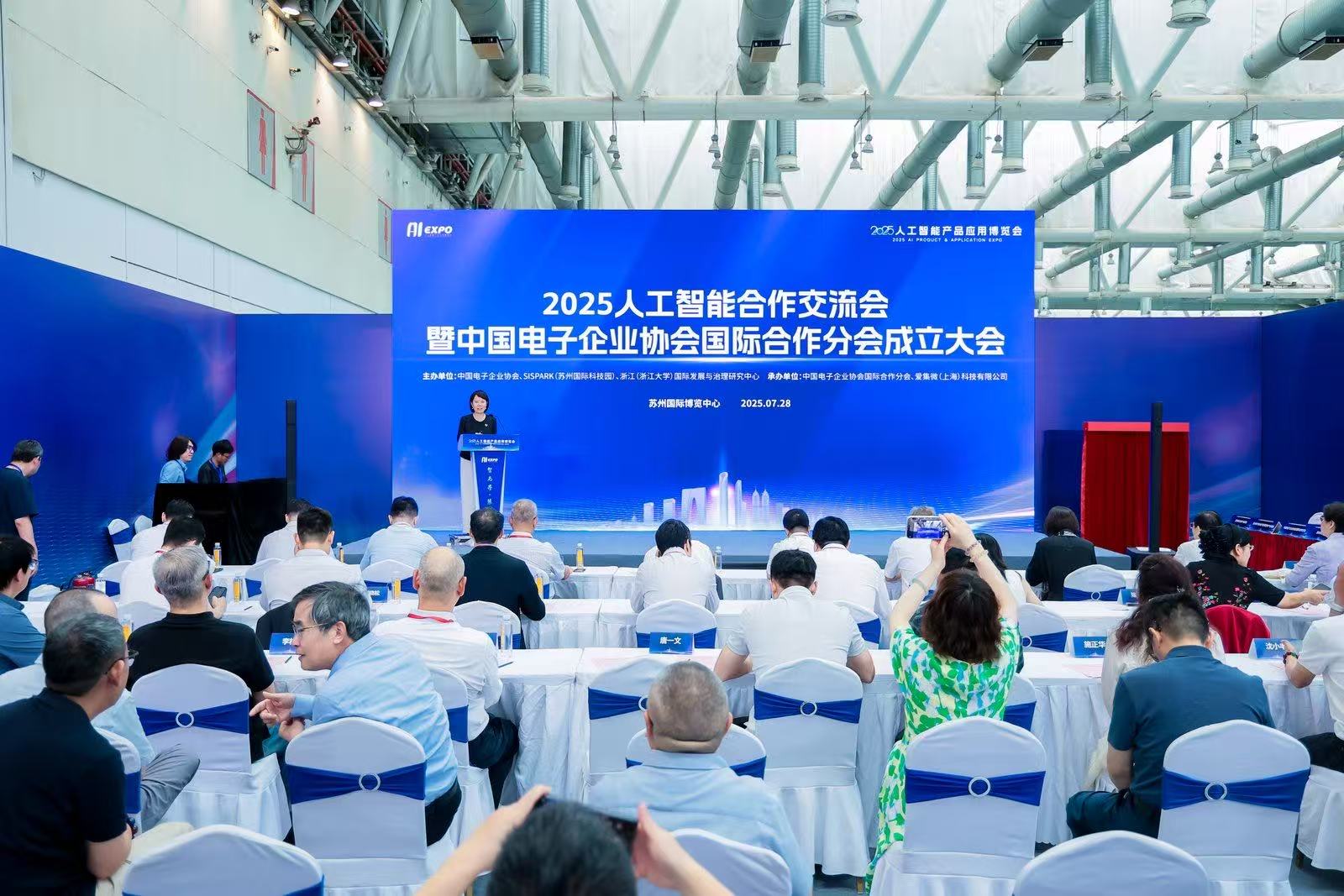
7月28日下午,2025人工智能合作交流会暨中国电子企业协会国际合作分会成立大会在苏州成功举办。大会由中国电子企业协会、(SISPARK)苏州国际科 技园、浙江(浙江大学)国际治理与研究中心联合主办;中国电子企业协会国际合作分会、爱集微(上海)科技有限公司共同承办。 工业和信息化部电子信息司副司长史惠康,中国电子企业协会国际合作分会指导委员会主任、浙江(浙江大学)国际发展与治理研究中心主任贡森,中国电子 企业协会国际合作分会指导委员会副主任阮汝祥,中国电子企业协会会长罗涛,中国电子企业协会秘书长曾继新,苏州市委统战部副部长、市工商联党组书 记王蓓蕾,苏州工业园区科技创新委员会党组书记、主任潘瑜,苏州市工业和信息化局副局长朱科,(SISPARK)苏州国际科技园董事长、总裁张峰,以 及来自政府园区、企业院所、投资机构、金融机构和产业链重点企业的嘉宾代表出席。会议由中国电子企业协会国际合作分会秘书长、赛迪工业和信息化研 究院集团(苏州)有限公司总经理杜娇主持。 本次大会以中国电子企业协会国际合作分会成立为契机,聚焦全球人工智能产业发展趋势与国际合作新路径,旨在搭建高水平对话平台,推动电子信息产业 国际协同创新与资源 ...