
Software

Search documents
万人公测!华为云,AI大动作
Zhong Guo Ji Jin Bao· 2026-02-11 10:32
【导读】华为云码道代码智能体已开启公测,AI编程领域再添国产强手 AI智能编程领域,迎来重磅消息! 2月11日,中国基金报记者获悉,华为云码道(CodeArts)代码智能体,已在马年春节前夕开启公测,参与公测人数已超1万人。 华为云码道代码智能体定位于实干派AI编程工具,其核心是高效替代高频重复的工程化开发工作,从而大幅度降低编程门槛,有助于加速AI编码技术的 产业化落地。 无编程基础者通过自然语音输入需求,即可借助华为云码道代码智能体搭建小程序等应用。 据悉,华为云码道代码智能体提供代码生成、研发知识问答、单元测试用例生成、代码解释、代码注释、代码调试、代码翻译、代码检查、代码优化等场 景功能。 业内人士透露,华为云码道代码智能体在项目级代码生成等关键场景实现突破,可适配企业研发需求,助力压缩开发周期、提升编码效率。 与华为云码道代码智能体同类的AI编程工具包括Cursor、GitHub Copilot等海外产品,以及字节跳动的Trae、腾讯云的CodeBuddy等国产产品。 华为云码道代码智能体的核心竞争力来自华为数十年积淀的高质量研发数据,整合了代码大模型、AI IDE(集成开发环境)、自主开发模式、代 ...

计算机行业事件点评:AI+招采迎来政策红利
Guolian Minsheng Securities· 2026-02-11 10:30
Investment Rating - The report maintains a "Recommended" rating for the computer industry, indicating an expected relative increase in stock prices of over 15% compared to the benchmark index within the next 12 months [4][10]. Core Insights - The report highlights the integration of AI in the bidding and procurement sector, driven by new policies from the National Development and Reform Commission and other departments, aiming to enhance efficiency and transparency in the bidding process [6][7]. - It identifies 20 key application scenarios for AI in the bidding process, including document detection, intelligent evaluation assistance, and identification of collusion, which are expected to be implemented by the end of 2026 and 2027 [6][7]. - Companies deeply engaged in AI applications within the bidding sector, such as EazyDevelop, Newpoint Software, and Bosi Software, are anticipated to benefit significantly from these policy changes [7]. Summary by Sections Policy and Development Goals - The report outlines specific goals for AI integration in the bidding process, with a focus on enhancing the efficiency of transactions, competition, and regulatory oversight [6]. - It emphasizes the importance of using intelligent technologies to ensure transparent and fair bidding practices, thereby reducing risks associated with low-cost bidding and enhancing regulatory effectiveness [6][7]. Company Opportunities - EazyDevelop is set to launch an AI bidding system that streamlines the entire bidding process, improving compliance and efficiency [7]. - Newpoint Software's AI applications cover all transaction scenarios, aiming to reduce costs and enhance regulatory efficiency [7]. - Bosi Software's "Sunshine Public Procurement Model" has achieved a 100% accuracy rate in AI-assisted evaluations, significantly reducing the time required for expert evaluations [7]. Investment Recommendations - The report suggests focusing on companies such as EazyDevelop, Newpoint Software, Bosi Software, and others that are well-positioned to leverage AI advancements in the bidding and procurement sector [7].


Stock Market Today: Dow Jones, S&P 500 Futures Gain As Investors Await January's Job Report—Cloudflare, AST SpaceMobile, Mattel In Focus - State Street SPDR S&P 500 ETF Trust (ARCA:SPY)
Benzinga· 2026-02-11 10:19
U.S. stock futures rose on Wednesday following Tuesday’s mixed close. Futures of major benchmark indices were higher.On Tuesday, the Dow Jones index hit a new record for the third consecutive day, even as the Nasdaq Composite dropped over 100 points. Investors are bracing for January’s U.S. employment report, unemployment rate, and hourly wages data scheduled to be released today before the market opens. Meanwhile, the 10-year Treasury bond yielded 4.13%, and the two-year bond was at 3.45%. The CME Group's ...


还在为Agent“能用不好用”而困扰?网易智企让AI知识库真正为业务而生
Sou Hu Wang· 2026-02-11 10:16
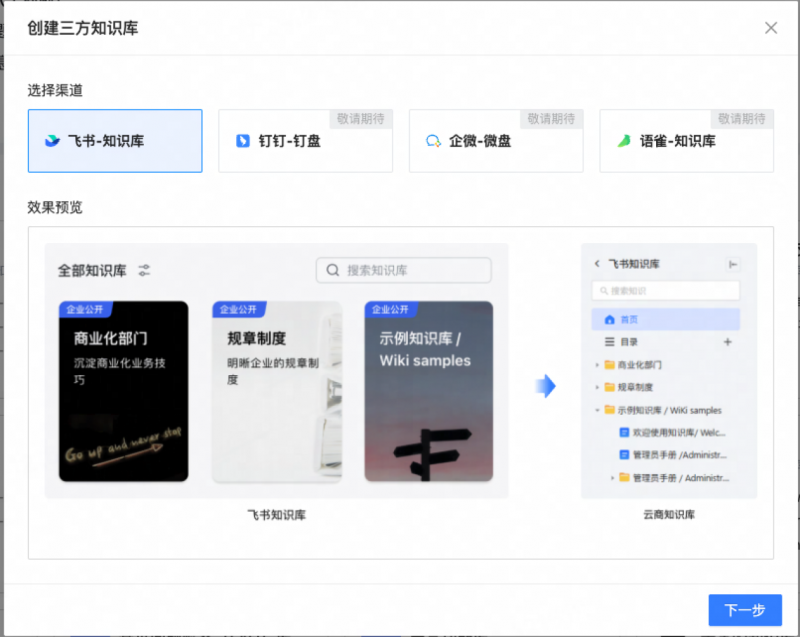
Core Insights - Many enterprises deploying AI agents find them to be underperforming due to inadequate knowledge bases, which are crucial for the agents' effectiveness [1][2] - The quality and adaptability of the knowledge base account for over 80% of the performance issues faced by AI agents, highlighting the importance of structured and relevant knowledge [2] - NetEase's AI knowledge base focuses on creating industry-specific, deeply integrated "intelligent knowledge engines" rather than generic solutions, aiming for optimal performance in specific business scenarios [2][10] Knowledge Base Challenges - The primary challenge in implementing AI agents is the quality and structure of the knowledge base, which directly impacts the accuracy and utility of the agents' outputs [2] - A significant portion of the issues arises from the knowledge being poorly maintained or irrelevant to the business context, leading to a "ceiling" on the agents' intelligence [2] Knowledge Base Development - NetEase's AI knowledge base offers a dual-engine model for rapid knowledge base setup, significantly reducing the time required for traditional knowledge structuring from weeks or months to minutes [3][4] - The system supports quick synchronization of internal knowledge and integration of external content from platforms like Feishu, enhancing the efficiency of knowledge updates [3][4] Intelligent Knowledge Extraction - The AI agent can extract valuable insights from historical customer service interactions, transforming unstructured data into a structured knowledge system that can enhance business operations [6] - The knowledge extraction process includes static knowledge (fixed Q&A), dynamic knowledge (contextual answers), and standardized responses for various customer inquiries [6] Practical Implementation - A case study illustrates how a client utilized NetEase's AI knowledge base to automatically extract valuable knowledge from customer interactions, resulting in over 1,000 new high-quality knowledge entries in a single day [8] - The implementation of the knowledge extraction feature allowed the client to significantly reduce the manual effort required to curate knowledge, leading to a more efficient knowledge management process [8] Security and Industry Focus - To address concerns about knowledge security, NetEase implements a three-layer protection system to ensure the safety of enterprise knowledge while adopting AI solutions [9] - The company plans to deepen its industry-specific strategy by collaborating with clients to build tailored knowledge graphs and continuously optimize the user experience [10]

代码“自动驾驶”元年!华为云码道万人公测:代码版权归用户
Xin Lang Cai Jing· 2026-02-11 10:16
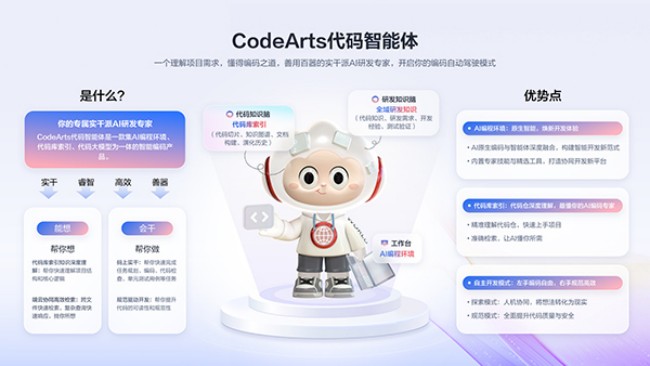
从行业长远走向来看,华为云码道的上线标志着软件研发正从"告警与补全"向"自主智能体"跨越。2026 年AI代码智能体正重构全球信息工作市场,程序员的角色正在从代码编写者转变为系统指挥官。随着 类似DeepSeek-V3.2这类高性能且低成本模型的普及,AI不再仅仅提供单行建议,而是能独立处理复杂 的Issue并提交完整的Pull Request。这种变革预示着未来开发范式的重塑,即由人类明确目标,而由AI 【iMobile爱科技资讯】2月11日消息,近日华为云正式宣布旗下 "码道"(CodeArts) 代码智能体开启万 人公测,并明确个人版面向开发者免费开放。作为华为云研发大模型的核心落地产品,码道不仅深度支 持主流IDE集成,更在模型层完成了双旗舰接入,同时支持智谱 GLM-4.7 与 DeepSeek-V3.2。 官方特别强调由该智能体生成的代码版权将完全归属于用户,这一举措从根本上解决了企业与个人开发 者对AI辅助编程的合规性与资产归属顾虑。功能层面,码道已进化为具备自主思考能力的数字工友, 能实现项目级的代码自动续写、单元测试生成以及复杂的架构知识问答。不同于传统的代码补全,华为 云码道强调的是智能体 ...

Dassault Systemes Shares Slump on Weak Sales, Guidance
WSJ· 2026-02-11 10:15
Core Insights - The software maker reported a decline in adjusted operating profit and issued annual guidance that disappointed investors [1] Group 1 - The company experienced a decrease in adjusted operating profit [1] - The annual guidance provided by the company did not meet investor expectations [1]

山姆·奥特曼:软件已死?它变了,但绝对没死
阿尔法工场研究院· 2026-02-11 10:13
Core Viewpoint - The release of a new productivity tool by Anthropic PBC has led to a significant decline in software, financial services, and asset management stocks, particularly affecting tech software stocks in the US, raising questions about the future of software [1] Group 1 - OpenAI CEO Sam Altman addressed the recent concerns sparked by Anthropic during an interview with TBPN, discussing the implications for the tech industry [1] - The interview also covered the upcoming release of GPT-5.3-Codex and the importance of managing AI agents as a key technological shift [1] - Altman highlighted that future social experiences will undergo significant changes, with OpenAI exploring applications of AI technology in the social domain [1] Group 2 - TBPN is recognized as a popular tech business live show in Silicon Valley, having featured prominent figures such as Mark Zuckerberg, Sam Altman, Mark Cuban, and Satya Nadella [1]

业绩指引不及预期,英伟达软件供应商股价重挫20%!
Hua Er Jie Jian Wen· 2026-02-11 10:09
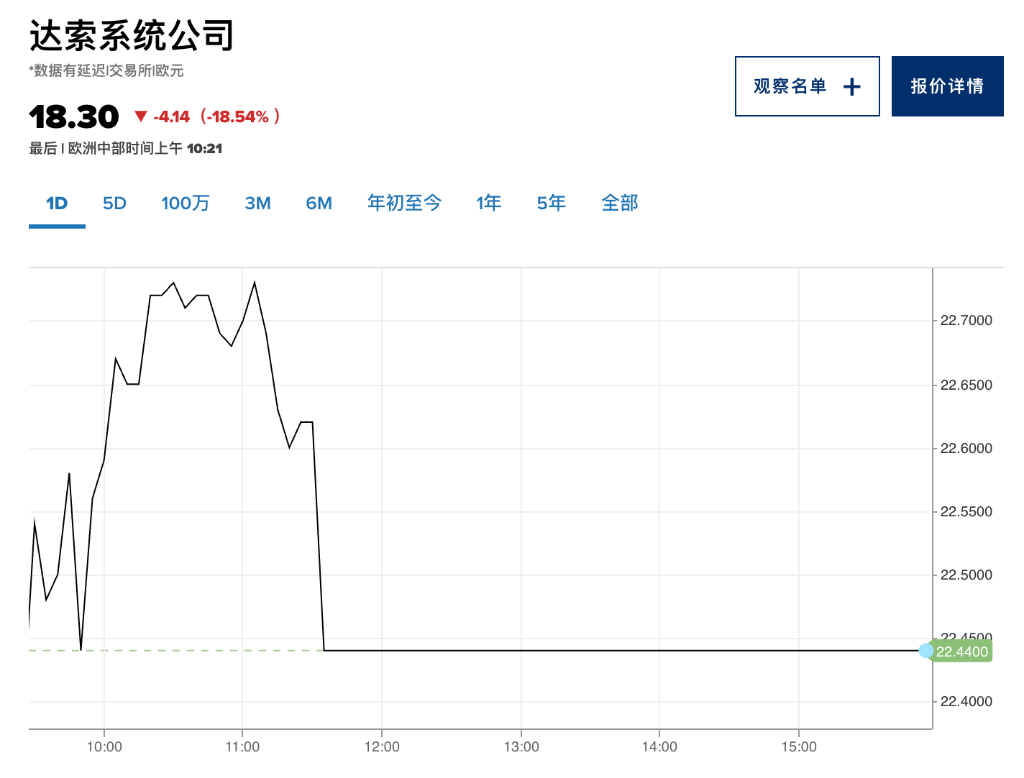
受第四季度业绩不及预期及2026年展望疲软拖累,法国工业软件巨头达索系统(Dassault Systemes SE)周三欧股早盘一度暴跌21%,接近创下上 市以来最大盘中跌幅。该股在巴黎交易所开盘后即触发短暂交易暂停,目前跌幅仍维持在19%附近。 据彭博汇编数据,达索系统第四季度营收为16.8亿欧元(约20亿美元),同比下降4.1%,低于市场预期的17.4亿欧元。公司预计2026年non-IFRS 营收增幅为3%至5%,同样未达分析师预期。这家曾被英伟达CEO黄仁勋称为"工业AI前沿中心"的企业,正面临传统软件业务被新兴AI工具加速 替代的担忧。 尽管公司此前将AI技术浪潮视为工业软件升级的重要驱动力,最新业绩却反映出其转型进程不及预期。摩根大通分析师Toby Ogg团队在报告中指 出,公司给出的增长预测"甚至低于最悲观投资者的预期"。面对来自生成式AI等新兴工具的竞争,达索系统的疲弱指引进一步加剧了市场对传统 工业软件业务护城河收窄的担忧。 英伟达供应商遭遇挫折 尽管英伟达是达索系统的客户之一,后者为其提供生成式3D虚拟环境软件,但这一合作关系并未能缓解市场对业绩疲软的强烈反应。 英伟达CEO黄仁勋上周接受 ...

Enterprise Group Inc's (ETOLF) Upcoming Quarterly Earnings Overview
Financial Modeling Prep· 2026-02-11 10:00
Company Overview - ETOLF is preparing to release its quarterly earnings on February 11, 2026, with expected earnings per share of approximately $0.016 and projected revenue of around $7.43 million [1][6] - The company has a price-to-earnings (P/E) ratio of 28.21, indicating strong investor confidence in its earnings potential [1][6] Financial Metrics - The price-to-sales ratio is 2.95, reflecting the market value relative to sales, while the enterprise value to sales ratio is 3.49, suggesting a higher total valuation compared to revenue [2] - ETOLF's enterprise value to operating cash flow ratio is 10.67, indicating how efficiently the company generates cash from its core business activities [3] - The earnings yield stands at 3.55%, showing the percentage of each dollar invested that was earned by the company [3] - The debt-to-equity ratio is 0.31, indicating a conservative approach to financing, appealing to risk-averse investors [4][6] - The current ratio of 2.56 highlights ETOLF's strong liquidity and ability to cover short-term liabilities with its short-term assets [4][6] Industry Context - In the competitive landscape, companies like Upland Software and Coveo are advancing in AI-powered solutions, showcasing the dynamic nature of the industry in which ETOLF operates [5]

华为云“码道”代码智能体万人公测启动,马年新春献礼开发者
Huan Qiu Wang· 2026-02-11 09:56
即日起,"码道"个人版已面向所有开发者免费开放。用户只需登录华为云官网,搜索"码道"或访问 CodeArts产品页面,即可参与公测,抢先体验AI驱动的"编码自动驾驶"新范式,在新的一年里开启高 效、智能的研发之旅。(张阳) 作为一款深度融合AI能力的智能编程工具,"码道"集成了编程环境、自主开发模式与代码库深度检索三 大核心能力,打造了一个"自带AI大脑"的一体化开发平台。开发者只需用自然语言描述需求,AI即可自 动生成完整、可用的代码,真正实现从需求到落地的"端到端"智能编码体验。 目前,"码道"已在项目级代码生成、智能代码续写、研发知识问答、单元测试用例生成等多个关键场景 取得显著突破,大幅降低开发门槛,提升软件交付效率与质量。更值得一提的是,华为云明确表示, 由"码道"生成的代码版权完全归属用户,充分保障开发者权益。 【环球网科技综合报道】2月11日消息,在马年春节前夕,华为云推出"码道"(CodeArts)代码智能 体,并正式启动万人规模公测,为广大开发者送上一份高效、智能的"新春编码大礼"。 ...