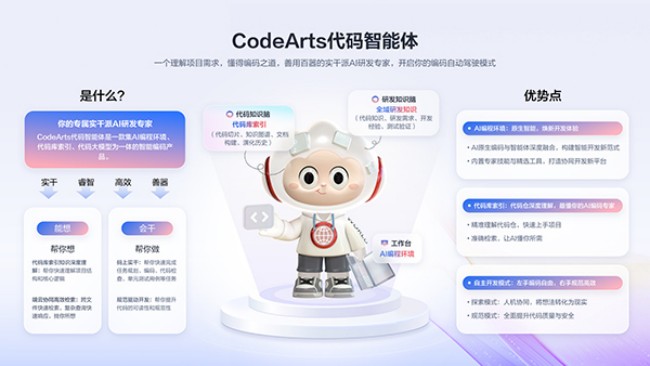
华为云码道(CodeArts)

Search documents
【太平洋科技-每日观点&资讯】(2026-03-02)
远峰电子· 2026-03-01 11:55
Market Overview - The major indices showed mixed performance with the Shanghai Composite Index up by 0.39%, while the ChiNext Index fell by 1.04% [1] - The TMT sector led the gains, particularly in communication cables and related services, which rose by 3.71% and 3.13% respectively [1] Domestic News - Anlu Technology announced a price increase across its entire line of FPGA packaging products, with increases ranging from 20% to 60% [2] - Phison indicated that the rapid development of AI infrastructure has significantly boosted NAND demand, leading to changes in payment terms from suppliers [2] - Huashengchang plans to acquire 100% of Jialante for an estimated valuation of 460 million, marking its entry into the core field of optical communication testing [2] - Xidian Microelectronics announced a price adjustment for some IC products due to rising costs in wafer foundry and packaging [2] Overseas News - Micron officially opened its semiconductor packaging and testing factory in Sanand, Gujarat, India, with expectations to package tens of millions of chips by 2026 [3] - Broadcom has begun delivering the industry's first 2nm custom computing SoC based on its 3.5D XDSiP platform [3] - Dell reported over $64 billion in AI-optimized server orders for the year, with a backlog of $43 billion as it approaches fiscal year 2027 [3] - Counterpoint Research forecasts a 139% year-on-year increase in global smart glasses shipments in the second half of 2025, driven by AI smart glasses [3] AI News - Google launched its new image generation model, Nano Banana 2, which offers over 50% cost reduction compared to its predecessor while enhancing text comprehension and generation speed [4] - Tongyi Lab's AgentScope team announced the open-source release of its personal assistant product CoPaw, focusing on usability and local deployment [4] - Huawei Cloud released the public beta of its CodeArts AI coding solution, integrating a large code model with various development environments [4] - Tencent Research Institute's DeepSeek collaborated with Tsinghua and Peking University to publish a DualPath inference system that significantly improves throughput [4] Industry Tracking - Electric Science Blue Sky reported an 82% participation rate in the satellite development plan for the National Grid constellation [5] - A team from China successfully developed a flexible electrode for brain-machine interfaces, addressing key challenges in dynamic brain movement [5] - Tianhua Chemical Group signed contracts for key projects under its 14th Five-Year Plan, with a total investment of 800 million, expected to generate an annual output value of 1.5 billion [5] Earnings Announcements - Demingli reported total revenue of 10.789 billion, a year-on-year increase of 126.07%, with a net profit of 688 million, up 96.35% [6] - Shunluo Electronics achieved total revenue of 6.745 billion, a 14.39% increase, with a net profit of 1.021 billion, up 22.71% [6] - Jingfang Technology reported total revenue of 1.474 billion, a 30.44% increase, with a net profit of 370 million, up 46.23% [6] - Shengmei Shanghai reported total revenue of 6.786 billion, a 20.8% increase, with a net profit of 1.396 billion, up 21.05% [6]


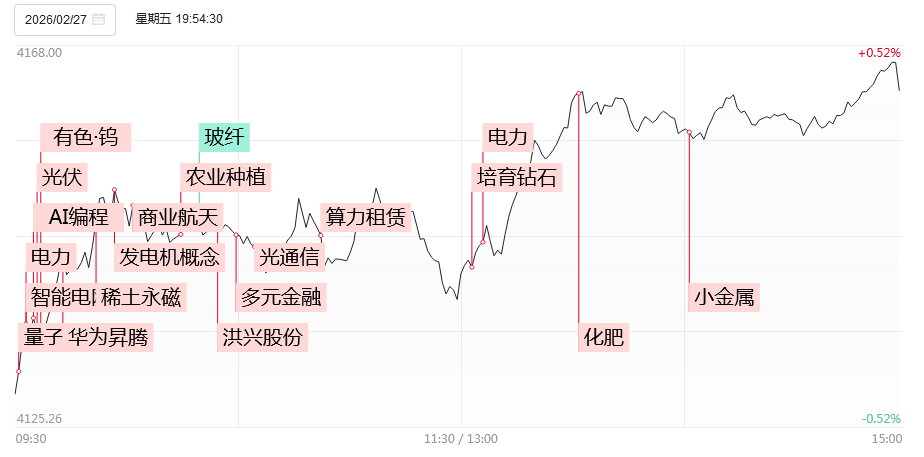
涨停复盘:今日全市场共92只股涨停,连板股总数10只,算力板块爆发,豫能控股、泰嘉股份涨停!
Jin Rong Jie· 2026-02-27 13:30
Market Overview - On February 27, the three major indices showed mixed results, with the Shanghai Composite Index rising by 0.39% and the ChiNext Index falling by 1.04% [1] - The total trading volume in the Shanghai and Shenzhen markets was 2.49 trillion yuan, a decrease of approximately 504.22 billion yuan compared to the previous trading day [1] - A total of 3,267 stocks rose in the market, with 92 stocks hitting the daily limit [1] Sector Performance - Rare metal concept stocks experienced a surge, leading to a wave of limit-up stocks, while sectors such as steel, gas, coal, and electricity also saw significant gains [1] - The cloud computing, AI applications, and computing power leasing themes were active, with notable stocks like Taijia Co., Ltd. and Tuo Wei Information hitting the limit [1] - The focus stocks included YN Holdings, which achieved a seven-day consecutive limit-up, and Jin Zheng Da in the chemical sector, which reached a four-day consecutive limit-up [1] Limit-Up and Limit-Down Stocks - A total of 75 stocks hit the daily limit (excluding ST and delisted stocks), with 10 stocks achieving consecutive limit-ups and 15 stocks failing to hit the limit, resulting in a limit-up rate of 83% [1] - Key stocks in the computing power sector included YN Holdings with seven consecutive limit-ups and Jiang Neng Co. with three consecutive limit-ups in the electricity sector [1] Related Hotspots - The fiber optic industry is experiencing high demand driven by global AI data centers and drones, while supply-side constraints are limiting rapid capacity increases [11] - The hard tool industry is facing a new round of price increases due to rising tungsten raw material prices, with tungsten powder exceeding 1,800 yuan per kilogram [11] - The computing power hardware sector is buoyed by Nvidia's performance guidance, alleviating market concerns about an "AI bubble" and demonstrating sustained demand for AI [11] - Huawei's CodeArts, an AI coding intelligent agent, was released for public testing, aimed at providing developers and enterprises with intelligent coding solutions [11]

ETF盘中资讯|华为云CodeArts重磅上线!算力价格20年首次反转,Token五年暴增400倍!大数据ETF(516700)拉升1.2%,拓维信息涨停
Sou Hu Cai Jing· 2026-02-27 03:50
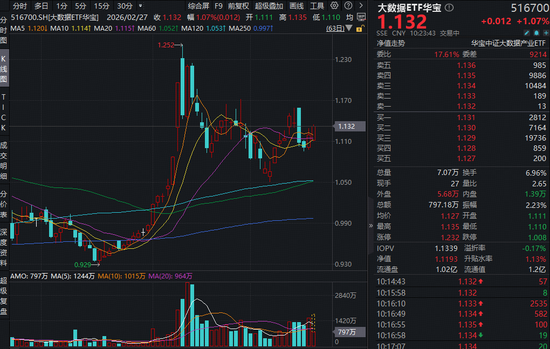
Core Viewpoint - The domestic computing power sector, particularly in IDC and server markets, and the domestic AI application field are experiencing significant activity, as evidenced by the performance of the big data ETF (516700) which has shown a price increase of over 1.2% during trading [1]. Group 1: ETF Performance - The big data ETF (516700) is currently trading at 1.132, reflecting a 1.07% increase from the previous day [2]. - The ETF's five-day moving average is 1.120, indicating a recovery above this level during trading [2]. - The total trading volume for the ETF reached 70,700, with a turnover rate of 6.96% [2]. Group 2: Key Stocks Performance - Notable stocks within the ETF include: - Tuowei Information, which reached its daily limit with a 10% increase [3]. - Yuntian Lifi, which surged over 13% [3]. - Wangsu Science and Technology, which increased by over 6% [3]. - Other stocks such as Youke De-W, Yunsai Zhiliang, Qi Anxin-U, and Tuolisi also experienced gains [3]. Group 3: Industry Insights - The AI computing power sector is projected to see a compound annual growth rate of approximately 330% from 2025 to 2030, with a total increase of about 370 times over five years [4]. - Domestic cloud service provider Youke De announced a price increase for all products starting March 1, marking a significant shift in the industry where prices have historically only decreased [4]. - The global cloud computing market is entering a price increase cycle, influenced by rising hardware costs and high demand for AI inference [4]. Group 4: ETF Composition - As of the end of 2025, the big data ETF (516700) will have a weight of 40.91% in computing power concepts and 37.43% in AI application concepts within its benchmark index [5]. - The ETF passively tracks the CSI Big Data Industry Index, focusing on sectors such as data centers, cloud computing, and big data processing, with major holdings in companies like Zhongke Shuguang, Keda Xunfei, and Inspur Information [6].

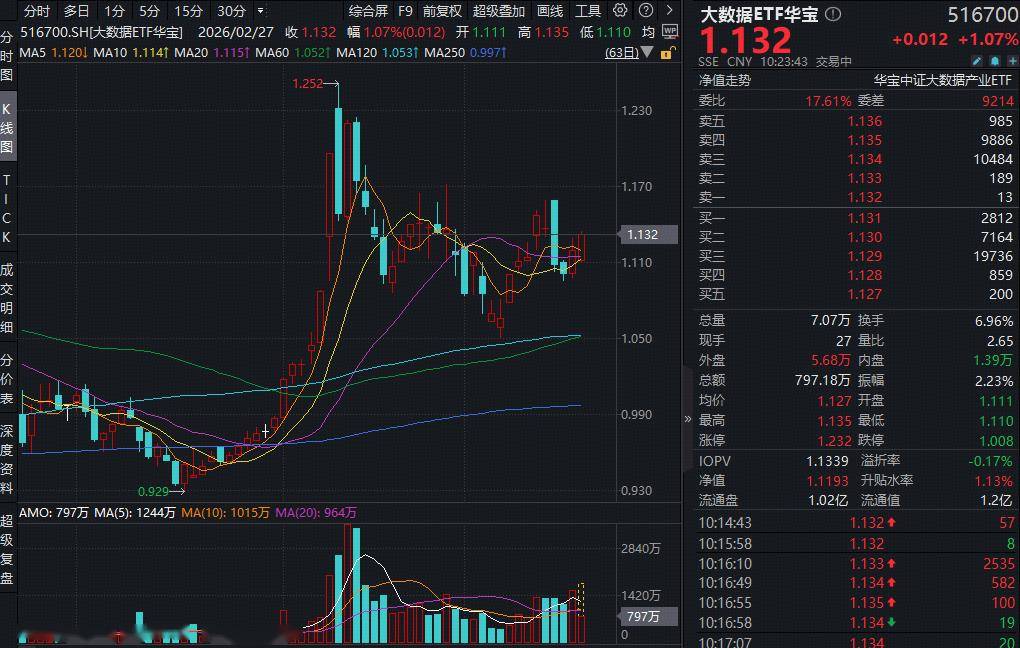
华为云CodeArts重磅上线!算力价格20年首次反转,Token五年暴增400倍!大数据ETF(516700)拉升1.2%
Xin Lang Cai Jing· 2026-02-27 02:37
Core Viewpoint - The focus is on the active performance of the domestic computing power (IDC, servers) and domestic AI application sectors, particularly through the big data ETF (516700), which has shown a price increase of over 1.2% and currently stands at a 1.07% rise, recovering the 5-day moving average [1]. Group 1: Market Performance - The big data ETF (516700) is heavily weighted towards computing power concepts (40.91%) and AI application concepts (37.43%) as of the end of 2025 [5][10]. - Key stocks in the ETF include Zhongke Shuguang, Keda Xunfei, Unisplendour, Inspur Information, China Greatwall, and China Software, focusing on data centers, cloud computing, and big data processing [12]. Group 2: Stock Movements - Notable stock performances include: - Yuntian Lifa-U with a rise of 13.34% [2][11] - Yuwei Information increasing by 10% [2][11] - Wangsu Science and Technology up by 6.68% [2][11] - Other stocks like UCloud, Yunsai Zhili, Qi Anxin-U, and Tuolisi also showed positive movements [4][11]. Group 3: Industry Trends - Morgan Stanley predicts a compound annual growth rate of approximately 330% for AI inference token consumption in China from 2025 to 2030, with a projected growth of about 370 times over five years [3][10]. - The domestic cloud service provider UCloud announced a price increase for all products starting March 1, breaking a two-decade trend of declining prices in the cloud service industry [3][10]. - The global cloud computing market is entering a price increase cycle, driven by rising hardware costs and high demand for AI inference, as evidenced by price hikes from major players like Google Cloud and Amazon AWS [3][10].
上证早知道|可回收火箭将密集发射;华为云码道公测版发布;这家公司今日复牌
Shang Hai Zheng Quan Bao· 2026-02-26 22:57
Company News - BeiGene reported a total revenue of 38.205 billion yuan for 2025, representing a year-on-year increase of 40.4%, with product revenue reaching 37.770 billion yuan, up 39.9% year-on-year [7] - Furi Group announced that Anxin Investment has cumulatively increased its stake in the company by 5 million shares, accounting for 0.53% of the total share capital, with an investment amount of approximately 57.6 million yuan [7] - Mindray Electronics plans to issue A-shares to raise no more than 1 billion yuan, with 700 million yuan allocated for high-voltage power semiconductor components and integrated circuit wafer foundry projects, and 300 million yuan for working capital [7] - Purun Co. expects to achieve an operating revenue of 2.32 billion yuan in 2025, a year-on-year increase of 28.62%, while net profit attributable to shareholders is projected to decline by 28.79% to 208 million yuan [7] - ST Dali signed a framework agreement for equipment procurement with a leading new energy company, with a contract value of approximately 88.8794 million yuan, which is expected to positively impact the company's future operating performance [7] Industry Insights - The National Energy Administration has announced the inclusion of 43 projects, including a friendly new energy power station project in Huainan City, Anhui Province, as part of the first batch of pilot projects for enhancing new power system construction capabilities [2] - The Chinese AI model API aggregation platform OpenRouter reported that from February 9 to 15, 2026, the call volume for Chinese models reached 41.2 trillion tokens, surpassing the U.S. models for the first time [6] - The commercial rocket industry in China is entering a period of intensive testing and verification, with multiple reusable rockets scheduled for launches, indicating a shift towards scalable, reusable, and cost-effective solutions [5][4] - The market for AI coding tools is projected to reach a value of 26 billion USD by 2030, driven by advancements in large model programming capabilities and the dual drivers of open-source ecosystems and enterprise payments [3]

英伟达跌超5%,市值蒸发1.77万亿元;人民币对美元升破6.85;重磅新规来了!整治“幽灵外卖”; 德国总理默茨参访宇树科技丨每经早参
Mei Ri Jing Ji Xin Wen· 2026-02-26 22:52
Market Overview - The US stock market closed mixed, with the Nasdaq down 1.18%, S&P 500 down 0.54%, and Dow Jones up 0.03%. Major tech stocks mostly declined, with Nvidia dropping over 5%, losing a market value of $259.2 billion (approximately 1.77 trillion RMB), marking its largest single-day drop since April 16 of last year [2][5] - The onshore RMB against the USD traded at 6.8370, surpassing 6.85, with a cumulative appreciation of over 1400 points since November 2025, attributed to the stabilization of US-China trade relations and an improved external environment for China [5][8] Regulatory Developments - A new regulation titled "Regulations on the Implementation of Food Safety Responsibilities by Online Catering Service Operators" will take effect on June 1, requiring delivery-only restaurants to prominently display a "No Dine-in" sign on their main page, with platforms also required to show this on merchant listings [9] International Relations - German Chancellor Merz visited China, engaging with 10 Chinese companies and expressing interest in collaborating with more German firms to advance the global smart robotics industry [3][7] - The Chinese Ministry of Commerce reported that over ten commercial agreements were reached during Merz's visit, covering sectors such as automotive, machinery, energy, logistics, and finance, reflecting Germany's strong interest in deepening bilateral economic relations [7] Technology and Innovation - China's AI model API usage surged by 127% over three weeks, surpassing the US for the first time, with four Chinese models ranking in the global top five, indicating a rapid growth in domestic AI capabilities [10] - Huawei launched the public beta of its AI coding assistant, CodeArts, aimed at enhancing software development efficiency for developers and enterprises [19][20] Automotive Sector - NIO's chip subsidiary completed its first round of financing, raising over 2.2 billion RMB, which will enhance its core competitiveness in the electric vehicle market [17][18] - Tesla announced a new financial incentive policy in China, offering low-interest loans for all models, aimed at stimulating market demand [21][23] Pharmaceutical Sector - Changchun High-tech's stock surged over 12% following the approval of a clinical trial for a new drug targeting developmental issues in boys, indicating potential market opportunities in niche medical segments [24][25]


以实干促创新,华为云发布“码道”代码智能体公测版
Huan Qiu Wang· 2026-02-26 12:54
Core Viewpoint - Huawei Cloud has launched the public beta of CodeArts, an AI coding platform designed to enhance efficiency, security, and standardization in enterprise-level development, leveraging over 20 years of R&D experience and a vast codebase of billions of lines [1][3]. Group 1: Product Features - CodeArts is not merely a code completion tool but an integrated AI coding platform that includes a code large model, intelligent IDE, and autonomous development mode, covering core AI coding capabilities such as code generation, knowledge Q&A, and unit test case generation [3]. - The platform supports the ArkTS language for HarmonyOS native application development, significantly improving development efficiency and accuracy within the Harmony ecosystem [3]. - CodeArts is compatible with mainstream development environments, including IDE, VSCode, JetBrains, and CLI, achieving a 30% reduction in token consumption for the same tasks, thus providing a more precise and efficient development experience [3]. Group 2: Security and Privacy - Huawei Cloud adheres to principles of local data processing, immediate data destruction, and encrypted transmission, ensuring that user code remains in the local environment to prevent sensitive information leakage [5]. - Future features will include audit logs, malicious code detection, and open-source copyright alerts to strengthen the AI coding security framework [5]. Group 3: Customization and Scalability - CodeArts includes high-frequency scenario skills covering the entire software lifecycle, such as requirement management and vulnerability remediation, and allows enterprises to quickly import custom skills for personalized AI agent customization [5]. - The platform integrates leading open-source models GLM-5.0 and DeepSeek-V3.2, along with exclusive models for HarmonyOS and Ascend, and offers third-party model access interfaces [5]. - Its innovative four-layer intelligent agent expansion architecture enables developers to define main and sub-agents flexibly, continuously expanding capabilities to meet complex development needs [5]. Group 4: Industry Impact - Industry experts believe that AI coding tools like Huawei Cloud CodeArts are evolving from auxiliary roles to core productivity drivers in development, potentially lowering software development barriers and enhancing innovation efficiency, thus contributing to the high-quality development of the software industry in China [5].
华为云码道公测版发布 工程化 AI 编码重构研发新范式
Xin Lang Cai Jing· 2026-02-26 09:18
Core Viewpoint - Huawei Cloud has launched the public beta of CodeArts, an AI coding assistant, emphasizing "AI coding pragmatism" and aiming to transform software development from "tool assistance" to "intelligent collaboration" [1][7]. Group 1: Product Features - CodeArts integrates multi-model capabilities and full-stack development tools, leveraging over 20 years of Huawei's R&D experience and a codebase of over 100 billion lines [1][8]. - The platform features a unified architecture of "large models + IDE + self-developed mode," covering the entire AI coding process, including code generation, knowledge Q&A, unit test case generation, and codebase indexing [2][8]. - CodeArts supports various development environments, including native IDEs, VS Code, JetBrains, and CLI, ensuring compatibility with developers' existing habits [3][9]. Group 2: Efficiency and Quality - CodeArts optimizes efficiency by reducing inference rounds, saving 30% of tokens for equivalent tasks, thus providing a "more accurate, faster, and cost-effective" coding experience [3][9]. - The platform emphasizes quality assurance through a structured "specification" that AI can read, ensuring code generation meets standards, comprehensive unit testing, and intelligent checks throughout the development process [4][10]. - A full-dimensional security system is established, including local storage of code files, "burn after use" cloud data, and encrypted transmission to prevent data leaks [4][10]. Group 3: Customization and Expansion - CodeArts allows developers to add custom skills and supports integration with third-party models, enhancing the adaptability of the AI assistant to various industry needs [6][11]. - The platform's unique four-layer expansion mechanism enables developers to customize the AI assistant and its sub-assistants, catering to personalized development requirements [6][11]. Group 4: Industry Impact - The launch of CodeArts aligns with the industry's shift towards "engineering implementation" in AI coding, moving beyond mere technical accumulation to meet enterprise demands [6][12]. - As AI coding enters a critical phase in 2026, CodeArts aims to provide a practical AI coding solution that integrates engineering capabilities, enterprise standards, and ecological adaptability [6][12].
代码“自动驾驶”元年!华为云码道万人公测:代码版权归用户
Xin Lang Cai Jing· 2026-02-11 10:16
Core Insights - Huawei Cloud has officially launched its "CodeArts" code intelligence tool for public testing, with a free version available for developers [1][8] - The tool supports major IDE integrations and features dual flagship model access, including Zhiyu GLM-4.7 and DeepSeek-V3.2 [1][8] Company Developments - The copyright of the code generated by the intelligence tool will fully belong to the users, addressing compliance and asset ownership concerns for both enterprises and individual developers [3][10] - CodeArts has evolved into a digital assistant with autonomous thinking capabilities, enabling project-level code auto-completion, unit test generation, and complex architectural knowledge Q&A [3][10] Industry Trends - The launch of CodeArts signifies a shift in software development from "alert and completion" to "autonomous intelligence agents" [5][12] - By 2026, AI code intelligence agents are expected to reshape the global information workforce, transforming programmers from code writers to system commanders [5][12] - The proliferation of high-performance, low-cost models like DeepSeek-V3.2 will allow AI to independently handle complex issues and submit complete pull requests, indicating a fundamental change in development paradigms [5][12] - The clear ownership of AI-generated code will accelerate the rise of solo developers and shift human developers' focus towards high-level logical design and final audits of AI outputs, marking a transition from "implementers" to "decision-makers" [7][12]