在线旅游

Search documents
同程旅行(00780.HK)发布2025半年报:用户价值持续提升,营收90.5亿元
Ge Long Hui· 2025-08-18 08:44
Group 1 - The core viewpoint of the articles highlights the strong performance of Tongcheng Travel in the first half of 2025, driven by the growing demand for travel, particularly in non-first-tier cities [1][2] - In the first half of 2025, Tongcheng Travel achieved a revenue of 9.05 billion yuan, representing a year-on-year growth of 11.5% [1] - Adjusted EBITDA for the same period reached 2.34 billion yuan, with a significant year-on-year increase of 35.2% [1] - The adjusted net profit for the first half of 2025 was reported at 1.56 billion yuan [1] Group 2 - The total number of service users reached 1.99 billion by the end of Q2 2025, marking a year-on-year growth of 7.2% [1] - The number of annual paying users hit a record high of 252 million [1] - Revenue from accommodation services grew by 18.8% year-on-year, amounting to 2.56 billion yuan, indicating a rising demand for high-quality lodging [1] - Transportation revenue also saw an increase of 11.6% year-on-year, reaching 3.88 billion yuan, with a notable 241% quarter-on-quarter growth in first-time airline users [1] Group 3 - Other revenues, including online vacation services, reached 1.36 billion yuan in the first half of 2025, reflecting a year-on-year growth of 24.1% [2] - The demand for travel has shifted from "essential travel" to "leisure travel," expanding from domestic to international markets [2] - International ticket sales volume increased by nearly 30% year-on-year, with daily ticket volume hitting a historical high [2] - The CEO of Tongcheng Travel expressed optimism about the long-term prospects of the mass tourism market, emphasizing the company's commitment to enhancing product quality and service [2]
美国IPO一周回顾及前瞻:上周有8家企业IPO,15家企业递交申请
Sou Hu Cai Jing· 2025-08-18 08:24
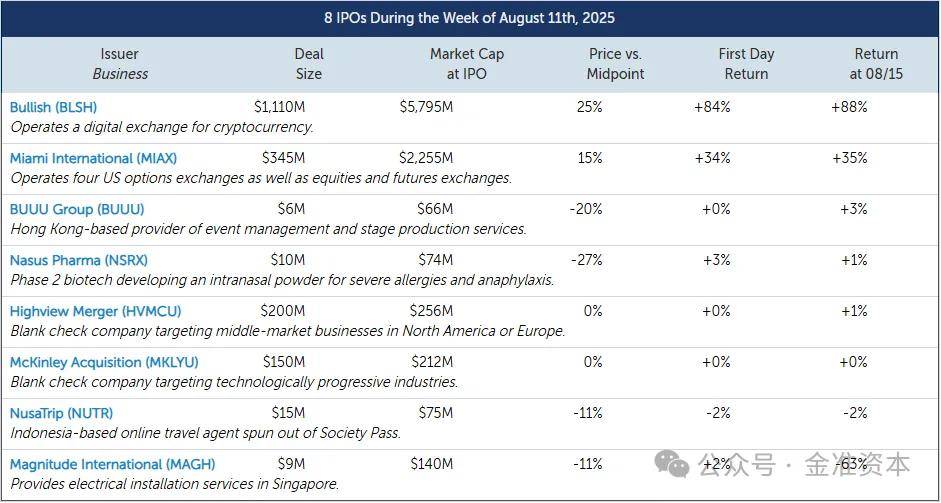
Group 1: Recent IPO Activity - Eight companies went public in the US last week, including two SPACs, with seven IPOs and eight SPACs filing initial applications [1][4] - Bullish, a cryptocurrency exchange, raised $1.1 billion at a valuation of $5.8 billion, with a first-day return of 84% and a closing increase of 88% [1][4] - Miami International Holdings raised $345 million at a valuation of $2.3 billion, with a first-day return of 34% and a closing increase of 35% [1][4] Group 2: Performance of Other IPOs - NusaTrip, an Indonesian online travel agency, raised $15 million at a valuation of $75 million, closing down 2% [2][4] - Nasus Pharma, an Israeli biotech company, raised $10 million at a valuation of $74 million, closing up 1% [2][4] - Magnitude International, a Singapore-based electrical installation company, raised $9 million at a valuation of $140 million, closing down 63% [2][4] Group 3: Upcoming IPOs and Market Outlook - No IPOs are scheduled for the current week, but some smaller issuers may still price [7] - Major issuers like Gemini and Via Transportation have joined the IPO pipeline, with expectations for larger listings after Labor Day [7]


世运会期间 成都入境游出行人次同比提升超三成
Si Chuan Ri Bao· 2025-08-18 05:01
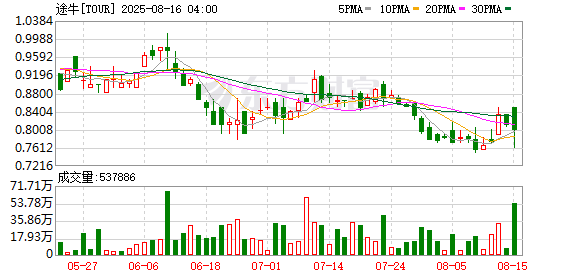
Group 1 - The Chengdu Universiade has significantly boosted inbound tourism in Chengdu, with a 31% year-on-year increase in inbound travel during the event [1] - Major sources of foreign tourists include Thailand, Malaysia, Japan, South Korea, and Singapore, among others [1] - Popular tourist destinations during the Universiade include Chunxi Road, Taikoo Li, and Tianfu Square [1]
没有中间商赚差价,航旅纵横机票价格为何不占优势?| 声动早咖啡
声动活泼· 2025-08-18 04:30
Core Viewpoint - The launch of the official direct sales business by the domestic aviation information service platform, Hanglv Zongheng, has not resulted in lower ticket prices compared to third-party online travel platforms, raising questions about its pricing strategy and market positioning [2][3][4]. Group 1: Overview of Hanglv Zongheng - Hanglv Zongheng, developed by China Civil Aviation Information Group, is supported by major state-owned airlines and covers almost all mainstream domestic airlines, making it a crucial tool for travelers [3][4]. - As of March 2023, Hanglv Zongheng has over 24 million monthly active users, positioning itself as a significant player in the aviation ticketing market [3][4]. Group 2: Pricing Comparison - Despite being a direct sales platform, ticket prices on Hanglv Zongheng are often higher than those on platforms like Ctrip and Qunar, with specific examples showing price discrepancies for flights [3][4]. - The platform's claim of "0 markup, 0 bundling, 0 tricks" is contradicted by the reality of higher prices compared to other online travel agencies (OTAs) [2][3]. Group 3: Sales Models - The ticket sales model is divided into direct sales (by airlines) and distribution (via agents and OTAs), with airlines using dynamic pricing even in direct sales [4][5]. - Airlines typically do not set their direct sales prices as the lowest in the market to maintain relationships with distribution channels, which affects the pricing strategy of Hanglv Zongheng [5][6]. Group 4: OTA Market Dynamics - OTAs like Ctrip and Fliggy have diversified their revenue streams beyond ticket sales, with hotel bookings becoming a primary source of income [6]. - OTAs often subsidize ticket prices through profits from higher-margin services, allowing them to offer more competitive pricing [6][7]. Group 5: Strategic Implications for Airlines - Airlines are focusing on increasing their direct sales to reduce reliance on distribution channels, which can save significant costs [7][8]. - The push for direct sales aligns with government policies aimed at increasing the direct sales ratio among state-owned airlines [7][8]. Group 6: Future Outlook - While Hanglv Zongheng may not currently challenge OTAs, it provides airlines with a new channel to reach customers directly and may develop additional value-added services in the future [8].


途牛2025年第二季度净收入同比增长15.3%
Cai Jing Wang· 2025-08-18 04:07
Core Insights - Tuniu's net revenue increased by 15.3% year-on-year in Q2 2025, with packaged travel product revenue growing by 26.3% [1] - The net profit for Tuniu in the same quarter was 14.1 million yuan [1] Financial Performance - Tuniu's live streaming channel payment and redemption amounts both saw over 50% year-on-year growth [1] - As of the end of June, Tuniu had opened nearly 320 offline stores in key cities across the country [1] Strategic Initiatives - Tuniu's CEO, Yu Dunde, emphasized the company's commitment to strengthening the integration of supply chain, products, and channels [1] - The company aims to leverage its industry chain advantages to create differentiated products that cater to diverse customer needs [1] - Tuniu plans to apply digital technology to more business scenarios to enhance customer experience and operational efficiency [1]

据报Klook已聘请投行协助美国IPO,或筹资5亿美元
Ge Long Hui A P P· 2025-08-18 01:08
格隆汇8月18日|据路透引述消息人士称,软银支持的旅游应用程序Klook(客路)已聘请高盛、大摩及摩 通协助安排在美国IPO事宜,集资约5亿美元,但上市时间及集资规模取决于市场情况。Klook在今年2 月宣布,已在由欧洲投资公司Vitruvian Partners领投新一轮融资中筹集1亿美元,但当时并未揭露公司估 值。 ...
携程发布“智旅未来”计划 助酒店降低流量焦虑
Mei Ri Shang Bao· 2025-08-17 22:18
Core Insights - The Chinese hotel industry is experiencing intensified competition with a projected total of 348,700 establishments and 17.64 million rooms by the end of 2024, surpassing the peak levels of 2018-2019 [1] - Ctrip's "Smart Travel Future" hotel empowerment plan aims to address challenges in language, technology, and traffic, focusing on enhancing service quality to achieve sustainable growth [1] Group 1: Industry Overview - The hotel industry in China is facing increasing competition due to a growing number of establishments and rooms, indicating a saturated market [1] - User decision-making is becoming more rational and diverse, posing challenges for hotels to maintain sustainable growth [1] Group 2: Ctrip's Strategy - Ctrip plans to optimize its review ecosystem to alleviate hotels' traffic concerns, enhancing trust through improved review descriptions and selection mechanisms [1] - The company aims to shift the industry focus from "traffic competition" to "service excellence" by encouraging hotels to prioritize service quality [1] Group 3: User Experience Enhancements - Ctrip is implementing features like intelligent room upgrade recommendations and a "stay first, pay later" payment option to boost user confidence and conversion rates [2] - Personalized recommendations and streamlined filtering options are being introduced to help users quickly find suitable hotels, significantly improving conversion rates for family-oriented packages [2] Group 4: Future Directions - Ctrip intends to continue developing the "Smart Travel Future" plan, collaborating with hotels to overcome challenges in language and technology, aiming for high-quality and sustainable growth [2]
途牛计划回购最多价值1000万美元的美国存托股票
Xin Jing Bao· 2025-08-17 11:21
Group 1 - The company has approved a new stock repurchase plan, intending to buy back up to $10 million worth of American Depositary Shares [1] - In the second quarter of 2025, the company reported net revenue of approximately 135 million yuan, representing a year-on-year increase of 15.32% [1] - The company's net profit for the same period was approximately 14.526 million yuan, showing a year-on-year decrease of 66.24% [1]
途牛第二季度归母净利润同比减少66%
Zheng Quan Ri Bao· 2025-08-16 04:31
Core Viewpoint - Tuniu Corporation reported its Q2 2025 financial results, showing a mixed performance with revenue growth but a significant decline in net profit [2] Financial Performance - Tuniu's net revenue for Q2 was approximately 135 million yuan, representing a year-on-year increase of 15% [2] - The company's net profit attributable to shareholders was about 14.526 million yuan, which reflects a year-on-year decrease of 66% [2] Revenue Breakdown - Revenue from packaged travel products was around 113 million yuan, marking a year-on-year growth of 26% [2] - Other revenue sources amounted to approximately 21.45 million yuan, showing a year-on-year decline of 21% [2] Stock Buyback Plan - The board of Tuniu approved a new stock repurchase plan, intending to buy back up to 10 million USD worth of American Depositary Shares [2]
三大股指期货涨跌不一,凌晨3点特朗普会见普京
Zhi Tong Cai Jing· 2025-08-15 14:49
Market Overview - US stock index futures showed mixed performance with Dow futures up by 0.59% and S&P 500 futures up by 0.12%, while Nasdaq futures declined by 0.05% [1] - European indices had varied results, with Germany's DAX up by 0.09%, UK's FTSE 100 down by 0.11%, France's CAC40 up by 0.58%, and the Euro Stoxx 50 up by 0.27% [2][3] - WTI crude oil prices fell by 0.53% to $63.62 per barrel, and Brent crude oil prices decreased by 0.39% to $66.58 per barrel [3][4] Geopolitical Events - A significant meeting is scheduled between US President Trump and Russian President Putin in Alaska, focusing on the Russia-Ukraine conflict and peace prospects, marking their first in-person meeting in four years [5] Federal Reserve Insights - Federal Reserve Chairman Powell is set to speak at the Jackson Hole conference on August 22, with market expectations leaning towards a potential 25 basis point rate cut due to inflation impacts and a slowing job market [6] - Bank of America strategist Hartnett warns that if the Fed signals a dovish stance at Jackson Hole, US stocks may face a "buy the rumor, sell the news" scenario [7] Hedge Fund Activity - Hedge funds have significantly increased their holdings in technology stocks during Q2, with notable purchases in Microsoft and Netflix, amidst a backdrop of market volatility due to trade policies [8] Economic Concerns - Bank of America raises alarms about the potential for the Fed to lower rates in a rising inflation environment, a scenario not seen in nearly two decades [9] Company Performance - Tuniu (TOUR.US) reported a 15.3% year-over-year revenue increase in Q2, with a new $10 million stock buyback plan announced [10] - New Oxygen (SY.US) experienced a 7.0% decline in Q2 revenue, attributed to a decrease in the number of medical service providers subscribing to its platform [11] - Applied Materials (AMAT.US) provided disappointing Q4 guidance, raising concerns about demand suppression due to US-China trade tensions [12] - Viomi Technology (VIOT.US) anticipates over 70% year-over-year revenue growth for the first half of 2025, driven by strong sales of home water purification devices [12]