买预期卖事实

Search documents
读研报 | 避险资产“失灵”之谜
中泰证券资管· 2026-03-24 11:32
Core Viewpoint - The traditional view of gold as a safe-haven asset has recently failed, with gold prices experiencing significant declines despite rising geopolitical tensions. This shift indicates a change in the pricing logic of gold, moving from risk-driven to interest rate-driven factors [1][2]. Group 1: Changes in Gold Pricing Logic - Recent reports indicate that the pricing logic of gold has shifted due to rising real interest rates and a strengthening US dollar, moving away from geopolitical risk to monetary tightening as the primary driver [1][2]. - The expectation of rising real interest rates has increased the opportunity cost of holding non-yielding assets like gold, leading to its recent price decline [1][2]. Group 2: Impact of Monetary Policy and Market Dynamics - The adjustment in gold prices is closely linked to expectations of tighter monetary policy, particularly in the Americas, where there has been a notable outflow of funds from gold investments [2][4]. - The liquidity situation in the market has also been a significant factor, with reports suggesting that sharp declines in risk assets may trigger liquidity events, forcing traders to sell gold to meet margin calls [4]. Group 3: Long-term Value of Gold - Despite the recent downturn, multiple reports still recognize the long-term investment value of gold, suggesting that the upward price logic for gold remains intact [8]. - The current market confusion is attributed to the interplay between two pricing logics: one based on the stability of the US dollar and the other on concerns about its creditworthiness, which could support gold prices in the long run [8][9].


美联储降息后,你的钱正在经历这四种变化,普通人理财的转折点已经到来
Sou Hu Cai Jing· 2025-11-01 18:28
Group 1 - The Federal Reserve announced a 25 basis point interest rate cut, marking the first reduction since December 2024, shifting U.S. monetary policy towards easing [1] - Following the rate cut, global markets reacted with U.S. stocks initially declining before rising, gold prices fluctuating, and the Chinese yuan strengthening [1][3] - A-share semiconductor and communication equipment sectors rose against the trend, while gold-related stocks generally fell [3] Group 2 - Historical data shows that during preventive rate cut cycles, A-share technology and core consumer assets perform well, with U.S. tech stocks rising nearly 30% within six months after the 2019 rate cut [3] - The rate cut is expected to lower corporate financing costs, boosting profit expectations, particularly benefiting capital-intensive sectors like semiconductors and artificial intelligence [3] - However, bank stocks may face pressure due to narrowing interest margins [3] Group 3 - Gold prices initially surged to a historical high of $3,700 per ounce before retreating to around $3,650 after the rate cut, reflecting a "buy the rumor, sell the news" phenomenon [3] - Long-term trends indicate that gold typically performs well during rate cut cycles, with an average increase of over 5% in the six months following the first cut since 1990 [3][5] - Deutsche Bank raised its 2026 gold price forecast to $4,000 per ounce, citing strong central bank demand and expectations of a weaker dollar [5] Group 4 - The bond market reacted inversely to the rate cut, with new bond yields decreasing, making existing high-yield bonds more attractive [5] - The U.S. 10-year Treasury yield fell from 4.3% to 4.0% before the cut, leading to a price increase, but some investors took profits post-announcement, causing a slight price correction [5] - The rate cut reduced the interest rate differential between China and the U.S., alleviating depreciation pressure on the yuan, which appreciated from 7.15 to around 7.12 against the dollar [5] Group 5 - The yuan's movement is not unidirectional; if the People's Bank of China cuts rates or if the U.S. economy performs unexpectedly well, the yuan may come under renewed pressure [7] - While a stronger yuan benefits imports, it may weaken the competitiveness of export goods, prompting foreign trade companies to use hedging tools to mitigate risks [7] - The Fed's rate cut acts as a catalyst for broader market reactions, influencing asset allocation for ordinary individuals [7]

国际黄金亚盘震荡偏强 机构看涨预期升温
Jin Tou Wang· 2025-10-31 03:17
Core Viewpoint - The global gold market is experiencing increased bullish sentiment, with institutions adjusting their price forecasts significantly upward due to geopolitical uncertainties and inflation concerns [2]. Group 1: Gold Price Trends - As of October 31, international gold is trading around $4017.70 per ounce, with a slight decline of 0.17% from a peak of $4044.48 [1]. - Wells Fargo Investment Institute has raised its gold price target for the end of 2026 to a range of $4500-$4700, up from the previous $3900-$4100 range [2]. - The current market shows a strong demand for gold from both central banks and private investors, driven by concerns over inflation and currency devaluation [2]. Group 2: Market Dynamics - The U.S. dollar index rose by 0.38% to close at 99.51, reaching a high of 99.72, the highest level since August 1 [3]. - Typically, a stronger dollar exerts downward pressure on gold prices; however, strong safe-haven buying has mitigated this effect, indicating heightened market sensitivity to uncertainty [3]. - Recent technical analysis suggests that gold prices may rebound after reaching support near the 10-week moving average, with potential entry points identified near the middle band of the Bollinger Bands if further declines occur [4].
【南篱/黄金】老鲍反鹰,黄金五浪运行中
Sou Hu Cai Jing· 2025-10-30 08:45
Core Viewpoint - The market is reacting to the uncertainty surrounding the Federal Reserve's interest rate decisions, particularly the potential for a rate cut in December, which is now seen as less certain [5][6]. Group 1: Federal Reserve Insights - The Federal Reserve's independence is emphasized, indicating that it will not rush into rate cuts, especially if the government remains in a state of shutdown [5]. - Market sentiment has shifted, with reduced confidence in a December rate cut, reflecting a more hawkish stance from the Fed [5][6]. Group 2: Market Reactions - The gold market has shown signs of adjustment, with a recent long upper shadow indicating potential bearish momentum, and key price levels to watch are 4030 and 3886 [6][8]. - A shift in market positioning is noted, with a balanced ratio of long and short positions emerging, suggesting a transition into a consolidation phase after a significant decline [8]. Group 3: Technical Analysis - Technical patterns in gold suggest a complex wave structure, with the potential for further price movements depending on the formation of new lows or resistance levels [10]. - Silver's market dynamics are also under scrutiny, with a need for strong momentum to initiate a rebound in gold prices [10].

美联储10月30日降息是大概率事件,对资本市场影响几何?|国际
清华金融评论· 2025-10-29 10:11
Group 1 - The core viewpoint of the article is that the Federal Reserve is likely to cut interest rates by 25 basis points at the end of October, which is seen as a preventive measure to improve liquidity in the tech sector, although caution is advised regarding potential profit-taking due to "buy the expectation, sell the fact" behavior [1][2]. - The expected interest rate cut will bring the rate range down to 3.75% - 4.00%, with a total reduction of 75 basis points anticipated for the year [2]. - Four main reasons for the Fed's decision to cut rates include: a relatively weak job market with increased layoffs, easing inflation pressures as core CPI continues to decline, weakening economic momentum with a predicted -1.8% growth rate for Q3, and a temporary easing of geopolitical tensions, particularly in US-China relations [3]. Group 2 - The impact of the Fed's rate cut on the US capital markets includes short-term volatility in the stock market, but mid-term support for tech stocks due to improved liquidity, while value stocks in financial and industrial sectors are expected to show resilience [5]. - The 10-year US Treasury yield is projected to fall below 4.0%, with short-term rates being more certain, while long-term rates face limited downward space due to European fiscal expansion and expectations of Japanese rate hikes [6]. - In the foreign exchange market, the US dollar is under pressure, benefiting non-US currencies, with the dollar index potentially dropping below 98, and the Chinese yuan expected to appreciate [7]. Group 3 - The Chinese market is expected to benefit from the Fed's rate cut, particularly in sectors like AI computing and semiconductors, with foreign capital inflows and liquidity easing [9]. - The yuan's exchange rate is likely to stabilize and rise due to a weaker dollar and narrowing US-China interest rate differentials, increasing foreign investment interest in yuan-denominated assets [9]. - Market participants are advised to closely monitor the Fed's rate decision and Powell's statements regarding December's policy for potential trading insights [9].

黄金价格还能继续飙升?三大核心支撑解密未来走势
Sou Hu Cai Jing· 2025-10-06 15:46
Core Insights - The recent surge in gold prices has been unprecedented, with prices rising from $2100 to $2400 per ounce in just over a month, marking a 44% increase from November 2022 to May 2024, despite the Federal Reserve's interest rate hikes [3][5] Group 1: Drivers of Gold Price Surge - Geopolitical tensions, including the ongoing Russia-Ukraine conflict and unrest in the Middle East, have heightened demand for gold as a safe-haven asset, leading to a significant increase in gold ETF holdings during risk events [5][7] - Market expectations of a shift in monetary policy, with predictions of at least two interest rate cuts by the Federal Reserve this year, have reduced the opportunity cost of holding gold, historically correlating with a rise in gold prices as the dollar index declines [5][7] - Central banks globally, including the People's Bank of China, have been increasing their gold reserves, with a record purchase of 1136 tons in the previous year, indicating a strategic move to counteract the weakening dollar system [7] Group 2: Risks and Considerations - Despite the bullish trend, there are risks associated with potential economic recovery in the U.S. that could delay interest rate cuts, leading to a sharp decline in gold prices, reminiscent of past market reactions to hawkish Federal Reserve statements [8] - Investors are advised to adopt a phased investment strategy rather than attempting to time the market perfectly, with a recommendation to limit gold holdings to no more than 15% of the total investment portfolio [9] - For current investors, setting profit-taking levels around $2300 per ounce is suggested, as gold serves as both a speculative asset in the short term and a stable investment in the long term [9]
0922:金价再创历史新高,存储芯片表现活跃!
Sou Hu Cai Jing· 2025-09-22 15:37
Core Viewpoint - The article discusses the recent developments in gold prices, the Federal Reserve's interest rate decisions, and the economic forecasts, highlighting the potential for gold prices to reach new highs amid geopolitical tensions and central bank buying activity [2][6][12]. Group 1: Gold Market Insights - Gold prices have shown volatility, dropping from $3707 to $3627 after the Federal Reserve's interest rate cut, indicating a classic "buy the rumor, sell the news" market behavior [8][10]. - The World Gold Council's survey indicates that more central banks are expected to join the gold buying trend by 2025, although smaller nations may face limitations due to foreign reserve constraints [10]. - Recent geopolitical tensions and the potential for a U.S. government shutdown are contributing to ongoing support for gold prices, which reached a record high of $3728.50 per ounce before experiencing a slight pullback [12]. Group 2: Federal Reserve Economic Forecasts - The Federal Reserve has revised its economic growth forecasts upward, with projected GDP growth rates of 1.61% for 2025 and 1.8% for 2026, compared to previous estimates [7]. - The unemployment rate forecasts have been adjusted downward for 2026 and 2027, now expected to be 4.4% and 4.34% respectively [7]. - The Fed has also increased its inflation expectations for 2026, with the PCE inflation rate now projected at 2.6% [7].

美联储降息如期而至,国际金价却大幅下跌,市场风向要变?
Hua Xia Shi Bao· 2025-09-20 14:44
Core Viewpoint - The international gold market has experienced significant fluctuations, with gold prices reaching historical highs before a sharp decline following the Federal Reserve's interest rate cut, indicating a classic "buy the rumor, sell the news" scenario [1][2]. Group 1: Federal Reserve's Actions and Market Reactions - The Federal Reserve announced a 25 basis point rate cut, which was already anticipated by the market, leading to a sell-off in gold as traders took profits [1][2]. - Prior to the rate cut, gold prices surged from $3,350 to $3,744 per ounce, reflecting excessive market trading on the expectation of multiple rate cuts [2]. - Fed Chairman Jerome Powell's cautious statements post-meeting indicated that the rate cut was a risk management measure rather than the start of a sustained easing cycle, contributing to the decline in gold prices [2][3]. Group 2: Economic Indicators and Predictions - The U.S. non-farm payrolls data showed a significant drop in job growth, with only 22,000 jobs added in August, far below expectations, which influenced the Fed's decision to cut rates [4]. - Despite the weak employment data, inflation remains resilient, with the Consumer Price Index (CPI) rising 2.9% year-on-year, suggesting that the economic context differs from previous years [4]. - Analysts predict that the Fed may implement two more rate cuts by the end of the year, each by 25 basis points, which could support gold prices [5]. Group 3: Market Sentiment and Future Outlook - Market sentiment has shifted, with some analysts warning of potential short-term profit-taking in the stock market following the Fed's rate cut, which could lead to increased interest in gold as a safe-haven asset [6]. - Geopolitical risks, including the ongoing Russia-Ukraine conflict and Middle East tensions, have heightened investor demand for gold, although the primary driver for gold's price movement remains monetary policy expectations [7]. - Long-term, concerns about U.S. dollar credibility and the expansion of U.S. debt could provide upward momentum for gold prices, despite short-term fluctuations [8].
美联储降息如期而至,国际金价却大幅下跌,市场风向要变?|大宗风云
Hua Xia Shi Bao· 2025-09-20 02:26
Core Viewpoint - The international gold market has experienced significant fluctuations recently, with gold prices reaching historical highs before a sharp decline following the Federal Reserve's interest rate cut [2][3]. Group 1: Gold Price Movements - On September 18, the COMEX gold futures contract peaked at $3744 per ounce, marking a historical high since its listing, but subsequently fell by $39.6 to close at $3678 per ounce [2]. - As of September 19, COMEX gold was reported at $3677 per ounce, indicating a notable drop after the initial surge [2]. - The market had already priced in the expectation of a rate cut before the Federal Reserve's announcement, leading to a classic "buy the rumor, sell the news" scenario [3]. Group 2: Federal Reserve's Rate Cut Impact - The Federal Reserve's decision to cut rates by 25 basis points was perceived as a risk management move rather than the start of a sustained easing cycle, which contributed to profit-taking among gold bulls [2][3]. - Market expectations had previously anticipated two rate cuts by the end of the year, but the actual cut was less than expected, leading to a sharp decline in gold prices [3][4]. - The cautious tone of Fed Chair Jerome Powell, emphasizing the uncertainty of future rate cuts, did not provide a strong signal for further easing, causing market doubts about the rate cut trajectory [3][4]. Group 3: Economic Indicators and Future Expectations - Recent U.S. non-farm payroll data showed a significant drop, with only 22,000 jobs added in August, far below expectations, which raised concerns about the economy [5]. - Despite the weak employment data, inflation remains resilient, with the core PCE inflation rate still above the 2% target, indicating that the economy may not require aggressive rate cuts [5][6]. - The next Federal Reserve meeting is scheduled for October 28, with expectations of two more rate cuts this year, each by 25 basis points, which could support gold prices [6][7]. Group 4: Market Sentiment and Geopolitical Factors - Wall Street's outlook on gold has shifted, with some analysts warning of potential market corrections following the Fed's rate cut, as the market had already priced in the easing [7][8]. - Geopolitical risks, including the ongoing Russia-Ukraine conflict and Middle East tensions, have heightened investor demand for safe-haven assets like gold [8][9]. - Long-term factors driving gold prices include concerns over U.S. dollar credibility and the sustainability of U.S. fiscal policies, which may provide upward momentum for gold [9].
美指美债起,黄金落
Sou Hu Cai Jing· 2025-09-19 08:58
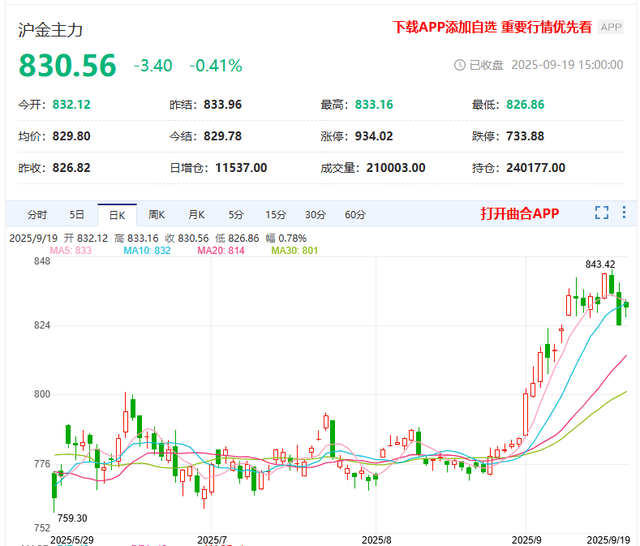
Group 1 - The US Treasury yields have collectively risen, with the 10-year yield increasing by 3.2 basis points to 4.108%, marking the first consecutive rise since early September and achieving the largest two-day gain in a month [1] - The 30-year yield also rose by 5 basis points to 4.724% [1] - The US dollar index continued its rebound, increasing by 0.4% to 97.347, after initially dropping to a new low of 96.22 since February 2022 following the Federal Reserve's decision [1] Group 2 - The rebound in the US dollar index and Treasury yields has suppressed gold prices, leading to a decline in gold prices, with Shanghai gold closing down 0.41% at 830.56 yuan per gram [2] - According to Guangfa Futures, the market interpreted the Federal Reserve's interest rate decision as neutral, and with the dollar index recovering, there are signs of overbought conditions in precious metals after rapid price increases since September [4] - The outlook suggests that with increasing risks in the US labor market, the dual characteristics of "expectation reinforcement - independence undermined" in the Federal Reserve's policy path will continue to suppress the dollar index and Treasury yields, while geopolitical tensions in Europe and the US will increase institutional demand for gold as a safe haven [4]