基金

Search documents
首批商业不动产REITs上报 拟募资超300亿
Bei Jing Shang Bao· 2026-02-01 15:55
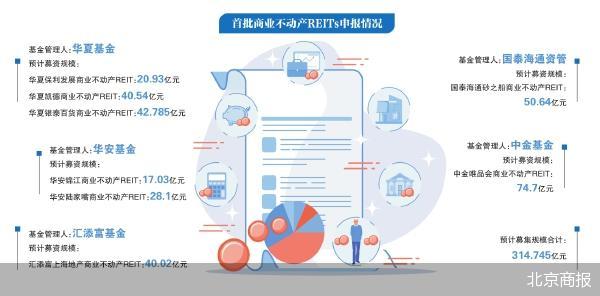
北京商报讯(记者 李海媛)在商业不动产投资信托基金(REITs)试点政策落地后,首批产品陆续上 报。北京商报记者注意到,近日,上交所受理8单商业不动产REITs项目,基金管理人包括国泰海通资 管、华夏基金、汇添富基金、华安基金,预计募集金额合计超300亿元。首批项目的资产形态包括商业 综合体、商业零售、商业办公楼等商业不动产。有观点指出,商业不动产REITs的推出对盘活存量资产 具有较好的导向,对于商业地产的开发商而言也意味着更好的融资渠道的建立。 1月29日—30日,首批8单商业不动产REITs项目获上交所受理。其中,华夏基金申报了3单,华安基金 申报了2单,汇添富基金、中金基金和国泰海通资管则各申报了1单。项目资产形态包括商业综合体、商 业零售、商业办公楼等商业不动产。 其中,华夏保利发展商业不动产REIT、华夏凯德商业不动产REIT、华夏银泰百货商业不动产REIT的预 计募集规模依次为20.93亿元、40.54亿元、42.785亿元;华安锦江商业不动产REIT、华安陆家嘴商业不 动产REIT预计募集规模分别为17.03亿元、28.1亿元;汇添富上海地产商业不动产REIT、国泰海通砂之 船商业不动产REI ...

基金市场跟踪与 ETF 策略配置月报-20260201
Xiangcai Securities· 2026-02-01 15:38
1. Report Industry Investment Rating No relevant information provided. 2. Core Viewpoints of the Report - As of January 31, 2026, the total number of funds in the market increased by 104 to 13,722, while the total net asset value decreased by 452.4 billion yuan to 37.22 trillion yuan. Growth - type funds outperformed value - type funds in January 2026 [3][7]. - As of January 31, 2026, there were 1,430 ETFs in the Shanghai and Shenzhen stock markets, an increase of 28 from the previous period. The total asset management scale decreased by 555.748 billion yuan to 5.46 trillion yuan, and the total share decreased by 92.652 billion shares to 3.28 trillion shares. Commodity - type ETFs had a higher overall return in January, while bond - type ETFs had the worst performance [4][18]. - The industry ETF rotation strategy based on main funds and the PB - ROE framework both achieved positive excess returns compared to the CSI 300 Index in January 2026 and since 2023 [5][40][50]. 3. Summary According to Relevant Catalogs 3.1 Fund Market Tracking 3.1.1 Market Overview - As of January 31, 2026, the number of funds increased by 104, and the total net asset value decreased by 452.4 billion yuan. Hybrid, bond, and stock - type funds had the highest proportion in terms of quantity, while money - market, bond, and stock - type funds had the highest proportion in terms of scale [7]. - In January 2026, the number of stock - type funds increased by 49, and the scale of stock - type and bond - type funds decreased by 552.001 billion yuan and 88.818 billion yuan respectively [11]. 3.1.2 Fund Performance - From January 1 to 31, 2026, the returns of value, balanced, and growth fund indexes were 3.92%, 6.10%, and 7.02% respectively, all outperforming the CSI 300 Index. Growth - type funds outperformed value - type funds [13]. - The differences among large - cap, mid - cap, and small - cap fund indexes were small in January 2026, with mid - cap funds slightly outperforming large - cap and small - cap funds, and all outperforming the CSI 300 Index [13]. - The median return of all funds in January 2026 was 2.53%, and 94.84% of funds achieved positive returns. The top - performing fund was SDIC UBS Silver Futures A, with a gain of 61.60% in both January and year - to - date [16]. 3.2 ETF Market Tracking 3.2.1 ETF New Products - In January 2026, 33 ETFs were newly listed, including 3 science - and - technology innovation board chip ETFs and 30 other stock - type ETFs. 27 ETFs were newly established, with a total issuance scale of 16.57 billion yuan [20]. 3.2.2 ETF Product Classification Performance - Commodity - type ETFs had a median return of 18.61% in January, bond - type ETFs had the lowest median return of 0.25%, and stock - type ETFs had a median return of 4.74%, outperforming cross - border ETFs. Stock - type ETFs had the highest internal deviation in January [4][24]. - Among stock - type ETFs in January, gold - related and mining ETFs performed well, while bank - related ETFs performed poorly. The average share change of stock - type ETFs was a decrease of 108.9666 million shares, with chemical and software ETFs having significant share increases and CSI 300 and SSE 50 ETFs having significant share decreases [25]. - Among bond - type ETFs in January, the convertible bond ETF had the highest increase of 5.90%, and the science - innovation bond ETF had a decrease of 0.01%. As of January 31, 2026, the Haifutong CSI Short - Term Financing ETF had the largest scale of 70.223 billion yuan [29]. - Among cross - border ETFs in January, the China - South Korea Semiconductor ETF had the highest increase of 45.09%, and the Hong Kong Stock Connect Medical ETF had the highest decrease of 4.20%. The year - to - date performance was similar [31]. - Among commodity - type ETFs in January, the gold ETF had an increase of 19.11%, and the soybean meal ETF had the smallest increase of 1.69%. As of January 31, 2026, the Huaan Gold ETF had the largest scale of 93.985 billion yuan [35]. 3.3 ETF Strategy Tracking 3.3.1 Industry ETF Rotation Based on Main Funds - The strategy focused on non - ferrous metals, non - banking finance, and steel in January 2026. The cumulative return in January 2026 was 9.01%, with an excess return of 7.36% compared to the CSI 300 Index. Since 2023, the cumulative return was 61.84%, with an excess return of 40.28% compared to the CSI 300 Index [5][40][42]. 3.3.2 Industry ETF Rotation under the PB - ROE Framework - The strategy focused on communication, agriculture, forestry, animal husbandry, and fishery, and transportation in January 2026. The cumulative return in January 2026 was 2.83%, with an excess return of 1.18% compared to the CSI 300 Index. Since 2023, the cumulative return was 29.03%, with an excess return of 7.47% compared to the CSI 300 Index [5][50][51]. 3.4 Investment Recommendations - For the industry preference of main funds in February 2026, the steel, coal, and non - ferrous metal industries are favored, and the corresponding ETFs are their industry ETFs. - Based on the industry PB - ROE situation and supplementary indicators, the ETF rotation strategy under the PB - ROE framework recommends paying attention to the non - ferrous metal, transportation, and public utilities industries in February, and the corresponding ETFs are their industry ETFs [6][57].
路博迈基金:转型金融的“中国样本”
Guo Ji Jin Rong Bao· 2026-02-01 15:34
Core Viewpoint - The article highlights the need for financial support for high-carbon industries undergoing low-carbon transformation, as existing green finance tools primarily focus on "pure green" projects like solar energy and electric vehicles. The estimated investment demand for China's high-carbon industries by 2060 is projected to reach 139 trillion yuan [1][3]. Group 1: Green Finance Development - China's green finance is transitioning from a "policy-driven" to a "market-driven" model, with a rapid expansion of tools like green credit and green bonds, placing it among the top globally in terms of scale [2]. - The introduction of the "CFETS 0-5 Year Climate Change High-Grade Bond Composite Index" represents a significant innovation in the domestic market, aiming to fill the gap in financing for high-carbon industries [4][5]. Group 2: Transformation Finance - Transformation finance is emerging to support the low-carbon transition of high-carbon industries, addressing the limitations of traditional green finance that lacks effective incentives and oversight mechanisms [3][5]. - The new index is designed to assess not only current carbon emissions but also future climate goals and the effectiveness of corporate governance, providing a comprehensive evaluation of companies' willingness and capability to transition [7]. Group 3: Collaborative Efforts - The collaboration between the three institutions—Loomis Sayles, China Foreign Exchange Trade System, and Shanghai Pudong Development Bank—has resulted in the first domestic climate change-themed bond index, showcasing a successful integration of international experience with local practices [4][8]. - The project has received positive market feedback, with funds linked to the index performing well and gaining recognition from investors and partners [8]. Group 4: Future of Green Finance - The future of green finance in China is expected to be more refined, with a focus on decentralized projects and innovative financial products that directly link to carbon reduction [12]. - The development of green financial products will require continuous efforts from various participants to demonstrate sustainability through traceable investment performance and solid investment capabilities [12].

最牛石油股1个月飙涨133%
2 1 Shi Ji Jing Ji Bao Dao· 2026-02-01 15:06
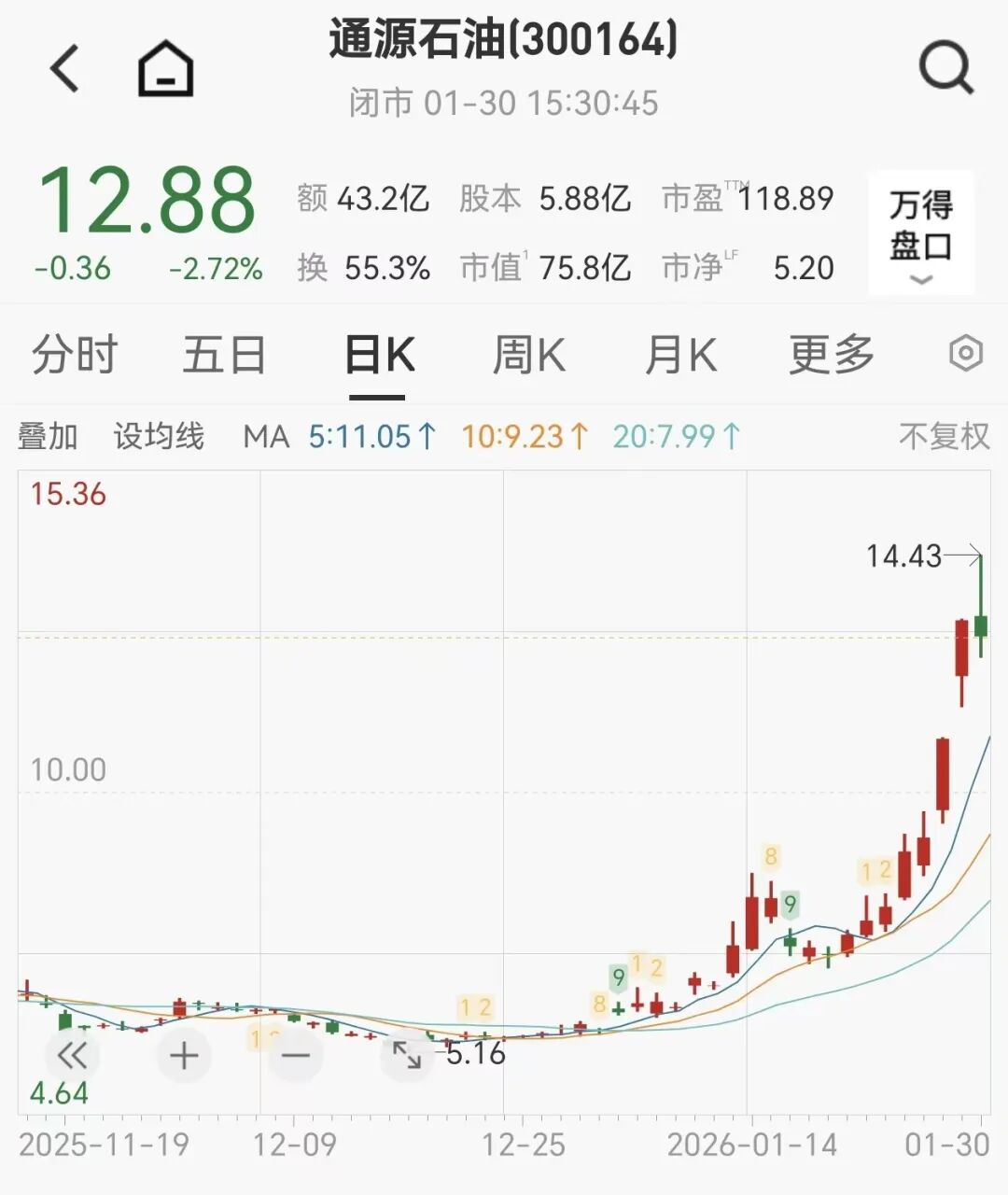
Group 1 - Geopolitical factors have driven up oil prices, leading to a strong increase in oil funds and related stocks [1] - The stock of Tongyuan Petroleum (300164.SZ) has surged over 63% in a week, making it the top-performing stock, with a year-to-date increase of over 133% [2] - The oil and gas industry has seen significant price movements, with the oil service sector rising nearly 15% in a week, driven by geopolitical tensions and cold weather [5] Group 2 - E Fund Management announced that its crude oil LOF fund's market price significantly exceeded its net asset value, prompting a warning about premium risks [3] - Several oil funds, including those managed by GF Fund Management and Huaxia Fund Management, have also reported substantial premiums in their market prices, leading to temporary trading suspensions [3] - Tongyuan Petroleum reported abnormal stock price fluctuations, with a cumulative increase of over 30% in three trading days, and emphasized that there was no violation of information disclosure [5]

最牛石油股1个月飙涨133%
21世纪经济报道· 2026-02-01 15:04
Core Viewpoint - Geopolitical factors have driven up oil prices, leading to a strong rise in oil funds and related stocks [1] Group 1: Oil Funds and Market Reactions - Four oil funds have collectively warned about premium risks, indicating that investors may face significant losses if they buy at high premiums [1] - The E Fund's crude oil LOF fund (code: 161129) showed a significant premium, with a net asset value of 1.1514 yuan on January 28, 2026, while the market closing price was 1.340 yuan [4] - Other funds, including those managed by GF Fund, Huaan Fund, and Harvest Fund, also reported substantial premiums and announced temporary suspensions of trading to alert investors [4] Group 2: Stock Performance - Tongyuan Petroleum (300164.SZ) emerged as the top-performing stock, achieving a weekly increase of over 63% and doubling its price since the beginning of the year, with a cumulative rise of over 133% [3] - The stock experienced abnormal trading fluctuations, with a cumulative price deviation exceeding 30% over three consecutive trading days [6] - The oil and gas extraction industry is closely linked to international crude oil prices and capital expenditures, with geopolitical tensions in regions like Venezuela and Iran contributing to supply risk concerns [6] Group 3: Industry Trends - The oil and petrochemical sector saw a nearly 8% increase in a week, with oil service engineering rising nearly 15% [6] - Recent reports indicate a significant increase in market sentiment towards oil, driven by geopolitical and macroeconomic factors, although no substantial fundamental improvements have been observed [6]

多只LOF,明日停牌1小时!套利热潮藏隐忧
Zhong Guo Zheng Quan Bao· 2026-02-01 14:40
Core Viewpoint - The recent surge in LOF (Listed Open-Ended Fund) products has attracted significant attention from investors, with 16 LOFs experiencing a rare collective price surge, leading to a heightened interest in arbitrage opportunities [1][2]. Group 1: LOF Market Dynamics - The LOF arbitrage trend was ignited by the popularity of the Guotou Silver LOF, which saw its price soar due to its unique focus on silver futures, achieving a premium rate exceeding 60% [2]. - Following the suspension of subscriptions for Guotou Silver LOF, oil-related LOFs gained traction, with several experiencing price increases and premium rates surpassing 20% due to rising international oil prices [2]. Group 2: Investor Behavior and Sentiment - Many investors, like Xiao Lin, have reported significant gains from LOF arbitrage, with some achieving returns of 100% within a month, reflecting a widespread belief in the profitability of these investments [3]. - The allure of easy profits has led to a surge in interest, with social media influencers providing detailed guides on how to engage in LOF arbitrage, further fueling the trend [2]. Group 3: Risks and Challenges - LOF arbitrage is not without risks; the time lag in transactions (T+2 for LOFs and T+3 for cross-border products) can lead to potential losses if market conditions change during the waiting period [4]. - Liquidity risks are significant, as some LOF products have low trading volumes, which can result in sudden price drops and difficulties in selling during market downturns [4]. - There is a concern that some LOFs are experiencing price increases without underlying asset support, leading to irrational premiums that could result in losses for investors who chase high premiums without due diligence [4].
德邦基金“大V”违规带货被罚,流量狂欢难掩合规缺失
Xin Lang Cai Jing· 2026-02-01 14:19
Core Viewpoint - The rapid growth of the Debon Fund's AI application-themed fund has attracted significant market attention, leading to regulatory scrutiny due to alleged violations in marketing practices [1][2][5]. Group 1: Fund Performance and Growth - The Debon Stable Growth Flexible Allocation Mixed Fund's scale increased from below 200 million yuan to 1.027 billion yuan by the end of 2025, with a sudden rumor of a single-day inflow exceeding 12 billion yuan [1][6]. - The fund has shown impressive short-term performance, with returns of 31.35% over the past month and 35.3% over the past three months, significantly outperforming the CSI 300 index [8][26]. - As of January 30, the fund's one-year, two-year, and three-year returns were 28.05%, 72.18%, and 10.15%, respectively, placing it in the mid-range among similar products [24][26]. Group 2: Regulatory Issues - The China Securities Regulatory Commission (CSRC) issued a regulatory notice indicating that Debon Fund engaged in marketing practices with unqualified internet influencers, leading to a suspension of public fund product registration [1][20]. - The fund's marketing strategy involved paying large advertising fees to internet influencers, which was deemed a violation of regulations regarding investor risk disclosure and suitability management [20][23]. - The CSRC's actions highlight deficiencies in Debon Fund's internal control mechanisms, prompting a call for accountability among senior management [5][23]. Group 3: Market Dynamics and Strategy - The fund's significant holdings in AI application stocks contributed to its rapid net value increase, with top ten holdings accounting for 68.29% of the portfolio [10][29]. - The fund's strategy allows for flexible asset allocation, adjusting stock positions based on market conditions, which is crucial for managing risk and capitalizing on market opportunities [35]. - The recent surge in fund inflows led to two rounds of purchase restrictions to mitigate potential dilution of returns, reflecting a strategy to protect existing investors' interests [34][36].
【财富周刊】多家银行再度抬高积存金准入门槛,多只LOF基金暂停大额申购
Xin Lang Cai Jing· 2026-02-01 13:49
多家银行再度提高积存金准入门槛 随着金价不断上涨创出新高,继去年多家银行上调积存金的购买门槛后,2026年年初至今,又有工商银 行、农业银行等国有大行相继发布公告,进一步收紧积存金业务准入条件。 2月1日傍晚,白银基金——国投白银LOF发布公告宣布复牌。 公告称,国投白银LOF基金将于2026年2月2日开市起至当日10:30停牌,自2026年2月2日10:30复牌,复 牌后的交易按照《深圳证券交易所交易规则》的相关规定执行,价格涨跌幅限制比例为10%。 宽基ETF连续两周规模缩小 本周大资金继续撤退,宽基ETF规模再度缩水超4000亿元,全市场ETF总规模也跌至5.46万亿元。数量 方面,Wind数据显示,截至1月31日,本周新增7只ETF,其中股票型ETF达5只,剩余2只为跨境ETF; 至此,上市ETF总数量达1419只。 多只LOF基金暂停大额申购 1月30日晚间,包括黄金、原油等多只大宗商品类LOF公告大额限购,个别产品申购上限甚至低至单日2 元。有业内人士分析称,市场大跌时,相关基金可能因其主题或策略成为焦点,涌入大量短期抄底或投 机资金,而相关基金底层资产投入的是额度有限的QDII产品,难以新增投资 ...
每日钉一下(消费行业,为啥这轮牛市中表现比较低迷?)
银行螺丝钉· 2026-02-01 13:40
Group 1 - The core concept of fund advisory is to address the issue where funds make profits, but investors do not [4] - Fund advisory services are designed to help investors achieve better returns through professional guidance [5] - The consumption sector has shown relatively low performance in the current bull market compared to its historical returns [10][12] Group 2 - The consumption industry has experienced a decline in valuation since 2021, leading to a correction in overvalued stocks [12] - The fundamental performance of the consumption sector has been weak, contributing to its underperformance against the market [15] - The consumption sector is currently in a low fundamental cycle, similar to the technology sector two years ago, and is expected to recover once earnings improve [15]

[2月1日]美股指数估值数据(黄金白银大跌,原因为何?)
银行螺丝钉· 2026-02-01 13:40
Core Viewpoint - The article discusses the recent trends in global stock markets, highlighting fluctuations in various indices and the impact of liquidity changes on asset valuations. Group 1: Global Market Trends - This week, global stock markets experienced slight increases with minimal volatility [1] - U.S. stocks showed mixed performance with minor fluctuations [2] - Non-U.S. global stock indices also saw slight increases [3] - The Hong Kong stock market was notably strong, with the Hang Seng Index rising by 2.3%, leading global gains [5] - The majority of the global stock market gains occurred from Monday to Thursday, while Friday saw significant volatility [6][7] - On Friday evening, global stock indices fell by 0.87% [8] Group 2: Commodity Market Volatility - The commodity market experienced substantial fluctuations, with gold prices dropping by 9.25% [10] - Silver prices fell by 26%, with an intraday drop of 35%, marking the largest single-day decline in the past two to three decades [11] - The volatility in silver is attributed to two main factors: prior short-term surges leading to high valuations and market concerns over potential changes in Federal Reserve policies following Trump's nomination of a hawkish Fed chair [12][18] Group 3: Small Asset Rally - Over the past two years, there has been a "small asset frenzy" in global markets, with A-shares and small-cap stocks leading the gains [21] - Many small-cap stocks in countries like South Korea, Japan, Brazil, and Spain have also seen significant increases [22] - The primary driver of this trend is the anticipated interest rate cuts by the Federal Reserve starting in September 2024, leading to increased liquidity in the market [24][25] Group 4: Market Valuation Insights - The article references Warren Buffett's perspective on liquidity cycles, indicating that during a rate-cutting phase, high valuations may present profit-taking opportunities, while tightening phases may reveal undervalued assets [30][31] - Historical data shows that after significant rate hikes by the Fed in 2021-2022, A-shares and Hong Kong stocks fell to lower valuation levels [32] - Current market concerns are primarily driven by news, but a rebound in some assets is expected once fear subsides [34] Group 5: Global Stock Index Evaluation - The article presents a star rating system for global stock indices, indicating that the market is currently not very cheap, with a star rating around 2.8 [37] - The star rating system categorizes 4-5 stars as relatively low valuation, while 1-2 stars indicate higher valuations [38] Group 6: Investment Opportunities - The article discusses the availability of global stock index funds in overseas markets, which total over a trillion dollars, but notes the lack of such funds in mainland China [40] - The company has introduced a "Global Index Advisory Portfolio" that diversifies investments across multiple stock markets [41] - There are limitations on investment amounts for mainland investors, with a maximum daily purchase of 50 yuan [43] Group 7: New Publication - The company has released a new book titled "Dividend Index Fund Investment Guide," which quickly became a bestseller on platforms like JD.com [46] - The book aims to address common investor questions regarding dividend products and is designed for easy understanding [47]