
半导体存储

Search documents
大普微(301666):领先的本土企业级SSD供应商
Shenwan Hongyuan Securities· 2026-03-27 11:28
Investment Rating - The report assigns a rating of "Neutral" to the company based on its AHP score of 3.26, which places it in the 44.6% percentile of the non-technology innovation system AHP model [6][7]. Core Insights - The company, Dapu Micro, is the first unprofitable IPO on the ChiNext board, with a 40% lock-up ratio for offline investors. The AHP score, adjusted for liquidity premium, is 3.26, indicating a competitive position in the market [2][6]. - Dapu Micro has a complete self-research capability in enterprise-level SSDs, with a product matrix covering PCIe 3.0 to 5.0, and is among the first to mass-produce PCIe 5.0 SSDs. The company has significantly increased its overseas revenue share from 8.11% in 2022 to 35.13% in the first half of 2025 [2][10]. - The company is expected to turn profitable in 2026, driven by domestic substitution and AI demand, with a projected global enterprise SSD market size of $51.42 billion by 2027, growing at a CAGR of 20.25% from 2022 [11][12]. Summary by Sections AHP Score and Expected Allocation Ratio - Dapu Micro's AHP score is 3.26, ranking in the 44.6% percentile, with expected allocation ratios for offline investors at 0.0206% for Class A and 0.0179% for Class B under neutral conditions [6][7]. Company Fundamentals and Highlights - Dapu Micro is a leading provider of enterprise-level SSDs with a complete self-research capability, achieving significant market share among domestic competitors from 2022 to 2024 [2][8]. - The company has successfully expanded its overseas customer base, including major clients like ByteDance and Google, and has a strong pipeline for future growth in AI applications [10][11]. Comparable Company Financial Metrics - Dapu Micro's revenue from 2022 to 2024 was 5.57, 5.19, and 9.62 billion yuan, with a CAGR of 31.46%. However, it has not yet achieved profitability, with net losses of -5.34, -6.17, and -1.91 billion yuan during the same period [21][25]. - The company's gross margin has been low, with rates of -0.09%, -27.13%, and 27.28% from 2022 to 2024, reflecting its early-stage development and high R&D expenditures [26][28]. Fundraising Projects and Development Vision - The company plans to raise funds for the development of next-generation SSDs and a testing base for SSD modules, aiming to enhance production efficiency and meet customer demands [34][36].
大普微(301666):注册制新股纵览20260327:领先的本土企业级SSD供应商
Shenwan Hongyuan Securities· 2026-03-27 11:17
Investment Rating - The report assigns a rating of "Neutral" to the company based on its AHP score of 3.26, which places it in the 44.6% percentile of the non-technology innovation system AHP model [7][8]. Core Insights - The company, Dapu Micro, is the first unprofitable IPO on the ChiNext board, utilizing a proportionate allocation model for offline subscriptions with a lock-up ratio of 40% [2]. - Dapu Micro has established itself as a leading domestic enterprise-level SSD supplier with comprehensive self-research capabilities across the entire stack, including "controller chips + firmware algorithms + modules" [2][9]. - The company has shown significant growth in overseas revenue, increasing from 8.11% in 2022 to 35.13% in the first half of 2025, with notable clients including ByteDance, Google, and China Telecom [9][12]. - The company is expected to turn profitable in 2026, driven by domestic substitution and AI demand, with a projected compound annual growth rate (CAGR) of 20.25% for the global enterprise SSD market from 2022 to 2027 [12][15]. Summary by Sections AHP Score and Expected Allocation Ratio - Dapu Micro's AHP score is 3.26, ranking in the 44.6% percentile, indicating a strong position in the market [7][8]. Company Fundamentals and Highlights - Dapu Micro has a complete product matrix for enterprise-level SSDs, covering PCIe generations from 3.0 to 5.0, and is among the first to mass-produce PCIe 5.0 SSDs [9]. - The company has achieved a cumulative shipment of over 4,900PB of enterprise SSDs, with over 75% utilizing self-developed controller chips [12]. - The company is expanding into the AI sector, with significant growth in revenue expected due to the increasing demand for AI infrastructure [11][12]. Comparable Company Financial Metrics - Dapu Micro's revenue for 2022, 2023, and 2024 was 5.57 billion, 5.19 billion, and 9.62 billion respectively, with a CAGR of 31.46% from 2022 to 2024 [22]. - The company has not yet achieved profitability, with net losses of -5.34 billion, -6.17 billion, and -1.91 billion for the same years [22][26]. - The gross margin has shown improvement, moving from -0.09% in 2022 to 27.28% in 2024, although it remains below the industry average [27]. Investment Projects and Development Vision - The company plans to raise funds for the development of next-generation controller chips and enterprise SSDs, as well as for a mass production testing base for SSD modules [35][37]. - The total investment for the next-generation controller chip project is approximately 958.28 million, with a construction period of 3-4 years [37].
美光科技(MU):内存产品供给端严重受限,首签五年期战略长协订单
First Shanghai Securities· 2026-03-25 13:25
Investment Rating - The report assigns a "Buy" rating for Micron Technology (MU) with a target price of $626, representing a potential upside of 54.27% from the current price of $404.35 [4][5]. Core Insights - The report highlights a significant increase in revenue driven by strong demand for memory products, particularly in the AI sector, with projected revenues for fiscal years 2026 to 2028 reaching $115.8 billion, $181.6 billion, and $191.2 billion respectively [4][5]. - Micron has signed its first five-year strategic long-term cooperation agreement, indicating a shift towards a more visible profit model in the storage industry [5]. - The company is expected to benefit from technological advancements in DRAM and NAND production, leading to improved efficiency and cost reductions [5]. Financial Summary - For fiscal year 2024, total revenue is projected at $25.1 billion, with a year-over-year growth of 61.6%. By fiscal year 2026, revenue is expected to surge to $115.8 billion, reflecting a staggering growth rate of 209.7% [4][8]. - GAAP net profit is forecasted to increase from $778 million in 2024 to $70.5 billion in 2026, with GAAP earnings per share rising from $0.7 to $63.0 over the same period [4][5]. - The gross margin is expected to improve significantly, with projections of 39.5% in 2026 and 40.5% in 2028 [11][12]. Segment Performance - DRAM revenue is anticipated to grow from $17.6 billion in 2024 to $90.6 billion in 2026, with a compound annual growth rate (CAGR) of 74.7% [7][8]. - HBM revenue is projected to increase from $0.4 billion in 2024 to $12.6 billion in 2026, with a CAGR of 73.6% [7][8]. - NAND revenue is expected to rise from $7.2 billion in 2024 to $24.9 billion in 2026, with a CAGR of 192.5% [8][12].

长约时代来临:一场重塑存储行业定价权的战争
美股研究社· 2026-03-24 11:41
Core Viewpoint - The article discusses the current dichotomy in the semiconductor storage sector, highlighting the contrast between strong fundamentals and a cold capital market response, particularly in the context of Micron Technology's recent financial performance and SK Hynix's plans for a U.S. IPO [2][3]. Group 1: Market Dynamics - The storage sector is experiencing a "split moment," characterized by a divergence between strengthening fundamentals and market skepticism, as evidenced by Micron's stock price decline despite strong earnings [2][4]. - The shift in the semiconductor industry towards the AI era is causing a profound change in underlying logic, with AI-driven demand for high bandwidth memory (HBM) leading to increased capital expenditures, while the capital market remains cautious [3][6]. Group 2: Valuation and Investment Sentiment - The traditional cyclical nature of the storage industry is being challenged as cloud providers begin to sign long-term agreements with prepayment constraints, leading to a re-evaluation of the cyclical attributes of storage stocks [6][7]. - Investors are questioning the sustainability of the "smoothing" of cycles, as long-term contracts may limit the potential for explosive profit growth that typically occurs in traditional cycles [7][9]. Group 3: Long-Term Contract Mechanism - The essence of the long-term contract mechanism is a shift from "betting on prices" to "locking in cash flows," providing suppliers with revenue visibility and reducing financing costs [8][9]. - This mechanism also diminishes the volatility of prices and weakens the industry's self-correcting ability during downturns, potentially leading to overcapacity if demand structures change [9][10]. Group 4: Future Variables and Risks - The key variable for the future of the storage industry may shift from demand to "capital expenditure discipline," as major players like Samsung, SK Hynix, and Micron pursue expansion plans that could lead to uncertainty in the medium to long term [11][12]. - Historical patterns indicate that crises in the storage industry often arise not during periods of low demand but during overly optimistic phases, where aggressive capacity decisions are made based on misjudged demand sustainability [11][12]. Group 5: Conclusion and Strategic Implications - The article concludes that the current market dynamics are not simply a story of rising demand but a reconstruction of pricing logic in the industry, emphasizing the need for manufacturers to maintain discipline in capital expenditures [13]. - Investors may need to adjust their expectations, moving away from strategies based on price speculation to those focused on cash flow quality and technological barriers, as the storage sector transitions from a cyclical gamble to a more stable cash flow model [13].

大为股份(002213) - 2026年3月24日投资者关系活动记录表
2026-03-24 10:40
Group 1: Semiconductor Storage Business Performance - In 2025, the company's semiconductor storage business achieved revenue of 10.98 billion yuan, a year-on-year increase of 25.20% [2] - The core growth logic for the semiconductor storage business is driven by a "super price increase cycle" and the explosion of domestic substitution and AI demand [2] - The company has established supply relationships with multiple original manufacturers to ensure future raw material supply [5] Group 2: Inventory and Production Capacity - As of the end of 2025, the company's inventory was approximately 2.40 billion yuan, accounting for 33.90% of total assets, an increase of 22.59% from the beginning of 2025 [5] - The company’s subsidiary, Shenzhen Dawi Chuangxin Microelectronics Technology Co., Ltd., produces a range of DRAM products and NAND Flash products, meeting diverse customer needs [3] Group 3: New Energy Business Development - The lithium battery new energy project in Chenzhou has achieved significant milestones, with a cumulative investment of approximately 1.55 billion yuan [6] - The mining area in Guiyang has been evaluated to have a resource reserve of 20,953.3 million tons of feldspar, with lithium oxide (Li₂O) mineral quantity reaching 323,700 tons [7] - The company is actively working on the approval process for mining rights, with the project expected to contribute significantly to the company's revenue in the future [8] Group 4: Future Business Strategy - In 2026, the semiconductor storage business will focus on high-end applications in AI, with plans to accelerate the mass production of eMMC and LPDDR5 products [10] - The new energy business will aim to scale up the Chenzhou lithium project and extend the carbon lithium business supply chain [10] - The company plans to enhance its self-owned brand "Dawi Chuangxin (DW Micro)" by focusing on high-end, domestic products and strengthening strategic cooperation with upstream supply chains [6]

内存暴涨,华强北姐弟半年猛赚400亿
创业家· 2026-03-24 10:22
Core Viewpoint - The article highlights the remarkable growth of Jiangbolong, a semiconductor storage company, which has transformed from a small stall in Huaqiangbei to a billion-dollar enterprise, capitalizing on the cyclical nature of the storage industry and the recent surge in demand driven by AI technologies [4][6][42]. Group 1: Market Trends and Price Changes - In 2025, gold prices increased by 65%, copper by 42%, and silver by 147.8%, but the price of memory modules surged by 300%, with a 256GB DDR5 memory module exceeding 40,000 yuan [5][6]. - The semiconductor storage market has experienced significant price increases since the second half of 2025, with DRAM prices expected to rise by approximately 46.9% and NAND Flash prices by about 56.6% [39][41]. Group 2: Company Growth and Strategy - Jiangbolong's market capitalization reached 150.6 billion yuan in March 2026, making it the largest independent storage manufacturer in China and the second globally, with the founders' wealth increasing by 40 billion yuan to over 60 billion yuan [6][41]. - The company transitioned from a trading model to manufacturing, focusing on developing its own brand, FORESEE, which successfully penetrated the enterprise market [20][27]. - In 2017, Jiangbolong acquired the high-end consumer storage brand Lexar from Micron Technology, significantly boosting its market presence and revenue [27][28]. Group 3: Strategic Initiatives - Jiangbolong has invested heavily in R&D, increasing its budget from 219 million yuan to 910 million yuan between 2020 and 2024, and expanding its technical staff from 501 to 1,177 [33]. - The company has adopted a dual strategy of "building high walls" through patent acquisition and "storing grain" by increasing inventory levels to mitigate cyclical risks [36][37]. - By the end of Q3 2025, Jiangbolong's inventory reached 8.517 billion yuan, surpassing competitors by over 30%, indicating a proactive approach to managing supply chain dependencies [36]. Group 4: Future Outlook - The article anticipates that Jiangbolong will benefit from the upcoming price surge in the storage industry, driven by the explosive demand for storage chips in AI applications, positioning the company for continued growth [39][41]. - The founders' vision of making Jiangbolong a top player in the global storage market is on track, with projected revenues for 2025 estimated between 22.5 billion and 23 billion yuan, reflecting a year-on-year increase of 150.66% to 210.82% [41].

江波龙(301308) - 2026年3月16日-19日投资者关系活动记录表
2026-03-23 11:06
Group 1: Market Trends and Opportunities - The global storage manufacturers are shifting their focus towards the enterprise market, leading to structural adjustments and ongoing supply shortages in the semiconductor storage industry. Micron has announced a halt in the development of future mobile NAND products, reshaping the competitive landscape of the consumer storage market [3]. - Despite supply shortages and rising prices, there remains demand for consumer storage, particularly in AI and mid-to-high-end smart terminal devices. The company aims to leverage this opportunity by focusing on technology upgrades and enhancing its product offerings, particularly in high-end consumer storage [3]. Group 2: Business Strategy and Performance - The company ranks third in total capacity for enterprise SATA SSDs in China as of the first half of 2025, and first among domestic brands, according to IDC data. The company is focusing on high-value, high-tech barrier projects and deepening collaborations with well-known clients in various fields [3]. - The company has developed a product matrix for automotive-grade storage, including UFS, eMMC, LPDDR, and USB, and has achieved key industry certifications such as AEC-Q100 and IATF 16949, allowing entry into the supply chains of major automotive manufacturers [4]. Group 3: Future Growth in Automotive Storage - The automotive sector is expected to experience rapid growth in automotive-grade storage, driven by the development of smart vehicles and autonomous driving technologies. The company is well-positioned in this market, having entered early and established a comprehensive product offering [4].
内存暴涨,华强北姐弟半年猛赚400亿
凤凰网财经· 2026-03-21 15:58
Core Viewpoint - The article highlights the significant price increases in various commodities, particularly in the semiconductor storage market, where memory prices have surged dramatically, with Shenzhen Jiangbolong emerging as a key player in this trend [2][4][49]. Group 1: Market Trends - By 2025, gold prices are expected to rise by 65%, copper by 42%, and silver by 147.8%, but memory prices have skyrocketed by 300% [2][3]. - The semiconductor storage market has seen substantial price increases since the second half of 2025, with Jiangbolong's market value reaching 150.6 billion yuan, making it the top independent storage manufacturer in China and second globally [4][49]. Group 2: Company History and Development - Jiangbolong was founded in 1999 by siblings Cai Huabo and Cai Lijiang, starting from a small counter in Huaqiangbei, focusing on the trade of storage products [9][10]. - The company initially faced the cyclical nature of the storage industry, experiencing both significant profits and losses due to market fluctuations [11][16]. Group 3: Strategic Shifts - After experiencing the volatility of the storage market, Jiangbolong shifted from a trading model to manufacturing, emphasizing the importance of having its own brand and production capabilities [17][20]. - In 2011, Jiangbolong launched its own brand, FORESEE, targeting the enterprise market and achieving significant recognition [23][25]. Group 4: Mergers and Acquisitions - In 2017, Jiangbolong acquired the high-end consumer storage brand Lexar from Micron Technology, significantly increasing its market presence and revenue [27][28]. - Following the acquisition, Jiangbolong's revenue surged from 4.228 billion yuan to 9.74 billion yuan over four years, marking a growth of over 130% [29]. Group 5: Future Outlook - Jiangbolong aims to become one of the top three storage brands globally, with plans to enhance revenue and profit through strategic investments and acquisitions [30][31]. - The company has increased its R&D investment significantly, from 219 million yuan to 910 million yuan between 2020 and 2024, and expanded its technical workforce [37][39]. - By the end of Q3 2025, Jiangbolong's inventory reached 8.517 billion yuan, positioning the company to better withstand market fluctuations [42].
存储的“英伟达时刻”,行情还能走多远?
3 6 Ke· 2026-03-20 09:18
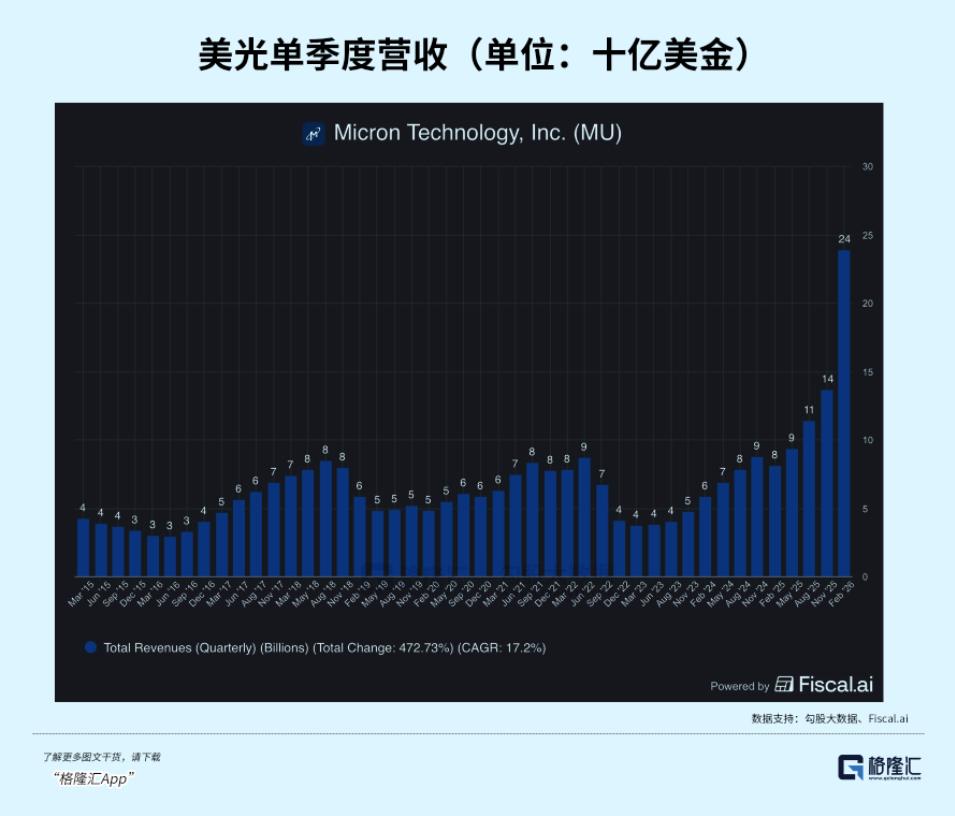
Group 1 - Micron's FY26Q2 financial report shows a remarkable performance, with revenue reaching $23.9 billion, a 75% quarter-over-quarter increase and nearly 200% year-over-year growth, surpassing any previous full-year revenue before FY24 [3][6] - The earnings per share (EPS) recorded an impressive $12.2, reflecting a significant year-over-year increase of 682% [6] - The gross margin for the quarter was reported at 75%, an 18% increase from the previous quarter, with guidance for the next quarter indicating a projected gross margin of 81% [9][10] Group 2 - Micron's management emphasizes that storage is now a defining strategic asset in the AI era, moving away from its previous perception as a cyclical component [13][14] - The company has signed a five-year Strategic Customer Agreement (SCA), indicating a shift in business model towards long-term commitments from major clients, which will reduce performance volatility [15][16] - Micron plans to increase capital expenditures to over $25 billion for FY26, reflecting a structural supply gap that cannot be resolved through price increases alone [17][19] Group 3 - Micron has entered mass production of HBM4, designed for NVIDIA's next-generation architecture, showcasing its competitive edge in the high-bandwidth memory market [21] - The demand for storage is rapidly increasing across various sectors, including mobile devices and autonomous vehicles, with significant growth expected in robotics as a future growth vector [22][23] - Samsung, another storage giant, is also making strides in the AI space, securing exclusive contracts and enhancing its vertical integration strategy, which positions it as a key player in the AI chip ecosystem [24][25]

大为股份20260316
2026-03-17 02:07
Summary of Conference Call for Dawi Co., Ltd. Industry and Company Overview - **Company**: Dawi Co., Ltd. - **Industry**: Semiconductor storage and lithium mining Key Points from the Conference Call Semiconductor Storage Business - Revenue from semiconductor storage exceeded 1 billion yuan, with a year-on-year increase of over 25%, accounting for more than 90% of total revenue [2][16] - Gross margin for the semiconductor storage business is approximately 6.5% [2][16] - The company successfully introduced products to major clients such as Sichuan Jiuzhou, Konka, and leading domestic server ODM manufacturers, enhancing its market penetration in key industries [2][4] - The core growth logic for 2025 includes the super price increase cycle in the industry, domestic substitution trends, and the explosive demand from AI scenarios [3][16] - The company is transitioning from a module supplier to an integrated design and manufacturing entity by establishing a subsidiary focused on high-end storage chip R&D [2][7] Product Development and Client Expansion - The company is optimizing its product structure, maintaining stable sales of DDR4, LPDDR4X, and eMMC series while increasing the sales proportion of server memory and enterprise SSDs [3] - New key clients include Youxian Technology, Sichuan Jiuzhou, and Guangdong Chaoge, which diversify the client structure and enhance strategic cooperation [4] Supply Chain and Risk Management - The company has established a dual-driven supply system combining international and domestic suppliers to mitigate risks from core material price fluctuations [5] - Strategic inventory management and supplier relationships are in place to ensure material supply and counteract price volatility [5] Future Plans and Market Positioning - In 2026, the focus will be on high-end storage applications in AI, with plans to accelerate the production of large-capacity eMMC and LPDDR5 products [6] - The company aims to deepen collaboration with upstream and downstream partners to optimize product performance and reliability [6] Lithium Mining Projects - The company has invested 150 million yuan in the Chenzhou lithium project, with a key milestone achieved in the exploration report approval [9] - The Guizhou Dachong lithium mine has significant resources, including 200 million tons of feldspar and 320,000 tons of lithium oxide, with a potential value in the hundreds of billions [11][12] - The mining strategy includes a combined recovery process for lithium, tungsten, and tin, maximizing resource utilization and reducing costs [11][15] Brand Development - The company's self-owned brand "Dawi Innovation" (DW Micro) has made significant progress in product development and market entry, focusing on high-end and domestic products [8] - The brand has received recognition and certifications, enhancing its market presence [8] Financial Strategy - The company is launching a targeted private placement to fund embedded storage R&D, with an expected post-tax internal rate of return of 14% [2][17] - The financing aims to capitalize on the current AI-driven market demand and support the company's long-term strategic goals [16][17] Competitive Advantages - The company possesses advanced equipment and a solid R&D team, ensuring high-quality product development and market competitiveness [16][18] - Established relationships with major clients and a robust supply chain position the company well for future growth [18][19] Tungsten Mining Strategy - The company plans to develop tungsten resources alongside lithium mining, utilizing a comprehensive recovery approach to enhance economic efficiency [20] This summary encapsulates the key insights and strategic directions discussed during the conference call, highlighting the company's growth trajectory in the semiconductor storage and lithium mining sectors.